
monday
1 comment
Foreign Policy photo feature: An exclusive look inside a booming multibillion-dollar, evangelical, global Thai cult. Lots and lots of meditators. [via]

Foreign Policy photo feature: An exclusive look inside a booming multibillion-dollar, evangelical, global Thai cult. Lots and lots of meditators. [via]
Remember that assassination of the Hamas guy in Dubai last year? GQ has a huge investigative piece that reveals, among other things, that the same team tried to kill him a few months earlier (with poison), but failed. Later they were successful, but the Dubai police were meticulous in their investigation, exploited the hit team's mistakes, and revealed all. (If you don't want to read the whole thing, Threat Level summarizes.)
Haiti, a year later: Great photo on the front page of the NYT today. She's a dancer.
The definitive piece on quicksand, including an entire section on fetishes that I never would have considered.
so i've grown tired of my snarkiness today and spent a little time looking at things i really love, like robots, and cool, fun stuff.
once i got my head back on all straight and optimistic, i went straight over to see some smart happening on Faris Yakob's blog. because that's where you go when you need an intellectual pick-me-up.
and then, feeling nostalgic for memes & 'idea multipliers', i wound my way over to BBH Labs and some thinking about crowdsourced creativity and open source creativity. and then, glancing at the twitter feed, stumbled upon this:
maybe the optimism wore off just a little. -- FB
The Notebook Blog is a strange, yet beguiling, charming thing. Put together by writer Claire Cameron, the site is composed of digital photographs of physical collages Claire has created.
It thus exists in a pleasingly liminal space between old and new, electronic and paper, sincere and wry. With titles like Page 35's "We Like Lists Because We Don't Want to Die", or Page 28's "I Believe Mustard To Be One Of The Most Amazing Condiments", it almost out-Tumblrs Tumblr for that mix of the heartfelt and sheer post-ironic oddness.
Yet, like Tumblr, it's the occasional juxtaposition that's most jarring - most likely to stop you dead in your tracks as you careen through your feeds - like the contrast in pictures and text that appear on "We're a Virus With Shoes, That's All We Are". -NA
h+ magazine is an online publication that purports to talk about the scientific and cultural trends that will fundamentally change humanity - and occasionally feels like the imaginary lovechild of Donna Haraway and the guys at Snarkmarket.
Exemplary stories: this recent piece on explaining consciousness; how 'Gamification' is turning work into play (which Rex also presciently wrote about in 2007); Transhumanism and Superheroes; or Jonathan Lethem on Phillip K. Dick. -NA
The interesting thing about this defense of shyness [via] is that it suggests that the more 'we live in public', the more diffidence is counter-cultural - i.e. it kinda' makes you unreadable in way that Facebook/Twitter et al obviously do not. -NA
Tim Rogers has lived in Japan for several years. He's sick of it -- very, very, very sick of it. So sick of it, he's written one of the longest* blog posts in the history of blog posts to explain all the ways he's sick of it. I didn't read the whole thing, but most of it seems to be because they put meat on everything and scream all the time.
*Errol Morris is probably his closest competitor. --ADM
The hit squad that killed the Hamas commander in Dubai apparently used a fast acting muscle relaxant to disable him before they smothered him. Earlier reports on the execution said the door was latched from the inside when the body was discovered. Anyone have any idea how they might have done that? --ADM
Update: Not sure what happened to the comment, but someone here posted a link to this video showing how to do it.
NYT has readers' photos of earthquake damage in Chile. As usual, the Boston Globe's Big Picture collects some of the most dramatic pictures from the mainstream media. --ADM
Why is Toyoda not spelled 'Toyota'? The Washington Post explains. Executive summary: His grandfather started the company, but they changed the name because "Toyota" has a luckier number of brush strokes (8). --ADM [via Consumerist]
Gay couples seeking surrogate mothers are the latest group looking to outsource to India through cheap "rent a womb" plans: "We feel we hit the jackpot because we got two healthy and beautiful twins for a fraction of what it would have cost in the U.S." --FD
From "Destination: Haiti," an unsentimental yet illustrative account of Port-Au-Prince by a young freelancer based in Mexico City: --FD
As the bus pulled into Petionville, on the hills north of Port-au-Prince, some Texas evangelists I had met on the ride invited me to stay with them at the home of a Haitian pastor. We piled into the pastor's white Montero, driving carefully past people sleeping on the streets, too terrified of aftershocks to spend the night in their homes. That night Jose, a freelance photographer I had met on the bus, and I camped in the pastor's large garden. Getting more than one thing done a day in Haiti required an act of violence, the pastor's wife said.
I think Zizek just fixed the internet: "I'm not human. I'm a monster, I claim." [via] --RX
Some new things added to the 2009 List of Lists: Buzzmarketing Daily's 10 Most Important Tweets, The Week's 10 Most Compulsive Twitterers, The Frisky's 10 Worst Boyfriends And Husbands, Onion A/V's Year in Swag, Idolator's Worst Album Covers, Yale Book of Quotations' Most Notable Quotations, Business Insider's 10 Most Infamous Lawyers, Top Recording's Top 20 Albums, Ad Freak's 30 Freakiest Commercials, Wall Street Journal Top Art Sales, and Reality Blur's Top Reality TV Whores.
The monstrous list of 2009 lists leaped up to nearly 700 entires over the weekend. Some new things include WSJ's Year in Photos, Billboard's Artists of the Year, YouTube's Most Watched and Searched For, AOL's Hot Searches, Jezebel's 10 Best Cover Lies, Glamour's 10 Best Dressed, Videogum's Best Viral Videos, and Babble's Best Mommy Bloggers.
Some new things recently added to the LIST OF 2009 LISTS: Roger Ebert's Best Films, Pitchfork's Top 50 Albums, Mediaite's 50 Innovators and Influencers, Cryptomundo's Top 10 Cryptozoology Stories, HuffPo's Funniest Protest Signs, The Big Pictures' Year In Photos, and Pitchfork's Top 100 Tracks.
Some of the people speaking at TED this year include Sarah Silverman, Bill Gates, Jamie Oliver, David Byrne, Ze Frank, and moot.
Just in case it got lost in the shuffle of decade nostalgia, Alex Pareene's Encyclopedia of Counterintuitive Thought, which itemizes all the ways in which convention wisdom has been undermined, reveals what may have been the prevailing intellectual trick of the decade.
Kottke launched a list of all the decade lists. In the meantime, the 2009 list here has passed 100 entries, but should quintuple by the end of the month.
Random thing I noticed: both GQ and Wired featured this axe in their holiday shopping guides. Axes are hot Christmas gifts this year!
Everyone should be forced to create resumes in the form D&D Character Sheets.
Have you ever picked up a pill, wondered what exactly it was, noticed an indiscriminate marking on it, and pondered whether you should just toss it down your gullet? Wouldn't it be cool if could look up what exactly the drug was from those indiscriminate markings? Well, there's a website for that!
Some things that come out tomorrow: Californication, Season Two; The Last Days of Disco, Criterion Collection; Humbug, Arctic Monkeys.
A Short Manifesto on the Future of Attention
I imagine attention festivals: week-long multimedia, cross-industry carnivals of readings, installations, and performances, where you go from a tent with 30-second films, guitar solos, 10-minute video games, and haiku to the tent with only Andy Warhol movies, to a myriad of venues with other media forms and activities requiring other attention lengths. In the Nano Tent, you can hear ringtones and read tweets. A festival organized not by the forms of the commodities themselves but of the experience of interacting with them. Not organized by time elapsed, but by cognitive investment: a pop song, which goes by quickly, can resonate for days; a poem, which can go by more quickly, sticks through a season. A festival in which you can see images of your brain on knitting and on Twitter.
For $600 you can fly as often as you like to anywhere on Jet Blu, from Sept. 8 - Oct. 8. (If this were last year, I'd be gone.) [via]
This has never happened to me, yet I feel like it's happened to me a hundred times. (Guy goes to Europe for two weeks, but somehow his girlfriend forgot the conversation in which he tells her this. She goes a little crazy. It's nearly eight minutes long, but it's pretty great.) [via]
I could play with this infographic all day and still not be sure about what I learned: How Different Groups Spend Their Day. [via]
Slate's Choose Your Apocalypse. Zero results for the intersection of SEX and MONEY.
It seems like just yesterday that you fell off the deck at Emo's (or flash-mobbed The Omni), but registration for SXSW 2010 has opened.
This is the kind of thing that someone usually leaves as spam in the comments of my site, but is actually pretty cool: A Pictorial History of Dentistry. Those 700 BC braces are wicked.
Trope is the New Meme. "A few years ago it felt like one could scarcely read a think-piece in any newspaper or magazine without coming across some mention of the word 'meme.' Now it seems as though the new meme is the word 'trope.' Trope is everywhere." See also: recent xkcd.
Snarkmarket interviews the guy behind New York Review of Ideas. Turns out it's the outcome of an NYU grad class project.
The best thing you're going to read on the internet for a while is Errol Morris' seven-part series on frauds and fakes for NYTimes.com. Part 1 is about art forger Han van Meegeren; Part 2 is an interview about the Uncanny Valley with Edward Dolnick; the rest are forthcoming.
What comes around goes around and around and around? The Rise of the Black Hipster.
I attended the n+1 panel discussion on the '90s on Friday. I had a question that I wanted to ask, but the q&a was dragging on, and raising my hand felt like a complicated extension of a prolonged My So-Called Life marathon (so good, yet who has the time?). Had I raised my hand, this is what I might have asked:
Nostalgia wasn't always like this, right?
History wasn't always this flat, and everything didn't always seem to happen at once. While we like to point at a decade where "accelerated culture" became normative, nothing actually sped up in the '90s. Everything just ground down to a black hole slacker halt. It was timeless, dude.
Sure, there was that whole internet thing, gnawing at time and space while scrapping our quaint notions of subculture and identity politics. But postmodernism was pimpin, and all of history was being prepped for the pillage. Beavis and Butthead, the Beastie Boys, Jeff Koons, Napster -- these were the princes of pastiche, gobbling up the table scraps the Boomers left behind.
Let me say it more clearly: the '90s invented nostalgia. Or at least nostalgia as we commonly now know it. There was always that anxiety of influence playing its fatherly games, but the '90s morphed anxious fear into an international pastime. The decade obsessed about historicizing itself precisely because history felt as flimsy as the Berlin Wall that had crashed into it. I Love The '70s could not have existed in the '80s, but I Love The '90s could only have existed, instantaneously, in 2000.
This way of thinking -- nostalgia for nostalgia -- now seems commonplace. But it didn't exist in the Reagan '80s or the Wategate '70s. Fukuyama was fugged up enough to see these signs and declare it the end of history (the '00s version of which is the world is flat). He saw the right symptoms, but came up with the wrong diagnosis.
Nostalgic for itself, the '90s were indeed a trap. But never mistake ambivalence for apathy. While the rock gods of yesteryear all perished in accidental pools of vomit, it took an act of will -- a shotgun blast to the head -- to break with the past. Or at least try. It was like that Dostoyevsky Wannabe character in Slacker who asks "Who's ever written a great work about the immense effort required in order not to create?"
And that's why this panel itself seemed yanked out of the past, like that Indiana Jones scene where they find the Ark of the Covenant in a warehouse. The format itself seems tied to the days when the culture wars still mattered and you couldn't Skype your way to Tokyo. I remember panel discussions about "the future" all the time on CNN circa 1995. Now they prop up two bozos to fight out the definition of torture. (Look! Nostalgia for nostalgia!)
Oh yeah, a question? Can we talk about Courtney Love please? Oh well, whatever, nevermind.
See also: Foster | Leon | Bakes.
Slate launched a new woman-focused site today: DoubleX. They made an infomercial that's pretty good, but they also sent out the most embarrassing accidentally-non-BCCed announcement email of all time. Update #1: The Trouble With Jezebel. Hrm. Update #2: Oh yeah, The Stimulist also launched today. Spiers is involved but I don't get it at all.
What Makes Us Happy? The Atlantic gets access to a 72-year Harvard longitudinal study about happiness.
"There are no hipsters, only anti-hipsters -- or at least the ratio is approximately the same as that of actually existing Satanists to anti-Satanists during the heavy-metal and Goth panics of the 1980s and 1990s." [via]
"A new status anxiety is infecting affluent hipdom," says The Atlantic in Class Dismissed.
Adderall gets the New Yorker treatment. In trying to balance the good and the bad effects, it ends up like an affectless jumble. Or wait, maybe that's the point?
Sometimes you wonder if the only reason beauty pageants still exist is so that we can see pretty people saying stupid things.
WSJ: Why the crash of housing market crippled the economy but the dot-com bubble didn't.
The Crisis of Credit Visualized. Decent 11-minute animation that explain the financial crisis.
Steve is doing another Rental Car Rally, this time from SF to Tijuana. The pics from last time will probably entice you Californians.
The 15 Strangest College Courses In America. This sorta looks like my college transcript.
Conversant Life: Are You a Christian Hipster? If you don't like contemporary Christian music, megachurches, and mimes, yet do like "Chuck Klosterman, David Sedaris, or anything ancient and/or philosophically important," then yes, you are a Christian Hipster!
Village Voice does something linkable: Interview with Carles of Hipster Runoff. The guy uses square quotes like there's no tomorrow: "I don't think I'm looking to 'shame' people. I just think that 'being yourself' is a bold decision. However, the decision to declare 'yourself' can leave you vulnerable to criticism. Not sure if that has to do with our modern world or if it has 'always been that way.' So whether you attach yourself to a band, an idea, a fashion sense, or a general aesthetic, I feel like we're all open to criticism and analysis from various perspectives. I just feel like in our world, 'how you present yourself' matters more than ever to everyone else but you." [via]
New on Twitter: @Genny_Spencer, the daily diary of a young farm girl in 1937. [via]
Nancy Cartwright, the voice of Bart Simpson, confirms voicing a commercial in her Simpson's voice for a Scientology promotion.
The best thing found on Google Maps ever. Update: it's an art project -- video explanation.
This feels eerie familiar: The Gig Economy, which "helps explain why it now takes a good ten minutes to get the answer to the once-breezy question, 'So, what are you up to these days?'"
Snarkmarket rewinds a year and looks at last year's miserable predictions. Jim Cramer's prediction about Goldman Sachs closing the year at $300/share is particularly spicy.
To go with my annual 36 Predictions for 2009 in Media/Tech/Pop, here are a few other prediction links: Rachel's The Year Ahead in Media, Jon Fine's Media Predictions, Path 101's Crowdsourced Predictions, Folio's Magazine and Media Predictions, Read Write Web's Web Predictions, CNN's Political Predictions, The Edge's What Will Change Everything, Peter Kim's Social Media Predictions, Socialized's Facebook Predictions, Biz Week's What Won't Happen, and Louis Gray's 10 Predictions In Tech.
The annual Edge question: "What game-changing scientific ideas and developments do you expect to live to see?" Answers from everyone, including Kevin Kelly, Douglas Rushkoff, Chris Anderson, Freeman Dyson, Eric Fischl, and Brian Eno.
Word of the year according to Webster's? Overshare. What an honor for you, dear blogosphere. There's a video press release. [via]
Some of the lists recently added to the 2008 list of lists: Google's Zeitgeist, Pitchfork's 20 Worst Album Covers, Pantone's Color of the Year, Time's Top 10 Everything, New York Magazine's Year in Culture, Jonathan Yardley's Best Books, Christianity Today's Top News Stories, London Times' 100 Best Records, Salon's Book Awards, Sasha Frere-Jones' Best Of 2008, Mr. Skin's Top 20 Celebrity Nude Scenes, Global Language Monitor's Top Words of the Year, Roger Ebert's Best Films, ArtForum's Best of 2008, PetFinder's Most Popular Pet Names, and Candy Addict's Best Candy.
Urban Outfitters' breaks down your shopping list -- the narcissist, the name dropper, the party girl. That's everyone on my list!
Saw these within seconds of each other: How To Run a Con (Psychology Today) | How To Avoid Getting Conned (Portfolio).
The YouTube spin-off version of the NYT Mag story on experimental philosophy from a couple years ago: Experimental Philosophy Starring Eugene Mirman.
Kottke breaks down the cultural logic of old, by showing the half-life of movies and music. "Watching The Godfather today is like watching Charlie Chaplin's Modern Times (1936) in 1972." While this is certainly true in purely linear terms, I wonder if something has happened (postmodernism!) to cause the timeline to shrink in the past couple decades.
Huh, Einstein and Freud corresponded. Einstein sends the first volley: "I greatly admire your passion to ascertain the truth -- a passion that has come to dominate all else in your thinking." [via]
Flavorpill launches new blog: Flavorwire. This post suggests what you'll find.
I told Carney last night that I'd like to do a YouTube show with him where we sit around and review movies like two old curmudgeons. But then I realized that the Glynnie & Carney financial show would be much better.
Idaho has the same population as Manhattan? Female voices in #1 hits are slowly becoming more frequent? People in the Deep South and Deep Midwest put their missed connections at Wal-Mart on Craigslist? More visualizations at Very Small Array.
Like the Unnecessary Censorship thing that Kimmel does with video, here's the photo version: You Got Blurred. [via]
"The Intelligence Group" (ha!) is offering "classes" (haha!) for "trend school" (hahahaha!). It's over, America. It's really over.
Chris Anderson on the loss of meaning in words that quantify things in open systems. In other words, think about how the term "most Americans" has some meaning, while the term "most writers" is becoming fuzzy. Loosely similar today, Jarvis on the myth of the creative class.
It's not your imagination, the douchebag count has been growing since 2004, especially in blue states. [via]
Wait, wait, wait. All this time, the identity of the Montauk Monster has been right under our noses.
The site for SXSW 2009 relaunched today (with help from my Seattle pals). Registration has also opened; the panel picker surfaces next week.
Ad Busters: Hipster: The Dead End of Western Civilization. "The hipster represents the end of Western civilization -- a culture so detached and disconnected that it has stopped giving birth to anything new." [via]
Four years later, Slate revisits "The Long Tail" and concludes it's probably wrong.
Getty Images + Flickr Make a Deal. Under the terms, Getty will scour Flickr for photos they think should be part of the Getty library, and if the photographer agrees, Getty pays residuals.
Recommended: NYT Mag's story on suicide, which focuses on issues like location, historical trends, and method. An interesting stat, among many: twice as many people die from suicide as homicide.
Ron Rosenbaum has always been obsessed with catch phrases. Back when he was at The Observer, I remember a column in which he went on a tangent about the coinage of playahata, which was brand new to the vernacular at the time. Whatevs, he has now devoted a whole column to the idea, which rips through dozens of catch phrases like "not so much," "it is what it is," "my bad," "the party is over," "teh," "at the end of the day," "stay classy," and on and on...
Well, maybe the plot of The Happening (trees are killing you!) isn't so absurd after all (dolphins are committing suicide!). [via]
Cool interactive panorama of the new Shibuya subway station. (Warning: huge file.)
10 Zen Monkeys: A complete history of Mat Honan's "controversial" Wired drug story.
A ton of video from the New Yorker Conference just went live. Various luminaries in there: Malcolm Gladwell, Bill Buford, Gavin Newsom, Anne Wojcicki.
Long New Yorker story on hangovers. Yeah, you wanted a cure, but you got a cultural history instead. Eat your vegetables, too.
Last week, Slate did a special issue on procrastination. On the internet. Where you waste time.
If I see one more editorial about how texting is going to destroy the English language, I'm going to take away all your typewriters. I'm looking at you, Boston Globe.
Radar: guy posing as a 10-year-old boy writes letters to serial killers and politicians asking if he should drop out of school. They write back.
This link is for Marina: eight-minute documentary about gyaru, extreme Japanese fashionistas. Focuses on the black face fad, but the bit about something called yamanba ("mounting hag") is magnets. [via]
From "The Lives of Elevators" in the New Yorker.
In most elevators, at least in any built or installed since the early nineties, the door-close button doesn't work. It is there mainly to make you think it works. (It does work if, say, a fireman needs to take control. But you need a key, and a fire, to do that.) Once you know this, it can be illuminating to watch people compulsively press the door-close button.
Interpathic. n. Knowing what someone is going to do on the Internet before they do it. (With scary accurate example that is, likely, interpathic.)
The 2008 Pulitzer Prizes. Junot Díaz, Mark Feeney, lots of Washington Post, and... Bob Dylan? Alright, whatevsky.
Becuz someone had to: StuffNobodyLikes.com. I doubt it gets a $300k book deal though.
"Have you been Turing'd?" | "Benjamin Franklin, blogging role model?" Why those two links? Because I wanted to suggest to you that Marc Andreessen and Kevin Kelly (two names most remembered from very early dot-com successes) are perhaps the two best idea bloggers out there right now.
Adam Sternbergh in The New Republic on Why White People Like 'Stuff White People Like' -- a seven-layer cake of meta that goes down rough.
As expected, the media went bat shit crazy with the puppy story today. In related news, lots of crazy people emailed me!
Update to the puppy story from earlier today: military police are investigating the incident.
You know what SXSW really needs? Some social networking device that will tell me exactly which of my friends are going, so I can stop asking everyone in little IM windows, in drunken bar conversation, in garbled Twitter threads. So if you're going, leave a comment, and I'll buy you a drink, or twelve.
Wired's cover story this month: Free! Chris Anderson argues that the best business model is to make your product free.
Okay, just one more Tay Zonday link. When my pal Steve Marsh interviewed him, he asked if Tay understood what it means to sell out. Tay opened up a can of theoretical whoop ass on him: "The subtext of that is that this somehow relates to social justice. That's what's behind that. The implication is there is a social justice politic, and somehow a piece of art undermines the social justice politic. And I don't believe an image can cause social oppression. I don't think it can be the origin of social injustice." It goes even more crazy from there.
The first time you try to describe EveryBlock to someone, it can sound kinda boring. It aggregates piles of local information, like restaurant reviews and crime stats, which are then displayed block-by-block. Hm, that's interesting, but is it compelling?

If you give it some time, the answer is absolutely. Once you start playing with the site (and "playing" might be the best word to describe the meandering sensation of floating around in the data pools), your mind begins to wander with speculation: how did they get that? what does this say about my neighborhood? what else could be done with all this data? how can I add to this?
Those were just some of the many questions I had about EveryBlock, which launched a few weeks ago with the help of a $1.1 million Knight News Challenge grant. A few stories and interviews popped up when the site launched, but I noticed that the interviewers seldom asked the other questions that I had about the site. So I decided to ask site's founder, Adrian Holovaty, some questions directly. Here's our exchange:
Last year, New York City famously banned trans fats in restaurants. I found a page on EveryBlock that shows all the violations of this ban -- several every day! I love these little hidden narratives inside of EveryBlock. Do you have any favorites?
Great question. Here are a few interesting nuggets:
Also, more generally, it's fascinating to follow address-specific breaking news/events on our site. For example, a couple of weeks ago, a water main broke on the north side of Chicago. Afterward, on the relevant EveryBlock pages -- for example, Ravenswood or the 1800 block of W. Montrose -- you could see a bunch of assorted news items about the incident: newspaper articles from the Trib and Sun-Times, TV station reports and Flickr photos of the torn-up street that were taken by some people who happen to live nearby. Each of those "raw" chunks of information was displayed in the timeline of news for that block.
We've seen a similar thing happen with trendy new restaurants. First you see the business license, then (possibly) the liquor license application a few days later, then the restaurant inspection, then a Yelp review or two, then a writeup by the newspaper's dining critic. The story slowly unfolds over time.

One of our post-launch priorities is to clean up the fire-hose of raw information, to introduce concepts of priority and improved relevance -- but I do think there's a certain appeal to that raw dump of "here's everything that's happened around this address, in simple, reverse-chronological order." When significant events happen, they sort of "pop out" of the list.
Can you talk a little bit about what you're doing behind-the-scenes? Are you using Django as a framework?
Sure. The first layer is the army of scripts that compile data from all over the Web. This includes public APIs, private APIs, screen-scraping the "deep Web," crawling news sites, plus harvesting data from PDFs and other non-Web-friendly documents. Some data also comes to us manually, like in spreadsheets e-mailed to us on a weekly basis. For each bit of data, we determine geographic relevance and normalize it so that it fits into our system.
The second layer is the data storage layer, which we built in a way that can handle an arbitrary number of data types, each with arbitrary attributes. For example, a restaurant inspection has a violation (or multiple violations), whereas a crime has a crime type (e.g., homicide). Of course, we want to be able to query across that whole database to get a geographic "slice," so there's a strong geo focus baked into everything.
The next layer is the Web layer, which is standard Django. Oh, and I should mention that we use Python for everything, from the ground up.
What has been the hardest piece to accomplish so far?
I honestly can't decide what the hardest piece has been. A number of pieces were all hard to pull off in their own way.
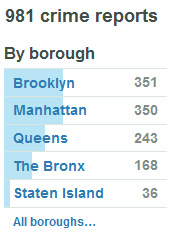
The user interface was, and continues to be, a challenge. How do you display so many disparate pieces of data together, without overwhelming people? How do you account for the variety of distinct data types? (That's both a user-interface and a backend challenge.) How do you maintain visual interest when dealing with so much raw textual data? How do you make the block page feel like a geographic home page rather than a search result? Wilson, our designer, has done a great job within these constraints, but we all agree there's still much room for experimentation and gradual improvement.
Dealing with structured data is relatively easy, but attempting to determine structure from unstructured data is a challenge. The main example of unstructured data parsing is our geocoding of news articles. We do a pretty good job here, but we're not crawling all of the sources we want to crawl -- again, there's a lot of room to grow.
On a completely different note, it's been a challenge to acquire data from governments. We (namely Dan, our People Person) have been working since July to request formal data feeds from various agencies, and we've run into many roadblocks there, from the political to the technical. We expected that, of course, but the expectation doesn't make it any less of a challenge.
How much of your data aggregation is scraping html pages versus getting structured data?
At this point, we're doing more scraping than consuming formal APIs and data feeds, but I expect (and hope) the balance will shift over time. It's been tricky explaining our concept to data providers in government, but we're hoping that gets easier now that we have a public site that people can browse and understand.
Do you have any fears of scaling the system?
Yes and no. We knew from the start that EveryBlock isn't something that can be scaled overnight to every city in the world. There are too many special cases, too many relationships to build, too many local quirks to work out. There's no nationwide database of restaurant inspections or building permits that we can magically tap into; every city is different. Aggregating local information is a deep, difficult problem.
Some companies try to scale pieces of what we're doing -- like geocoding every news story in the U.S., or making maps of blog entries, or aggregating crime, or aggregating restaurant inspections -- but we're the first ones to do all of that. That's why we're taking a depth, not a breadth, approach: I'd much rather do three cities well than 1,000 cities poorly.
Rather than use Google Maps or Microsoft's Virtual Earth, you built your own mapping service application. Why?

That, along with "When will you bring EveryBlock to city XXX?", is by far the most frequently asked question we get. Paul, our developer in charge of maps, is working on an article explaining our reasoning, so I don't want to steal his thunder. I'll just say that the existing free maps APIs are optimized for driving directions and wayfinding, not for data visualization. And, besides, having non-clichéd maps is an easy way to set yourself apart. Google Maps is so 2005. ;-)
How hard was it to build?
We use an open-source library called Mapnik to render the maps, so that library does the heavy lifting for us. Paul is also working on a how-to article, in the spirit of giving back to the open-source community, that explains how to use Mapnik.
In many ways, what you're doing is taking a bunch of data sources and normalizing them for a single use case. Now that it's normalized, I imagine developers could do a ton of interesting things with this data. Are there plans to do an API?
Yes, I strongly suspect we'll have an API eventually -- it's one of the many things on our site wish list. We had to draw a line and call the thing "ready" at some point, so despite the fact that we're launched, we've got hundreds more features and data sources to add.
I was talking to someone recently about all the cool mashups you could do, and we decided that looking for patterns between Republicans and sex offenders would be the best!
Beyond the technical difficulties of creating parsers and algorithms for geotagging this data, have you had any political/legal obstacles? Is there data you'd like to get your hands on but can't for some reason?
Yes, and yes. I'd estimate we only have about 10% of the data we'd like in the long term, for Chicago, New York and San Francisco. As we expected, some government agencies haven't been able to provide us their public data, and the reasons vary. A common reason is a lack of resources. In other cases, we've simply been stymied by bureaucracy. But we're keeping at it.
An obvious example of data that's EveryBlocky (EveryBlockish? Um, location-specific?) but not yet on our site is the set of recent home sales -- lots of local relevance there. Of course, we're a news site, not a real-estate site, so it'll be interesting managing people's expectations about what real-estate data and features we offer.
I'd like to even out the three cities' data offerings, too. We publish building permits in San Francisco and New York, but not in Chicago. We publish filming locations in Chicago, but not in New York or San Francisco. We publish zoning agenda items in San Francisco, but not in the other two cities.
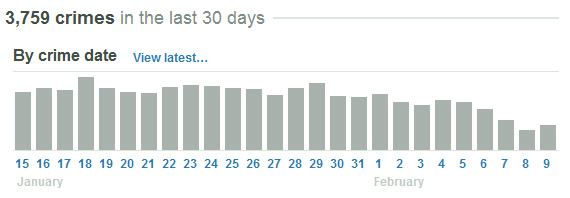
We're also working on improving the data we already have. An example is crime in San Francisco. After running into some problems having requested a formal data feed from them directly, we get the data by screen-scraping the SFPD's site -- but that site doesn't publish the location of each crime. In fact, the only location data the SFPD site publishes is implicit in the searches you do. The site lets you search for crimes by police district, ZIP code or neighborhood, so the best we can do is to deduce the police district, ZIP code and neighborhood that contain a particular crime. (If you search for ZIP code 94109, you can safely assume the resulting crimes are in that ZIP code.)
That's why San Francisco crime on EveryBlock, lamely, only geocodes crimes to the ZIP code level: because that's the only data we could get, and something is better than nothing. But, anyway, we're hoping the SFPD will release more granular locations in their crime data.
You've mentioned your hope that EveryBlock could introduce some standards for news organizations to do geotagging. I'm sure you've discovered wholes swaths of civic data that could use standardization. Can you talk a little bit about what you want to do in this area?
The standards we're thinking about are related to the geotagging of unstructured data -- namely, news articles. I guess there'd be some value in standardizing approaches to structured data (like, building a nationwide crime database), but we're more immediately interested in standardizing the geocoding of "blobs." The main premise is that locations in news articles should be defined in a machine-readable way. Look for something from us soon.
Everyblock lets me find everything in my neighborhood... except other people. Why is that? Do you have any plans to incorporate direct input of local voices into the site?
In time, Rex. In time. :-)
If we'd launched with awesome reader-contributed content features, that's all that people would be talking about. "EveryBlock: a user-generated news site!" People are very quick to make judgments about a Web site, pigeonholing it into some generic "user-generated" or "Web 2.0" bucket. I wanted to send the message that our focus is on providing a newspaper for your block. The tone was set. Any subsequent features that we add -- whether they involve local voices or not -- are in support of that core goal.
Besides, we already have the problem of offering so many interesting data sets and features that people can only focus on one or two of them. The classic example is that a lot of people haven't noticed that we rolled our own maps (your question above notwithstanding).
I know you constantly get asked the question about scaling the site to other local areas, but here's an idea: say I'm an enterprising small town citizen who's willing to plug in data from my city by matching data to similar fields that you are using. Possible?
Yes, that's possible -- we've built the system in a way that would allow that to happen. Again, as in my response to your reader-generated content question, it's just a matter of implementing it. We had to launch with something, and if we'd included every one of our ideas in the launch version, we'd be on target for a launch in mid 2017. :-)
One of the obligations of the Knight grant is to make all the source code available. Does that affect how you think about the site as an asset?
The open-source requirement affects both our technology and business decisions. We've engineered the thing so that it can be replicated in any area, with any data. I suppose we would've done that anyway, even without the open-source requirement, because it's just the Right Way to do it, but the open-source requirement certainly influenced us.
I'll paraphrase something really smart that Wilson, our designer, said recently: We've created a machine that's capable of publishing address-specific news, and our initial launch is a demonstration of its potential. Now that we're live, it's time to improve the machine and improve the demonstration.
On the business side, clearly we'll have to figure out how the site is going to sustain itself after our grant money is spent. I have a feeling some solution will make itself apparent at some point over the next year and a half. But even before that, we'll find out whether our idea is something that catches on with our audience -- this whole thing is an experiment, after all! For all we know, EveryBlock might be a novelty that doesn't sustain an audience in the long term. Being honest Chicago people, happily far away from the Silicon Valley BS, we have no delusions of grandeur.
I liked your answer to whether EveryBlock constitutes journalism in the OJR interview ("People can define 'journalism' however they'd like"). I'm curious, do you have traffic goals for the site? Or let me ask it a different way: how are you evaluating success?
This is cheesy, but I aim to help people, or improve the world in some way. The tricky thing is that there aren't many concrete ways of measuring that, aside from anecdotes. I suppose we could look at traffic numbers, but, no, we haven't set any traffic goals.

Okay, last question. It's a weird one. Your interest in gypsy jazz is well known. (The last time I saw you, it was in a Toronto bar that supposedly had a jazz scene, but was actually a frat bar. We were both gravely disappointed.) Do you ever think about the relationships between your musical interest and your programming/information interests? Is there anything -- structural, cognitive, performative, whatever -- that makes EveryBlock similar to Django Reinhardt?
Wow, a weird question indeed! Hmm. I guess that, in both music and programing, I strive for subtlety, for elegance.
And EveryBlock cannot be compared to Django Reinhardt. That's sacrilege.
Thanks, Adrian!
(Thanks to Ben, Matt, Robin, Andy, and Matt for suggesting questions for this interview.)
When I revisited the first issue of Wired last week, it was obvious that I had unfortunately glossed over several areas (the design, in particular, got an unfair treatment). But as Valleywag ruefully noted, it was already 1,600 words long.
So I was thrilled when the founding editor, Louis Rossetto, emailed me a lengthy response, which serves as a great Round 2 of the first issue. With his approval, the email is printed below.
Rex,
Liked your piece on Wired 1.1.
A few things:
1. There was a beta. Actually two. Back in April 1992, John, Barb, Jane, and I created a "Manifesto" in a three day-and-night charette in the studio of photographer Neil Selkirk in Chelsea that stated what Wired was about, and set out the design philosophy. Barlow was on the cover, swiped from the New York Times Magazine, if I remember correctly. It had a proposed table of contents, proposed masthead (we still hadn't contacted any writers except for Markoff and Michael Schrage), an ad or two, the opening spread of a story. Six months later, I created a second prototype on my own. Learned how to use Quark, Photoshop, and Illustrator in the same month -- and juggle too. Eugene Mosier, who was later to join us as head of production, called in sick to his day job and helped put it together (making him employee number zero since we couldn't pay him anything but cookies). Jane sweet-talked equipment out of Radius (a name from the past) and others, since we not only didn't have money to pay people like Eugene but to buy equipment either. This beta was a full-on 120 page prototype, with actual stories re-purposed from other places, actual art, actual ads (someone quipped that it was the ultimate editor's wet dream to be able to pick their own ads), and then all the sections and pacing that was to go into the actual magazine. The cover was lifted from McLuhan's The Medium is the Massage; it was the startling black and white image of a guy's head with a big ear where his eyes should have been. The whole thing got printed and laminated in a copy shop in Berkeley that had just got a new Kodak color copier and rip. Jane, Eugene, and I went in when the shop closed on Friday evening and worked round the clock through the weekend. Took 45 minutes to print out one color page! We emerged Monday morning with the prototype, which we had spiral-bound in a shop in South San Francisco, before we boarded a plane for Amsterdam to present it to Origin's founder and CEO Eckart Wintzen, to see if he would approve the concept, agree to advertise in the magazine, and then give us the advance we crucially needed to keep the project alive. He did, hence Origin's ads in our early issues.
2. Nicholas's statement about HD was not inaccurate. Resolution is not the big deal -- delivery and access is. YouTube is a bigger revolution than HD by a mile, regardless of how many big flat panels are in people's homes.
3. True, Nicholas's email address was laughably wrong, but I'm not sure even now I know why. It's certainly not because we were shy about printing email addresses. Addresses of writers appear throughout the issue -- a first for any magazine, as far as I know. My email address appeared under my editorial -- got hundreds of replies, each of which I answered. I think there was some kind of screw up in the handling of the text, perhaps someone slugged something in waiting for his real address, and then, in the insane rush to get out the first issue, it ended up being published as is. Nicholas himself was perhaps the most chagrined. It was corrected by the second issue, and yes, that address reached him.
4. I think you radically underestimate John and Barb's design work. As they often said, their job was to imagine what the future looked like, and do it on a medium out of the past. They brought amazing design smarts to the process of putting out the magazine, as well as incredible production chops, which were reflected in Wired from the first issue. That opening multi-page spread illuminating the McLuhan quote which launched the issue, that incredible graphic indulgence which continued for the entire time I was editor, and which is conspicuously absent from the current, was true modern graphic art -- in the case of the first one, a collaboration between John and Erik Adigard (Erik's work would appear regularly in the mag, and, for a while, he worked at HotWired/Wired Digital helping Barb create it's graphic sensibility). John and Barb were the ones who landed us our printer, a company back East in Connecticut John had worked with on slick annual reports. They had just taken delivery of a brand spanking new Heidelberg six color (CMYK plus two spot colors -- ah, that's how it was done!) press as big as a couple of box cars. We were the first clients on the press. The first issue was on press over Xmas 1992, and John, Barb, Eugene, and I were on press check. The pressmen were grizzled 30-year pros. They set up the press, they put on the VW size rolls of our special matte paper, they poured in the gallons and gallons of our eye-burning fluorescent ink, they started the press, they adjusted the print flow, they ripped off the first pages and put it under the calibrated lights to check color, they looked at it through a loop to check the dot gain, they did this half a dozen time, then they pronounced it perfect -- calibration was absolutely nominal. I can still remember how John took one look and said: put more ink on the page. The pressmen were aghast. It was perfect as is, just the way it was supposed to be. John insisted. They ultimately relented. He looked at the new sample. He told them he wanted still more ink. They protested again. They finally relented again. John looked at the new sheet. This time he told them: I want you to turn the ink up until it smears, and then dial back to where it's only just not smearing; and that's how I want the entire job done. The pressmen were appalled, outraged, embarrassed. But ultimately, they did what John told them. That's why the magazine looked and felt the way it did, because it literally carried more and brighter inks than a normal magazine -- they leaped off the matte paper. Later, as the magazine started to get recognition, the Wired job became the one the pressmen all wanted to work on. Under John's direction.
P.S. We collected the opening spreads of the first few years of Wired when we started our book company Hardwired. Called it Mind Grenades. Each of those introductions reflected my trolling through an issue and finding a quote somewhere that seemed portentous enough to be chiseled onto the side of a public building. Funny thing was, taken all together and in sequence, those randomly picked quotes made a coherent argument. As well as a mindblowing visual statement. Eugene did the press check, in Singapore. That book reprinted the original colors used in the intro spreads, which meant, I believe, something like 26 spot colors. Not many printed objects with 26 spot colors.
5. The baby pissing ad got us some shit. We were glad.
6. Wired/Tired was an afterthought, John Plunkett's idea, I think. On the last day of production, we would shout stuff around the office as we were working, and I'd write it down. Utterly subjective. Except, for about the first two years, we made sure that Manhattan was always in the Tired column in some way, trying to stick to the know-it-alls in what they parochially thought was the center of the universe. It was either Clay Felker or Jann Wenner who said that it's not only important for a magazine to have heros, but also pick the right enemies. Course, NY got its revenge at the time of the IPO, but that's another story.
7. The dotcom stock market bubble occurred after I already left the magazine, so I will decline to comment on whether Wired abetted it or not. But while I was there, we frequently indulged our cynicism, as with Chip Bayers' story in our April 1996 issue, "The Great Web Wipeout."
8. The colophon was fun. I wanted to list the stuff we used to make the magazine, because I wanted people to see that it didn't require a huge operation to make a great magazine -- in other words, that you didn't need Hearst or TimeLife or IDG overhead to produce a magazine that looked better than theirs. I think it was Eugene who added the drugs, with some notable exceptions, given that we were figuratively and literally at the epicenter of the SF rave culture. For that first issue, I might have also added adrenaline and optimism.
Thanks for taking the time. Hope your archaeology didn't screw up your issue too much. If so, let me know, maybe I can scrounge up a replacement.
Best,
Louis Rossetto
Thanks Louis!
For anyone who is really into this history, I also recommend Gary Wolf's book, Wired: A Romance, which is basically a biography of the magazine.
Rickrolling the Church of Scientology. I can't even explain how complex and brilliant and stupid and wonderful and retarded that doing an IRL Rickroll on Scientology is.
Ze Frank's video for SXSW Interactive, "the one that's screwing up those other two's business models." (You're going, right? I'm doing the trifecta again this year.)
An interview with Monica Peters, who wrote the book Build Your Own Army of Web Bots Within 24 Hours and has started the site AIlegacy.org which offers support for those looking to create text bots.
The article from this month's Fast Company that calls BUNK! on "influencer theory" (and its sister, "the tipping point") has finally gone online.
Convergence! Synergy! Well, this one gets some points for modest ingenuity if nothing else... Celebutantes is a new novel coming out next month that has an accompanying web tv series, which will immediately carve out the lovers/haters of the book (is there really any way to intellectualize superficiality?). Tilzy describes it as "a young Sophia Coppola farce with an exaggerated Entourage and/or Californication aesthetic."
I had this stupid idea this morning that -- you know what? -- relationships and recessions work in exactly the same type of cyclical patterns. Suddenly, a 2,000-word essay popped into my head. Thank god Twitter exists, so I don't actually have to write it.
Don't freak out, but it turns out that nerds make the best terrorists. So stop picking on them.
The Tom Cruise Scientology Indoctrination Video: "Gawker is now hosting a copy of the video; it's newsworthy; and we will not be removing it." (The soundtrack creeps me out!)
NYT Styles: Has Gawker Jumped the Snark? Nick's response: Always Jumping The Shark. Gothamist's link roundup: Gawker So Over.
I once had a screenplay idea for this very event: Unknowing twins marry each other. I guess now it could be "based on a true story."
More seemingly random words put into a sentence that shouldn't make sense together: n+1 has a great interview with a hedge fund manager. Robin perfectly dissects the bit about "black box trading."
Fortune has an interesting profile of Melinda Gates -- words I never thought would be put together into the same sentence. [via]
This Video Makes Bill Gates Look Cooler Than Steve Jobs. Cameos by Matthew McConaughey, Jay-Z, Bono, Spielberg, Clooney, and Jon Stewart.
Do you remember the guy who went to every Starbucks in Manhattan in 24 hours (171starbucks.com)? His new gimmick is living in Ikea (MarkLivesInIkea.com).
Awesome. The English language has always needed a gender-neutral pronoun, but prescribed words like hir reek of east-coast liberal elitism. So I'm down with flipping this inner-city and going with yo.
Interesting USA Today story on how government subsidies keep small-town airports alive. Marginal Revolution makes a chart out of it, illustrating a shocking passenger-per-flight ratio.
This one will ruin your day in the good way: The Annual Edge Question. 2008's question: What have you changed your mind about? Here are the 17 pages of answers.
Pictures of faces with mouths photoshopped in where eyes should be. Happy New Year!
Everyone else is linking to it already, but Matt Webb's 2007 brain dump is quite impressive.
NY Mag's annual Reasons to Love New York. (My Twitter account has lately seemed like "Reasons Not to Love New York," but I'm really loving it so far. No, really.)
VBS.tv's nine-part series on the Colombia drug scopolamine (aka "Devil's Breath") is INSANE. Warning: 45 mins to watch it all. [via]
Greg responds to NYT's 53 Places to Go in 2008. "I was intrigued as the next guy by the list of 53 Places we're supposed to go in 2008, then I realized that almost without exception, the 'reason' to go is the opening at long last of that destination's first 'luxury' accommodations. Which seems about the dumbest reason I can think of for choosing where to travel."
If you haven't been paying attention, the temp editor at Kottke.org this week has been lonelysandwich15 -- haha, I mean lonelysandwich -- better known around these parts as the-jerk-who-is-trying-to-be-a-better-Twitterer-than-me (and winning). The best thing so far has been the bit on fictional products becoming real (also covered by Buzzfeed and Karina). Anyway, I'm secretly writing a book about fake things (which I'll probably never finish, so it's ultimately fake too), so I love this little meme and now find it everywhere -- like today when I saw Gothamist report that the fictional grilled fontina cheese sandwich with truffle oil that Serena van der Woodsen eats in Gossip Girl has become real. (Editor's note: If this post had tags, they would be kottke, twitter, defiction, gossipgirl, lonelysandwich, and cheesesandwich. I win.)
Huh, the super awesome Ace Hotel is opening a branch in NYC. I lived right next door to the Seattle one, and stayed at the Portland version for the MeFi meetup.
The Ten Videos to Change How You View the World. Basically a Best-of-TED compilation.
Paul Ford gives The Morning News 100 Ways to Say "I Love You". It's pretty sweet.
Forbes has a SPECIAL REPORT on the THE FUTURE. Okay, I'm teasing, it doesn't look that bad -- and there's some fiction at the bottom that looks worth checking out.
The NY Times Mag this week is all about college, with several readable pieces, but I'm most intrigued by the college essay "The Posteverything Generation". I often wonder how Gen Y posits itself in relationship to Gen X, simply because there was so much acrimony between Gen X and Baby Boomers 15 years ago. However, this piece suggests that the kids in college today still view themselves, like me, as post-Cold War, post-Boomer. It reads exactly like something I would have written in college, Jameson quotes and all.
"We're drowning in quirk. It is the ruling sensibility of today's Gen-X indie culture, defined territorially by the gentle ministrations of public radio's This American Life; the strenuously odd (and now canceled) TV sitcom Arrested Development; the movies of Wes Anderson; Dave Eggers's McSweeney's Web site; the performance art, music, and writing of Miranda July; and the just-too-wacky-to-be-fully-believable memoirs of Augusten Burroughs." --The Atlantic.
Radar story on everything that can be counterfeited: Ferraris, Cohibas, Bolgheri Sassicaia, etc.
I haven't ever posted a job listing here, but my pal Ted from Dogster is looking for a Community Manager, which seemed like a gig that might interest someone here.
Time for this week's new releases...
DVD: Zodiac and The Host.
Books: Warren Ellis' first novel, Crooked Little Vein.
Music: Yeah, Yeah, Yeahs' The Is Is, Prince's Planet Earth, and Sebodoh's reissue of The Freed Man.
Onion A/V on hipster-hating hipsterism, a.k.a. why midwesterners like me still have cultural brawls with New Yorkers every chance we get.
Good (even though Gawker will make fun of it in 5... 4...): 50 Things You Should Never Say. "We met on eHarmony.com." "Bros before hos." "I actually make my own granola."
"Groceteria.com is a site about the history of the American supermarket, from both an architectural and a business perspective."
Y'all know about the Steampunk meme, right? I haven't linked to any of it because BoingBoing has been all over it like... yeah, that. Anyway, Wired has a decent slideshow to catch you up.
One of the best blog features around is Cynical-C's Two O'Clock Trailers, a simple daily link to a random movie trailer that somehow manages to apply an element of programming on a seemingly un-programmable medium (by their very nature, blogs resist time-sensitive "programmed" features). I frankly want to steal this idea and link to random video clips every day (today it would be the old John Hodgman interview on the Daily Show for the release of The Areas of My Expertise), but I lack the discipline to be here every day at 2:00.
More good 10 Zen Monkeys: RU Sirius interview with David Weinberger, who recently published Everything is Miscellaneous, which I read a few week ago and should really review here, but will just lazy link instead.
Wikipedia: gigantic list of protologisms, which are make-believe words you hope become real words. So for those of you keeping score, a protoprotologism would be a sniglet (both, uh, literally and semantically).
So apparently a quote from Edward O. Wilson -- "Imagine an electronic page for each species of organism on Earth, available everywhere by single access on command" -- led to the idea of The Encyclopedia of Life. And this video makes it look like a very impressive project.
It's another Hot 100 List! But this time, it's which actresses lesbians think are hot, in which you will mutter to yourself, "yeah, I can see that."
JetBlue is adding real-time Google Maps in flight. (See also: Ben's detailed post on how to improve the in-flight experience.)
"In the future, I plan on taking more of an active role in the decisions I make." - Paris Hilton, in a written statement.
Pretty great: dial-a-human shortcuts. Tells you what numbers you need to press to get to an actual talking person on automated-phone systems.
Time for this week's best new releases. Music: The Afghan Whigs' Greatest Hits. Books: The Cult of the Amateur. DVD: The Sergio Leone Anthology.
26 Reasons What You Think is Right is Wrong. Lists cognitive biases, including such things as the bandwagon effect and the blind spot bias. See also: NYT Mag story on self-deception.
It's New Media Tuesday, with one new releases in each category. DVD: Pan's Labyrinth; books: Don DeLillo's Falling Man; music: Wilco's Sky Blue Sky.
Entertainment Weekly: The Sci-Fi 25, which counts down the top 25 moments in science fiction over the past 25 years.
The Iraq war has cost $456 billion -- which equates to giving every American free gas for a year-and-a-half. Man, that stat hurts to type.
The idea of pop-up stores fits perfectly with just about every theory I have about contemporary consumer culture.
Thousands of Wikipedia articles that have pinched from a 1911 version of Encyclopedia Britannica that is now in public domain. [via]
Someone needs to explain this one. XXXchurch.com, "the #1 Christian porn website" (WTF?), is holding something called Unscripted 2007 that has something to do with Stryper, Ron Jeremy, and professional wrestling. (UPDATE: ABC News story on XXX Church. [via])
Does everyone you know have a digital camera? Are you sick of finding pictures of yourself on the internet? Try FlickrBlockrs!
In conjuncture with its 90th anniversary, Forbes has launched Corporate Org Chart Wiki. Kinda neat. [via]
Big Box Watch tracks big box store (Best Buy, Home Depot, Ikea, JCPenney, Kohl's, Lowe's, Target, Wal-Mart) store openings. [via]
NYT Mag has a fascinating little article on something that I think about constantly: to what degree random historical factors and self-fulfilling markets determine the success of cultural products. A study from the authors suggests that social influence can affect judgments of quality to exponential degrees.
Slate.com: The You Decade. Christopher Hitchens asks, "So, whatever happened to the Me Decade? The answer is that nothing happened to it. It mutated quite easily and smoothly into a decade centered on another narcissistic pronoun."
On the list of articles that I want to pitch but haven't gotten around to is something called "The Rise of Hatah Culture." (Think: Simon Cowell, Gawker, Pitchfork, etc.) Although not exactly my story, NYT Styles (dammit! trite idea!) has something today on "The Rise of the Takedown."
10 Strange Facts About Einstein. UPDATE: Walter Isaacson, who has a biography of Einstein out next next month, wrote about him in Wired.
Recently trapped in the Columbus, OH airport, I opened up my MacBook to discover that I had free WiFi. Huh, that's weird, I mused. But apparently I completely missed the trend that has led to so many airports offering free WiFi -- according to this chart, it looks like about two-thirds. (A story in the Times about Starbucks and WiFi elicited this irrelevant post.)
How's this for snack culture? Discover magazine is sponsoring a contest in which people attempt to describe string theory in less than two minutes.
Esquire.com redesigned (or perhaps, designed) and now includes some fresh bits, including Chuck on Britney's hair cut: "Because she is a celebrity, it is always assumed that what she does is driven by motive. I see no evidence of this.... Think of the dumbest, goofiest, richest 25-year-old woman you've ever known: Did her day-to-day decision-making process reflect anything about her ambition, her self-awareness, or her ability to deal with reality?"
Another article on Microsoft's life-caching research, this time from the guys themselves. [Via Scoble, who actually makes some good points about the lag-time of research vis-à-vis products like Twitter.]
Great Slate essay on the rise of the interjection, with emphasis on internet-speak. Great discussion of um, meh, feh, haha, ew, awww, and duh. [via]
Long NYT Mag story on designer dogs. I'm all about the hybrid, so puggles are alright by me.
Too often we bloggers point to items, but then never come back to the conversation that proceeds from there. So to revisit a couple: Greg rocks out on the "unfilmable novels" thread from last week, and Robin compares the iPhone with our notions of transparency.
My City. "Urban Outfitters asked 18 artists and designers to describe their city in sticker form."
Just when you sorta think the world is going to hell, the New York Times tells you that half of American women aren't married. Hey, you have your version of progress, I have mine. Update: I'm not sure where this fits in, but "ladies night" has been banned in Colorado. If giving women free drinks is anti-feminist, I'm going to hell.
Forbes: 100 Best Companies To Work For 2007. 1) Google. 4) Container Store. 5) Whole Foods. 11) Cisco. 16) Starbucks. 31) Adobe. 44) Yahoo. 50) Microsoft. 62) Mayo Clinic. 68) P&G. 69) Nike.
Oh great, now that NY Mag says anal is in, I need to find a new transgression.
New Edge question for 2007: What are you optimistic about? Over 150 answers, including those from Daniel Dennett, Walter Isaacson, Chris Anderson, Howard Rheingold, Kevin Kelly, Jared Diamond, Ray Kurzweil, Douglas Rushkoff, Freeman Dyson, Clay Shirky, Xeni Jardin, Rudy Rucker, Richard Dawkins, Jaron Lanier, Jason Calacanis, Stewart Brand, Brian Eno, Michael Wolff, and Cory Doctorow.
Whah? Have you heard the story about Jesus' foreskin? There's even a Wikipedia entry.
Gladwell attempts to outline some criteria for understanding the varieties of racism.
A ridiculously comprehensive list of female teachers accused of having sex with their students.
Khat is the new craze drug, yet one Village Voice writer can't seem to find the stuff anywhere. People talked about it in Minneapolis (the home to the largest Somali population in the U.S.) all the time, but it never seemed to be on the street either, probably cuz it sounds about as strong as caffeine.
Saying you hate Paris Hilton is pretty much the most trite thing you can possibly say. Asking why Americans love hating Paris Hilton -- hey, now there's something to think about.
My mom sent me this article from home. I'll just give you the lede: "Prosecution of a case involving alleged sexual contact with a dead deer may hinge on the legal definition of the word 'animal'."
Our furry friend Robert Marbury of the Minnesota Association of Rogue Taxidermy (first mentioned way back with their first show at Creative Electric in Minneapolis) has spread the word to NYC according to a Village Voice story.
You might have noticed that Maureen Dowd has a decent interview with Jon Stewart and Stephen Colbert in the new issue of Rolling Stone, but there's also a strange little story that looks at the the baby billionaires of Silicon Valley, which reads like it really wants to have salacious stories but has nothing much to offer.
Some researchers fly an autistic dude over Rome... he comes back and draws the whole thing with exacting memory. Pretty amazing. [via]
Kottke's coverage of PopTech have been pretty great. There's also a live webcast -- here's the schedule.
Lifehacker: How To Beat A Speeding Ticket. None of this would ever work for me though, cuz I'm constitutionally incapable of being nice to cops.
This is pretty cool. The faculty at Cornell was asked to each pick a chart (graph, map, diagram, table, etc.) that has been "the most important, remarkable, meaningful or valuable." The results include some of the best info porn of all time.
What was the first double album? Blonde on Blonde. What was the first rock album with printed lyrics? Sgt. Pepper's. More firsts from Blender.
NYT Mag: Okay-but-could-been-better look at how satire has taken over culture.
Lots and lots of photos from Banksy's opening in L.A. Strangely, Bradjolina was there, depite the pachyderm controversy.
Columnists try to impose their meaning on an image by essentially trying to pull a "caption this photo" on a controversial 9/11 shot, which Gawker brings full circle by making fun of it. Ya know, sometimes an image is worth zero words.
Insane mention of Mike Patton on All My Children. Actually, insane is an understatement.
Radar is back. Somewhere out there, Kurt Anderson is gritting over 50 Years of Radar.
Somehow, a post right here on Fimoc got taken over by emo lovers and hatahs in the comments.
Kottke rediscovers the Mill City Museum in Minneapolis, which really is one of the coolest renovations America has ever seen.
Sorry about the Paris links, but I can't help myself: she now says she's had sex with two people in her life.
The Power of the Marginal. Required reading for anyone trying to figure out business innovation.
NYT on the upcoming digital art exhibition in San Jose, ZeroOne, curated by my old acquaintance from The Walker, Steve Dietz.
"The sexual compatibility questionnaire is a way for you and your partner to discreetly and easily compare your sexual interests without any of the embarrassing chatter and looks that may come up by doing so in person."
Someone who apparently knows her (an actual writer) tries to convince you that Paris Hilton isn't an airhead. Like with Marilyn Monroe, I've honestly wanted this theory to be true, but I still really doubt it.
I like asking people how many best friends they have, and then asking them to compare it to the number of best friends they had at different points in their life. The Times Mag looks at a study that reveals people say they have fewer confidants than 20 years ago, but then opens up the reasons to some good speculation.
43 countries are expected to decline in population by 2050, including ones you wouldn't guess, like Russia, Germany, and Japan.
This week's Consumed notices an interesting cellphone development: the wireless headset jumped right over youth culture and into middle-management. Can it work its way back, despite the Star Trek factor?
The best part of The Stranger's coverage of the exodus of the Seattle Weekly editor is this line: "The New Times frat boy, Libertarian, hard-news formula is certainly at odds with Berger's utopian, ponderous, hippie vibe." With one quick dash of the pencil, a swipe at all of alt-media!
Usually, when famous people become weird, we start to hate them. There are only a few rare exceptions to this including Bob Dylan, Andy Kaufman, and a handful of other people it hurts my brain to remember. Given this theory, one must ask: where exactly does Amy Sedaris fit in?
Believe it or not, I've actually read every single Zaha Hadid story over the past few weeks (her Guggenheim retrospective has created more press than anything since Bilbao). The only one I'll bother linking to is Slate's contrarian is she really visionary?
I wonder what would happen if I tried to drink only beverages from Amazon's Sports & Energy Drink grocery category.
TOYS
 GenPets. For real.
FILM
Anton Corbjin is directing a movie about Joy Division: Control.
I noticed that A Scanner Darkly has an elaborate MySpace page. I wonder if they had to pay for the special treatment or if they just hacked it.
MUSIC
A gigantic Bjork box set comes out tomorrow.
Vice: How To Make A Playlist For A Girl. Condescending as fuck, but funny as hell.
WORDS
The Nerve.com Future Issue, which will feature writing from Joel Stein, Walter Kirn, Jay McInerney, Douglas Rushkoff, Rick Moody, Ana Marie Cox, and others.
Updike jumps up and down like a baby (an eloquent baby, I suppose) over Kevin Kelly's NYT Mag book story from a several weeks ago.
TV
Screens (Virginia Heffernan!) is a new tv/internet convergence blog on... yep, NYtimes.com. I'm calling it a "Lost Remote killer." (Sorry Cory, I kid.)
Robot Chicken is on DVD? How come no one told me?
ONLINE
Wikipedia: List of problems solved by MacGyver.
I'm not on Second Life yet, though I know I should be. I've been watching the site pretty closely for years, and it's fascinating that it's finally taking off, though I have no idea why now. Anyway, there's some reportage that Amazon.com is planning on extending their web services to support virtual stores within Second Life.
Finally, a reason to wed.
DRINK
I wonder what would happen if I tried to drink only beverages from Amazon's Sports & Energy Drink grocery category.
ARCHITECTURE
Believe it or not, I've actually read every single Zaha Hadid story over the past few weeks (her Guggenheim retrospective has created more press than anything since Bilbao). The only one I'll bother linking to is Slate's contrarian is she really visionary?
T-SHIRTS
We're half-way through 2006 and I've been listening to more music than usual. So here are my favorite thirteen albums so far:
1) Gnarls Barkley, St. Elsewhere
2) Yeah Yeah Yeahs, Show Your Bones
3) Sonic Youth, Rather Ripped
4) The Streets, The Hardest Way to Make an Easy Living
5) Arctic Monkeys, Whatever People Say I Am, That's What I'm Not
6) Peeping Tom, Peeping Tom
7) Flaming Lips, At War with the Mystics
8) Tapes 'n Tapes, The Loon
9) Danielson, Ships
10) The Coup, Pick a Bigger Weapon
11) Be Your Own Pet, Be Your Own Pet
12) DFA, Remixes
13) Built To Spill, You in Reverse
Great. Now I have to hide my vintage bottle of Cristal, because if friends come over and see it, I'm a racist. On with the links:
MEDIA
The Nation's annual Entertainment State diagram.
MUSIC VIDEOS
Just forget you had a day of work ahead of you: Pitchfork's 100 Awesome Music Videos, with YouTube vids included.
Moz versus the paparazzi in "The Youngest Was The Most Loved" video.
Tapes 'n Tapes got video!
Flaming Lips cover War Pigs with Cat Power.
Sunday Bloody Sunday. Video of the year.
ARCHITECTURE
So in Minneapolis last weekend, I saw both the new Cesar Pelli library and the Jean Nouvel theater. L.A. Times has a good review of the latter. Those two plus the new Walker and new Michael Graves MIA expansion make Minneapolis the hottest architectural city of the last couple years. (UPDATE: Newsweek's "Design Dozen" drops Minneapolis as #1 in its Design City issue.)
WORDS
FILM
Slate's profile of Keillor is gosh darn good.
Onion A/V: 10 Classic Movies It's Okay To Hate.
ONLINE
You saw Ze Frank in the Sunday Times, right?
T-SHIRTS
Is This What Passes for an Ironic T-shirt.
KLOSTERMAN
Book cover to A Decade of Curious People and Dangerous Ideas is out. That's Chuck above the 'K'.
On the lack of influential video game critics in Esquire.
FILM
So that little movie that got me in a little t-shirt trouble last Fall finally came out this weekend. I wish I still had enough agitprop in me to call for a boycott, but I'll probably go see it this week.
MUSIC
I doubt you watched VH1's Story of Heavy Metal last week, but the best part was a puffy, wasted, maudlin Jani Lane saying he could "shoot himself in the fucking head" for writing "Cherry Pie." Dude, Decline of the Western Civilization was decades ago!
If you missed it, Gnarles Barkley on the MTV Movie Awards.
The boys from Aesthetic Apparatus were on Coudal Partners' Field-Tested Books. I started a MNspeak thread.
Do you think the Flaming Lips snagged the bouncing balls idea from this famous Sony ad for their new video?
BOOKS
ONLINE
I should totally take Scoble's place.
Rocketboom Amanda was on Reliable Sources this weekend.
NORTH DAKOTA
North Dakota continues to befuddle me. I don't know how one can measure this, but it must be the most conservative state in the union, yet it still somehow elects Democrats to congress and has occasional socialist streaks. The latest is the North Dakota Farmers Union opening a restaurant in Washington, D.C. Agraria, which cost about $4 million to open, will feature home-grown product shipped directly from farmers -- about a third of it from North Dakota and the rest from family farms in 25 states. AP has some photos.
ONLINE
It's not at all fucked up that someone launched a celeb gossip blog in the form of Digg -- it's fucked up it was Conde Nast.
Drop a prospective hottie into SingleStat.us and it emails you when their status has changes to single (after you pay $4).
Google Map of the Apple iPod space advert (zoom in).
MUSIC
Using Cobain's suicide note to see what Google Ads turn up. Ouch.
Awesome history of a ubiquitious six-second drum break, sampled in everything from NWA's "Straight Outta Compton" to jeep commercials. You've heard it a million times but never even realized it.
This is weird. Both The Times (Sia Michel) and The Sun write up Tapes 'N Tapes and cite blogs (positively and negatively, respectively) as the primary reason for their success.
FILM
The Criterion version of Dazed & Confused comes out today.
Trailer to Woody Allen's newest (already?!), Scoop, starring Scarlett Johansson.
TV
Daily Show takes a swipe at Katie Couric in industry ad.
ONLINE
The best update of Hot Or Not of all time: Fuck Kill Marry.
The cure for illegal immigration? Webcams, of course.
TV
Typography brought down Dan Rather -- could it reveal the answers to Lost too?
NEWS
Snakes on a plane! Snakes on a plane! (But real.)
FILM
Remnick on Gore in the New Yorker.
Winona has reunited with director of Heathers for something called Sex and Death 101.
Apple on the use of Keynote in An Inconvenient Truth. A design firm actually helped him with the powerpoint.... er, keynote.
Trailer to another off-beat, quirky, indie comedy! Little Miss Sunshine, starring Steve Carell and Greg Kinnear.
T-SHIRTS
McSweeney's Lists: Comeback T-shirts, For "I'm With Stupid" T-shirts.
Boston Globe: On t-shirts and celebrity, aka art and copyright.
GAMES
So at some point I'm going to start reading Future of the Book's experimental collaborative book project on gaming, GAM3R 7H3ORY. But here's the hard question: when do I start? By the very nature of the project, it is never done. More thoughts on Future of the Book.
BOOKS
MUSIC
SPORTS
Both Klosterman and Gladwell use Kevin Garnett as important instances of different quasi-economic principles.
ONLINE
The best update of Hot Or Not of all time: Fuck Kill Marry.
The cure for illegal immigration? Webcams, of course.
TV
Typography brought down Dan Rather -- could it reveal the answers to Lost too?
NEWS
Snakes on a plane! Snakes on a plane! (But real.)
FILM
Remnick on Gore in the New Yorker.
Winona has reunited with director of Heathers for something called Sex and Death 101.
Apple on the use of Keynote in An Inconvenient Truth. A design firm actually helped him with the powerpoint.... er, keynote.
Trailer to another off-beat, quirky, indie comedy! Little Miss Sunshine, starring Steve Carell and Greg Kinnear.
T-SHIRTS
McSweeney's Lists: Comeback T-shirts, For "I'm With Stupid" T-shirts.
Boston Globe: On t-shirts and celebrity, aka art and copyright.
GAMES
So at some point I'm going to start reading Future of the Book's experimental collaborative book project on gaming, GAM3R 7H3ORY. But here's the hard question: when do I start? By the very nature of the project, it is never done. More thoughts on Future of the Book.
BOOKS
MUSIC
SPORTS
Both Klosterman and Gladwell use Kevin Garnett as important instances of different quasi-economic principles.
ONLINE
The best update of Hot Or Not of all time: Fuck Kill Marry.
The cure for illegal immigration? Webcams, of course.
TV
Typography brought down Dan Rather -- could it reveal the answers to Lost too?
NEWS
Snakes on a plane! Snakes on a plane! (But real.)
FILM
Remnick on Gore in the New Yorker.
Winona has reunited with director of Heathers for something called Sex and Death 101.
Apple on the use of Keynote in An Inconvenient Truth. A design firm actually helped him with the powerpoint.... er, keynote.
Trailer to another off-beat, quirky, indie comedy! Little Miss Sunshine, starring Steve Carell and Greg Kinnear.
T-SHIRTS
McSweeney's Lists: Comeback T-shirts, For "I'm With Stupid" T-shirts.
Boston Globe: On t-shirts and celebrity, aka art and copyright.
GAMES
So at some point I'm going to start reading Future of the Book's experimental collaborative book project on gaming, GAM3R 7H3ORY. But here's the hard question: when do I start? By the very nature of the project, it is never done. More thoughts on Future of the Book.
BOOKS
MUSIC
SPORTS
Both Klosterman and Gladwell use Kevin Garnett as important instances of different quasi-economic principles.
ONLINE
The best update of Hot Or Not of all time: Fuck Kill Marry.
The cure for illegal immigration? Webcams, of course.
TV
Typography brought down Dan Rather -- could it reveal the answers to Lost too?
NEWS
Snakes on a plane! Snakes on a plane! (But real.)
FILM
Remnick on Gore in the New Yorker.
Winona has reunited with director of Heathers for something called Sex and Death 101.
Apple on the use of Keynote in An Inconvenient Truth. A design firm actually helped him with the powerpoint.... er, keynote.
Trailer to another off-beat, quirky, indie comedy! Little Miss Sunshine, starring Steve Carell and Greg Kinnear.
T-SHIRTS
McSweeney's Lists: Comeback T-shirts, For "I'm With Stupid" T-shirts.
Boston Globe: On t-shirts and celebrity, aka art and copyright.
GAMES
So at some point I'm going to start reading Future of the Book's experimental collaborative book project on gaming, GAM3R 7H3ORY. But here's the hard question: when do I start? By the very nature of the project, it is never done. More thoughts on Future of the Book.
BOOKS
MUSIC
SPORTS
Both Klosterman and Gladwell use Kevin Garnett as important instances of different quasi-economic principles.
ONLINE
The best update of Hot Or Not of all time: Fuck Kill Marry.
The cure for illegal immigration? Webcams, of course.
TV
Typography brought down Dan Rather -- could it reveal the answers to Lost too?
NEWS
Snakes on a plane! Snakes on a plane! (But real.)
FILM
Remnick on Gore in the New Yorker.
Winona has reunited with director of Heathers for something called Sex and Death 101.
Apple on the use of Keynote in An Inconvenient Truth. A design firm actually helped him with the powerpoint.... er, keynote.
Trailer to another off-beat, quirky, indie comedy! Little Miss Sunshine, starring Steve Carell and Greg Kinnear.
T-SHIRTS
McSweeney's Lists: Comeback T-shirts, For "I'm With Stupid" T-shirts.
Boston Globe: On t-shirts and celebrity, aka art and copyright.
GAMES
So at some point I'm going to start reading Future of the Book's experimental collaborative book project on gaming, GAM3R 7H3ORY. But here's the hard question: when do I start? By the very nature of the project, it is never done. More thoughts on Future of the Book.
BOOKS
MUSIC
SPORTS
Both Klosterman and Gladwell use Kevin Garnett as important instances of different quasi-economic principles.
ONLINE
The best update of Hot Or Not of all time: Fuck Kill Marry.
The cure for illegal immigration? Webcams, of course.
TV
Typography brought down Dan Rather -- could it reveal the answers to Lost too?
NEWS
Snakes on a plane! Snakes on a plane! (But real.)
FILM
Remnick on Gore in the New Yorker.
Winona has reunited with director of Heathers for something called Sex and Death 101.
Apple on the use of Keynote in An Inconvenient Truth. A design firm actually helped him with the powerpoint.... er, keynote.
Trailer to another off-beat, quirky, indie comedy! Little Miss Sunshine, starring Steve Carell and Greg Kinnear.
T-SHIRTS
McSweeney's Lists: Comeback T-shirts, For "I'm With Stupid" T-shirts.
Boston Globe: On t-shirts and celebrity, aka art and copyright.
GAMES
So at some point I'm going to start reading Future of the Book's experimental collaborative book project on gaming, GAM3R 7H3ORY. But here's the hard question: when do I start? By the very nature of the project, it is never done. More thoughts on Future of the Book.
BOOKS
MUSIC
SPORTS
Both Klosterman and Gladwell use Kevin Garnett as important instances of different quasi-economic principles.
ONLINE
The best update of Hot Or Not of all time: Fuck Kill Marry.
The cure for illegal immigration? Webcams, of course.
TV
Typography brought down Dan Rather -- could it reveal the answers to Lost too?
NEWS
Snakes on a plane! Snakes on a plane! (But real.)
FILM
Remnick on Gore in the New Yorker.
Winona has reunited with director of Heathers for something called Sex and Death 101.
Apple on the use of Keynote in An Inconvenient Truth. A design firm actually helped him with the powerpoint.... er, keynote.
Trailer to another off-beat, quirky, indie comedy! Little Miss Sunshine, starring Steve Carell and Greg Kinnear.
T-SHIRTS
McSweeney's Lists: Comeback T-shirts, For "I'm With Stupid" T-shirts.
Boston Globe: On t-shirts and celebrity, aka art and copyright.
GAMES
So at some point I'm going to start reading Future of the Book's experimental collaborative book project on gaming, GAM3R 7H3ORY. But here's the hard question: when do I start? By the very nature of the project, it is never done. More thoughts on Future of the Book.
BOOKS
MUSIC
SPORTS
Both Klosterman and Gladwell use Kevin Garnett as important instances of different quasi-economic principles.
ONLINE
The best update of Hot Or Not of all time: Fuck Kill Marry.
The cure for illegal immigration? Webcams, of course.
TV
Typography brought down Dan Rather -- could it reveal the answers to Lost too?
NEWS
Snakes on a plane! Snakes on a plane! (But real.)
FILM
Remnick on Gore in the New Yorker.
Winona has reunited with director of Heathers for something called Sex and Death 101.
Apple on the use of Keynote in An Inconvenient Truth. A design firm actually helped him with the powerpoint.... er, keynote.
Trailer to another off-beat, quirky, indie comedy! Little Miss Sunshine, starring Steve Carell and Greg Kinnear.
T-SHIRTS
McSweeney's Lists: Comeback T-shirts, For "I'm With Stupid" T-shirts.
Boston Globe: On t-shirts and celebrity, aka art and copyright.
GAMES
So at some point I'm going to start reading Future of the Book's experimental collaborative book project on gaming, GAM3R 7H3ORY. But here's the hard question: when do I start? By the very nature of the project, it is never done. More thoughts on Future of the Book.
BOOKS
MUSIC
SPORTS
Both Klosterman and Gladwell use Kevin Garnett as important instances of different quasi-economic principles.
ONLINE
The best update of Hot Or Not of all time: Fuck Kill Marry.
The cure for illegal immigration? Webcams, of course.
TV
Typography brought down Dan Rather -- could it reveal the answers to Lost too?
NEWS
Snakes on a plane! Snakes on a plane! (But real.)
FILM
Remnick on Gore in the New Yorker.
Winona has reunited with director of Heathers for something called Sex and Death 101.
Apple on the use of Keynote in An Inconvenient Truth. A design firm actually helped him with the powerpoint.... er, keynote.
Trailer to another off-beat, quirky, indie comedy! Little Miss Sunshine, starring Steve Carell and Greg Kinnear.
T-SHIRTS
McSweeney's Lists: Comeback T-shirts, For "I'm With Stupid" T-shirts.
Boston Globe: On t-shirts and celebrity, aka art and copyright.
GAMES
So at some point I'm going to start reading Future of the Book's experimental collaborative book project on gaming, GAM3R 7H3ORY. But here's the hard question: when do I start? By the very nature of the project, it is never done. More thoughts on Future of the Book.
BOOKS
MUSIC
SPORTS
Both Klosterman and Gladwell use Kevin Garnett as important instances of different quasi-economic principles.
ONLINE
The best update of Hot Or Not of all time: Fuck Kill Marry.
The cure for illegal immigration? Webcams, of course.
TV
Typography brought down Dan Rather -- could it reveal the answers to Lost too?
NEWS
Snakes on a plane! Snakes on a plane! (But real.)
FILM
Remnick on Gore in the New Yorker.
Winona has reunited with director of Heathers for something called Sex and Death 101.
Apple on the use of Keynote in An Inconvenient Truth. A design firm actually helped him with the powerpoint.... er, keynote.
Trailer to another off-beat, quirky, indie comedy! Little Miss Sunshine, starring Steve Carell and Greg Kinnear.
T-SHIRTS
McSweeney's Lists: Comeback T-shirts, For "I'm With Stupid" T-shirts.
Boston Globe: On t-shirts and celebrity, aka art and copyright.
GAMES
So at some point I'm going to start reading Future of the Book's experimental collaborative book project on gaming, GAM3R 7H3ORY. But here's the hard question: when do I start? By the very nature of the project, it is never done. More thoughts on Future of the Book.
BOOKS
MUSIC
SPORTS
Both Klosterman and Gladwell use Kevin Garnett as important instances of different quasi-economic principles.
ONLINE
The best update of Hot Or Not of all time: Fuck Kill Marry.
The cure for illegal immigration? Webcams, of course.
TV
Typography brought down Dan Rather -- could it reveal the answers to Lost too?
NEWS
Snakes on a plane! Snakes on a plane! (But real.)
FILM
Remnick on Gore in the New Yorker.
Winona has reunited with director of Heathers for something called Sex and Death 101.
Apple on the use of Keynote in An Inconvenient Truth. A design firm actually helped him with the powerpoint.... er, keynote.
Trailer to another off-beat, quirky, indie comedy! Little Miss Sunshine, starring Steve Carell and Greg Kinnear.
T-SHIRTS
McSweeney's Lists: Comeback T-shirts, For "I'm With Stupid" T-shirts.
Boston Globe: On t-shirts and celebrity, aka art and copyright.
GAMES
So at some point I'm going to start reading Future of the Book's experimental collaborative book project on gaming, GAM3R 7H3ORY. But here's the hard question: when do I start? By the very nature of the project, it is never done. More thoughts on Future of the Book.
BOOKS
MUSIC
SPORTS
Both Klosterman and Gladwell use Kevin Garnett as important instances of different quasi-economic principles.
ONLINE
The best update of Hot Or Not of all time: Fuck Kill Marry.
The cure for illegal immigration? Webcams, of course.
TV
Typography brought down Dan Rather -- could it reveal the answers to Lost too?
NEWS
Snakes on a plane! Snakes on a plane! (But real.)
FILM
Remnick on Gore in the New Yorker.
Winona has reunited with director of Heathers for something called Sex and Death 101.
Apple on the use of Keynote in An Inconvenient Truth. A design firm actually helped him with the powerpoint.... er, keynote.
Trailer to another off-beat, quirky, indie comedy! Little Miss Sunshine, starring Steve Carell and Greg Kinnear.
T-SHIRTS
McSweeney's Lists: Comeback T-shirts, For "I'm With Stupid" T-shirts.
Boston Globe: On t-shirts and celebrity, aka art and copyright.
GAMES
So at some point I'm going to start reading Future of the Book's experimental collaborative book project on gaming, GAM3R 7H3ORY. But here's the hard question: when do I start? By the very nature of the project, it is never done. More thoughts on Future of the Book.
BOOKS
MUSIC
SPORTS
Both Klosterman and Gladwell use Kevin Garnett as important instances of different quasi-economic principles.
ONLINE
The best update of Hot Or Not of all time: Fuck Kill Marry.
The cure for illegal immigration? Webcams, of course.
TV
Typography brought down Dan Rather -- could it reveal the answers to Lost too?
NEWS
Snakes on a plane! Snakes on a plane! (But real.)
FILM
Remnick on Gore in the New Yorker.
Winona has reunited with director of Heathers for something called Sex and Death 101.
Apple on the use of Keynote in An Inconvenient Truth. A design firm actually helped him with the powerpoint.... er, keynote.
Trailer to another off-beat, quirky, indie comedy! Little Miss Sunshine, starring Steve Carell and Greg Kinnear.
T-SHIRTS
McSweeney's Lists: Comeback T-shirts, For "I'm With Stupid" T-shirts.
Boston Globe: On t-shirts and celebrity, aka art and copyright.
GAMES
So at some point I'm going to start reading Future of the Book's experimental collaborative book project on gaming, GAM3R 7H3ORY. But here's the hard question: when do I start? By the very nature of the project, it is never done. More thoughts on Future of the Book.
BOOKS
MUSIC
SPORTS
Both Klosterman and Gladwell use Kevin Garnett as important instances of different quasi-economic principles.
...Probably Doesn't Want You To Say While Listening To His New Solo Album
10) "This makes sense."
9) "Pitchfork will give this a -1."
8) "If it weren't for Nigel, this would suck."
7) "Too political."
6) "Rockist!"
5) "Is this that creep dude?"
4) "Despite all my rage, I am still just a rat in a cage."
3) "Is this an NIN remix?"
2) "Where are the guitars?"
1) "Sounds like Coldplay."
Ya know, I haven't seen the Al Gore movie yet, but how fucking awesome is it that a gigantic powerpoint has been getting raves? It give nerds hope.... too much hope. On with the links:
MUSIC
National Review's Conservative Top 50 Songs. Fuck you, classic rock.
I started watching this commercial for Beck's beer thinking it was a new Beck music video. Actually, is there any difference anymore?
Suicide Girls interview with Mike Patton, whose Peeping Tom came out this week.
ONLINE
The New Yorker revisits Jason and Meg. The original, from six years ago. Gawker's take.
TV
I wonder why Pinky and the Brain isn't on DVD.
Holy shit, there's a lot of bad reality tv coming to network this summer.
LISTS
Chronicle of Higher Ed: The Lure of Lists.
WORDS
Guardian Mag profile of Douglas Coupland, in which 1) he subtly disses Steven Berlin Johnson's game book, 2) we learn he has a movie called Everything's Gone Green coming out, and 3) he delivers his definition of irony.
FILM
Google has movie trailers now too.
TV
I was just thinking the other day how strange it is that Amazon hasn't significantly monetized IMDB.com. Then along came this NYT profile of the founder.
Is Lost the best thing on TV, like, ever? There are too many topics to link to (Dickens?), but here's a strange interview on Jimmy Kimmel with the Communications Director of the Hanso Foundation?
T-SHIRTS
MUSIC
National Day of Slayer (6/6/06 -- June 6, 2006) is coming up.
Pitchfork's long look at the state of current and future music recommendation systems is pretty good.
Tapes 'n Tapes link: Hey, I recognize that apartment.
FILM
An archive of William Burroughs cut-up films and audio.
Salam Pax's book is being made into a movie.
FOOD
Amazon.com has launched a grocery section. In other news, a certain nerd in Seattle decides his entire life will consists of the Microsoft cafeteria and whatever he can buy off Amazon.
ONLINE
PopURLS.com aggregates the aggregators, or something like that.
The Morning News gives its Online Excellence Awards.
THINKING
Brian Grazer and Malcolm Gladwell have a hair-off on the Charlie Rose show. Among other things, they talk about Gawker.
MEDIA
At the end of last year, I chose Arianna Huffington as an "artist of the year." My lede: "The Huffington Post should completely suck." David Carr notices the one-year anniversary of The Huffington Post in The Times. His lede?
"When it began a year ago, The Huffington Post seemed like a remarkably bad idea." Yo, just sayin.
WORDS
NYT Mag: Scan This Book! Surprisingly polemic towards the end, but spot-on.
NYT: Media Immersion Pods in Tokyo.
TV
Okay, why hasn't the Al Gore on SNL thing been yanked of YouTube yet? I'll never understand...
NYT gave my fave girl Virginia Heffernan an upfronts blog. It's snarky!
T-SHIRTS
MUSIC
Klosterman texted me from the ooh-ooh-big-deal GNR show in NYC ("Axl got thin again!"), but the big news is that Axl is obsessed with his online persona.
FILM
Wow. This is the best thing since those Negativland Casey Kasem tapes: Siskel and Ebert behind-the-scenes from 1987.
MUSIC - REMIX
MNstories has a couple videos of Mark Hosler of Negativland setting up his exhibit at Creative Electric in Minneapolis. Hosler has been hanging out in MSP for a few weeks now -- makes me miss home.
Excellent Daily Show segment on Mini Kiss versus Tiny Kiss.
Remix David Byrne and Brian Eno's My Life in the Bush of Ghosts.
Who needs Axl when you have Fergie butchering GNR songs.
Blender: 500 Greatest Songs Written Since You Were Born | Rolling Stone: Most Excellent Songs Of Every Year Since 1967.
TV
The Lloyd Dobler moment for a new generation, from The Office finale: Jim says "I'm in love with you." Response: "What are you doing?"
ONLINE
On the page listing the NYTimes.com blogs, I see they've given Stanley Fish an education blog called "Think Again," but it's barred in behind Times Select.
Huh, even The New Yorker is getting into online video: Ken Auletta in conversation with Terry Semel.
25 Things I Learned on Google Trends.
LoveLines is an interesting little interface.
FILM
Scanner Darkly remix contest.
WORDS
Compare Kurt Anderson's good essay on plagiarism from last week with Malcolm Gladwell's equally good essay on plagiarism from last year.
BOOKS
I've been buying up "Choose Your Own Adventure" books on eBay for the past couple years, and now it turns out they're being reissued.
Back in Minneapolis, the new Ceasar Pelli library is opening, which could rival the Seattle Koohaas library. Alt-Text has some pics.
MUSIC
The new Gnarles Barkley video for "Crazy," from the album, St. Elsewhere, which comes out this week. It will be the best album of the summer. (See also: performing live on Top of the Pops.)
T-SHIRTS
Colbert Has Stones. (Buy the video on C-SPAN.org.)
TV
Best. Website. Ever. IsLostARepeat.com.
CBS launched Innertube, AOL has In2TV, ABC launched full-episode stream, MTV has Overdrive, Comedy Central has Motherload, and NBC.... the Dwight Bobblehead!
FILM
Syndey Pollack has made a documentary of Frank Gehry. Trailer.
The movie that almost got me sued has premiered in St. Paul. Back when the movie was being filmed, I published some exclusive photos of a sickly Lindsay Lohan from the set. She looks so much... less sickly now.
ADS
The new Apple ads, starring John Hodgman.
ONLINE
For the archive, Kurt Anderson on Web 2.0.
While recently packing my belongings to move across the country, I unearthed a box of wallet-sized high school photographs. I'm not actually sure if the rest of the country did this, but back in the Midwest we would all write little phrases on the back of these photos (similar to the yearbook phenom) and hand them around to our friends. Gathered below is a collection of actual inscriptions from every high school photo I still have:
"Even though it may not seem like it, I think your a real cool guy and good friend." -Kevin
"I'm glad I'm getting to know you better. You're fun to be with." -Diana
"Don't forget we're drinkin' J.D. at the graduation party." -Tom
"To a real loser with the ugly shades. Keep rockin' and breakin' curfew. You have a nice car. I had fun running with and against you. If you want to be backstabbed, just call." -Devin
"To a crazy guy who has a heap of shit for a car, if you call it that. Good luck in the future & hope you party more." -Tommy
"To a pretty cool guy that I have gotten to know a little better this year. Hopefully we can get out and party together some weekend. Take it e-z on the girls and stay out of trouble." -Steph
"To the biggest dirtbag I know who has nothing going for him except a severe case of the herpes and a tight-ass girlfriend who is a dyke. But I still hope we can be butt-buddies. Don't suck too much dick and take it EZ." -William
"You're such an original. You really changed over the summer; I feel that you did, anyway. I consider you a close friend of mine, even if you don't. May God Bless You." -Sandra
"To a funny guy in school. Stay away from Todd in the future and if I will stay away we'll be friends." -Kasey
"To one cool ass guy who knows how to party and get into Deep Shit. Good luck trying to get something off Mac." -Mark
"To a neat and very cool guy. We have had some good times. We can maybe get another Santa. We have to party more." -Danny
"To a real nut who I feel like killing sometimes. But a funny guy. People change, I have told you that. But I hope you don't change too much. Hope we can party together sometime." -Connie
"You are the oddest S.O.B. I know but it's cool I guess." -Troy
Shockingly, McSweeny's Lists passed on this fine collection.
BOOKS
Finally, a follow-up to my very old Amazon list "College Friends Who Punched Me," I have created "My Year As..." in response to the spate of recent books in which people do something (strip, change genders, read the encyclopedia, etc.) for a year. Let me know what's missing from the list.
ONLINE
NYT Biz: Making money with MySpace. (Onion: New MySpace Security Measures infographic.)
Onion: iTunes To Sell You Your Home Videos For $1.99 Each.
Be honest, you spent your Sunday reading the Google/China NYT Mag story too.
TV
NYT (Itzkoff again) on Robert Smigel's upcoming SNL retrospective.
Full-length video on IFCtv.com: Behind The Badge (SXSW), with by Ben Brown of Consumating as the interactive lead.
Just when I began to think we had no modern cultural heros left, the Wonder Showzen guys come along.
MUSIC
Love the new Air video.
"Once you hear my audio demo, you'll just be blazed!"
Blender (on AOL?): The 50 Worst Things To Ever Happen To Music.
Smashing Pumpkins. Despite all my rage...
T-SHIRTS
TV
The single best piece of tv in 2006 so far has been SNL's TV Funhouse take on Disney. Which leads to the question: why isn't TV Funhouse available on DVD? (SNL will be airing a "Best Of" special on April 29.)
MAGAZINES
Diesel Sweeties on the music magazine.
Magazine Death Pool (dot-com).
NOSTALGIA
Do you remember Bill Paxton and Judge Reinhold being in the video to Pat Benatar's "Shadow of the Night"? And that it has a Nazi theme? And that it has Pat as a Dancer In The Dark-era Bjork-like character fantasizing in a Rosie the Riveter get-up? Is this really what the '80s were like?
Kerouac on The Steve Allen Show, interviewed by William F. Buckley, and eulogized by Walter Cronkite. Is this really what the '60s were like?
SODA
I'm obsessed with Coke Blak in the same way I was obsessed with OK Soda.
FILM
Trailer to The Fountain, Aronofsky's newest.
Best Week Ever wants to know if The Legend of Simon Conjurer (starring Jon Voight) is an elaborate hoax. Trailer.
ONLINE
Webcam vids have truly gone postmodern: Watching Norna (NYT) and Webcam Girls Gone Wild.
MySpace, what have you wrought? "thanks for the add you guys rock".
MAPS
CITIES
Last time I was in San Francisco, I hung out in a nearly vacant South Park, which now is filling up again.
For the archive, last week's NYT Mag analysis of North Dakota.
Nearly a dozen years ago, Douglas Coupland published his third novel, Microserfs, at a moment where everyone knew the future was about to happen, but no one knew quite what it would look like.

After moving to Seattle a month ago to work on the campus depicted in the novel, I returned to the same book that many years ago intrigued this Midwestern twenty-something, to see how the world (and my perspective on it) has changed. I have several conclusions, which I'm aggregating for a longer analysis. In the mean time, I have gathered the notes that I scribbled in the margins of the book. Below is a mish-mash of observations about cities, companies, and Microserfs, then and now.
+ The basic plot arc of Microserfs is that an ensemble of 'softies quit their jobs and move to San Fran to create a new software start-up. They begin building something called Oop! (can this sound any more like present?), which actually is a pun off object-oriented programming, but is essentially a 3D modeling program which you can use to create pretty much anything. The idea is loosely inspired by Legos, but in the intervening decade nothing has been invented to compare it to -- until I recently saw Will Wright demo his new game, Spore.
+ Even though the inaccurate predictions are less numerable, they say more about the mid-'90s than the accurate ones.
+ The descriptions of Microsoft campus life -- right down to the soccer fields and hidden paths -- are still quite accurate. The detail that seems to have changed the most is the relationship of employees to Bill. He was apparently a Geek God in 1994, whereas now he's more of a beleaguered Yoda. It's good we skipped over the anti-trust days though.
+ There's a great observation early in the book about how Microsofties don't put bumper stickers on their cars. This is still startlingly true, and it gives campus a sort of post-political feel. Or at least as post-political as 20,000 Audis lined up in a cement parking garage can be.
+ Except for occasional baby pictures and markup boards, Microserfs don't decorate their offices. At all.
+ At the beginning of the book, Apple is at the top of the world -- the computer company that all geeks aspire to. By the end of the book, the boys from Cupertino are sliding into oblivion, rumored to be bought out by Samsung. How many times has Apple died and been resurrected?
+ Quick quiz: what was the subtitle of Coupland's first novel, Generation X? Bzzt. "Tales for an Accelerated Culture." So much for slackers.
+ Off-topic: Has anyone else noticed that Ginsberg's "Howl" needs an update? I'll take a shot at it: "I saw the best minds of my generation, destroyed by Aeron chairs, tattooed hyper fresh, dragging themselves though Ikea on Sundays looking for an angry futon." Perhaps this is where a Wiki could help. Wiki Howl!
+ It seems unfathomable now, but this book was published before Windows 95 even came out.
+ Know what else people forget about this book? It's written in diary form. And you know what else? Less than a third of it happens in Seattle -- the rest occurs in Silicon Valley, except for the second-to-last chapter which is in Vegas (at CES).
+ Microserfs places Seattle in opposition to San Francisco. While there is still a tension between the Emerald City and Silicon Valley, Seattle now posits itself in relationship to Los Angeles.
+ Since moving here from Minneapolis, I constantly find myself appending rows to a grid that I've drawn in my mind with two simple columns: Minneapolis | Seattle. When I decide which city has "won" a particular feature, checkmarks get added to new rows of the mental grid. Traffic, for instance, of course gets a Minneapolis check, while food goes to Seattle. Daily papers, Minneapolis; weekly papers, Seattle; malls, Minneapolis; record stores, Seattle; pizza, Minneapolis. I already have hundreds of rows in my micro-niche grid. By the way, Seattle's Ikea totally sucks.
+ I am convinced this book could not exist today -- not in its current form, as fiction. Our first-person culture would undoubtedly force it into a memoir. Or perhaps Scoble is the modern equivalent. Microserfs even hints at its historical future by being structured like a journal. We all speculate about how blogging is changing journalism, but one should ask if memoirs are doing the same thing to fiction, especially in light of Freygate. Exploring this, you see, is partially why I moved to Seattle, and I hope to devote more thinking in this space. To be continued...
Six months ago, I wanted to write about the trend in which a new type of blogger was emerging -- one who was not happy with just one blog, but needed two or three to satisfy different appetites. Now, however, I want to write about all the bloggers who seem to have let their sites go a little gray as they work double-time for big companies or small startups. Oh wait, both of those are autobiographical stories.
Hey look, some links:
MEDIA
The Times is hiring a futurist. Too bad I'm too busy with the present right now.
ONLINE
Patent infringements that most of us actually believe in: Netflix sues Blockbuster, TiVo sues Echostar.
Danah Boyd was on The O'Reilly Factor talking about MySpace. I wish she had mentioned either a) that MySpace is owned by FOX or b) MyDeathSpace.com.
Gawker has a headquarters.
TV
EW has a screengrab of the Lost map that Locke saw, which you can now stare at for 20 uninterrupted minutes.
Now this is TV blogging: 10 Best 80s Movie Music Videos.
BOOKS
Steven Johnson is writing another book you probably should have written first.
MUSIC
What's the new Spin gonna look like? This! OMG JK!
Onion A/V: Seven Songs With Factual Or Logical Mistakes In The Lyrics.
Tapes 'n Tapes album now available on Amazon.
Relive the Replacements' "Bastards of Young" video. Or fast-forward to today with the new Flaming Lips video.
Sebadoh III is being reissued and Pitchfork reviews it. Love this line, from Barlow himself: "Turning personal vendetta and small-minded revenge tactics into eventual cult status."
PERSONAL
Kurt Cobain died 12 years ago today in the city I now live in.
You know what? My workspace ain't that much different from Bill's. Except I think I have bigger monitors.
I can't possibly be the only one who saw Google Romance (April Fools!) and thought it was real. "When you think about it, love is just another search problem." Nay, hoped it was real.
Traffic is to Seattle as weather is to Minneapolis. People love to talk about hating it, but they're all resigned to its existence. Alright, here are a few links:
MEDIA
So I'm listening to last week's On The Media via podcast, and I hear Bob Garfield start swearing at an FCC official. It's both really funny and really good. But I'm thinking, "This can't possibly have aired. This must just be on the podcast." But no, it turns out that it actually was broadcast. There appears to be no fall-out yet, but I can't wait until next week's reax pieces, which seem inevitable.
ONLINE
Digg Soundboard. Indeed.
MUSIC
Since earlier this week we linked to a Tom Waits dog food commercial, this week you get a Rolling Stones 1964 Rice Krispies commercial.
The first eight paragraphs of Melissa's Yeah Yeah Yeahs Spin cover story. Good.
Klosterman wrote a fake review of Chinese Democracy, but half the blogosphere thinks it's real.
SOCIETY
I became obsessed this week with NY Mag's "Up With Grups" story, which is effectively about aging hipsters. I basically took over a MNspeak thread with my theories.
My life coach (Daily Show | NYT Styles) says I better get blogging again because not even Amanda reads me anymore. So here are some links:
FRIENDS
I have much to talk about, but first here are some updates from various Friends of Fimoculous:
Tapes 'N Tapes were on last week's Best Week Ever. After taking SXSW by storm (and landing an 8.3 on Pitchfork), last night they played the last show on this tour here in Seattle. They were awesome.
Diablo Cody was on Letterman last week. So best, go girl.
Michaelangelo Matos has exited his perch as the music critic at the Seattle Weekly to join the up-and-coming eMusic. For his final goodbye, he gives a farewell mixed tape to Seattle.
Waxy is still fighting Bill Cosby.
Elizabeth Spiers' DealBreaker.com launches on Wednesday. Interview.
Chuck Olsen interviewed Bruce Sterling.
Klosterman wrote an essay for the upcoming Criterion version of Dazed & Confused. His forthcoming book, Chuck Klosterman IV, is a collection of his previously-published work.
MNstories did a video of my farewell party in Minneapolis. That's really not me crying at the end.
TV
Whoa, did you know Andy Milonakis is 30 years old? According to The Times, he has a growth hormone condition. He's the Gary Coleman of our times!
In addition to VH1's Web Junk 20 and Bravo's Viral Videos, other upcoming projects include a show on USA based upon eBaum's World and a show on NBC called The Net With Carson Daly. In the future, everyone will create a viral video.
The first season of Wonder Showzen is coming out on DVD this week.
BOOKS
Which is more peculiar -- that Terry Gross' interview with J.T. LeRoy is online without any notation of recent events, or that J.T. LeRoy sounds so obviously like a chick in the interview?
Enter the ISBN number of a book into BarnesAndNoble.com and get a quote for how much they will buy it for. Cool.
I've been busy alphabetizing my CDs and running to Ikea for book shelves, so somewhere along the way I missed that Malcolm Gladwell started a blog.
Although I'm morally obligated to read every book even remotely related to the internet (especially if it has something to do with blogging), I haven't decided whether to dive into Kos' Crashing The Gate. The decent NYTBR review includes the first chapter, so maybe that's a good starting point.
FILM
[Insert Snakes on a Plane link here.]
Well, at least William Gibson liked V is for Vendetta.
A second Scanner Darkly trailer.
MUSIC
Go read Douglas Coupland's "interview" with Morrisey, which is really an essay on the state of the interview.
Even Tom Waits once did a commercial -- for dog food, no less. It's especially interesting since he later sued Frito-Lay for impersonating him.
ONLINE
There's hope for all of us: Jason and Meg got married. Remember when they sorta spatted on Blogumentary?
Newsweek's cover story: Putting the 'We' in the Web.
You've probably read Danah's essay on why Friendster lost to MySpace, but here's the link anyway.
CITIES
The Top 15 Skylines in the World.
GAMES
One of the many things I like about Wired is that it truly is a magazine. That is, for all the talk about the death of print, Wired stories are the best example of the perfection of a medium that doesn't easily translate into other mediums. You can, for instance, read most of Will Wright's game issue online, but it's not nearly the experience that the magazine is. (See also: Wright doing a walk-through of Spore.)
On the new Google Finance, you won't find this info: how much of Google stock that Google execs have sold.
FOOD
Every side-street around Microsoft campus seems to have one of those create-a-home-meal shops, so I'm not surprised to learn that Seattle is home to one of the biggest chains. From the NYT story: "The prototype, a kind of elevated cooking session among friends in a commercial kitchen, popped up in the Northwest in 1999. The concept did not take off until 2002, when two Seattle-area women streamlined the process so customers could make 12 dinners for six in two hours for under $200. That company became Dream Dinners, which opened a year later and now has 112 franchise stores, with 64 under construction." (Old MNspeak thread on the MSP-based versions.)
I'm officially a Seattle-ite now, even if I'm here with only a suit case for the next few days. I'll have more to talk about at the end of the week.
QUASI-PERSONAL
I'm moving to Seattle in a few weeks and can't decide whether to change my phone number -- from a 612 area code to a 206 area code. NYT Styles tells me this is the existential crisis of our times, or something like that.
Similarly, there's also this little trend piece about girls taking pictures of themselves. I've asked girlfriends about this peculiar obsession, and they all claim that it's somehow liberating.
FILM
Put this one together: Michel Gondry will direct a Rudy Rucker novel with a screenplay written by Daniel Clowes and starring Jack Black. C'mon, that doesn't even make sense.
A Scanner Darkly trailer. Sweet.
TV
Did anyone else think that the scene in last week's Lost in which Hurley was caught with a stash of food was simply a ploy to explain that he wasn't losing weight on the island? Well, according to a Maxim interview, he has lost 30 pounds.
MUSIC
Video. Of. The. Year. Kanye's "Touch The Sky".
That Arctic Monkey album that the English won't shut the hell up about comes out Tuesday.
So there's new buzz on the internets that Axl will actually release Chinese Democracy soon. Even Slash says so. Stereogum has some MP3s. They suck.
ONLINE
Video of Daily Show's MySpace segment. Brilliant. Here's Demetri's MySpace page -- 19,000 friends!
Daytrading is back -- in Japan.
Just when you thought you heard everything about Web 2.0, how about a Marx comparison!? Oh, Weekly Standard. Doy.
WORDS
Could this be my first link to a William Safire column? Let's just assume so: Blargon, which looks at blog jargon. Some people are already looking for errors.
Good interview with The Smoking Gun regarding the Frey scandal.
FOOD
The real reason that people like a New York Times food critic should have a blog is so that they can occasionally write about Hooter's.
PERSONAL
City Pages this week has interviews with Craig Newmark and... ME! It reads pretty nerdy, but it sprawled into an interesting citizen journalism conversation on MNspeak.
USA Today gives props to our Olympics videoplayer strategy, but points to a future in which everything will likely be online. (This topic is huge, and maybe I'll write about it after the Olympics.)
TV ON THE INTERNET
Matt Haughey's little essay on Blogging TV and YouTube is right on. I hope lawyers don't squash this.
So best: Tom Cruise on Oprah, as it should have been.
Fox Reality is a new entire channel dedicated to reality tv. Reality Remix is a show -- staring Kennedy! -- that is now completely available online.
FILM
When did this sneak up us? Basic Instinct 2, starring MILF-ish Sharon Stone. Who knows, it could even be okay (I actually love the campiness of the first). No Michael Douglas though.
The 10 Best Sci-Fi Films That Never Existed is pretty darn awesome.
ONLINE
NYT reports on on sites like Don't Date Him Girl, which are out to ruin my life. (C'mon, I'm kidding.)
Ya know, I really liked Clive's NY Mag blog story. Nice seeing my pal Rojas on the cover.
I've ditched my Netflix account because I had stopped using it (too much TiVo, too much DVD buying), but now I see they are testing a $5/month plan, which could bring me back.
DRUNKS
Nerve.com: Last Night on Earth, a photo-essay inspired by the wrtings of Bukowski.
MUSIC
Yeah Yeah Yeahs in the New Yorker. Would you like to see the video for the first single? Okay.
PRETTY GIRLS
Kristen Bell (i.e., Veronica Mars) in Maxim.
I heard Sports Illustrated half-naked girls on the internet today.
What the Victoria's Secret catalogue looked like in 1977. Weird.
TV
Did you skip the Olympics to see the last two hours of Arrested Development? Thank you, TiVo. (The show finished fifth in ratings for the night -- after the Olympics, Dancing with the Stars, WWE's Friday Night Smackdown, and a Ghost Whisperer re-run. Go America!)
It was pretty good, but it's also a mystery why the Pamela Anderson roast is being released on DVD.
Biz Week: Can MTV Stay Cool?
DATING/SEX
TiVo is holding a Wishlist Mixer in San Fran. Dammit, I'm moving to the wrong city.
The editor of Modern Love give his stake on the state of love in contemporary America. I seem to disagree with half of it.
Mike Figgis made a short film, Tied up at the Office [not safe for the office], for lingerie peddlers Agent Provocateur. I get it as much as I got Demon Lover.
Found on Amazon: Pierced Attachable Nipples. C'mon, for real?
DESIGN
T-SHIRTS
That controversial Mohammed cartoon has been turned into a t-shirt.
Cheney gun t-shirts already.
BOOKS
There was actually a book (Nic Kelman's 2003 novel, Girls) that had blurbs on it written by both James Frey and JT Leroy.
FILM
Kottke on Ebert on "hyperlink movies."
ONLINE
The Huffington Post's Contagious Film Festival is out. Meh. I wonder if the Gawker one will be better.
Which internet company is the least willing to provide financial information about itself? Not Google -- it's Amazon.
NYT has does a quick story with examples of searches on the new Google.cn.
Google, cover of Time. Blah, blah.
ART
On made-to-order artwork for offices.
MUSIC VIDEOS
I don't care what you say, these last few Madonna vids have been good. Her new video for "Sorry" has more street dancing, this tine looking like crumping-meets-Barbarella-meets-Mad-Max.
Check it out, two updates in one week. Someone call the Weblog Awards, pronto.
QUASI-PERSONAL
Intel is debuting a new DVR-ish technology called Viiv with us on NBColympics.com. This Biz Week story explains.
The SXSW Interactive list of evening events. Looks fun. I still haven't decided if I'm going -- will have moved to Seattle just days before it starts.
TRAILERS
Dave Chappelle's Block Party, directed by Michel Gondry.
New Jack Black: Nacho Libre.
Let's watch that Sofia Coppola Marie Antoinette trailer again, shall we?
MUSIC VIDEOS
Harmony Korine directs new Cat Power video.
New Goldfrapp video: Ride a White Horse.
CEREAL
Cereality, the cereal cafe that first opened in Philly, is starting to spread.
New Johnny Depp cereal. Which would you rather have -- your own cereal or your own scent?
ONLINE
Current Rocketboom ad price: $30K. Biz Week has an audio interview with Andrew.
MAGAZINES
Vanity Fair steals a scene from my life for its cover.
BOOKS
Bloggers chicks with book deals.
FOOD
TV
The Stephen Colbert Newsweek story.
FUN
The JT Leroy hoax is sadly over.
This feels like turning in a term paper a month late, but here's an idea I've been playing with: James Frey blew it.
Or rather, James Frey blew it twice. First, he blew it by writing a mediocre fictional tale and passing it off as the truth. But then, he blew it again by posturing as guilty and sorrowful and repentant and worst of all -- tedious.

Hear me out.
Do you remember how Jason Blair handled his succès de scandale? Bold, without regret. How about the author of Sokal Text? With absolute glee. Sure, these are different scenarios (Blair was trapped; Sokal's entire plan was to expose the academic publishing as fraudulent), but they open a glimpse into a radical alternate history, one in which James Frey had scoffed at Oprah's wimpy "embarrassment" and laughed this in her face:
"Ha, ha, gotchya sucka."
Frey could have quickly followed it up with a perfectly lucid explanation: he was merely trying to expose the slippery line between fact and fiction that our age has created. He could have pointed out that his book isn't all that different from, say, Brett Easton Ellis' novel Lunar Park. In fact, Lunar Park has probably as much truth in it as A Million Little Pieces, and everyone wanted to know which of the stories were real. He could have laughed in the face of authenticity, chuckled at the do-gooders and their truthiness. He could have cited that Harold Pinter nobel speech that everyone surprisingly saw online. He could have ripped apart the artifice of reality tv and MySpace profiles and tabloids. He could have torn down the curtain that is PR being passed as news -- and don't forget our government's staged news events. Instead of the pathetic villain, James Frey could have been the heroic villain, the necessary foil that exposes the weakness of all you self-righteous supermen.
Who oh why, James, didn't you just suck it up and call the whole damn thing a sham, one big fucking Matrix, dude.
Imagine for a moment how the punditocracy would have reacted. Would Gawker have applauded him? Would Oprah book clubbers have gasped? Would Jon Stewart have called him wile? What the hell would the Situation Room have said? Who would get the next night's interview -- Charlie Rose? Or just Larry King? Would he have sold more books? Would Gawker have changed its mind by the end of the day and condemned him?
Would Oprah have recanted?
James, I wish you could go back and do it all over again -- not erase the lies, but dared us to live with them. Alternate histories are always the scariest.
TV ON THE INTERNET
Look at all this: 1) NBC is producing an internet-only reality tv show called Star Tomorrow. 2) Bravo will launch a site, OutZone.tv, with original gay programming. 3) AOL and Mark Burnett are working on an internet reality tv show called Gold Rush. 4) NBC is greenlighting Carson's Cyberhood, a showcase of homemade videos. 5) Amazon is starting an original talk show hosted by Bill Maher called Amazon Fishbowl. All of these online-only -- no broadcast.
Occasionally funny: MySpace: The Movie. "Why am I not in your top eight?"
Current Rocketboom ad price: $15K
Super Bowl ads via Google Video.
MUSIC
Alright, what the hell is this about? Disney hijacked Devo for... Devo 2.0?
ONLINE
This is painful: Blogonomics Blog Cruise.
New Denton blog: Valleywag. Gotta love the post about the Larry Page's girlfriends.
FILM
More trailer mashups: Brokeback to the Future.
Or how about fake trailers? Tarantino and Rodriguez have crazy ideas.
What was the weirdest part of the Super Bowl? Noticing during the Mission Impossible III trailer that Philip Seymour Hoffman is the main villain in the movie. Here's a PSH interview with David Remnick.
SPORTS
Klosterman's ESPN.com Super Bowl blog was quite fun, right? He talks about blogging here.
MEDIA
The editor of the SF Bay Guardian thinks that Craig Newmark isn't the hero you think he is. Anil responds.
TV
Time's tv critic, James Poniewozik, has a blog: Tuned In.
FAKE NEWS
A new journal for cross-disciplinary studies in plagiarism, fabrication, and falsification: Plagiary. [via NYT story.]
Next time. Next time I'll live blog Frey on Oprah too. Kick it:
PERSONAL
Hey, I sold my community website, MNspeak.com. Now if I could only sell this dumb thing...
ROCKETBOOM
Psst, Amanda is going to be on this Thursday's episode of CSI.
Andrew has decided to auction off his first Rocketboom advertising on eBay.
ONLINE
So I had been away from the blogging world for a few weeks and I come back to see embedded video everywhere via You Tube. Looks like this could quickly become what Google Video and Current.TV and Brightcove (and several others) wanted to be overnight.
Wow, someone did the research that I've been dying to know: how much is a viewer in advertising revenue versus download revenue? The answer: $.57 for advertising to $1.44 for download (with a ton of caveats applied).
The Joshua Schachter interviews is becoming the new Craig Newmark interview.
Very long yet surprisingly uninformative NYT story on Yahoo.
FILM
Via a WSJ story not online, weekend box office reports on Bubble are quite disappointing.
Veronica Mars is in a computer movie! Looks like it sucks though.
Filmmaker interview with Linklater on A Scanner Darkly. Res has one too, but it's not online.
COMEDY
Decent NYT Styles story on the rise of the alternative comedy scene.
ADVERTISING
Alright, PETA has gone too far.
CONSUMPTION
Gillette Fusion is out. Five! Fucking! Blades! My Mach3 is totally Atari 2600 now.
MUSIC VIDEOS
Huh, the Gondry-directed video for Kanye's "Heard 'Em Say" came out after all.
Trent Rezor pre-NIN is very Flock of Seagulls.
LISTS
Oh yeah, the lists of lists aggregation machine.
FILM
Media pundits are flopping around like suffocating carp over Soderbergh's new movie, Bubble (trailer), which will be released on DVD (now available for pre-order on Amazon) just a few days after it comes out in theaters.
T-SHIRTS
Is Chuck a t-shirt merchant now? I guess so. His newest (and strangest) Esquire column invites you to buy one of these t-shirts.
ONLINE
From last month, a Rolling Stone profile of the guy who created NowThatsFuckedUp.com, which is extremely fucked up -- among other things, the site contains gruesome unedited photos of people killed in Iraq.
Tag everything: TagWorld.
Last year's totally old rumor is back: Yahoo to buy Technorati?
Current.TV has put up a training module for citizen vlogging called survival guide. Meanwhile, Blogumentary has Vlognomics.
TV
Anyone else notice that nearly all the skits on this weekend's SNL contained musical numbers, including the intro monologue by Scarlett Johanson? Lazy Sunday, what have you wrought?
Outrageous Firsts in Television History. First toilet on tv, first use of the word fuck, first abortion, first rape, and of course first lesbian kiss.
Did you catch the first episode of Web Junk 20, the new show created by Viacom for VH1 after purchasing iFilm (VH1 link | iFIlm link). Why does it suck so much?
GADGETS
Although I've already got a Harmony 880 remote, this new SimpleRemote with WiFi sure does look tantalizing.
MUSIC VIDEOS
Wikipedia entry for Trapped in the Closet. The DVD is awesome.
3030Media.net is collecting some of the best hip-hop vid clips on tv, including the amazing Lil Wayne / Robin Thicke performance on Leon last which, which Kelefa gave a NYT shout-out to.
ADVERTISING
Cool Sony commercials in which balls are set free in San Francisco.
The Go Daddy commercials that won't air on the Super Bowl. Boring.
MEDIA
Think your a hot shot in forecasting the big events in 2006 culture? Take the USA Today quiz to make your predictions.
BOOKS
I've had several conversations with people who so greatly misinterpreted Gladwell's Blink that it seemed they never read it, but I never realized someone could write a whole book about his misinterpretation: Think.
I should really start a whole blog about last week's James Frey scandal, but here are just some related links: mammoth Kottke thread, Laura Miller at Salon offers her take, a history of literary hoaxes, and what will happen to Frey's and JT Leroy's movie deals?
MOVIE TRAILERS
Idlewild, the new Outkast film.
Miami Vice, the Jaimie Foxx / Colin Farrell version directed by Michael Mann.
Apocalypto, in which Mel Gibson goes native.
Tristram Shandy, the first postmodern novel turned into movie.
Manderlay, in which Lars von Trier continues his Beckett-inspired movie-plays.
Apologies for the navel-gazing nature of this post, but a lot has happened in my life lately, and since this is ostensibly a personal blog (hi Mom!), here are some notes on recent personal events:
+ At work, we recently launched this new little site: NBCOlympics.com. The winter games are in Torino, Italy in February.
+ Friends, family, and pretty much all of Minneapolis already knows this, but I've never officially announced it to the estranged readers of Fimoculous: After the Olympics, I will be moving to Seattle, where I took a new job at MSNBC.com. As you probably know, MSNBC.com is co-owned by NBC and Microsoft, so I'll be working on the Microsoft campus in a fun new capacity. I'll have more to say about it later, but in the meantime... Seattle, holla fo' me, yo.
+ I was hoping to make an exciting announcement on the future of MNspeak (my local citizen journalism site) by now, but we're still sorting that out. Soon....
+ The annual list of lists got some press attention again this year. A sampling: NY Times mention (text), WCCO story (video), WAMC interview (audio), Rocketboom mention (video), Rex Blog interview (text).
+ For City Pages' annual "Artists Of The Year", I wrote about Arianna Huffington (second entry).
+ I have an essay in the new book Digital Think from the New Media Institute.
+ Random quote in a Pioneer Press story about the effect blogging will have on the '06 political season: "I'm not sure those kinds of blogs are going to change anything in the world."
That's all for now. My '06 resolution: Make Fimoculous cool again.
Although I'll continue to add lists as they come in, it looks like List of Lists: 2005 is winding down. As a final punctuating coda to the year, here are my Top 20 Lists of 2005:
1) Mug Shots Of The Year from The Smoking Gun
2) Top 100 People from USA Today's Pop Candy
3) The Year In Ideas from New York Times Magazine
4) 100 Most Annoying Things from Retro Crush
5) The Best Links from Kottke.org
6) Top Viral Videos from iFilm
7) Top 20 Public Domain Files from Public Domain Torrents
8) Year In Review from Week In Review
9) 100 Most Annoying People from Am I Annoying
10) The Year In Swag from The Onion A/V Club
11) Top 50 Music Videos from DoCopenhagen
12) The Year In Corrections from Regret The Error
13) Top 10 Baby Names from Babycenter
14) 10 Sexiest Geeks from Wired News
15) Best Cast & Dogs from Dogster / Catster
16) Words of the Year from Merriam-Webster's
17) Banished Words from Lake Superior State University
18) Google Zeitgeist from Google
19) 10 Grossest Things We Saw On TV from Entertainment Weekly
20) Top Cryptozoology Stories from Loren Coleman
Are we there yet?
While everyone else tells you that 2005 was the year of disasters and chaos, I was too busy trying to figure out the cultural significance of Million Dollar Homepage and the E!'s Michael Jackson trial re-enactments.
Okay, it wasn't a great year, but at least you didn't hear anyone use the phrase "year of the blog" anymore. So just thank your lucky stars the whole friggin world didn't blow up, and prepare yourself for next year when it undoubtedly will.
And with that shot of optimism, I present my idiosyncratic mix of Predictions for 2006 in Media, Technology, and Pop Culture.
1) Netflix will be bought by TiVo, which will be bought by Yahoo. Since I obviously should be drawn and quartered for last year's prediction that Apple would buy TiVo, I might as well double-down on my bet.
2) Absolutely no one will buy Knight Ridder. C'mon, would you?
3) NBC's new Thursday comedy line up will be a big enough success that tv execs will once again try to invoke the phrase "destination tv," while the rest of us have no idea what network or time the shows are even on because our TiVo neglects to tell us.
4) A new Pew study will reveal something about internet use that will be drastically over-cited by people who are reading this blog post.
5) David Chappelle will do something that makes everyone ask "why the hell did he do that?" It will be "brilliant," but "enigmatic and frustrating."
6) Showtime will pick up Arrested Development. And then Showtime will announce a deal with iTunes in which the show becomes the first of its kind to have more viewers watching via portable player than on tv.
7) "Hello Katie, welcome to CBS."
8) After a guest appearance on Veronica Mars, Amanda Congdon will sign a deal to host a new show on UPN. That's Viacom-owned UPN, peeps. You know, CBS. So get ready for the Katie and Amanda show in '07.
9) Book publishers will drop their silly little fiat and announce a triumphant partnership with Google Print.
10) Nonetheless, Google's stock price will slip 20% by the end of the year.
11) Someone in Seattle or San Francisco will get beaten to death at a dinner party after saying the words "Web 2.0" for the five-trillionth time before the first course.
12) 2005: the year of search. 2006: the year of mobile. No, for real this time! The big change will be that carriers open up the deck to external providers. Why? Because Google releases the killer mobile apps that everyone needs. Seriously!
13) Current TV will start to show up in Nielsen. The numbers will be good, not great.
14) The break-up of Viacom will have unforeseen repercussions. Okay, that's vague, but I predict no less than three essays from Marketwatch.com about the failure of the split.
15) Steve Jobs will announce a DVR. That one's a no-brainer, but the big deal here is that iTunes video downloads will skyrocket. No wait, that's a no-brainer too. Fine, I predict...
16) iTunes will give in to record labels and adjust pricing such that songs will range from $.50 to $2. Oh hell, another no-brainer.
17) Sirius will double subscribers but it still won't be enough to pay Howard Stern's salary.
18) David Letterman will announce his retirement. Or at least I hope so, because right now it's like watching your favorite band from the '80s do a reunion show.
19) Microsoft's new operating system, Vista, will launch in mid-summer, and will get surprisingly good reviews.
20) Despite the L.A. Times' dismal failure, several media organizations will release successful wikis -- this time, in areas that actually make sense.
21) Martha Stewart will quietly become a nobody. Donald Trump, however, will still somehow manage to remain famous.
22) Mary-Kate and Ashley will return. Where the hell did they go, anyway? Some upcoming indie film director will cast them in a "quirky New York film" with Parker Posey playing their mom. Gen-Xers suddenly realize they're the next Baby Boomers.
23) One person will finally figure out a cool use for Google Base, sparking over-use of the word "mashup" by Slashdot nerds.
24) At the end of the year, the New York Times will drop Times Select. Soon after, CNN.com will make Pipeline free.
25) Despite some inspired ideas, Craig Newmark's new journalism project won't be a gigantic success, but it will inspire others sites that quickly take off.
26) News Corp's purchase of MySpace will yield a decent record label that has a surprise hit.
27) FBC -- Fox Business Channel -- will launch. Pundits describe it as "more fun" than CNBC.
28) Ten major cities will release city-wide WiFi.
29) Fergie from Black-Eyed Peas will announce a solo album. It will be Entertainment Weekly's worst album of the year for 2006.
30) The New York Times Sunday Styles section will write a trend piece about the trend of trend pieces. It will then implode.
31) Chuck Klosterman will announce he's writing new columns for Vanity Fair, Wired, and Modern Midwestern Living.
32) Fimoculous.com makes a triumphant return as an "almost decent" blog.
33) Anderson Cooper will claim he's the father of Katie Holmes' baby. A wicked paternity suit -- in which everyone refuses to take DNA tests -- ensues.
Note: I have zero insider knowledge on any of these predictions. And except for the last one, I actually believe them all, if only metaphorically in some cases.
FILM
The trailer to Sofia Coppola's Marie Antoinette looks almost like a parody music video.
TV
NYT Styles tries to convince you that men like Neanderthal TV.
Rocketboom is now available on TiVo. (Lookie, Amanda in the Times.)
Season Seven of The Simpsons came out on DVD yesterday. And so did Season Two of Miami Vice.
SEX
The teaser on the print edition of this NYT story was "Pamela Rogers Turner was 28; her lover, or victim, 13. Discuss." I've had about a dozen conversations recently about these cases.
ONLINE
Yeah, you know already: Yahoo bought del.icio.us.
Adam Penenberg used to write a column at Wired News, but has moved over the Slate where he's done a couple great piece on Apple/iTunes/iPod: Apple's Next Move | The Right Price for Digital Music.
GAMES
MUSIC
So best. Amazon has put up a page for GNR's Chinese Democracy -- check out the release date. It seems optimistic that Axl will be dead by then. (Update: drat, it's already been removed. For those who missed it, the release date was listed as December 31, 2025.)
New Fiona Apple video.
TV
Lost + wikis = Lostpedia
WEALTH
Everyone keeps emailing me Forbes' list of the 15 Wealthiest Fictional Characters to add to the list of lists, but it's not a "of the year" list.
CHRISTMAS
Sarah Silverman: "Give The Jew Girl Toys" (video).
FRIGGIN WEIRD
Oklahoma Full Auto Shoot. And I thought North Dakota was nuts.
Eminem is getting back together with his ex-wife. This guy is so Axl it's sick.
ONLINE
So yeah, CNN.com launched Pipeline, their subscription broadband multi-stream portal. I haven't even looked at it yet.
Google's 10 Golden Rules.
DESIGN
Someone did a parody of Jakob Nielsen's infamous 2000 column about Flash 1996 column about frames and pretty much just supplanted "Ajax" for "Flash" "Frames" -- even the Slashdotters got tricked for a bit.
Uh-oh, lookie what's changed: Macromedia.com.
BLOGGING
Kottke: do you keep a secret site?
The Gawker kids launched another: Consumerist.
43 songs about the blogosphere.
The annual list of lists has started to take off. Rex (no relation) at RexBlog did an interview with me about list-making.
I have some big personal announcements to make soon, but first a small one: I have an essay in this new book from the American Press Institute.
Okay, some links:
MUSIC
Everyone I know wants to talk about Camille Paglia on Madonna in Salon. Seriously.
Remember The Strokes? Here's the new video for "Juicebox," the first single off their next album. It, like, rocks in that, like, MTV way, right?
DATING
Rexie's dreams really do come true: Poddater.
TV
Whoa, Veronica Mars this week, right? See the alternative ending. Double whoa!
See the new TiVo features?
ONLINE
Rocketboom: IE or Firefox? Good.
That's a whole lotta words that SF Weekly gave to Craig Newmark.
The debate at the New York Public Library between publishers and Google is now online (mp3).
Google has started a new blog for Google Base. Hopefully it will tell me what the hell to do with Google Base.
BLOGS
Panopticist: Gawker as purchased by NYT.
Holy nobody-cares-but-everybody-cares: Calacanis and Jarvis are cat-fighting.
FILM
Long Ebert profile in Chicago magazine.
MUSIC
iTunes now sells more music than Tower Records, Sam Goody, and Borders (but it's still behind Wal-Mart, Best Buy, Amazon, etc.).
Who's gonna play Janis Joplin in that new biopic? Pink!
Here's a clip of Kanye on BET in which he talks about his Bush-hates-black-people remarks, plays a strange game of name-that-historical-quote, and introduces his new video for "Heard 'Em Say."
TV
Remember the guy who won a bjillion dollars on Press Your Luck? Here's the video from the episode.
NYT: Itzkoff does a nice job getting at the mystery behind Dave Chappelle and his Las Vegas shows.
MACHINIMA
Haven't seen any xBox 360 machinimas yet, but The Codex is getting rave reviews lately.
Machinima about the riots in France.
MEDIA
Stock prices of broadcast companies over the past year. Ouch.
PBS NewsHour's story on citizen journalism.
ONLINE
1) The Boondocks is much better than you've heard. Some dude on NPR said he didn't like the show, but wondered aloud whether it was because he was a politically correct white guy. Word.
2) No fibbing, Breaking Bonaduce has been one of the most amazing reality tv shows of all time. The night in which Danny goes ballistic and the producers are all scattering around, dropping their cameras, and trying to prevent him from killing himself or others -- it's that Man Bites Dog moment you wished would happen on every show. The fourth wall has fallen.
3) Talking about Lost is better than watching Lost.
4) Prison Break is less believable than Harry Potter, but ya gotta love these kinds of confined structural puzzles. Marti Noxon of Buffy fame is a producer on the show, and I credit her with every harrowingly claustrophobic moment.
5) Did you watch the short movie that the kids on the Real World created at SXSW? It sucked so hard that they only put it on the internet.
6) There was the briefest moment in the last episode of The Girls Next Door where the lead hen quit playing her role and blurted out something about being a clone who was probably too smart for Hef's taste. Then she cocked her Stepford head back into place, and with a quick giggle was a blonde bimbo again. Those two seconds have made the show the most important reality tv show of the year. It is the definition of simulacra.
7) Because America isn't as classist as Britain, The Office isn't quite as good here in the States.
8) With Bree on the show, I'll watch Desperate Housewives until I'm 137.
9) Did you see that episode of Veronica Mars where Joss Whedon and the lesbian chick from America's Next Top Model guest starred as coworkers in a car rental shop? More of that, please.
10) Invasion is still on the TiVo sked -- just barely. At any second it could take a red state turn, and it's bye-bye baby squid martians.
11) Though it took a while to get used to, shows like Politically Incorrect and The Daily Show have made us accustomed to this kind of joke interview where media celebs are asked a mix of funny and serious questions. The Colbert Report has extended that idea into some sort of hyperreal fantasy of what talk shows are like in another dimension. Let's get this straight: Colbert interviews serious people in character -- and not only that, but pretending to be a real character from another show (Bill O'Reilly). Yes, we live in an era in which no one finds anything odd in what is effectively Space Ghost: Coast To Coast for the Charlie Rose set. Can he possibly do this 200 times per year? I hope so.
12) When did Letterman stop mattering? And why can't Conan stop that humility shtick? And can we possibly say that Jimmy Kimmel is the best thing on late night network tv? Is there any chance Chappelle comes home and saves us?
13) I told you that the new Daily Show set would eventually grow on you.
14) What the hell happened to Wonder Showzen?
15) Fuck you, Fox, for canceling Arrested Development, which actually might have been the best sitcom of all time.
For those of you who read this site via RSS, I've launched the 2005 List of Lists page. (Previously: 2004 | 2003 | 2001.) As usual, email me if I'm missing something.
DATING
Is it true that Match.com had its employees go on bogus dates just to keep people subscribed to the service? And do they post faux-profiles that present flirtatious intent? Yes, according to a lawsuit...
New York Magazine has six sex columnists compare notes.
BOOKS
Not sure what this rebranding is about, but print.google.com has become books.google.com.
GalleyCat has an excellent first-hand account of last week's New York Public Library debate between Google and publishers groups. (Also in NYT.)
I didn't even realize that NYT gave Marjane Satrapi (the author of Persepolis) a blog which apparently illustrates her experience growing up in Iran. I say "apparently" because it's behind Time Select.
MUSIC
The only good thing about reissues is getting to read contemporary rock critics on classics. Pitchfork, somewhat surprisingly, rolls out a 10.0 for Springsteen's Born To Run 30th Anniversary Edition.
CELEBRITY
Google Maps + Celebrity Addresses = Celebrity-Maps.com
PHILOSOPHY
Deborah Solomon calls up Jean Baudrillard for an interview in the Sunday Times Mag. Peculiar answers.
TV
Did you hear about this supposed reality show where contestants will be tricked into believing they're in outer space!? (via)
FILM
The trailer to some crazy ass shit that Tarantino produced.
Wouldn't it be fun to turn this into a Maureen Dowd blog for a couple months? Yeah, okay, maybe not.
TV
Arrested Development is going bye-bye. Steve Holt!
Rich people love The Apprentice.
Biz Week's interview with MTV's Jason Hirschhorn covers a lot of interesting ground, including Comedy Central's Motherload, MTV's Overdrive, and iFilm.
MEDIA
NY Mag's long look at Mike Lacey (New Times' exec editor) and the history of the Village Voice is the best piece so far on this whole alt-weekly skirmish.
ONLINE
WaPo does a conspiratorial Google rant, but it's also the first mention of Google's dream to make your DNA searchable. You read that right: "Sergey Brin says searching all of the world's information includes examining the genetic makeup of our own bodies, and he foresees a day when each of us will be able to learn more about our own predisposition for various illnesses, allergies and other important biological predictors by comparing our personal genetic code with the human genome, a process known as 'Googling Your Genes'."
Paris Hilton doesn't change facial expressions.
For the true nerd: digg vs. dot.
MUSIC
Madonna's new album comes out this week. Have you seen the video to the first single? Yowza.
New White Stripes video staring Conan, directed by Michel Gondry.
New Shakira video. NYT is all hyped on her this week: The Shakira Dialectic.
A large Wikipedia entry on Paul Is Dead.
FILM
NYT has a small item on the film Zizek, which I saw here in Minneapolis last week.
SARAH SILVERMAN
Even more: Rolling Stone | Slate | Newsday | NYT.
Shut up, where have you been?
SARAH SILVERMAN
With recent profiles in Radar, Believer, L.A. Times, and The New Yorker, it seems our hipster pinup has truly made it. Her movie, Jesus Is Magic [trailer], was in festivals over a year ago but is finally hitting mainstream theaters next week. Popbytes has some video clips.
MUSIC
You've heard the White Stripes' version of Tegan and Sara's "Walking with a Ghost," right? Good.
Slate.com: Anatomy of a rock snob.
It's old news, but let's not forget that MySpace has a record label starting soon.
BLOGS
The production blog for the new Danny Boyle film Sunshine.
The CEO for Whole Foods has a blog.
ONLINE
100 Greatest Internet Moments.
Discuss: Would you pay $5/month to use Google?
Interview with our pal Andrew of Rocketboom.
Revver is a new get-paid-to-upload-your-video site.
NYT: Just Googling It Is Striking Fear Into Companies | A Journey to the Center of Yahoo.
Yahoo's new Google-ish Local Maps uses Flash instead of Ajax (or actually, uses both). [See also: Yahoo Maps pranks Google.]
WORDS
Financial Times has lunch with Brett Easton Ellis.
McSweeney's has a new online store, and the first thing I notice is a new DVD magazine called Wholphin.
PORN
Just weeks after the new Video iPod comes MyDirtyIpod.com.
Entertainment Weekly did a story on the average age of viewers on some tv shows. Here are some of the published results:
AGE SHOW
29.0 The Simpsons
30.5 The O.C.
31.3 Veronica Mars
32.0 Everybody Hates Chris
35.6 Prison Break
42.6 Desperate Housewives
43.3 Lost
43.7 ER
45.0 Survivor
46.4 House
48.7 Medium
49.1 CSI
49.6 Two and a Half Men
51.8 Without Trace
53.0 Ghost Whisperer
54.0 Commander In Chief
Some surprises in there, no? Who would've thought that Jennifer Love Hewitt's new show (Ghost Whisperer) would draw mostly 50-year-olds?
MUSIC
Panopticist has the first music video shot entirely using cell phones, from the Presidents of the United States of America.
New Boards of Canada out today.
TV
NYT Mag: Chuck watches too much tv.
Don't have Current.TV but you'd like to see that Google Current thing? Then Google "Google Current" on Google Video.
ONLINE
Fortune has a long profile of BitTorrent.
You know about this already, but I need to put it here for the archives: Yahoo Podcasts.
SEARCH
New blog search engine: Sphere.com.
New news search engine: Inform.com.
NEW BLOGS
Business Week has a new blog on media and advertising: Fine On Media.
Regina Lynn (the sex columnist at Wired News) has a blog.
Blogebrity relaunched.
PUBLISHING
The American Society of Magazine Editors chooses the top 40 covers of the past 40 years. Nice.
Congrats to Elizabeth on the book deal. Last week's Gawker drama was just too much.
TECH
NYT Mag's life hackers story does a good job of getting its arms around a complex topic, but I gotta believe that so much of this is still sci fi.
Time assembles a bunch of smart people to talk about technology.
Yo, I'm in Seattle Oct. 12-15. If you are too and wanna hang, drop me an email.
While being interviewed the other day, someone asked me about my political affiliations. After stammering for a bit, I said, "Do you know the phrase 'South Park Republican'? I suppose I'm a 'Daily Show Democrat'." You heard it here first.
TV
Metacritic.com (which you might remember was recently purchased by CNet) has added tv reviews. So far, Prison Break has been my favorite show of the year, while critics have Everybody Hates Chris as the best.
So you're watching Lost, right? At first all this talk about the curse of The X-Files / Twin Peaks seemed a worthwhile concern, but season two has been great so far. So "4 8 15 16 23 42," right? The site 4815162342.com has been the best for gossip and theories, including one that concludes that the numbers are GPS coordinates. Damn, that's so... post-Google.
ONLINE
Back when my pal Andy launched Upcoming.org, I asked him what he'd do with all that money when Google bought him out. I was only wrong about one thing. Congrats, man.
Oh hell, Google launched a newsreader.
Blogebrity has more details on the Weblogs Inc deal with AOL.
After weaning myself off Gawker, the comments on threads like this just might bring me back.
WORDS
A full list of Dubya nicknames.
Chuck did a face-off with Bill Simmons last week. It turned out pretty good, except when they talk about blogging.
MUSIC
List: cool musicians who blog.
Ratsin-fratsin Spin.com didn't put up all of Phoebe's outrageous interview with Courtney Love, so here it is.
Pitchfork reviews the new Director's Label Series.
FILM
Hilarious remix of The Shining as a family flick.
Trailer to that new Woody Allen starring Scarlett Johansson.
SHIRTS
No, I Don't Want To Read Your Blog (or hear your demo).
GADGETS
Just the other day I decided I was tired of having eight remotes to run my house and bought a Harmony 880. And then PVRblog got one too.
MEDIA
Is it my imagination or has Wired News sorta fallen off the radar since they did those lay-offs a few months ago?
Salon.com redesigned. It looks like a mashup of Slate.com and The Huffington Report.
FUNNY
Aziz carries the world's shittiest mixtape around on a boombox.
The Onion: Project Manager Leaves Suicide PowerPoint Presentation.
The most awesome quarters players ever.
Hey, I was "on" the Harry Shearer show (audio) a couple weeks ago.
TECH
Biz Week profiles Google hottie Marissa Mayer but doesn't mention that she's rumored to be Larry Page's girlfriend (which is revealed in a footnote of Battelle's The Search, which I'm just finishing up).
Engadget gets their hands on the new Windows-powered Treo 700. Looks like an upgrade to Rexie's life is coming soon.
ONLINE
Gawker opened up to invite-only comments. I'll give you one if you sneak me into a Kate Moss bathroom party.
SaveMyAss.com: "a personal assistant that keeps your girlfriend or wife happy by sending her flowers on your behalf, on a regular but semi-random basis." Created by James Hong, a HOTorNOT founder.
The Million Dollar Homepage is cruising along. I can't decide which I hate more: the idea, or that I didn't come up with the idea.
MEDIA
Nominees for the 2005 Online Journalism Awards. I'll be in NYC for the awards & conference next month.
NYT Mag's Funny Pages archive.
NYT interviews Christie Hefner: It's Not Her Father's Playboy.
Reporters Without Borders publishes a Handbook for Bloggers and Cyber-Dissidents (pdf).
This happened a while ago, but I'm finally getting around to reading CBSnews.com's new blog, Public Eye, which is supposed to bring transparency to CBS News. Oh, the magic of blogs.
MUSIC
Golden Fiddle reports that the new Gang of Four CD comes with an actual $1 bill inside. Ya gotta love that Marxist marketing.
Listen to a stream of Metric's new album, Live It Out, which comes out in a couple weeks. Or watch the video to the first single, "Monster Hospital." I've been hoping that Metric breaks through for a long time, and this might finally be that moment.
Stereogum has Liz Phair doing a cover of "Mother's Little Helper" (and here's a NY Daily News profile) while Dreams of Horses has M.I.A. covering the Kaiser Chiefs.
Ultragrrrl has a book, and I don't.
TV
Reality Blurred reports that the next Real World will be in Key West.
Boston.com: Top 50 Sci-Fi Shows of All Time.
FILM
Joss Whedon interviewed in the Times.
Trailer to Clooney's Good Night and Good Luck, about some guys named Murrow and McCarthy.
FILM
Who wants to play Tube Poker? Cool, here are the rules and a trailer.
Trailer to Walk The Line, wherein Joaquin Phoenix plays Johnny and Reese Witherspoon plays June.
ONLINE
A lot of people are talking about Yahoo's recent forays into content, including hiring Kevin Sites (who some people know as an intrepid Iraq blogger, but I know as the guy who beat me for the Wired Rave Award -- I kid). Yahoo has already launched a promotional page, Kevin Sites in the Hot Zone, which hints at some of what he will be doing.
Google Earth used to discover Roman ruins. Up next: WMDs in Iraq.
MUSIC
It took a full month for the New York Times to retaliate Salon's heavy-metal-is-smarter-than-you-think feature with their own heavy-metal-is-smarter-than-you-think feature.
Oh what the heck, another M.I.A. profile (WaPo). But the one in The Observer a couple weeks ago was better.
Please, someone else read the NYT Mag cover story on Bono and tell me if it's worth it, cuz it's just going to lay untouched by my bed for a week otherwise.
PRODUCTS
A while ago, The Onion did a parody of the Gillette vs. Schick battle over blades on the razor. Then it became real.
NOT FOOD
Smoking Gun: Hooter's Employee Manual.
MUSIC VIDEOS
I think Prodigy only exists to make music videos. The new one for "Voodoo People" is a reality tv sendup.
DESIGN
Huh, Business Week gave John Maeda a column.
WORDS
The Ten Stupidest Utopias. Good stuff, but B.F. Skinner's Walden 2 is missing.
FILM
Wait, how come no one told me about a Capote biopic starring Philip Seymour Hoffman?
Edge Codes is a film about film editing. Trailer.
A website for all those viral Serenity clips: Session 416.
MUSIC VIDEOS
BLOGS
You saw Sploid's redesign, right? Yeah, I dunno either.
TV
The new Danny Bonaduce show coming to VH1 in September sounds like the best celeb reality tv breakdown ever. Although the details about binge drinking, vicodin, and steroids might be the most interesting to some, I'm most enamored with the story about how he married his wife, the co-star of the show: drunk, on their first date, because she wouldn't have sex with him unless they were married. Awesome.
The first season of Lost came out on DVD today.
The NYT Mag cover story on Les Moonves is okay, but for its length, it left out several things, such as his tepid public relationship with Letterman (those are the only good episodes Letterman does anymore) and any crafting of how splitting up Viacom will affect CBS. For instance, look at something like Rock Star: INXS, which started on VH1 but eventually migrated over to CBS -- that kind of, er, synergy won't happen in a split-Viacom world.
If you still somehow don't have a TiVo, just follow Haughey's instructions on how to get paid to own one.
If you're a fan of Lost, I suggest The Lost Master Plan.
EW's Fall TV Preview is out. Unlike last year (Lost, Desperate Housewives, Veronica Mars), nothing looks great, except for maybe Martha Stewart's Apprentice.
MUSIC VIDEOS
Waxy.org says exactly what I think about the state of music videos online (and I've even thought about starting a business around this gripe). With Feist videos!
FILM
New Atom Egoyan, starring Kevin Bacon: Where The Truth Lies.
MUSIC
Who will be the first to sample Kanye's "George Bush doesn't care about black people"? Here's the video.
ONLINE
Ballmer: "I'm going to fucking kill Google." Heh.
WORDS
NYTBR wonders what happens to letters in the age of email.
DVD
The Suicide Girls have a DVD out. Amazon says 15% of the people who buy it also bought the Prozac Nation DVD. Not rated.
MUSIC
Lookie! New Franz Ferdinand video.
Plastic discusses "the perfect album."
New music releases today: Kanye West's Late Registration and Death Cab for Cutie's Plans.
TV
Awesome news for the best show on tv: Charlize Theron to be in this season's Arrested Development. She'll play Jason Bateman's love interest.
New on TV DVDs today: First Season of Roseanne.
MEDIA
Even the New York Times is paying attention to the Flying Spaghetti Monster now.
ONLINE
The Onion has a big new redesign, and the lead story right now is Google Announces Plans To Destroy All Information It Can't Index. Ouch, Google backlash from the hipsters.
Doonsbury: I'm so stealing that blog idea.
MUSIC/ONLINE
When News Corp announced it was buying MySpace for $580 million, there was some speculation that Murdoch would use the site as a backdoor to competing with Viacom's MTV. News Corp execs shrugged this off, saying they were just interested in audience, not in changing MySpace. Then comes NYT Styles (yes! NYT Styles!), which throws MySpace as its lead story this week, with a final line quoting co-founder Tom Anderson (the guy who is friends with everyone who joins MySpace by default): "It's kind of like, who cares about MTV anymore?" Also revealed: MySpace will be creating a new record label, which will work under a major label's supervision. So with one purchase, Murdoch managed to sneak in a way to compete in three industries (internet, cable tv, and music).
For the second time this summer, business coverage of MTV lands on the front page of NYT Sunday Arts. This time, it's basically a look at MTV's "multi-plat-fornication" efforts disguised as a profile of the network's president, Van Toffler. The focus is on MTV Overdrive, which I predicted a while back would quickly disappear, but last night's VMAs were an attempt to prove the "broadband video channel" (blech) is a real competitor. I suppose this is one prediction I wouldn't mind being wrong about.
TV
Iraq has adopted Western-style reality tv in many forms, including Materials and Labor (basically Extreme Makeover: Home Edition) and Iraq Star (basically American Idol).
More on those viral Serenity promos over on Ponderance. I guarantee Whedon has been reading Gibson.
WORDS
The lead review in this week's NYTBR is Jay McInerney. He reviews a new novel that I've never heard of, but it's an interesting essay on first novels and the bildungsroman.
Umberto Eco on KCRW's Bookworm.
New Yorker: Dictionaries slip in fake words.
MUSIC
An obscenely large collection of Madonna through time: Madonnashots.com.
ILM thread on the VMAs. It's way to easy to be sarcastic about the VMAs, but this was easily the worst one in several years.
BLOGS
CJR interviews Jessica Coen and Jesse Oxfeld.
MUSIC VIDEOS
Me likey the new LCD Soundsystem video.
Mark Romanek guest hosts NYT's Playlist. Because the site doesn't nicely link to everything, here are most of the clips he mentions: Nine Inch Nail's "Only" | Beck's "E-Pro" | Iron and Wine, "Naked as We Came" | The Sun's "Romantic Death"| Bright Eyes' "Easy/Lucky/Free".
ONLINE
I don't know if these are new, but I recently found links to some funny Ze Frank featurettes (i.e., commercials) on my Amazon wishlist: "History" and "Use".
Score one for our pals at Rocketboom who got on CBS the other night. Chuck has the video.
HEAVY METAL
Slate.com on heavy metal. Surprising number of underground metal bands cited.
Unbelievable. Slipknot is suing Burger King for that Coq Roq thing.
Top 10 Most Ridiculous Black Metal Pics of all Time: Part 1 and Part 2.
ADVERTISING
On my other site, I posted some of the ads from the Target issue of the New Yorker.
MUSIC
Ask Metafilter: Bands named after members of the band that aren't the lead vocalist.
Radiohead is sorta kinda blogging.
"Gwen Stefani's 'Hollaback Girl' is one of the most baffling pieces of music of the modern age."
FOOD
New foodie blog: Slashfood.
FILM
Roger Ebert himself jumps into the comments on a Cinematical thread.
This is either something stupidly viral or Joss Whedon is reading William Gibson.
Trailer to 10 mph, about riding a Segway across America.
MUSIC VIDEOS
New Smog video starring Chloe Sevigny.
New peculiar Mountain Goats video for "This Year".
FUNNY
Carrot Top is disturbing.
BLOGS
Yeah, Trump has one now too.
Comedy Central starts a blog, with links to videos.
Blogebrity: Kottke interview.
G.W. Bush: Podcaster.
FILM
Aeon Flux trailer, starring Charlize Theron and Frances McDormand.
The trailer to Doom would seem to suggest that movies based upon first-person-shooter games completely miss the point. See also: ItPlaysDoom.com.
Ebert gives his most-hated films.
MUSIC VIDEOS
The new Green Day video is getting a surprising round of accolades.
New White Stripes video.
TV
Joss Whedon loves Veronica Mars too. See, I told you.
Engadget has pics of TiVo's upcoming download service. Looks like the first partner will be IFC, which is awesome because they happen to not be part of my Time-Warner cable package.
FOOD
NYT Mag is excited about cryovacking (sous vide).
I've been talking a lot again about trying to start a restaurant. I'm rather enamored by this idea to mix tv and dining, although it would play horribly in Minneapolis, which has the lowest tv-viewing rates per capita in the nation.
ONLINE
Rumor: Technorati about to be sold. Debate ensues on whether its to Google or Yahoo, while DataMining watches the rumor spread.
Rumor: Google and Apple to partner. Apple stocks rise.
Google halts Google Print. BoingBoing gathers some reactions.
Elizabeth Spiers and Danah Boyd were on To The Point for an episode on Google and security.
WORDS
NYTBR: Brett Easton Ellis reading from Lunar Park. Here's the review.
NYT looks at the change in books being stocked at airports (more smart non-fiction).
Why lie, I need a beer. Correction: why lie, this is a link blog. As of today. Again.
FILM
Encyclopedia of Lesbian Movie Scenes.
The Strangers with Candy movie appears to be no more, which is odd because Stephen Colbert and Amy Sedaris are pretty much at the top of their game right now.
MUSIC
Bjork's soundtrack to Barney's Drawing Restraint 9 comes out Aug. 23. There's also an import.
WORDS
NYT calls Brett Easton Ellis "The Man in the Mirror." His new book, Lunar Park, comes out next week.
GAMES
Busting open machinima to the masses, the NYT Mag: The Xbox Auteurs.
TV
If you heard that HBO's Entourage was good, here's your chance to judge for yourself.
MUSIC
Cool (literally) Ladytron video.
T-SHIRTS
GADGETS
It's been a long while (a whole year!) since I cared about new cellphones, but the Treo 670 running on Windows Mobile is intriguing.
BLOGGING
So Microsoft is back in the content game? Color me confused! Filter is apparently a blog network. After poking around at them for a bit, I can't even get into how horribly executed they are.
And I have no comment on that thing in Gawker, Current.TV, or Robert Novak.
MEDIA
Tucker Carlson and Jon Stewart are going head-to-head again. Their shows will air at the same time.
NYTBR has Richard Posner looking at the media.
MUSIC
NYT's Sunday arts cover story is on the history and future of the music video.
Spin.com: Klosterman Q&A.
ONLINE
Wired's 10 years cover story is starting to appear online. Good stuff, including Kevin Kelly's We Are The Web.
Of all the uses for Google Maps, this is by far the mostest awesomest. Instant maps of where the hotties are.
Speaking of which, did you know that there's a Google TV ad campaign for Google Maps?
FILM
NYT Mag profiles Jim Jarmusch.
Quirk ensemble indie film or trite remake of the genre, you decide.
An excellent list of good upcoming movies. (New ones by David Lynch, LaBute, Aronofsky, Tarantino, Linklater, etc.) Looks like 2006 will be a good year for film.
T-SHIRTS
BLOGS
The Onion A/V Club has a blog.
BlogHer was the place to meet babes this weekend. Oh, I'm so bad. Here's a Flickr stream.
Don't ask. Really, just don't ask.
DVD
You saw that Errol Morris' First Person and DVD Collection came out yesterday, right? Delish.
BLOGS
Forbes: Best of the Web, The Blog Edition.
Lockhart (Curbed, Gawker) has a strange video profile where you see him blog. And Elizabeth Spiers (Mediabistro) has a profile of her own.
ONLINE
I'm not unbeaten at AimFight, but I've got a pretty good record. (Username: ibsrex)
How Craigslist has changed New York.
OJR is trying to do a Wiki story on video journalists.
MUSIC VIDEOS
ADVERTISING
Yeah, another Burger King minisite. This one is a faux metal band named Coq Roq.
FILM
The reason you've seen Natalie Portman bald: V for Vendetta trailer.
DATING
Whoa, this NYT story says that 58 percent of people have dated someone at work.
Big news! Because I really didn't have enough to do, I launched a t-shirt line on my local (Twin Cities) site. The options are mostly -- but not exclusively -- local, but you'd be surprised how many snarky t-shirt buyers we have. In addition to plugs in both local dailies, the New York Times even mentions one of our t-shirts today in a profile of the movie version of our little home-grown radio franchise. To quote: "The movie [A Prairie Home Companion] is being shot digitally, so the Altman crew has managed to feather itself into the old theater with a minimum of impact. And because it is a local boy's project, the locals have taken to the filming with calm and equanimity -- give or take a 'Prairie Ho Companion' shirt -- even though Major Hollywood Stars are in downtown St. Paul, a little city that takes pride, not offense, in its general reputation for sleepiness." That tee -- "A Prairie Ho Companion" -- is our best seller, so buy now before they run out.
Alright hipsters, now's your chance to wrangle with your midwestern nightmare. I will be in New York City very soon -- July 15-19. Each day already has an event attached to it (HiFi on Friday, Siren Music Festival on Saturday, Eyebeam on Sunday, Chuck's book launch party on Monday), but if you drop me an email, we can probably find a place to meetup.
TV
So I'm watching the Daily Show yesterday and I'm instantly concentrating on the new set. I understand what they're trying to do -- move away from being a night time talk show set (think Johnny Carson) and be more of a conversation set (think Charlie Rose). That part doesn't bother me. But the graphics are just weird. Dana Stevens at Slate was freaked out.
Who cares that Paris and Nicole aren't on speaking terms -- they're still being forced to do a tv show together.
PUBLISHING
A long academic paper that studies students' motives for using RateMyProfessors.com. There's irony in there somewhere.
FILM
Today I downgraded my Netflix account to the two-movies-at-a-time option because I was using my three-movies option enough. But now, HackingNetflix discovers that Netflix' download service may be coming soon, which makes me wonder what the pricing would be.
I haven't watched much yet, but I'm immediately excited by some new machinima: This Spartan Life, which is a live talk show using the Halo engine. Future of the Book has a profile.
Kevin Smith has a blog.
The trailer for Wedding Crashers lets up you upload a picture of yourself and become one of the characters. It's gimmicky, but it also has beginnings of a good idea.
Trailer to Shopgirl, based on a Steve Martin novella, also starring Claire Danes and Jason Schwartzman. Funny, I didn't think of Lost in Translation until the font for the titles appeared.
GAMES
Wired News on the new alternate-reality game, Perplex City.
MEDIA
Somehow Newsweek got ahold of the Cooper/Rove emails, and Isikoff says that Rove was the source but probably didn't knowingly reveal Plame's name. Dude, I've tried that excuse so many times, and she's never bought it....
On The Media has a decent piece (audio) starring Clay Shirky on Wikipedia's coverage of the London bombing.
Did you see who's replacing Howard Stern? The '80s are truly back.
The New York Observer redesigned their website, which needed it very badly.
ROOFTOPS
You know already these two things about me: 1) I hate New Yorkers who talk about their stupid rooftop parties (I even said so on Rocketboom), and 2) the Sunday NYT Styles section makes me reach for the revolver. Put those together and you get The High Life. That sound you hear is a growl.
BLOGS
File under: blogs will eat themselves. The guy who started Gawkerist is now the new editor Gridskipper.
ONLINE
Can't Find On Google (dot-com).
Amazon.com is 10 years old. USA Today did an interview with Bezos, and NYT gave him a (mildly negative) full-length profile.
TV
Hooking Up, which is sort of reality-tv-meets-documentary look at online dating, premieres this Thursday on ABC. NYT has a quick interview with the director.
GAMES
NYT on the making of the Godfather videogame.
MUSIC
Mash-up: White Stripes + Jay-Z.
The Scotsman likes the new Franz Ferdinand tracks.
MUSIC VIDEOS
Kayne West's new video looks like one of those a Flash intro screen for one of those "design your house" websites.
T-SHIRTS
"Hey, Aren't We Friends on My Space?"
CELEBS
What did I do over the long weekend? I saw both War of the World and Star Wars: Episode Three, so that you don't have to. But mostly I waited for the "Karl Rove is the Valerie Plame leak" plot to develop -- but it hasn't even made it onto NYT yet. Please God, let it be Rove.
BLOGS
Someone should write a crazy-murderer-speech-algorithm that catches things like this blog, which was written by Joseph Duncan, who's being held for murder in Idaho. I have a ton more links over at MNspeak.
Reading NYT's piece on writers who are using blogs to help write books, it's immediately glaring how many of these books are exactly what my friends and I are reading right now (including Steven Levitt's Freakonomics and Steven Johnson's Everything Bad Is Good For You) and are looking forward to reading (including David Weinberger's Everything Is Miscellaneous, Chris Anderson's The Long Tail, and John Battelle's The Search.
Tony Pierce lists the 100 Greatest American Men of All Time.
FILM
In a wait rivaling Chinese Democracy, the release of the movie Prozac Nation is finally upon us today -- but it went straight to DVD.
MEDIA
Wired has most of its Remix issue online. It's my favorite issue in many months.
NYT reports on Romenesko's salary, a cool $169K/year.
MUSIC
NME has a bit about Franz Ferdinand's new album, due in September. And another bit about The Darkness' new album, due in October.
127 is a Iranian band that has been trying to play in the U.S. since at least SXSW, but hasn't gotten in yet. And they don't sound bad. Here's one profile from the Chi Trib about them.
Missy Elliot's new album, The Cookbook, comes out today.
CELEBRITY
Finally, it took Tom Cruise to get the brilliance of Brooke Shields onto the NYT Op/Ed pages.
BOOKS
Suicide Girls interviews Rick Moody.
DESIGN
158-image slideshow from IDEA / Business Week's annual designs awards.
SHOES
Casa Camper is a Barcelona hotel designed by Camper shoes. Yeah, I don't get it either.
ART
Decent NYT story on wetware (aka bioart).
Am I a blog casualty? Heck no, I've just been busy over at MNspeak. You have to understand, we have Lindsay Lohan in town right now, and the whole state is a-twitter.
TV
Did you watch the first episode of Stella on Comedy Central? The promotion machine has been gigantic (I heard that somewhere here in Minneapolis they were giving away free Stella Artois to promote the show). Here's Slate.com's view. My thoughts: I didn't laugh once. Sorry guys, it's not even as funny as The Office remake.
WORDS
Suicide Girls interview Chuck Palahniuk.
ADVERTISING
How many burgers did that racy Paris Hilton advert sell? Almost none.
Nike apologized for their Minor Threat ad. But the ILM thread on this was quite good.
Ad-free versions of Gawker and Page 6.
ONLINE
Gothamist has a salacious interview with Washingtonienne. The best part is where she talks about her night out with Ana Marie Cox, and then says they don't talk anymore but suggests there's an off-the-record story to be told.
What happened to Suck.com? The full (very full) story.
Lately, I spend several hours a day reading what other dot-com media companies are doing (today, I read at least a dozen different articles on Yahoo's new My Web 2.0 ). It takes something like this NYT story to remind me of all the stuff that's happened in the last couple weeks -- and since that article yesterday there has been updates to Google Print, Yahoo's Map API, Amazon's A9, etc., etc. It's a crazy time.
I completely missed this... did everyone know that the new iTunes supports videoblogs too? Rocketboom on my iTunes, delish. And since you can charge for feeds.... could this be intro to micropayments?
FUNNY
The Onion: New Us Quarterly To Explore Celebrity Issues In More Depth.
FILM
The trailer for King Kong, which stars Naomi Watts and Jack Black, looks like outtakes from Jurrasic Park.
Let me tell you a story.
The first couple months of college sucked. I was a pre-med student at a boring midwest state school who hung out with other boring pre-med kids from the midwest. It was like high school, except everyone wanted to be valedictorian. The best thing I could say about my doctor-to-be friends was that they were as exciting as organic chemistry.
One day, I accidentally walked into a dorm room where a couple slacker kids were on the floor playing Nintendo. Not even bothering to notice what game they were playing, I immediately focused on the poster hanging on the wall. It was a standard-issue Michael Jordan dunk shot -- the kind of poster that has no purpose other than to hang in a dorm room. Except the ingenious Nintendo players had taken a standard 8.5 x 11 piece of paper, cut a 3 x 3 hole in the center, taped it over the poster so that the hole highlighted one player in the fuzzy background on the bench beneath Jordan's splayed legs, and scribbled "Detlef Schrempf" on the poster.
I instantly knew that these guys were going to be my friends.
And now, let's have Chuck give his version:
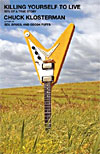 The first story is how I remember meeting Chuck Klosterman; the second is how he tells it in his new book, Killing Yourself To Live, which officially comes out today.
I'm not here to tell you Chuck is lying about how we met. For his last book, I did a point-by-point response to what he wrote about us, and he almost seems to concede fuzzy historical remembrances this time around by subtitling the book "85% of a True Story." Actually, I might be completely wrong about what really happened. In fact, "what really happened" is probably a useless concept when discussing drunken Nintendo battles.
(But just for the record, let's get a parenthetical in here. I am resisting the temptation to tell you the 15 percent that is inaccurate in his telling of our times together -- which you can hear for yourself in this MP3 of him reading from that chapter. But again, that's not what I'm here to talk about, because, for the most part, it's "true" (especially when you put it in quotes), and whatever isn't true is better this way anyway.)
Here's where I should tell you about the book. KYTL is basically a travelogue disguised as a memoir. First devised as an article for Spin, the ostensible narrative is Chuck travelling around America and visiting the places that rock stars died -- but that's all subterfuge for reflecting on various relationships and friendships from the past (and that's all subterfuge for reflecting on life and death). When he comes to Minneapolis (in theory, to visit the place Bobby Stinson died), the book recounts how a group of music critics (plus me, "someone who probably should have been a music critic") go to the Kitty Cat Klub, drink too much, argue way too much, go back to my house, drink more, climb on the roof, and nearly kill ourselves. And yeah, there's some stuff about the fist-fights we had in college.
Now that's out of the way, so let's get back to what I wanted to say. Look at the two different stories at the top of this page -- now ask yourself this: Which story is better? In college, this was the kind of thing that Chuck and I would have argued about for a week -- not just whose story is better, but what percentage of other people would think each is better, and who told the story most economically, and which story was more historically true, and if historical accuracy even matters, and who would play the parts in the movie of this story, and what Kant thought "better" actually meant, and so on. It was completely nuts.
But it was also probably the most important time of my life. Even though there were several occasions where I literally wanted to strangle him, nowadays my emotions about Chuck are pretty simple: I think he's funny, and he only occasionally pisses me off. As for "what really happened," it's all a blur, some of it intentionally so. But I now know this: I learned more about friendship from him than anyone else in my life.
But I can still totally kick his ass.
The link farm: Buy the book Listen to part of the book Discussed on Stereogum. On The O.C. Entertainment Weekly review KYTL being made into movie. The Dessert Island Question. Book Notes from Large-Hearted BoyTV
The stupid TiVo auto-recorded the final episode of the Capital Gang this weekend, and it made me wonder if political shows have always been this dull.
MUSIC
NYT Mag profiles Nic Harcourt, "the star maker of the semipopular," of KCRW radio.
Nike rips off Minor Threat. And Hot Topic is selling John Coltrane t-shirts.
BOOKS
Why someone isn't translating these Saddam Hussein novels into English is a complete mystery to me.
The world's most popular authors (according to Google Adsense).
Apparently NYTRB couldn't avoid reviewing The Washingtonienne and finally caved in.
ART
The Salvador Dalí Museum (which is right next to the Poynter Institute in St. Petersburg) is moving, thanks to Jeb Bush.
McSweeney's: Things Not Overheard At A Conceptual-Art Gallerying Opening.
MISC. WORK THINGS
Little Lost Robot likes my "Send To Proof" button!
Whenever someone uses the word juvenile to describe some piece of cultural junk, I immediately want it. That said, I've never really understood the appeal of NewsBreakers.org, the pranksters behind the tv live-shot media stunts. However, NYT chooses to stack them next to Howard Stern and the Merry Pranksters. I guess if there were more of a point to what they do (like, say, The Guerilla Girls), I might be more sympathetic. Then again, saying that these pranks lack a point is, well, missing the point. I guess.
In college, Lawrence, Kan. was synonymous with William Burroughs (for me, anyway). Now, in my new media work world, it's forever associated with online news innovation. NYT looks at what The Lawrence Journal-World is in The Newspaper of the Future.
MUSIC
Does anyone else find it suspicious that Billy Corgan has taken out an advert (pdf) to reunite Smashing Pumpkins on the very day that his new solo album came out. Billy, why didn't you just become a contestant on Rock Star?
TV
This is sorta interesting... to synch up with the release of the Bewitched movie, the first season of the tv show has been released in both color and black and white.
ONLINE
Suicide Girls DVD trailer (NSFW, duh).
FUNNY
FOOD
New York jumps into the foie gras fracas.
DESIGN
ONLINE MEDIA
The L.A. Times has pulled down Wikitorial (announced here and touted and denounced in many places).
In the past, you needed a RealOne subscription to watch video on CNN.com. Starting today, you no longer do.
MSNBC.com teases its redesign.
I have been ignoring the debate about whether Google is a media company (such absolutist categorical thinking -- similar to "are bloggers journalists?" -- bores me), but here's NYT mentioning it in their "What's Online" column, which is clearly struggling at this point.
MUSIC VIDS
Forget those wannabes, here's the real deal: Nancy Sinatra's "The Boots Were Made For Walking" (1966).
TECH
Microsoft is developing a BitTorrent alternative.
I have no idea why everyone is surprised that Google is developing a PayPal rival. The second that Google Video was announced, it was an obvious step (and Google Print will likely be next).
YouTube. It appears to be Flickr for video... and I think it's new. At the same time, Vimeo has moved out of beta.
SHOES & TEES
WORDS
Dave Eggers issues a "small correction" on Neal Pollack's strange essay in NYTBR.
AUDIO
Steve Jobs' Stanford Commencement Speach.
MUSIC
The Onion A.V. Club presents this mixlist of highlights from moments when gaming and music collide.
ART
Finally! Bjork and Matthew Barney are working on a project together: Drawing Restraint 9.
ONLINE
Good stuff: EFF's Legal Guide for Bloggers.
The winners of the Contagious Media showdown have been announced.
GAMES
McSweeney's: Top Three Things Q*Bert Is Pissed About.
FILM
The 30th Anniversary DVD of Jaws came out yesterday.
Huffington Report: Errol Morris interview.
MUSIC
This week's new releases? Oh, alright: Foo Fighters, Dwight Yoakam, and Pernice Brothers.
WORDS
Wonkette's novel, Dog Days, is now available on pre-order on Amazon (though it's not out until 2006). Oooh, read the description -- looks like there are some roman à clef opportunities there.
The Anarchist Cookbook author disavows his book on Amazon.
RANDOMLY FOUND ONLINE
World Beard and Moustache Championships.
55 Optical Illusions & Visual Phenomena.
24 Different Ways To Lace Shoes.
T-SHIRTS
From the "pro-life store": Former Embryo.
There's some buzz online right now about the American Apparel models being a tad on the youngish side. You can judge for yourself.
MUSIC VIDEOS
Willie Nelson is really the highlight of Jessica Simpson's "The Boots Were Made For Walking" video. No, really.
The new Bloc Party video goes the way of Gorillaz: "Pioneers".
MUSIC
Slate.com: What's the worst ad song ever?
Mashup: Snoop Dogg vs. Led Zeppelin (mp3).
Mondo Kim's raided. Huh?
Pitchfork gives DJ Shadow's Entroducing... Deluxe Edition a 10.0.
Pink Floyd reunites with Gilmour, Waters, Mason and Wright.
For those who didn't even hear the music: Eleni Mandell, who sang the song in that Paris Hilton Carl Jr.'s advert, to release "I Love Paris" single.
WORDS
Malcolm Gladwell: My work space.
BLOGGING
NYT has launched their column that purports to be a snapshop of blog talk. Their first topic? Mark Cuban. Hm.
FILM
David Lynch's new movie: INLAND EMPIRE (and yes, it's apparently all in caps).
I will be in New Orleans for the Interactive Media Conference most of this week. Blogging could be light until next week.
ONLINE
The Washingtonienne snuck onto bookshelves this week. A few reviews: Wired | DCist | WashPost. And an excerpt.
The Gawker kids launched a new blog: Oddjack, about gambling.
MEDIA
80 Years of The New Yorker to Be Offered in Disc Form. Comes out in October. Amazon pre-order.
MUSIC
Someone must remix these: World Livestock Auctioneer Championship MP3.
New White Stripes video: Blue Orchid. Also, Jack White just married a Brazillian supermodel.
Some of my favorite music bloggers have created the Music Blog Network.
Celine Dion Weird Al-ing Michael Jackson. Strange.
MARKETING
MTV's new viral campaign: MTV Video Awards Categories That Didn't Make It.
Interview with Rob Walker, who does the highly-recommended "Consumed" column in the Times Mag.
EDUCATION
Have you seen the essay question that has been added to the SATs? Being a kid today sucks: "A sense of happiness and fulfillment, not personal gain, is the best motivation and reward for one's achievements. Expecting a reward of wealth or recognition for achieving a goal can lead to disappointment and frustration. If we want to be happy in what we do in life, we should not seek achievement for the sake of winning wealth and fame. The personal satisfaction of a job well done is its own reward."
FILM
Did you hear that Johnny Depp tries to act like Michael Jackson all the way through Charlie and the Chocolate Factory? Seems to be true: a new trailer.
New Wong Kar-Wai! New Wong Kar-Wai! New Wong Kar-Wai! (We've only been talking about it for two years, but at least there's a trailer now.)
I haven't read it yet, but you can be sure it's bookmarked: Zizek on Revenge of the Sith.
ART
LOCAL
I've been putting a lot of time into MNspeak lately, so we've been a little slow here on Fimoc.
WORDS
Awesome: List of fictional curse words.
McSweeney's: Pickup Lines: The First Drafts.
Random House: Twentysomething Essays by Twentysomething Writers Contest.
ONLINE
First indication [?] of who's behind Blogebrity.
I haven't been following Podcasting on this site, but I found it odd that TV Guide is now podcasting.
MUSIC
That immensely annoying frog song is at the top of the British charts.
Kaleefa Sanneh sings the praises of the new White Stripes.
New releases today: A Bjork remix and covers album, a new Oasis (which is getting a surprising amount of attention), and a new Smog.
New Yorker: The Record Effect.
In Spin, Chuck dissects music genres. "IDM: This is an acronym for 'Intelligent Dance Music.' Really. No, really. I'm serious. This is what they call it. Really."
Nerve.com: Sex Advice from Accordion Players.
TV
The first and second seasons of Moonlighting came out on DVD today.
TVsquad interviews Kendra from The Apprentice, who will be heading down to Palm Beach to oversee construction of a new Trump mansion, and according to this Palm Beach Post story, taking a salary cut.
FILM
A lucious six-flick Steve McQueen box set came out today. Makes me want to watch Bullitt right now.
Oliver Stone Arrested on Drug, DUI Charges.
MEDIA
Are you reading NYT's series on Class? Here's a fun interactive graphic showing how much class you have.
Kurt Andersen thinks Radar looks just a wee bit like another magazine from the '80s.
BOOKS
Bookforum: Pynchon From A to V.
NYT Styles this week looks at the glut of sex-themed books, which I won't say a thing about because I know at least two girls writing these.
I don't know if anyone is reading Umberto Eco's new book, but here's a profile of him in the Telegraph.
SHAMELESS SELF-PROMOTION
I was on Rocketboom earlier this week, talking about MNspeak.com and sparring with Amanda about rooftops.
SCIENCE
Finally, the've found the part of my brain that's overstimulated.
TV
For unexplainable reasons, the Lost Remote thread about Lost (the tv show) goes ape shit with comments. Also, there are two viral websites related to the show: Oceanic Airlines (the airline in the show) and Drive Shaft (Charlie's band).
FILM
New Cronenberg: A History of Violence trailer.
More details on Linklater's Fast Food Nation.
Me And You And Everyone We Know is getting mass attention right now (on the cover of both Filmmaker and Res). Trailer and blog.
Chronicles of Narnia and Dukes of Hazard trailers.
ONLINE
It's weird how I completely forgot that FuckedCompany.com (who were sorta important at one time) existed. The L.A. Times has a profile of its creator, who has a new dot-com venture.
Wired News' Media Hack on Salon (who maybe should be the company that we forgot yet it somehow survived).
Top 50 Internet Advertisers In April.
MUSIC
BLOGS
Jessica Coen of Gawker interviewed in Gothamist.
I'm on Blogebrity's "A-List." Now I'm blushing. Anyway, this attempt to get megalomaniac bloggers like me to link to it is of course part of the Contagious Media Showdown.
Did I say jokes are dead? Your blog is so....
MUSIC
Pitchfork's Summer Reading List.
New albums from Sleater-Kinney, Gorillaz, and Steve Malkmus came out today.
Billy Corgan hates Zwan too. And it turns out I've seen James Iha 5 more times than Billy has in the last four years.
LIFE
It should be that time of the week to roll out the Times Styles section and ridicule the cover story. Except this week, the story happens to be something that I've been saying for a while: the joke is dead. There was a time when people told jokes all the time at parties, but now everything is situational humor and nuanced wit. I will even occasionally tell jokes at parties, wait for people not to laugh, and then launch my shtick about the death of the joke. Yeah, that's right, I use the concept of jokes to set up idea humor. So anyway, NYT Styles, I applaud you for not being one big joke again this week.
Merriam-Webster: Top 10 Favorite Words Not in the Dictionary.
MEDIA
Who says the flash-in-the-pan media doesn't follow-up on stories after they've faded as talking points? WaPo has a long story on the hacker behind Paris Hilton's Sidekick scam.
I found an issue of Radar today (not supposed to be available for a couple days), and you know what? It's actually pretty good.
ONLINE
My dear internet, you have jumped the shark. Blogebrity.
NYT on Rocketboom's search for a weather person.
MUSIC
David Cross: Albums to Listen to While Reading Overwrought Pitchfork Reviews.
MIDI GNR: SelfSimilarGNR.com. Sounds a bit like Axl done by Kraftwerk.
NYT: Neil Diamond hanging with Rick Rubin.
New Basement Jaxx video: "U Don't Know Me."
FILM
Richard Linklater to direct movie version of Fast Food Nation (that isn't Supersize Me).
New documentary on the history of women's wrestling: Lipstick & Dynamite trailer. (This would have been the perfect opportunity to finally have a female voice do the trailer.)
Film Critic: The All-Time Top 100 Voices in the Movies.
NYT: For $1 You, Too, Can Be an Executive Producer. Profiles the attempts of MovieForTheMasses.org and IBI Films to micro-fund movie projects.
New Greg Araki: Mysterious Skin trailer.
WORDS
The meta-ness of Brett Easton Ellis.
LOCAL
Over on MNspeak, the Rogue Taxidermy cabal have a new website, Chuck was on the O.C., Flashmobs revisited, and Bob Mould releases new songs.
Early warning: I'll be in New Orleans June 7-9. If you will be too, let me know.
MEDIA
Yeah, Radar launched. We have officially entered the age of The NYC Media Glut.
MUSIC
Gang of Four's Entertainment! was re-released today.
50 Fun Things To Do With Your iPod (besides listen to music with those white earbuds).
Whatever happened to the kid on the Nirvana Nevermind cover?
TV
What's life really like for one of Donald Trump's apprentices?
FILM
Fearless Freaks, the Flaming Lips doc, came out today on DVD. So did Season Three of Six Feet Under.
TV
Time catches up with David Chapelle in South Africa.
It would appear that Arrested Development did not get axed.
MTV: Pimp My Trailer.
NBC's upcoming summer shows. Meh.
MUSIC VIDEOS
New Hot Hot Heat, directed by DNA's Marc Webb.
CONSUMPTION
Levi's new campaign: metrosexuality + naked GI Joe's + opera.
ONLINE
In something you just don't expect to see in your Sunday Times, James Fallows writes about Ajax, Flash, and other asynchronous internet strategies.
After leaving San Jose Mercury News, Dan Gillmor has started his first project: Bayosphere.
MUSIC
Own the audio to the shows you saw last summer: Pixiesdiscs.com.
Look, Nobody Cares That You're a DJ.
LOCAL
Over on MNspeak, we track every local reference on the new Hold Steady album and connect the Blu Dots.
FILM
What would it look like if the Times started to blog? Like this. Not bad, really.
The trailer to David La Chapelle's Rize is finally out. If you've forgotten, this is the documentary about Krumping, which is basically clowns meet hip-hop.
NSFW
What's up with the recent trend of R-rated music videos? Here's one Louis XIV did with a few Suicide Girls.
ONLINE
Google bought Dodgeball.com earlier this week.
DAILY SHOW
Get paid to watch (and write about) The Daily Show.
If you missed it, here's the hilarious Daily Show spot about cable news and blogs. The "Inside The Blogs" show on CNN is a favorite laughing point for me at work every day.
T-SHIRTS
Some new tees at La Fraise.
DESIGN
Netscape.com has redesigned completely in Flash.
WORDS
In the New Yorker, Malcolm Gladwell reviews the new Steven Johnson book.
MUSIC
Le Tigre is writing a track with Paris Hilton.
Weezer's new album, Make Believe, which Pitchfork gives a 0.4, came out today. So did Spoon's newest, Gimme Fiction.
The Hold Steady are reviewed in the New Yorker and are on the cover of The Village Voice.
M.I.A. finally reviewed on NPR.
DJ Spooky Raps in Wired News on Remixing.
MARKETING
Nike finally created a spot to follow-up Tiger Woods' 16th hole shot at the Masters.
TV
I haven't given the Huffington Post a real ride around the block yet, but I did read Tina Brown's mildy funny 10 Things I Learned at Topic A.
Today's the big day: the season finale of Veronica Mars. Here's a new interview with the creator, Rob Thomas, which contains a question about the DVD release.
DVD
Four notable new releases today: The Life Aquatic with Steve Zissou, The Complete First Season of The Partridge Family, Hoop Dreams, and Kinsey.
MUSIC
Some video involving Paris Hilton and Fat Boy Slim. I'm told this is a viral video to promote the release of Fat Boy Slim's new video. Which is the most hyper-real thing I've heard this month.
TV
Last week, AP ran a story about my pals at Rocketboom.
Tina Brown's Topic A goes bye-bye.
Systems of the Down got the F-word in SNL. Yawn.
BLOGGERS
Apparently because they haven't put Gawker on the Business page yet (next up: Travel?), NYT chats up the Gawker gang. What's the scoop? Blogs are over-hyped. Yeah, tell that to Calacanis, who is being stalked.
Tony Pierce was fired from his job at E!
NYT Editorial page gets all sappy about blogger ethics. Jarvis responds.
Tick-tock, tick-tock, tick-tock.... (Update, it launched.)
LOCAL
Over on MNspeak, some notes on Low, a non-debate about IFP MSP, and the phone book doubles in size.
ONLINE
I feel like the entire internet is debating the Google Web Accelerator at this very moment.
T-SHIRTS
CONSUMPTION
The Japanese keep inventing new ways to tell time.
WORDS
Steven Johnson's new book, Everything Bad Is Good for You, came out yesterday. If you don't know about it, Kottke can bring you up to speed.
Amy Sedaris interviewed in Bust.
MUSIC
NIN covers Johnny Cash. Heh.
FILM
Buried in this piece about Hayden Christensen it says that Tom Stoppard was a writer behind the new Star Wars.
MUSIC
It's Tuesday, so what are the new music releases? Glad you asked. We have a new Nine Inch Nails (With Teeth), a new Raveonettes (Pretty In Black), a new Aimee Mann (The Forgotten Arm), and a new Hold Steady (Separation Sunday).
Since there's no such thing as linking to an Esquire column, I'll point to Stereogum's large excerpt of Chuck's 21 CDs From the Past 3 Years. I think several of these are actually inspired by real people, and #10 is very likely me: "The Thrills, So Much for the City (2003): You will like this album if your apartment is actually a bar." And #1 couldn't be more perfect: "1. The Hold Steady Almost Killed Me (2004): You will like this album if you used to like AC/DC but now you just read a lot."
CELEBRITY
I thought the Michael Jackson trial on E! was pretty creepy, but putting Elizabeth Smart on People's 50 Most Beautiful People is downright insane.
NYT: Paris Inc.
TV
Does CNN have a stupid keyword stuffing campaign going on?
ONLINE
That's cool, Peter Rojas got a Bill Gates interview on Engadget.
WORDS
A new Chuck Palahniuk book, Haunted, is out today.
INTERACTIVE SHOES
Nike has a new towering presence in Times Square -- 22-story digital screen that you can control by calling a phone number build a personalized pair of shoes. A friend sent a picture.
Many of you have written to ask why I haven't said a word about Tina Fey's baby announcement. Yes, okay, I am a little upset that she didn't tell me first. Now that the humiliation is out there, let's check in with the scary & sexy nerds known as the blogosphere:
INTERNET/SEX
Nerve.com does Sex Advice From Bloggers. They never asked, but my answer to "What's the best way to get a blogger to go home with you?" would have been "tell him he looks hotter in real life than in that weird picture on the blog."
In Wired News, Regina Lynn take a look at HighJoy, a melding of dating, chat, and teledildonics.
FILM
New blog: Posterwire, a movie poster blog.
WORDS
They'll let anyone write a book nowadays... even fictional characters.
How Google is conquering TLS's Author Author quiz.
DESIGN
Amazon.com is trying to clean up the way they look -- no more infinite tabs.
MEDIA
File under: New York Post is doomed. Google is developing an algorithm for determining quality in news.
Unless you're in the creepy parts of the blogosphere, you don't see people linking to The Nation much anymore. But there's a decent story on the challenges that Al Gore's new network, Current, faces.
TV
Did anyone see the last episode of Wonder Showzen? The theme was patience, and until half-way through the show, the joke was that everything was going to be drawn out to stupidity. It was as funny as tedious gets. Then the second half of the show was the entire first half of the show played in reverse. There hasn't been anything this weird on tv since Andy Kaufman.
MUSIC
Video of New Order performing "Love Will Tear Us Apart" on Jimmy Kimmel's show.
NPR interviews Ian MacKaye about his new band, The Evens, which sounds surprisingly like a lot of Twin Cities bands.
SHOES
New book: Sneakers: The Complete Collectors' Guide.
LOCAL
Over on MNspeak, we've got news about the only two world-famous Minnesota Jews: Tom Friedman and Al Franken. (I know, I know, Dylan is sometimes Jewish too. But he doesn't write or call home anymore.)
MAGAZINES
Here I was talking about the Steven Johnson and Tom Friedman excerpts in magazines, but I completely overlooked that I was excerpted in Wired this month. Well, it's a blurb excerpt of this piece I wrote about viral marketing. Here's a picture of the excerpt, which you'll find on page 89 of the current issue on newsstands (the Star Wars one).
TV
No surprise, NBC's version of the The Office is about to get cancelled.
Ladies and gentleman, the most boring tv show of all time.
FILM
BLOGS
ifuckedanncoulterintheasshard.blogspot.com. "hard" is such a nice touch.
The Guardian pretends to get a peak on the new Huffington blog. And here's a list of 47 of the supposed 250 super-bloggers lined up. In what could be the strangest list of people of all time, we have Bill Maher, Christie Hefner, David Geffen, David Mamet, Diane Keaton, Gary Hart, Gwyneth Paltrow, Harry Shearer, Jann Wenner, John Cusack, Larry David, Maggie Gyllenhaal, Mike Nichols, Norman Mailer, Nora Ephron, Tina Brown, Vernon Jordan, and Walter Cronkite.
LOCAL
Over on MNspeak.com, we have news about Best Buy and some crazy ESPN.com guy.
It's about time we had some babies around here.
Today, Chuck Olsen and I are announcing a new site (still in beta!) that we are putting the finishing touches on. We present to you:
 MNspeak.com
Twin Cities, All Day, All Night
What the heck is it?
It's a few things, yet it's also something very simple: a one-site stop for Twin Cities conversations about culture, media, politics, and entertainment. MNspeak.com's primary function is to answer these two questions:
1) What are people in the Twin Cities talking about today?
2) What is going on around town tonight?
So yes, it's a blog -- or partially a blog. But it's so much more! The left column works like a traditional blog (but with a community of participants). In addition, there is an events calendar, a community feedback device, a local blog/media aggregator, and sponsorship opportunities. And if all goes well, there will be more soon.
I've been working in digital media for almost a decade, and I've seen a website or two in that time. A "community site" could mean innumerable things to innumerable people (photo-blogging, topic-driven bulletin boards, etc.). But we think MNspeak.com has crystallized the possibilities down to a few essential features done well.
Perhaps the best way to describe the site would be to compare certain parts to sites that have influenced me. Here are some of MNspeak.com's main features, with mentions of sites that influenced the idea:
Writing -- No one realizes quite yet what a huge effect Gawker is having on the way we talk to each other. I'm respectfully describing the tone of MNspeak.com as Gawker Minus The Mean-ness. If that doesn't grab you, try Putting The Irony Back In Minnesota Nice. In other words, expect information plus attitude, but we'll try not to hurt your feelings, unless you're Norm Coleman or CJ.
Email Newsletters -- There is no Flavorpill in the Twin Cities yet -- and now there never will be! We are offering two simple email options -- an every-day calendar email and a week-day blog email. Click here to sign up.
Calendar -- If you've known me more than five minutes, you've probably heard my rant about the media sector that's really missing the boat on the digital publishing revolution: the alt-weeklies. I honestly believe CityPages.com is doing interesting work with Babelogue, and VillageVoice.com seems to be giving it the college try -- but the rest are trapped in the dogmatic slumbers of a weekly publishing schedule. The goal of MNspeak.com's calendar is not to compete with the gigantic comprehensiveness of an alt-weekly -- rather, it's to offer a clear resource for answering this simple question: "What's going on tonight?"
Participation -- We are so lucky to have one the leading "open-source journalism" thinkers in America in our city (don't let the scatological humor fool you!). Chuck's Blogumentary has been getting accolades wherever the film screens, and it's a pleasure to finally be working on a project together. We'll be adding in more voices to the site, so stay tuned for some surprises.
Aggregator -- The problem with blogs is there's just too much. Aggregators like Kinja are doing a nice job of condensing the blogosphere into digestible units. Our aggregator still needs some work yet, but it has the potential to be -- and I don't mean this hyperbolically -- the leading community news source in the Twin Cities.
Design -- Often cited by big media as the little site they wish to be, Lawrence.com is the "disguised" entertainment site of a daily Kansas paper, The Lawrence Journal-World. The design has gotten a little messy lately, but the general structure is something that pleases me. (There are rumors that many daily papers -- including local ones -- are considering similar sites. How much you wanna bet on them "getting it"?)
Interviews -- When I met Gothamist publisher Jake Dobkin at SXSW, I talked him out of launching a branch of his growing empire in Minneapolis. Actually, he mentioned some mumbo jumbo about "market size," and I knew he'd never bother with our mini-metro. Seriously though, one of our favorite Gothamist features is the interviews, which we plan to blatantly steal.
Business Model -- Oh, bring that up, will you? Yes, we're selling ads right now. If you'd like to advertise with us, click here. You'll be shocked how inexpensive they are. I can't reveal much more, but we're also talking about creating revenue opportunities for other Twin Cities bloggers. If you think about it, you can imagine how that might work. More on that later...
We're obviously excited about the site. Check it out, leave comment, sign up for the newsletters, take out an advert, check out the aggregator, and tell your friends.
MUSIC
The big music release this week is New Order's Waiting for the Sirens Call. If that's not your thing, there's also a new Essential Barry Manilow.
You've certainly heard by now that the White Stripes released a new single exclusively on iTunes. No? Then here's the link.
The audio to the Lawrence Lessig / Jeff Tweedy conversation is finally available.
It looks like it finally launched: MTV's Overdrive, which is basically a video portal with videos/trailers/etc. My guess is it'll be gone by the end of the year.
BLOGS
NYT has more on Arianna Huffington's crazy blog adventure.
DrudgeReport turns 10 years old.
Cool Hunting redesigned.
DVD
Two new releases this week: Orson Wells' F for Fake and Charlton Heston's Soylent Green. There's also a new $21 Eternal Sunshine of the Spotless Mind / Lost in Translation value pack.
We've got a lot to talk about today, and I'm not not even going to link to Lohan's new blonde hair. Deep breath... ready, set, GO!:
TV
The TV season hasn't even come to the moment of finale spoilers and already ABC has scheduled the DVD releases of the first seasons of Lost and Desperate Housewives.
TVCarnage.com. "Hundreds of hours of exceptionally bad TV lovingly fused together into hour plus, glorious cesspools of retardation." Amazing clips. NYT says DVDs are available for free, but it looks like the link might be gone.
NewsBreakers.org. They break into local tv liveshots. Is it a sign of getting old that what once seemed funny is now lame? [via]
A look at the new TV Guide spin-off, Inside TV. Certainly no shocker: TV Guide's revenue's are plummeting.
The Gladwell-esque Opus Of The Summer is certain to be Steven Johnson's Everything Bad Is Good For You (released next month). The ususal suspects are already excerpting it, including NYT Magazine (with a section about narrative tv) and Wired (not online yet).
GAMES
In Guess-the-Google you see 20 images from a one-word Google Images search, and you have to figure out what the word is. Deceptively difficult.
Koerner's column this week is on the Star Wars version of the game Risk. (In other Star Wars commercialization news, here's Darth Vader in an Orange advert And more.)
CONSUMPTION
Rappers love to make liquids that you consume. Here's a sample of real hip-hop energy drinks: Lil Jon's Crunk!!!, Ice-T's Liquid Ice, Nelly's PimpJuice, and Russell Simmons' DefCon3. The new issue of Wired reviews them all (not online yet).
MUSIC VIDEOS
Music videos and movie trailers belong in approximately the same category, so why not just mix them? Voila: the new Unleashed trailer / Massive Attack video.
NME has the new Juliette Lewis video.
New Sleater-Kinney video (.mov) for "Entertain," off the new album coming out next month.
SIMPSONS
For no apparent reason, another profile of The Simpsons / Matt Groening.
Real Life Simpsons House. Freaky.
A gigantic MP3 archive of Simpsons music.
MUSIC
Been a while since I read an entire ILM thread: Songs about Heroin and Songs about Crack. Okay, I didn't read all of that one either.
A tidbit on Reverend Billy and the Church of Stop Shopping says that Wal-Mart is not stocking the new CD.
Tom Waits, who won a lawsuit against Frito-Lay in 1992 for using a voice that sounded like his, now unhappy with Opel commercial.
Pitchfork can't decide whether to give the new Rob Pollard album a 0.0 or a 10.0, so they give it a (1)0.0 .
MEDIA
New rule: No using "MSM" unironically.
BLOGS
I finally read the Biz Week cover story Blogs Will Change Your Business, which says nothing important to important people. The accompanying blog looks pretty elementary.
CONSUMPTION
The trailer to the new Lars von Trier flick, Manderlay, gets an internet NSFW rating for its use of the n-word.
T-SHIRTS
Some good ones at Future Relic and Glarkware.
If you've got a kid, dress it in something from PottymouthShop.com.
WORDS
London Review of Books Personals. Hot. [via]
LOCAL
Psst, wanna hear a secret? This LOCAL category will be disappearing soon, as we launch a new Twin Cities blog. We? Yes, we! Shhh, more details soon.
TV
The Onion A/V Club wishlists "war" on TiVo and records the results. Lots of Nickelodeon, ABC Family, and VH1.
Video: Jon Stewart's appearance on Oprah. Why the hell Cameron Diaz is sitting there is the biggest mystery since... since... since they gave Jimmy Kimmel a tv show. (Sorry, I know I can do better than that.)
Video of Ann Coulter getting freaky on FOX.
FILM
Here we are in 2005, and who could have guessed the words "the new film by Rob Zombie" would appear?
Those Taschen books are always so tempting, aren't they? Erotic Cinema. [Amazon link.]
ONLINE
You knew it was big news when you saw the 40-point hyperbolic headline on Drudge: GOOGLE KNOWS WHAT YOU SEARCHED LAST NIGHT.
WORDS
Village Voice hangs out with the famous lit bloggers.
MEDIA
It's been a while since we've seen a Romenesko profile.
MUSIC
Slate recounts the Fiona Apple fiasco, addressing the obvious Wilco comparisons.
LOCAL
Many months ago, I was actually thinking the best localite to review the new Walker would be Peter Ritter. And there he is in CP today. He nicely conjures the Death Star, the Cheshire Cat, and an REI climbing wall to describe out new fave ediface. Hoorah, our first readable Walker review.
Today is either huge day in Fimoculous history, or it's a brief moment of crazed myopia. After avoiding it for 4+ years, I've finally added comments. The little link appears at the bottom of the posts -- and it will probably disappear the second I start getting comment spam. Be kind, young netizens. (Oh, and you probably noticed the Google Ads. I'm making about $.08/day on those, so they also might be short-lived.)
TV
I know some of you are having a hard time seeing Wonder Showzen, which MTV2 buries in the after-hours. So I've uploaded a video of the entire first episode. Download it now before my ISP (or Viacom) calls. Yeah, that was short-lived. Server slowed down to a near dead-stop. I'm sure you can find a Torrent out there.
If you watched Arrested Development on Sunday, you heard them close with the line "Next season on Arrested Development...." What'd that mean? This season is over and next season is still iffy. And in a profile of GetArrested.com, NYT says we'll know next month whether FOX renews the show for next year.
The first season of Dynasty came out on DVD today.
PUBLISHING
Scary Ann Coulter on the cover of Time. (UPDATE: Drudge's take and giving bon mots at St. Olaf.)
MUSIC
Dinosaur Jr. tour schedule.
FILM
Out on DVD today: House of Flying Daggers and Primer.
BLOGS
Andrew Krucoff launched a blog mostly about obits (I think): Young Manhatttanite.
LOCAL
How come it took some NYC guy to inform me about The Walker's New Media Initiatives Blog?
CONSUMPTION
The Scrolling Belt Buckle is friggin brilliant.
A friend of mine worked on the market research for the new prescription bottle that Target is hoping will turn pharmaceuticals into destination shopping.
Another new viral campaign from BK, this time in the form of a game: NeedForFeed.com. No relation to MailOrderChickens.com.
MUSIC
The reverse of the censored album, these versions of NWA's "Straight Outta Compton" and "Fuck the Police" are the bomb.
TECH
Put away the rumors about Microsoft owning Flash, cuz Adobe is buying Macromedia.
TV
So best. Jimmy Kimmel is hiring for a "TV Watcher" who will watch the tube all day looking for the best clips for the show. If a blogger doesn't get the job, something's wrong.
Anderson Cooper Fan Blog. [via]
In a little ditty about ending the whodunit on Veronica Mars, this story also says UPN has renewed the show for a second season.
FILM
Trailer to the new Gus Van San movie, Last Days, a fictional account of the demise of Kurt Cobain that includes appearances by Kim Gordon and Harmony Korine.
Interview with EW's long-time film critic Owen Gleiberman.
MUSIC VIDEOS
"The Sad Song", "created entirely using 15 second jpg movies from my little Nikon Coolpix 775 still camera, reconstructed in AfterEffects."
WORD GAMES
The 20-question What Kind of American English Do You Speak? says I'm 75% General American English, 15% Upper Midwestern, 10% Yankee, 0% Dixie, and 0% Midwestern.
Slate on how Trivial Pursuit became the great repository of middlebrow boomer culture.
LOCAL
Varsity reopened.
If you missed it, here's NYT's architecture review of the new Walker from Friday. Best part of the opening party? Most people will tell you open access to Bjork (or Kim Gordon, or Yoko Ono) in the Target tent was cool. I'll tell you that the blinking red LEDs were attrocious.
ONLINE
Google has released a video upload tool. As the FAQ says, you have to own the rights to the video, but you will be able to charge people to view it. This completely breaks open the doors for micropayments.
Webby Awards Nominations, blah, blah, blah.
MUSIC
Does Bush's iPod contain stolen content?
Salon contends that Gwen Stefani neuters Japanese street fashion. By its very definition, doesn't Japanese fashion seem completely open to unbridled reification?
TV
New Frontline Punk Rock in the Holy Land.
MEDIA
LOCAL
CP's What the hell does the Walker addition look like? contest. Funny.
Citywide Wi-Fi? Starbuck's is gonna be pissed.
TV
If you're watching The Apprentice, you know that Chris being arrested for disorderly conduct couldn't be scripted more perfectly.
Big (and by big I mean bad) day in DVD TV releases today, with all of these first seasons coming out: Knight Rider,
The A-Team, Magnum, P.I., and The Bob Newhart Show.
C|Net has a three-day future of tv series.
GAMES
New Xbox to debut on MTV next month.
ECON BOOKS
Kottke has an interview with Steven Levitt, the author of Freakonomics, which comes out today.
MEDIA
According to NYT, the Spy-ish Radar Magazine is making a comeback next month in the form of a website. Although the site has some interesting ideas (such as a 15-minutes-of-fame image uploader), I have a bigger question: will my subscription from two years ago finally be validated?
FILM
Out on DVD today: Almodóvar's Bad Education and Hotel Rwanda.
MUSIC
NYT: What's on President Bush's iPod? Everything from Alejandro Escovedo to Kenny Loggins.
And what's new in music releases today? The only noteworthy item this week is the new Garbage album.
BLOGS
I seem to be trading nicely on Blogshares.
LOCAL
Sarah Vowell is reading tonight.
Greil Marcus and Crooked Fingers and Ben Lee (all audio links) did in-studio's on The Current.
NON-TRENDS
Yes, I realize it's a little silly to show up here at the beginning of every week to watch me get upset about the lead story on the NYT Styles section. But c'mon, the man date? Dear New York Media, why must you write trite trend pieces that cause the rest of us to consider molotov cocktailing Michael's?
MARKETING
Found on eBay: Scream Advertising. (Via BizarreBids.com, a good resource for strange eBay items.)
NYT Mag's cover story, "Our Ratings, Ourselves", tells the suprisingly fascinating story of the Portable People Meter -- a device that records all the media you've consumed in a day for marketing purposes. Pioneered by Arbitron and implemented by Nielsen, the PPM, which is about the size of a pager, accomplishes this by having all media encoded with an audio watermark. A broad range of other topics covered in the long piece: personal media device consumption, the arcane life of Nielsen labs, the shift from active to passive measurement, cable box innnovations, and direct measurement of advertising success. Two related items:
CJR asks Can Nielsen Keep up with the Way America Watches?
NPR's Bob Garfield foresees the Impending Period of Transitional Chaos for Media.
MEDIA
Fun idea: ask four people -- Lizz Winstead (co-creator of The Daily Show), Don Hewitt (founder of 60 Minutes), Mark Burnett (creator Survivor and The Apprentice), Al Primo (creator of Eyewitness News) -- how to reinvent CBS's evening news. The results are chaotic. (Reminds me of the time Wired asked for Google redesigns, and the results were a mess.)
MUSIC VIDEOS
I pretty much never have to link to a music video again after looking at this page.
BitTorrent link for the newest Daft Punk video of "Human After All."
IDEAS
William Safire's critique of privacy is a good place to jump into understanding ChoicePoint and other nefarious data-collection agencies. Sample quote: "The first civil-liberty fire wall to fall was the one within government that separated the domestic security powers of the F.B.I. from the more intrusive foreign surveillance powers of the C.I.A... But the second fire wall crumbled with far less public notice or approval: that was the separation between law enforcement recordkeeping and commercial market research."
CONSUMPTION
Fake bags become a brand unto themselves.
BLOGS
Kottke gives book-length update on his blogging micropatronage.
MUSIC
TECH
NYT asks "Will the Next Version of Windows Be Worth the Wait?"
LOCAL
Varsity what? Still closed.
I read every word of the Strib's multi-story Walker spread, but can't say it told me a thing. The online audio slideshow is a bit better though.
Huh, did you know that City Pages owns a local adult website, TC Uncovered (nsfw). The meta keywords include "escorts" and "domination," and there's employment and personals sections. Naughty.
If you know me, you know I love t-shirts. Compulsively and annoyingly so. Saying I'm a t-shirt collector would be stupid, but I do occasionally buy sweet tees with a "just to have it" mindset.
I dug through my closet and pulled out my favorites (an idea blatantly stolen from Preshrunk's "What's In Your Closet" feature). Click the thumbnails to see the fullsize (or view them on Flickr).
 | Atmosphere Keepin it real. |
 | Stryper I bought this beauty during a drunk eBay binge. Klosterman tried to buy it off my back one night. I told him I'd trade it for his Cenex tee. |
 | Rx It's, like, personalized for me, dude. |
 | Save Mary Kate Yep, the one that brought on a lawsuit. |
 | Wonkette Operative Shill. |
 | Hyperboy Probably my fave, this is early Bjork. |
 | Talk Nerdy To Me This tee doubles as my pajamas. |
 | Sheena, Suzi, Judy No one gets this one. They're all Ramones girls. Bought it from a store in Portugal for vastly too much. |
 | Nordeast Local favorite. |
 | I Read Your Email Total ThinkGeek. |
 | I Just Love Corporations My only remaining Onion t-shirt. The rest burned in the fire of '97. |
 | Not Helping From a Creative Electric show. |
 | Rumsfeld This guy is friggin Nietzsche. |
 | Radiohead The last non-ironic band tee I bought. |
 | Sonic Youth Very, very old. Long out of print. |
 | I Fuck Like A Girl I really do. |
 | Faux News I'm technically a journalist, but I still wore this to work one day. To hell with objectivity. |
Thanks for stopping by my closet. Here are some resources:
Preshrunk Cool Hunting Threadless Nerdy Shirts Busted Tees Non-Zero Chance
BLOGS
NY Observer has more about the Huffington Report, with copious comments from Drudge.
And that story launched today's juicy announcement -- a new Denton blog, Sploid.com, a tabloid site in direct competition with Drudge. Editors include the inimitable Ken Layne.
Sure, Sploid made a splash today, but the real action is this new cupcake blog.
Or maybe an NFL Cheerleader Blog is more your style.
Am I the only person in America following this stupid Belle de Jour identity thread? The Evening Standard has its own dude theory.
OJR profiles the aggregators, including CNN's Inside the Blog, Slate's Today's Blogs, and Kinja.
MUSIC
MTV.com beta launched Overdrive, which will download large videos in the background. FAQ.
PHOBIAS
My mom sent me this one: PhobiaList.com, a list of all phobias.
DESIGN
TV
The Daily Show is coming to DVD.
Video of Best Week Ever's Frantina Dulee spot that tricked me.
FILM
NYT's paid-for aggregation of Woody Allen's Filmography contains some old trailers and reviews.
LOCAL
There's nothing that says "Spring In The Midwest" more than spending the afternoon watching the local punks "debate" the smoking ban.
MEDIA
This is pretty neat: The Annotated New York Times. The site lists NYT stories with real-time reaction from the blogosphere. Curious if NYT Corp will frown on this.
Last time I saw Robin [blog], he wouldn't even whisper to me what the real name of INdTV would be. It officially launched today as Current TV. (C|Net story.) Looks exciting, even though The Post is being all playa-hatah about it.
MUSIC
McSweeney's: Implausible Claims Made By Vanilla Ice In His 1990 No. 1 Hit "Ice Ice Baby." "My style's like a chemical spill."
Tuesday is new-release day, but there's not much. Hot Hot Heat has a new album (Elevator) and so does Fisherspooner (Odyssey).
ONLINE
Google Maps has added Keyhole data, so you can now see satellite pics too.
FILM
Stereogum is all over this Pretty In Pink sequel.
New on DVD today: The Corporation and Sideways.
If you like Hal Hartley, you might want to check out the DVD collection of his short films. Includes an obscure short with Adrienne Shelley and Parker Posey as roller-blading, lip-synching cupids. (Trailer.)
TV
FOX is creating a reality tv cable channel.
If you feel like dropping $160, The Complete First Four Seasons of The West Wing came out on DVD today.
PEOPLE
Xeni lives in L.A.? Huh.
LOCAL
The Strib likes The Rake this week.
TECH
Can you imagine getting a text from the Vatican saying the Pope died? TTYL.
The best part about this Google piece in Newsweek is where Google claims they just "forgot" to put ads on Google News. Uh-huh.
REALITY ENTERTAINMENT
I fell for Best Week Ever's joke on Friday. In the recurring segment "Who's having the best week ever?" they name-checked Frantina Dulee. I was Googling her name 30 seconds into the segment, but by the end it was obvious she's, duh, not a real person.
The interesting proposition in this Chicago Tribune piece is that while sports has become increasingly scripted, entertainment has become increasingly competitive.
MUSIC VIDEOS
Cool pop & lock video: Futureshock's "Late At Night".
Bloc Party did a second (and better) video for "Banquet."
The new Moby video is peculiarly Flaming Lipsish.
New Interpol video: "C'mere".
The new Weezer album isn't out until May, but here's a video for "Beverly Hills", filmed at the Playboy mansion.
FASHION
John Malkovich has started a clothing line. If it weren't $70, I might buy this tee.
DATING
TrueDater.com is a date-rating service. That's right, people who frequent date sites are reviewed as though they were Amazon.com books. I feel so violated. [Via a Wired News column.]
In a review of The Hookup Handbook, NYT Styles tries to explain girls who aren't into relationships and aren't into casual sex either. I don't know where the hell these girls live (New York, you say? Never heard of it), but it sure is nice to have an article lying around that provides a definition of hookup.
GAMES
NYT has a nice profile of New Games Journalism, which includes a link to the manifesto.
John Woo to direct and The Rock to star in the Katamari Demacy film. What the hell with this script look like? Like Super Mario Bros. minus the brothers? Stupid April 1.
DRINK
Moby released a book about tea and shit last week.
Google's April Fool's drink: Google Gulp.
Not a joke: Kabbalah Energy Drink.
ART
It seems odd that NYT Mag did a long Murakami profile without a news peg, but it's not bad at using otaku as a means to talk about Japan. (Previous profile in Wired.)
LOCAL
KSTP and Star-Tribune fell for an April Fool's gag claiming that a Three's Company remake was coming to St. Paul.
Lookie! A school for strippers, right in our backyard.
ONLINE
Eek! Someone stole my modus operandi for meeting girls and turned it into a website. At Consumating.com, you "show off your quirky personality with zany answers to our constantly rotating questions." It also has some nicely-executed tagging functionality that allows you to sort people by their interests. Ba-bye, Friendster.
The Guardian on how Yahoo just passed by Google.
FILM
Onion AV on Bad Scenes in Great Movies and Great Scenes in Bad Movies. Fun.
Ebert gives Sin City four stars. Enteratainment Weekly only gave it a C+. But Metacritic is clocking in at green. See also: Wired's profile of Rodriguez.
MEDIA
Those damn bloggers are killing Liz Smith. Finally, an answer to Jack Shafer on the good that comes from Gawker.
TECHTV
Engadget scores a beta peak at TiVo Desktop 2.1.
Couple new blogs: Chuck Olsen's Digital Television Blog and TVsnob.com.
FOOD
Slate.com reviews Applebee's. Contains interesting info, and nails the success with this scrap of analysis: "How did Applebee's and its heavily sauced pork chunks make it to the top of the casual-dining heap? By treating sit-down dining establishments like fast-food outlets."
LOCAL
INdTV is holding a contest that will give $15K to the best video submission. I hope the winners are these hip-hop kids who give Mark Dayton a bling-bling chain and get Walter Mondale spinning records. Excellent.
Someone please call the insider police -- the Minneapolis alt-media just jumped the whole damn ocean. Okay first, a strange Rake Mag blog post gushes all over Wonkette (who would stoop to such a low?!) and casually drops reference to publishing her pre-fame. Okay, whatever, right? But then Steve Perry (editor of City Pages) jumps into the comments to... get this... line edit a blog post. Guys, guys, take it outside!
Star Tribune and Pioneer Press stories on the death of Mitch Hedberg, a MN native. Some other resources: Metafilter thread | LA Weekly profile | Wikipedia entry.
See ya at the opening party for M-SPIFF this weekend? Good.
STRANGELY FAMOUS
I would do anything to make NY Press' 50 Most Loathsome New Yorkers (which mentions the word "blog" 19 times -- hoorah!). Well, except move to New York.
Wikipedia's list of most sexually active popes. To make that list, I'd even move to New York.
FOOD
You see this new BK Enormous Omelet? 730 calories, 47 grams of fat -- more than a whopper. Delish, I'm sure.
GAMES
New Sony PSP advert featuring Franz Ferdinand's "Take Me Out."
MUSIC
As Greg said, Bjork and Matthew Barney are the last people on the planet you'd expect to live in New Jersey. And yet...
David Byrne's online radio station.
TV
No popup ads on my TiVo yet, but I'm ready to be pissed off too....
BOOKS
Cheney's daughter is writing a memoir.
BLOGGERS
This is the weirdest dot-com news we've seen in quite some time. Arianna Huffington is starting something called The Huffington Report, a culture and politics webzine that will have a group blog with a strange cast of characters: Larry David, Barry Diller, David Geffen, Vernon Jordan, Gwyneth Paltrow, Tina Brown, and more.
FILM
Thank god Courtney Love is back. She will be playing Linda Lovelace in a biopic.
SCIENCE
This New Scientist article was a fun read: 13 Things that Do Not Make Sense. Includes the placebo effect, dark matter, and cold fusion.
Slate reviews Make, which I have to confess I had a very hard time reading, and I'm probably the market demo.
LOCAL
To coincide with the smoking ban, City Pages did a printable guide to the only remaining smoker bars in the Twin Cities (all in St. Paul, of course).
Wow, that Strib story on punk rock glasses sure was fun, eh? I'm not going to say anything more than that because I see all the people in this story around Uptown, and I don't want any of them to punch me and break my non-retro glasses.
CP's music writing sure ain't slowing down with Missy Miss flying the coop. First off, Julianne Shepherd calls Beck's newest album his best ever. Whoa there, cowboy! And then there are Bridgette's and Lindsey's nice SXSW accounts, parts of which I got to see with them.
POLITICS/CULTURE
The America Spectator names Jon Stewart's America the worst book of the year. Can't wait to read the rest of the conservative's four-month-old recap of 2004. Maybe the Spectator staff will finally reveal what they think about this whole Franz Ferdinand phenom!
Pitchfork has a surprisingly good essay on The Pop Culture of 9/11.
BLOGS
Across the pond (did I just use that phrase? oh fuck it), the blogger Belle de Jour was a pretty big deal -- well, to pervs. The hidden identity of this supposed call-girl memoirist was even in the tabloids (yes! tabloids wrote about bloggers!). It seems she's been pegged as Lisa Hilton, a British author based in America. This was the blog that ostensibly revealed her identity. It's not really stated, but I think this means that the escapades were fiction. At least our secret salacious journals were real (well, probably). Update: of course the bloggers had her pegged months ago.
I am almost certainly the only person who gets giddy to see Lizzy Spiers write about the Tina Brown and Ana Marie Cox quasi-feud via a Liz Smith column. Move along.
MUSIC
Beck's new album, Guero, is out today.
The new Chemical Brothers video is adequately rad.
Guaranteed punchline headline for Weekend Update, Daily Show, and every late-night talk show: Rappers are being asked by McDonald's to name-drop big macs.
Somewhat funny New Yorker Shouts & Murmurs today: My Exes: The Set List.
FILM
David Duchovny is blogging. And not one damn word about Scully.
Closer came out on DVD today. Buy it for your girlfriend, and she'll always wonder how messed up you are.
If you watch the trailer to Bewitched, you'll get to see Nicole Kidman wiggle her nose, which is all you really wanted to see, so you can now skip the film.
TV
Grandmothers rejoice! The First Season of Murder She Wrote came out on DVD today.
Gotta love those fake blogs: I'm Stuck In Rehab With Pat O'Brien.
Salon pepper-sprays and then pees on PoweR Girls, the Lizzie Grubman reality tv show that I simply can't stop watching. And since you're waiting through the day-pass over there, might as well read an interview with the creator of Veronica Mars.
ADVERTISING
Fast Company profiles Crispin Porter + Bogusky.
ONLINE
Andy added some new features (tagging, API, etc.) to Upcoming.org. Cool.
LOCAL
The Rake's story on "Minnesota's greatest invention," the Post-It Note, is quintessentially Rakish.
ONLINE
So there's a name for those "enter the word to verify you're a human" things you see on consumer websites: Captcha, which stands for "completely automated public Turing test to tell computers and humans apart." What I really hate about these is that some of them are completely unreadable.
News Nerd Alert! Someone is aggregating a list of all sites indexed by Google News. You can also see it sorted by frequency.
Yet another panel (long streaming .wmv video) with the usual blog suspects, including Wonkette, Sullivan, and Shafer,
FILM
I forget to read Gawker on Friday, and Jessica lands a funny phone interview with Sir Vincent. (See also: Defamer's IM interview with David Cross.)
Stephen Tobolowsky's Birthday Party looks a less-funny Being John Malkovich. The trailer.
MUSIC
A couple new vids: Gorillaz' Feel Good Inc. and Daft Punk's Robot Rock.
I wish there were a way to scientifically prove or disprove the recent string of NYT arts trend stories (such as the one a couple months back that posited that SNL was more issue-oriented in the past). Sunday's lead music story is about the instant cover -- the proposition that musicians are covering more songs from their contemporaries than from previous generations. I feel obliged to come up with contrary examples (weren't Dylan and the Stones always covering each other?), but that seems to also be missing the points of these trend stories. I guess it's better than obsessing about band names like they do across the pond. Anyway, in addition to mentioning nearly every band recording music today, the story also name-drops Stereogum and Fluxblog.
A reason to read Magnet again? Sleater-Kinney interviewed by Eddie Vedder. Okay, maybe not.
ADVERTISING
NYT on The Future of the 30-Second Spot, which basically says Minority Report-ish ads are right around the corner. Includes numerous profiles of those in the personalized ads business including OpenTV, Navic Networks, Invidi Technologies, and Visible World.
For the three of you into this meme, more GoDaddy.com ads.
TV
Biz Week on Social TV.
LOCAL
Although my first reaction was "people still care about Gore Vidal?", CP's interview with him has been getting lots of blogosphere attention. Okay, I promise to read it this week.
New segement on The Current: Sounds Around Town (.rm audio stream). Dangerously close to tacky, yet still almost good. Hear also: Mark Mallman in-studio.
BLOGS
Rocketboom included the secrets to my blogging technique in a post a couple days ago. (It's toward the end of the segment.) You crazy vloggers! See also: some video of Chuck and I drunkenly quizzing Amanda about her role on The Restaurant at a strange house straight outta the movie Slacker in Austin at SXSW.
Anil pays tribute to Suck.com. I've been telling anyone who would listen that Suck.com doesn't get the cred it deserves. Everyone fondly remembers Spy and Might and even Inside.com, but I honestly feel that the attitude expressed in Suck was more influential than all of them.
ONLINE
Having crashed hours after launching, OurMedia.org is back online. And another social media site launched today: NowPublic.com.
MUSIC
Hey, Thurston Moore is in Wired. No, really.
Mashup: MIA's "Galang" vs Super Mario Theme Tune
Wired News story about the Decemberists releasing their newest video via BitTorrent.
This could pass for parody: Beck intereview in Elle. Sample questions: "So do you cry at movies?" and "If tomorrow you became a woman, who would you be?"
POLITICS
Don't ask why I have a Maxim subscription (it was free, honest), but I also stumbled when I saw the Bush twins.
LOCAL
Thoughts of a Dreamer, the LiveJournal of Jeff Weise. And the scary one: Weise posting on the Nazi.org message boards.
MBMA.net , Minneapolis Bike Messenger Association.
This Is Not Really A Review Of Soul Asylum's After The Flood. And While We're At It, Please Ignore Any Perceived Attempts To Compare A Natural Disaster To A Music Scene, Because That's Just Silly.
Even though we naturally resist reducing our lives to simple anecdotes, we all have had one momentous event happen to us that comes to completely summarize our life, typify our personality, or recapitulate the rest of our existence. You might try to deny this, but I'll call you a liar, because most of the time you are like me and resent that this event happened against your will.
My event was a flood, and then a fire.
You probably have a fleeting memory of the flood and fire that hit Grand Forks, ND, in 1997. Maybe you remember the famous picture of an apocalyptic downtown, or perhaps the "Come Hell And High Water" headline on the daily paper, or possibly President Bill Clinton coming to town and crying on live television (Monica notwithstanding, the only time that has ever happened).
For you, this is a scrap from the memory dustbin of natural disasters (although maybe a prominent one -- for two nights in a row, it was the lead story on all three networks' nightly news). For me, it completely changed my life in ways that I still feel I have no control of. Even as I type this, I'm resisting the urge to tell you the story -- I've told it so many times that it now seems like taking advantage of a community's tragedy. So let's modernize the story by reducing it to bullet points under the heading "Strange Things that Happened to Me Because of the Flood and Fire of 1997":
"Hi, welcome to, uh, the prom," were the first words Dave Pirner gave the teenagers that night almost eight years ago. I remember his intonation perfectly -- it was the line that began my live review for the local alt-weekly at the time.
+++++++++++++++++
This is where this story should end, and I should be banned from talking about any of this ever again. But then (you didn't see this coming?), completely by accident, while dumpster diving the used bin at Cheapo Records in Minneapolis, I happened upon After The Flood: Live From The Grand Forks Prom, June 28, 1997, which I instantly assumed was an obscure bootleg. But apparently Capital released the show earlier this year as a live album. It seems no one really noticed -- including me, and probably you.
There's Pirner again, sounding even more bemused than before: "Hi, welcome to, uh, the prom," just before launching into Alice Cooper's "School's Out," which has never made a group of kids more happy than it did that night at the Grand Forks Air Force Base (the school gymnasium -- and most of the city -- was still in post-flood disrepair). You see, we kids in the hinterlands probably never experienced Soul Asylum quite like you wise city folk. Even though they were beginning their descent from fame by this time, in our minds Soul Asylum was still the band the Village Voice dubbed "the best live band in America." We all knew and repeated this phrase all the time, even though we had nothing to compare this to, other than a guess that they sounded better than the Bad Company show at the Civic Center.
Soul Asylum plays the prom? It seemed an inconceivable fairy tail -- like a story about losing everything you ever owned in a fire that couldn't be extinguished because of too much water.
+++++++++++++++++
Although people like to say that music is best when it evokes certain memories from your life, it's a completely different scenario when a musician is literally attempting to elicit a specific memory out of you. After The Flood is packed with these moments, which is why it's nearly impossible for me to tell you whether this is a good album or not. It's just too strangely historical and personal, at the same time. When the line about "drama queens" in the hit "Misery" is changed to "prom queens," I'm not sure whether to grin or grimace. And in "Black Gold," the lines "This flat land used to be a town" and "This place just makes me feel sad inside" are intoned with such heart-felt anguish that I want to find somebody to shove.
But here's what I'll concede: the album perfectly captures that time and place, both in Grand Forks and where alternative culture was at the moment -- coming off a exhilarating and infuriating high that probably never should have been.
And what would a prom be without covers? There were strange ones: "Tracks Of My Tears" (the Smokey Robinson song about a dealing with a breakup) and "I Know" (the 1995 Dionne Farris hit that you instantly know when you hear it). Throw in Marvin Gaye's "Sexual Healing," Johnny Nash's "I Can See Clearly Now," and Glen Campbell's "Rhinestone Cowboy" -- you've got yourself the strangest cover set the prom has ever seen. All of them are on the album.
+++++++++++++++++
Here's the weird thing: this is the only Soul Asylum record I own now. Before the flood, I had all of them. For reasons that seem vaguely unjust, every Replacements record eventually made it back in to the collection after the flood. So did all those little Husker Du's. And you can't live 'round here without the Prince oeuvre.
But Soul Asylum is left as a sad memory of commercialization gone bad -- a big sparkly burst of popularity followed by dismissal and anonymity. Would it be trite for me to say that last sentence is also a fair description of both the entire '90s alt-rock scene and my little college town? Perhaps. But I know two communities who synchronously lived through a burst of fame, and at least one wasn't so sad to see it go.
+++++++++++++++++
Links:
Soul Asylum's After The Flood on Amazon. Flood Stage And Rising on Amazon. Red River Rising on Amazon. Voices from the Flood on Amazon Archive of the story on CNN.com. Bill Clinton's Speech.FILM
A movie about Friendster? Oh, boy. Well, it stars Topher Grace...
Rosencrantz & Guildenstern Are Dead came out on DVD today.
Parker Posey joins Superman cast, playing Kitty Koslowski, Lex Luthor's partner in crime.
TV
The Star Wars kid inspires this week's Arrested Development. With video.
Mars Investigations, for catching up on Veronica Mars, the best teen-show-really-for-adults on tv.
MUSIC
A flotilla of big new releases today: M.I.A.'s Arular, Block Party's Silent Alarm, Queens of the Stone Age's Lullabies to Paralyze, Moby's Hotel, Decemberists' Picaresque, and MF Doom's Live From Planet X. There are even a couple big re-releases: Dinosaur Jr.'s You're Living All Over Me and Brian Eno's Music for Films.
BLOGS
USA Today reports on "Inside the Blog," created by Joe Klein, the new head-honcho at CNN previously known for dissing blogs. From a couple weeks ago: Wonkette playa-hating the segment.
MSNBC story on vlogs [via Blogumentary].
Just a little bit jealous of Kottke today for landing an Eyebeam fellowship.
ONLINE
Ourmedia.org launched, and then quickly crashed. JD has the details.
ADVERTISING
New Yorker: Do ads still work?
LOCAL
The website for the MSP International Film Festival (April 1-16) went public today. Here's the schedule and the parties. At a quick glance, Olivier Assayas' Clean looks like the highlight.
FILM
New Line Cinema picked up Klosterman's new book (not out until July) for a potential film. I'm a "character" in the book again, and am demanding to be played by someone no less handsome than Giovanni Ribisi (which I'm sure means Steve Buscemi will be Rex Sorgatz). I'll do some kind of review of the book here in a couple months, but if you're curious, it's Chuck's modern-relationship-cum-dead-rock-star opus. (Previously: Rex Rock City.)
Pedro's house in Napoleon Dynamite is up for sale.
Everyone's talking about Old Boy (trailer), which won Cannes this year.
War of the Worlds trailer. Starring Tom Cruise; directed by Steven Speilberg.
Finally a Joss Whedon comeback? He will direct the next Wonder Woman movie. Radosh predicts the lead.
Woody Allen interviewed in... SuicideGirls.com? Huh.
ONLINE/TECH
Yahoo bought Flickr. A great move for Yahoo, which is kicking Google's ass in the user-generated content arena.
And Ask Jeeves is being bought by Barry Diller.... for $1.9 billion. Jeesh, Jeeves.
Somebody please stop Christine Rosen from publishing this story again. First in The New Atlantis, she wrote about how cell phones and TiVos are ruining our lives. Now she's done it again in a NYT Mag essay.
Agence France Presse is suing Google News. Although I'm sure this will quickly get settled out of court, this raises an interesting spectre around Google News, which makes no money because there are no ads -- and this almost gaurantees it never will.
The upcoming Microsoft typefaces for the next version of Windows.
SHOES
Pimp my shoe! NYT Mag story on shoe customizers who will turn a pair of Nikes into $500 collector's items.
Adidas' computerized sneaker.
Converse's "Spin The Bottle" commercial.
Reebok's controversial 50 Cent spot.
TV
Someone is aggregating all the Daily Show video links on one page. Sweet.
The video of the Lessig on West Wing episode.
Firefox advert or Franz Ferdinand video? You decide.
Everyone who wasn't talking about Flickr/Yahoo rumors at SXSW Interactive last week was talking about the Tivo/Comcast deal. Here's a good follow-up interview with the CEO of Comcast, which clears up some of the questions. [Via LostRemote.]
GAMES
For those who don't think Vice City is gritty enough, here's a preview to the new 50 Cent game, Bulletproof.
MUSIC
Tom Waits lists his top 20 albums.
Pitchfork gives the new Moby album a 2.4.
SXSW
Why can't it be SXSW every day? Here's a small selection of people that I had the great pleasure of speaking with for somewhere between 5 minutes and 8 hours in Austin last week: Malcolm Gladwell (author: Blink, Tipping Point), Chuck Olsen (blogger & filmmaker: Blogumentary), Rex Hammock (blogger: Rex Blog), Rob Davis (marketing maverick: Mozilla Foundation), Tara Hacker (blogger: HumminaHummina.com), John Vars and Ted Rheingold (web guys: Dogster), David Hudson (blogger: Green Cine Daily), Andrew Krukoff (blogger: Krucoff.com), Amanda Congdon & Andrew Barron (videobloggers: Rocketboom), Michaelangelo Matos (writer: The Seattle Weekly), Molly Steenson (blogger: Girl Wonder), Chuck Klosterman (author: lots of stuff), Lockhart Steele (editor: Gawker Media), Jason Kottke (blogger: Kottke.org), Jake Dobkin (publisher: Gothamist), Jason Calacanis (founder: Weblogs Inc.), Ricky Engelberg (digital guy: Nike), Ross Raihala (writer: Pioneer Press), Melissa Maerz (editor: Spin), Jennifer Maerz (editor: The Stranger), Matthew Haughey (web community guru: Metafilter & PVR Blog), Lindsey Thomas (editor: City Pages), Craig Finn (rocker: The Hold Steady), Bridgette Reinsmoen (editor: City Pages), Dave Campbell (publicist: 2024 Records), Alex Pappademas (editor: Spin), Anna Lee (fashionista: Voltage), Keith Harris (writer: freelance writer), and that one coke dealer. And how come no one told me Tony Pierce was in the house? Here are a few pics.
LOCAL
They love us! Both Newsweek and the Sunday New York Times wrote about our new museum expansion this week. In Newsweek, The Walker is called "probably the leading American venue for cutting-edge artists (both visual and performing)." Description: "The tour de force of their building is the silvery five-story cube, with its daredevil cantilevered corner hovering over the entrance -- anchored by hidden tons of steel and concrete -- and the whole shebang wrapped in shimmering aluminum-mesh panels that look as light and luscious as crumpled silk." In NYT, The Walker is dubbed "a place that prefers artful provocation to blockbuster entertainment, privileges the obscure and experimental over the tried-and-true, and cultivates a willful insouciance about the forces that govern most big museum establishment." And many arty lavishes are dished on our fair city.
It's sad that the problems that The Varsity Theater is having sound like something out of Kafka. The only good (if selfish) news is that the TC ElectroPunk Show might be rescheduled to a date that I'm in town.
I will be in Austin for SXSW the next 10 days. I have a platinum pass, so I'll be at all three segments: film, interactive, and music. The plan is to blog about all of them -- we'll see how much time there actually is. Update: There's just so many people to see, so much to absorb, so much to drink... I'll never be able to keep this site updated over the next week. Later.
TV
PVRblog has the video of Bruce Willis on The Daily Show talking about how much he loves TiVo. Interesting sidenote: Bruce was acting very strange on this episode -- talking about how he hadn't even changed clothes from the night before, full of innuendo. Then yesterday the NY Post does a gossip blurb about him possibly hooking up with Lindsay Lohan. Connect the dots?
Spike Jonze directs a commercial for Adidas. Music by Yeah Yeah Yeahs' Karen O.
The 100 Greatest TV Theme Songs.
Audio of Daily Show's Stephen Colbert on NPR's Fresh Air.
MUSIC
Looks like Spin is planning a redesign of the website. Here's the current site; here's a new site. (This isn't leaked information -- Spin sent out an email that [accidentally?] has the URL in it.)
FILM
Yowza. Tarantino might direct the next Friday the 13th movie.
New Woody Allen comedy: Melinda and Melinda trailer. Looks better than most recent films from the Woodster.
Website for the Wallace & Gromit movie, coming to theaters later this year.
Trailer to Herbie Fully Loaded, starring Lindsay Lohan.
WORDS
Another Eggers interview, this time in Salon. Topics include the start of 826 Valencia, the animosity directed at the McSweeney's crowd, and the film adaptation of Where the Wild Things Are with Spike Jonze. It's really pretty good.
Convicted killer reviews book about himself on Amazon.com.
BLOGS
If you don't have access to daytime cable tv, you might not know that Jeff Jarvis of Buzzmachine has pretty much taken over MSNBC during the day. Here's a video of him running down news on the blogosphere.
I was going to tell you that MSNBC was ahead of everyone else in their blog reportage -- especially with things like the web-only Hardball Blogcast. But then Wonkette reminded me of the "The Blog Report" on CNN. Funny ha-ha.
NYT Arts does strange back-to-back blogger profiles of Rosi O'Donnell (blog) and Will Wheaton (blog).
MEDIA
WatchingAmerica.com is a real-time collection of links to news stories about the United States by media organizations outside the United States. When necessary, they are translated into English.
CJR: The Case for Comics Journalism.
Slate takes a crack at the ol' 'who is a journalist?' conundrum.
DESIGN
The nominees for the 2005 Flash Film Festival are out. There's a ton of good stuff in there.
LOCAL
I hope you're noticing that Diablo Cody is doing excellent work at CP. Her analysis of Conan O'Brien this week is spot-on.
Made it over to Varsity Theater yet? Peter has a good historical story, which includes info about the genesis of the word Dinkytown.
North Dakota pops up in this Marketwatch interview with the CEO of Sportingbet, an online casino. It speculates that the casino might move to North Dakota if the legislature legalizes (and the public accepts) online gambling.
Even more anti-Star-Tribune blogging: Anti-Strib.
Greg debates our similarities with Canadians. He's so dead.
Dan Rather retires, and what do the kids in the local right-wing blogosphere (who helped oust him) do? Party!
TV
That Out profile of Anderson Cooper.
Oddly fascinating blog of screengrabs of people blinking on TV: Blink O Rama.
TECH
Official note about killing NYT Circuits.
In Dot-Con Job, the Seattle Times dissects the lies behind InfoSpace.com, which PaidContent.org calls "perhaps the most amazing piece of business journalism to come out in years."
MEDIA
Hot girl is the face of democracy in the middle east -- at least on American magazines.
ONLINE
About.com CEO on why NYT spent $410 million to buy the company.
WASAW (Writers And Artists Snack At Work) is a good spot for junk food reviews. The delish Take 5 (9.3 rating) just showed up at the vending machine at work.
MUSIC
Bono as World Bank Pres?
Get your Google buttons ready... Femminem is a Bosnian trio.
LOCAL
I'm not sure what to make of Blogologue, "a live web browsing sketch comedy multi-media stage experience" (in other words, a play) at the Bryant Lake Bowl.
Looks like there are two geek conferences coming to Minneapolis in June: Podcasting World (for Podcasters) and Flashbelt (for Flash developers). And of course there's CONvergence in July.
Popular goals of people in Minneapolis (according to 43 Things). #11: Live in Canada.
Hey look, a Melodious Owl video, directed by Chuck Statler.
CP has a bit of breaking news about the Star Tribune hiring a conservative columnist.
Oooo, music critic fight! (or the closest we come to it), in which The Rake takes issue with Dylan Hicks' review of Kings of Leon in City Pages. And Reimenschneider's name is evoked for some reason or another.
In the 5+ years that I've been doing this site, I've never run advertising or asked for donations. I'm not quitting my day job or anything that ambitious, but if you feel like dropping me a few dollars of appreciation, you can do so through PayPal or Amazon. That's the beginning and end of this pledge drive.
MUSIC
Oh boy, you simply gotta hear Usher's new single, "Dot Com". "Oh, I love the way you dirty type. Oh, I need your back space in my life.... Oh baby, if you log on, I'll make you dot com... I can't wait to give you megabytes. I got all the memory you need." I would call this a hoax if it weren't on AOL. This is so bad it's post-bad.
Long NYT Mag profile of Beck, which is somewhat boring until half-way through when he starts talking about Scientology and his posse -- he's married to Marissa Ribisi (Giovanni's sister) and hangs with Adam Goldberg and Christina Ricci (who contributed a Japanese-inflected line on the song "Hell Yes").
Mike Skinner talks to the Guardian about starting a label.
Axl is the cover story of the Sunday NYT Arts section.
ONLINE
Fred Durst sues Gawker . (And I can't even think of anything snarky to say. Well, except maybe a pun about having a Limp Bizkit.) See previously: Felix Salmon thought Gawker jumped the shark.
Google adds weather search. Brr, it's cold again this week.
What Happens to Your Online Self When You Die?
TV
NYT previews what the Fox vs. CNBC match will look like.
Exactly 48 hours ago, I was having a beer with Chuck Olsen and he told me about Plum TV (a new tv network for rich people), and I thought, "This would be a good story to pitch to the New York Times." Then the Sunday paper showed up.
Profile of the Korean animation studio that produces The Simpson's.
FILM
McSweeney's: "Who's On First" at the video story.
NYT: Is a Cinema Studies Degree the New M.B.A.?
Amazon.com: Short Film Competition.
PUBLISHING
Issue #2 of Work mag is out.
MEDIA
It looks like Michael Musto is outting Anderson Cooper.
Dan Rather historical interactive at CBSNews.com.
Kurt Andersen on the state of journalism in the age of bloggers.
Interview with Craig "Craigslist" Newmark where he talks about getting into citizen journalism.
GAMES
For New Yorkers, Moving Image Exibition on Digital Play; for San Franciscoans, Start SOMA Video Game Art Show.
DESIGN
All of Mediabistro's interviews in the Design Spotlight series.
LOCAL
We've got a local girl on the next America's Next Top Supermodel. ("Favorite movie: Snatch. Favorite TV Show: Poker Championship." Grrrowl.) Anyone know her?
The Current launches an events calendar.
The local right-wing bloggers are officially scaring me. I can already hear the echo chamber that is SwarmingTheStrib.com.
The Rake asks: Will Time Out come to the Twin Cities? (No.)
Over the weekend, I did a segment about online viral marketing on public radio's Weekend America. Here's the audio file (mp3 - 6.3mb).

Although most of us sentient beings think of advertising as predominantly evil (or, if forgiving, necessarily evil), an interesting contradiction arises out of viral marketing -- it's both detestable and fascinating at the same time. In that sense, viral marketing introduces complex issues about how we relate to media, how we want to believe in fantasy, and how we still cling to the notion of authenticity. Sometimes it's strangely addicting (Subservient Chicken), and other times it's like watching your parents dance to Outcast (Raging Cow).
As a compendium to the radio show, below are links to some online viral marketing campaigns. (If they aren't hyper-linked, that means the site no longer exists.) It's a long list, so skim it as you see fit:
Subservient Chicken -- Burger King
http://www.subservientchicken.com
Although it wasn't the first, it seemed to kick-off the trend. It also created spin-offs, including Crystal Clear's Ask Crystal Show and Subservient President.
Chicken Fight -- Burger King
http://www.chickenfight.com
Trying to follow-up the buzz behind Subservient Chicken, this was a game with a boxing bout between two chickens. It was pretty dumb.
Pimp My Burger -- Burger King
http://www.pimpmyburger.com
A recent take-off of MTV's Pimp My Ride. Long but mildly entertaining.
Angus Diet -- Burger King
http://www.angusdiet.com
Another BK one. A fake inspirational speaker and personal interventionalist espouses the benefits of eating beef.
The Beast -- A.I. Artificial Intelligence
http://www.cloudmakers.org
The Beast is the respected grandfather of the movement. The story: Evan Chan is murdered in the fictional world of the movie A.I. Clues are available on the internet on approximately 30 interlinked websites (disguised as universities, businesses, personal homepages, etc.). Over 7,000 people combine their knowledge to figure out the murder mystery.
I Love Bees -- Halo 2
http://www.ilovebees.com
Perhaps the most ambitious example of a new medium called "alternate-reality gaming" (which includes The Beast, above). Participants go to a website to learn what pay phones will be called that week (to make it even more geeky, they're listed by GPS coordinates). When they answer the phone, a message is given with a clue. Back on the website, you enter the answer to a question and then hear a 30-second clip of new material. Sometimes when you pick up the phone, you talk to with a live person, and what you say can be incorporated into the online game. The final episode, which had a War of the Worlds feel, was timed to the launch of the videogame. Millions of people came to the site.
MSN Found -- Microsoft/MSN
http://www.msnfound.com
MSN Found has six fake online personalities in their mid-20s (with profiles more stereotypical than MTV's The Real World) write blogs and post video clips. The blogs contain words ("hypnodragon" and "define vertigious") that are intended to drive you to use MSN Search for clues. The hook is that you're supposed to get interested in the personalities, and then use MSN's new search product to find out more about these people. Strangely, the site doesn't use Microsoft's own blogging software, Spaces.
The 2-Headed Dog -- MTV2
http://www.the2headeddog.com
This came about because of MTV2's new branding strategy to compete with the upcoming music video station, Fuse. The site (now defunct) didn't contain much more than strange visuals of two-headed dogs, but it made you scratch your head if you stumbled across it before the station redesign. MTV hired people to spread the word on message boards, which caused a backlash.
The Lincoln Fry Blog -- McDonald's
http://lincolnfry.typepad.com/blog/
http://lincolnfry.yahoo.com
A Super Bowl commercial about a couple who discovers a McDonald's french fry that looked like Abe Lincoln triggers this escapade. A fake blog chronicles the couple's adventures. After the ad ran, McDonald's decided to sell the fry online, where an online casino (GoldenPalace.com) paid $75,100 for it. So it's like buying someone else's viral marketing scheme to create your own.
Axe Feather -- Axe Deodorant
http://www.axefeather.com
Dumb.
Counter Counterfeit Commission -- BMW Mini
http://www.counterfeitmini.org
This somewhat clever campaign is a fake "detect a fake Mini" site, which contains photos on detecting a fake Mini and a $20 documentary DVD on the Mini counterfeit underworld.
Elite Designers Against Ikea -- Ikea
http://www.elitedesigners.org
Another fakie. Elite designers are against Ikea because their stuff is so cheap. I mean, inexpensive.
HalloweenM3 -- Mazda
http://halloweenm3.blogspot.com
This short-lived experiment from Mazda had a fake blogger talking about the new Mazda M3. The internet community generally disliked this disingenuous attempt. (NOTE: I somehow misidentified this site's name on the radio show. I called it "Raging Cow," which is below.)
Raging Cow -- Dr. Pepper
http://blog.ragingcow.com
Dr. Pepper enlisted six blogging teens to promote the product Raging Cow, a new milk-based drink. The strange thing is that the bloggers aren't paid, yet they enjoy talking about the product -- a clear precursor to the persuaders.
Find The Message -- GM Onstar
http://www.findthemessage.com
17 different words plus the URL FindTheMessage.com are placed on billboards around the country. The goal is to put all the words together to figure out a message. Pieced together from L.A. to New York, it turned out to be "This is the last time you will ever have to feel alone on our nation's roadways," which advertised GM's OnStar navigation product. A prize was to be given to whoever figured it out first, but someone cracked open the site's flash file, and revealed the phrase before actual terrestrial sleuths could figure it out.
Pump Up The Movie -- Best Buy / Nokia
http://www.pumpupthemovie.com
It too me a while to realize that this was a fake movie site which includes a "toss the cheerleader" game. (Created by Space150.com.)
Fight Big Overcoat -- Transglobal Vacations
http://www.fightbigovercoat.org
Another one involving billboards.
Rubber Burner & Super Greg -- Lee Jeans
http://www.rubberburner.com
http://www.supergreg.com
These long-gone fake homepages of out-of-touch losers were modeled on Mahir, the dancing Turkish hipster from 1999. Fallon was behind the project. (Sidenote: This one was first brought out into the open by Kottke on Metafilter, which seems like a million years ago.)
Who Ordered Room Service -- Not Bryan Adams
http://www.whoorderedroomservice.com
And now there's even parody viral marketing campaigns. At first this looked like a viral campaign by Bryan Adams for his new album, Room Service. Except he had nothing to do with it.
VW Suicide Bomber -- Probably Not Volkswagen
http://www.boreme.com/bm/JAN05/a/vw-suicide-bomber/fr.htm
Because viral marketing is now so prevalant, there's the danger that people will think parodies are real.
MORE RESOURCES
GOOD BLOGS & SITES
TRACKBACKS
POLITICS
Another design contest from MoveOn.org: BushIn30Years.com.
DRINK
Adjectives Rarely Used By Wine Tasters.
MUSIC
Sasha Frere-Jones on ringtones in The New Yorker. Contains surprisingly detailed info about the development of polyphonic ringtone and true tone, and some good-to-quote-at-parties information about such topics as the most popular genre (hip-hop -- 56%). My personal ringtone right now is the theme to Cops -- "Bad boys, bad boys, what'chya gonna do?" It's instantly recognizable. My last ringtone was the theme to Six Feet Under, which was also surprisingly recognized by anyone in their 30s.
A strange mashup of The Beatles' Revolver, which includes tracks with Beck, Madonna, Portishead, Coldplay, Genesis, Hendrix, Deeelite, The Who, The Cure, The Monkees, and Goldfrapp. This is what the kids call "good."
Beck is debuting five new songs on The O.C.
Dizzee Rascal arrested (cops found pepper spray and weed).
Rafat at PaidContent.org has started a blog with Billboard on the economics of digital music.
FILM
You've been hearing me complain about movie trailers getting their own releases, and now we have an example of a trailer to a trailer. Madness.
Just noticed the Illegal-Art.org is selling a DVD-R that contains a bunch of good stuff, including that banned Todd Haynes / Karen Carpenter video.
The SXSW Film site has trailers to most of the films. Here are some that jumped out at me: Sarah Silverman: Jesus Is Magic | Childstar | Palindromes.
DESIGN
Amazingly cool visual representation (using Flash) of Coltrane's "Giant Steps."
Google Image Search Montage Maker. Fun.
TV
Lawrence Lessig on CSPAN's Digital Future Series (that link has an archive).
The "I Hate Arrested Development" Contest.
I wonder how many other people (besides me) googled "4 8 15 16 23 42" after this week's episode of Lost. Yep, nothing.
VH1's Best Week Ever has completely revved up their website. Includes lots of video and a new blog.
BLOGGERS
Video to last night's Daily Show segment on bloggers-as-journalists that featured Jay Rosen.
As a run-up to her keynote at SXSW, Wonkette interviewed in the Austin Chronicle.
Kottke interviewed in Newsweek.
MEDIA
Alright, who photoshopped all the real media celebs into the FishbowlNY Launch Party pics? Ariel Kaminer, Ira Silverberg, John Homans, David Carr, Maer Roshan, and whoever-the-fuck else? When the hell did launching a website make you famous enough to dine at Michael's?
Ten unmissable examples of New Games Journalism.
ONLINE
The guy behind GroupHug.us has written a book. Boston Globe interview.
Almost a year-and-a-half ago, I did a post about what Friendster can do to keep its users, and perhaps develop a subscription model. Sixteen months later, some of those features are finally starting to show up. Yesterday, they added a subscription-based blogging tool powered by Typepad. (It kinda sucks.)
MARKETING
Dunkin Donuts is trying to go middlebrow.
LOCAL
Best news since they tore down the plexiglass: First Ave redesigned their website.
Cool! Amusement rides as transportation!
New Patriot is delving into video blogging by interviewing a candidate for Minneapolis Library Board.
Club 331 quietly opened in Northeast this week.
LIFESTYLE
Slate.com asks Which Condom Is Best?
ONLINE
Yahoo is 10 years old today. A 10-Year Netrospective. They're giving away ice cream.
TECH
No! It looks like NYT is cancelling Circuits [second item], the Thursday tech section. Actually, the section, which used to be a must-read, has been on the slow downward slide toward irrelevance for the past year.
AIM At Work allows you to synch your AIM Buddy List with Outlook.
TV
NYT has more on the reality tv show about the art world mentioned here a couple weeks ago.
FILM
WSJ reports that Green Cine Daily (which is one of my favorite blogs) "sparked a 20-fold rise in hits" for Green Cine (the rent-by-mail DVD service). See also: Netflix' corporate blogger, The Rocchi Report.
More ridiculous trailer premieres: Star Wars Trailer to Premiere On The O.C..
MARKETING
Slate loves that "All about the 'O'" commercial from Overstock.com.
T-SHIRTS
Some new ones at Non-Zero Change. I like "I'm Somebody's Fetish" and "I'm Not Your Damn Search Engine".
TIVO
Forrester Memo to Steve Jobs: Buy TiVo.
LOCAL
Dylan Hicks does a great job on a suite of stories about 89.3 The Current in CP. Paul Demko talks about the successes (sometimes forced) of the station, Diablo Cody looks at the personalities behind the station, and Dylan critiques the whiteness of the programming. Have you noticed that everyone is talking about radio lately?
I completely missed the story about a screenwriter who took out an advert in City Pages to contact Josh Hartnett about his screenplay. I almost hate to tell the guy that Josh regularly gets orange juice at my neighorhood coffeeshop.
You a nerd? Then MarsCon, which is going on this weekend, is probably for you.
A friend of mine from college has published her book about the Grand Forks disaster of 1997, where I lost my apartment and everything else in a flood and fire. (Previously: Ashley Shelby's book, where I'm a prominent "character.")
I haven't made it over to Creative Electric for the new poster show with Squad19 (CP story), but it looks like Minneapolis has another great design collective to add to the list.
The past five days have involved sleeping in a different city every night, in this order: San Francisco, Minneapolis, Toledo, Ithaca, and New York City. I have only one piece of advice from this experience: don't attempt to drive a Uhaul into Manhattan via the Holland Tunnel. Just trust me on this. But I'm home and safe, and here is where we left off:
BLOGS
Ana Marie is back at the helm of Wonkette.
The Guardian has launched a blog.
MARKETING
Burger King's take on Pimp My Ride: PimpMyBurger.com.
TV
Copyright issues are preventing shows like WKRP in Cincinnati from showing up on DVD.
CELEBRITY
In what must be a first, Halle Berry picks up her Razzie in person. (Update: A reader writes in to say that Tom Green showed up for his Freddy Got Fingered Razie.)
A little profile of Portia de Rossi in Paper.
PUBLISHING
For self-publishers: How to Sell Your Book, CD, or DVD on Amazon.
ONLINE
Wired mag profiles Yahoo as the UnGoogle. It's a good comparison the strengths of each company.
GADGETS
You'd expect a T-Mobile backlish with the newest Paris Hilton scandal, but the exact opposite happened.
MEDIA
Now Michael Wolff (through a proxy) has told Felix Salmon to take down the speech text. Now it's on Cryptome, therefore guaranteeing its legacy and creating even more controversy. Silly Wolff.
Profile of the Vice empire, which is now multi-million dollars strong.
MUSIC
Gothamist interviews Lou Barlow.
I hate that new Interpol puppet as much as that goddamn Arby's oven mitt. MTV.com has everything you wanted to know about the ugly marionette.
TECH
While I was out of town, it looks like Odeo launched (NYT story), and then unlaunched.
LOCAL
Lookie! The Walker relaunched the website with a new design. The plans for openening weekend (April 16-17) have been announced too.
Jayhawks: unbroken up.
Buffalo, MN becomes one of the first cities to have a mesh network.
If you read between the lines at this post from 89.3 The Current, it seems as though the station is failing to meet its financial (membership) goals.
Back from San Fran, here are some pics from the Wired Rave Awards party. My posse included Alexis, Maud, John (of Dogster), and Robin (of INdTV). Talked to a few people, including Xeni Jardin and Kevin Sites. Now I'm off to NYC, but first, today's links:
ONLINE
Wonkette on Howard Stern in Wired.
MSNBC.com's "Big Picture" for the Academy Awards is always pretty cool.
Vimeo, "a site for organizing and sharing your video clips." In other words, a video Flickr -- it even includes tags.
Panels for SXSW Interactive have been announced.
So Meg and Jason broke up. And Justin quit. And now Jorn is back? Slow down, internet.
DUMB CELEBS
How did Paris' Sidekick get hacked? Actually, it was cracked -- by using her pet's name as a password reminder. Brilliant.
Absolutely everything you wanted to know about George W. Bush's media/culture consumption, from what's on his iPod to his awareness of John Stewart and The Fockers.
MERGERS
Reuters is reporting that Apple might buy TiVo. I knew I should've bought stock when it was under $4.
Rumor that Yahoo is buying Flickr.
MUSIC
Video to LCD Soundsystem's "Daft Punk is Playing at my House." Excellent.
SXSW music schedule announced. 1300 bands in five days... how many will I even remember?
FILM
Trailer to A Scanner Darkly. Looks like another Linklater smash.
Google adds a new category (sorta): Movies.
DESIGN
When Multimedia was Black & White.
Macromedia gallery of Flash Apps on Mobile Devices.
WORDS
Dave Eggers interviewed in Onion A/V.
The first page of DeLillo's White Noise annotated.
BLOGGERS
Rappers and Bloggers, seperated at birth.
Slate.com has started a column called Today's Blogs, similar to the Today's Papers concept. Dumb thing: no permanent index page to link to or bookmark.
FASHION
New t-shirt: paris made me change my number.
New blog: Purseuing, "a blog obsessively covering purses, bags, totes, clutches, and just about anything else you can carry on your shoulder." (See previously: Wrist Fashion.)
LOCAL
Did you see the detailed piece that Pitchfork did on The Current? Good stuff, including some speculation that the model could spread.
State Of Minnesota Too Polite To Ask For Federal Funding.
Diablo Cody -- yes, she of the defunct Pussy Ranch -- is the new associate arts editor at City Pages. She brought back the blog.
LOCAL
A day of mixed emotions for me today as I fly back to Minneapolis to say goodbye to my roommate and favorite person in the world. (If you live up north, I hope to see you at the going-away party, which has four of the best local bands performing: Melodious Owl, Friends Like These, Thunder in the Valley, and Revolver Modele.) Melissa is leaving The Cities to work at Spin, where she'll join the rest of the Minnesota Music Mafia. Her final column is a big wet kiss for the Minneapolis music scene. I'll miss ya, kid. I expect drunken phone calls from Brooklyn rooftops.
Just a couple notes today: Kevin Sites won the Wired Rave Awards nod in the blogger category. I hope to congratulate him (though he's in Iraq, I think) and the others at the awards party tonight. Also, we should mention that Kottke has officially quit his job and moved his site to a contribution model. I'm sure everyone in the blogosphere is cheering for me. See ya in a couple days, unless I post something from the awards party.
Blogging might be light for a while, as this week marks the beginning of Rex's Pre-Spring World Tour. Over the next month, I'll be in San Fran (Feb. 21-23), NYC (Feb. 25-27), and Austin (March 12-20). Holler if you wanna hang.
TV
How convenient! The Parent's Television Council keeps a gallery of what it considers the "Worst Clips Of The Week." In other words, the best tv of the week.
TV Sked: When is Law & Order on? Answer: pretty much always.
Anderson Cooper becomes a tough guy when interviewing Jeff Gannon.
WORDS
Hunter S. Thompson killed himself.
Microsoft: A parent's primer to computer slang. Can you say grungegate?
CELEB
In a story ready-made for every site in the Denton network, Paris Hilton's phone was hacked, revealing naughty cam pics of her making out with Nicole Lenz and a gigantic address book of celebs, including Anna Kournikova, Vin Diesel, Victoria Gotti, Stephen King, Usher, Ashlee Simpson, Lindsey Lohan, Avril Lavigne, Lil John, Seth Green, Eminem, Russell Simmons, Christina Aguilera, Nicole Richie, Pat O'Brien, Fred Durst, and countless other strange aliases. Don't bother calling though -- no one's answering.
BLOGS
The video to the Charlie Rose special that featured bloggers.
The godfather of blogging, Justin Hall, stops updating his site and SF Chron writes about it. Includes mentions of other bloggers who have quit, including Andrew Sullivan, Peter Merholz, and William Gibson.
Gothamist interviews Best Week Ever's Jessi Klein.
IPOD
Wikipod, a wiki for iPods.
FASHION
Devastating. Dolce and Gabbana have split up.
FILM
Huh, they're letting David Duchovny direct: House of D trailer.
MUSIC
Guardian: 10 Greatest Rock 'n Roll Myths.
Performance video of Arcade Fire's "Wake Up."
LOCAL
The New York Times continues its fascination with all-things-North-Dakotan with a story that mixes Grand Forks fishing and podcasting.
Primo links today. Honest:
ONLINE
Someone finally posted the video from Wednesday night's Daily Show segment on blogs. Super excellent. (Chuck also has it.) See also: Daily Show Slash Fiction.
In addition to new instant messenger features, Friendster has added discussions, which have Craiglist-ish qualities. But ya gotta wonder: does anyone even notice or care anymore?
Friday Flash Fun: EndOfTheWorld.net.
Cool audio historical analysis of Wikipedia, with the Heavy Metal Umlaut as the subject.
MEDIA
I don't care what you say, I think it's weird that the New York Times bought About.com. I mean, imagine writing that headline five years ago.
FILM
From Errol Morris' Aborted Projects: Donald Trump on Citizen Kane. Friggin brilliant.
MUSIC
Beatallica (the Beatles-Metallica mashup) has been issued a cease-and-desist from Sony.
Ryan Adams has either lost his mind, or he's working a marketing angle in which you're supposed to think he has. His site now is just a big ball of worms -- literally. A couple of the worms make noise if you click them. A small area in the lower-right has a hidden link to a crazy recorded phone conversation between him and his label, which is probably staged.
GAMES
NYT Circuits hangs out with the designers and developers of America's Army while they are in turn hanging out with the U.S. military.
Of all the features to make available in video games, it's actually surprising that it took so long to add pizza delivery.
Looks like it's worth checking out: This Is Not A Game: A Guide To Alternate Reality Games. First two chapters available for download.
Kotaku has a minor scoop on the Xbox 360°.
ART
It's about time that the art world got its own reality tv show. Artstar is an unscripted television series about trying to make it big in the New York art world
Wall Street Journal story on digital art, with links to Mark Amerika, Mark Napier, and others.
MEDIA
I wonder if I should post the copy of the Michael Wolff speech that he demanded be removed from I Want Media. Does this remind anyone of, oh, say, Eason Jordan? And isn't he smart enough to realize that now everyone will seek out this speech? Or might he actually know that, hoping dumb bloggers like me give him more attention for a couple days? Oh, whatever, who cares, here it is. And that's the weird thing -- it's pretty good.
BOOZE
Slate.com: Which Celebrities Make The Best Wine?
SWIMSUITS
Slate.com: An Intellectual History of The Sports Illustrated Swimsuit Issue. And The Superficial has some very NSFW pics of the supermodel on the cover before she was, um, super.
LOCAL
Hey FOX9, editorialize much?
Is anyone attending any of the Spark festival? I feel kinda bad for not going to a single event so far.
FILM
Amazon.com of all places has the "world premiere" of the Hitchhiker's Guide To The Galaxy trailer. Since when do we have world premiere's of trailers? More info.
BLOGS
IDisagreeWithMaureenDowd (dot-com).
Interview with Mark of Whatevs.org.
NPR interviews Slate political blogger Mickey Kaus.
TV
More signs of Yahoo getting into content: it will stream the entire first episode of Fat Actress.
Jon Stewart now has a production company.
ONLINE
MSN's new viral game: MSN Found. [via]
Peter Jennings interviews Bill Gates.
MUSIC
Madonna's next album will be inspired by The Darkness. [via]
IPOD
11 percent of America owns one.
ONLINE
Yahoo released a little new search tool called Y!Q (beta). The idea is that you do contextual (rather than keyword), inline (rather than new window) searching. I don't think this will take off (except maybe in automated cases, like "related links" on pages), but I like the idea. Interview with the creator.
I'm so going to blog hell. Sports Illustrated Swimsuit Issue.
DVD
The director's cut of Donnie Darko came out on DVD yesterday.
WORDS
Why stop now? Malcolm Gladwell interviewed in Nerve.com.
No one even noticed that Bill Clinton won a Grammy (his second).
MEDIA
Michael Wolff, who I actually like, goes a little crazy.
Mark Cuban: Political Bloggers - The New Paparazzi.
The first issue of Make is out.
Al Jazeera is hiring executive producers in D.C. for its English-language network. [via LR]
TV
The first cool app to come out of TiVo opening the box to developers is an eBay client.
If you're one of those people who didn't understand the Buffy phenom until it was too late, then you should be watching Veronica Mars right now. It's the best show on TV that isn't Arrested Development. A couple stories: Veronica a Worthy Successor to Buffy (Philly Daily News) and Alyson Hannigan Talks About The Show.
T-SHIRTS
MUSIC
The much-anticipated LCD Soundsystem album came out yesterday.
ART
I swore not to write a word about The Gates in Central Park, until Greg.org did some math on the $20 million price tag. Also: space image and flickr photos and saffron is so hot right now.
DESIGN
Design Observer (today in the form of Tom Vanderbilt) on band fonts -- or actually on the rise and fall of rock and roll graphic design.
CELEBRITY
Jenna Elfman: crazy Scientologist.
LOCAL
The Current's playlist on Valentine's Day (audio). See, I told you it was pretty good.
Rob Nelson and Terri Sutton do their entertaining side-by-side film views again -- this time on Inside Deep Throat. Meanwhile, a long look at the history of Clear Channel.
FOUND ONLINE
Found on Amazon.com: JL421 Badonkadonk Land Cruiser/Tank. ($20K. Read the reviews.)
Found on Wikipedia: Twoallbeefpattiesspecialsauce
lettucecheesepicklesonionsona
sesameseedbun.
Found on McSweeney's: Necrophiliac Pickup Lines.
MUSIC
Someone mixed that Nina Gordon cover of "Straight Outta Compton" with video from NWA.
NYT: We Hate the 80's. The premise is GenX-ers aren't buying the nostalgia machine. I wonder.
New Gorillaz. Excellent.
WaPo: the future music format is no format.
FILM
A mobile film festival: Mobicine.com.
New film from Rebecca Miller (daughter of Arthur Miller): The Ballad of Jack and Rose.
Hanging out in Roger Ebert's four-and-a-half-story Chicago town house.
PUBLISHING
NYT profiles the site InsideHigherEd.com, "the first significant competition in higher education publishing since the intellectual-if-gossipy Lingua Franca folded." The site was started by two Chronicle of Higher Education alums.
Nerve.com: My Unrequited Love For A McSweeney's Writer.
At Salon.com, Laura Miller profiles H.P. Lovecraft, "America's greatest bad writer."
MEDIA
Rolling Stone profiles the Sinclair Broadcast Group, which is more to the right than Fox News.
In an otherwise unessential read, the first paragraph of this NYT story reveals that Armstrong Williams' partner in the Graham Williams Group was Stedman Graham -- yes, Oprah's boyfriend.
Jeff Jarvis was on Reliable Sources this weekend, talking Eason Jordon and Jeff Gannon. Here's the video.
NYT: Bloggers as News Media Trophy Hunters.
FUNNY DOGS
NYT Mag: Questions For Triumph The Insult Comic Dog.
TV
Morgan Spurlock of Supersize Me has a new film tv show in development in which a group of mothers drink what the average college senior drinks over the course of a month. Gawker has the casting call.
ManiaTV, a streaming tv network with music videos. I watched during the Grammy's and it wasn't bad.
NYT: The History Of Girls Kissing On TV. (I thought the first was Roseanne -- turns out, it was L.A. Law.)
B&C looks at the insurance costs inside Fear Factor and others. Includes a list of all the lawsuits filed against reality tv shows.
DESIGN
Cool interface for looking at baby name popularity.
NETFLIX
Ever wondered what a Netflix distribution center was like? Okay.
LOCAL
Did you know that Charlize Theron and Woody Harrelson are hanging out in the Iron Range?
Chalk up another quasi-win for Minnesota bloggers. Captain's Quarters was one of the leading blogs behind Eason Jordon's ouster.
MUSIC
It seems Pazz & Jop comes out later every year. Everyone knew Kayne would win, but Brian Wilson and Loretta Lynn coming in next was a surprise. Plus Green Day and U2 in the top 10 makes this the most conservative P&J that I can remember. The ballots.
Smoosh, a shockingly good indie rock band consisting of two sisters, ages 10 and 12. Album and samples on Amazon. [via Waxy]
MUSIC VIDEOS
Another Beck video: "Black Tambourine". Is he planning to do a video for every damn song on the new album?
ONLINE
Video from Vloggercon is now available.
Salon.com looks closely at 43 Things, which is funded by Amazon.
Friendster added a chatting service (one-to-one chat, like IM). I have no idea if this will save the company, but I suddenly have a bunch of friends using it.
IPOD
Sirius is trying (and failing) to hook up with the iPod.
GAMES
Alex Garland (28 Days Later) is pegged to do the movie version of Halo 2. Ridley Scott was rumored before. [via greg.org]
TV
Marcia Cross: not gay. And a good thread tracking the rumor.
Onion A/V: Interview with Mitchell Hurwitz, creator of Arrested Development. At the same time, bad news for the show.
Questions Frequently Asked About TiVo, Answered by Someone Who Loves TiVo Too Much. "Is TiVo male or female?"
NY Observer: The SNL Skit That Paris Hilton Wouldn't Do. What's she got against Joey Buttafuoco?
Cory at Lost Remote has some ideas on how to fix tv for our demographic. Includes ideas sampled from Fark, reality tv, and viral marketing.
WORDS
ART
A Yahoo Slideshow for a Lucien Freud painting (it's of a pregnant Kate Moss).
MEDIA
After its first profitable quarter ever, Dave Talbot is leaving Salon.
Paris Hilton is on the cover of Playboy, but her publicist says, "I don't even know where they got that photo." Is this a first for Playboy -- throwing a celeb on the cover without having pictures inside? The cover story -- "25 Sexiest Celebrites" -- seems like a shift toward a Maxim audience.
LOCAL
CityPages.com redesigned. What do I think? Well, let's just say I think they're under-playing what people want from a site like this: daily content. Too much "cover story think" for the wrong medium. Editor's note.
I guess MPLS Happy Hour wasn't enough -- we also got Thrifty Hipster.
Ross reports that The Current has started airing "Sounds Eclectic," the KCRW show which everyone cites as "what Minneapolis really needs."
Guess who's #1 on ESPN.com's Top 10 Overpaid Players? Spreeeeeeweelllll!
KARE11 did a long piece (5+ mins) on the power of blogs. They actually use the word "information superhighway" in the video.
Someone slow them down. Just launched: Google Maps.
Kottke noticed that Google switched their Dictionary.com link to an Answers.com link. (How does he always noticed things like this before anyone else?)
Wanna buy an internet company? About.com is for sale. Bidders include: Google, Yahoo, NYT, and AOL.
DESPERATE HOUSEWIVES
CNN just reported that Marcia Cross is a lesbian. She will come out in The Advocate, and apparently her character (Bree Van De Camp) will come out on the show.
The DVD version of Desperate Housewives will probably include some nudity and stuff.
SEX + VEGETARIANS
The PETA Super Bowl advert that was rejected.
Vegan Sex Shop (dot-com).
MUSIC
Banned 50 Cent video. I can't believe MTV won't air orgies.
FILM
Waxy's annual investigation into the Oscar-nominated films leaked onto the internet.
Wired News reviews the documentary 24 Hours on Craiglist (trailer), which chronicles the outcome of more than 80 craigslist postings from a single day.
ONLINE
Economist: The economics of sharing.
Interview with Stewart Butterfield on Flickr.
MARKETING
Business 2.0: MTV2's Two-Headed Dog Isn't Paper-Trained.
TV
If you missed Rumsfeld on Meet the Press last week, you missed quite a doozy. Lisa Rein has it.
LOCAL
Malcolm Gladwell is reading tonight at the Edina Barnes and Noble at 7:30.
Even though my friends chuckle when I say it, I don't think of myself as a gadget person. "Rex, you carry around your email in your pocket everywhere you go," they say. "And you move music videos from your TiVo onto a cell phone just so you can show them to people at parties."
Okay, maybe that's a little nerdy. But I don't identify with more reputable gadgeteers because I only believe in technology that makes my life better. I have a simple set of criteria for a gadget to make it into my world: if it makes my life more complex, slow, or tedious, I don't want it; if it creates new, quick experiences, I do.
With that in mind, here's an average day in my life, with digital devices being the organizing principle.
 8:00 AM -- Treo
The alarm on the PalmOne Treo goes off.
The best thing about my Treo is that I need fewer devices because of it. In addition to no longer tinkering with an alarm clock, there's no longer a home phone. And, for a long time, I didn't have a digital camera either. (The Treo's cam is pretty sucky, so I eventually bought a Sony Cybershot.) Some people think that forcing gadgets into a swiss army knife device will ruin them, but I actually long for the day that I can get a phone with a bottle opener.
 8:02 AM -- Cuisinart Coffee
I can hear beans grinding in the coffeemaker.
Saving me the messy tedium of moving coffee grinds from grinder to maker is almost enough to make this device worth its money. Additional cool features: the timer, a filter-less setup, and the R2D2 look.
 8:05 AM -- GoToMyPC
I sit down at my home computer and am instantly controlling my work desktop.
I'm not sure how I lived before GoToMyPC. Through some kind of miracle in engineering, I'm allowed to remotely take over my work PC. If someone were sitting in my office while I do this, they would see my mouse moving around and emails being typed. I could turn on iTunes for them, and play the new Daft Punk single.
I usually spend an hour answering email from home with GoToMyPC. This allows me to avoid early morning traffic while still being "in the office."
 9:30 AM -- PC
At home, I drive a Sony Vaio with a dual-monitor setup. At work, it's just one monitor, but I consume so much media through other screens, including a couple TVs that play CNN/MSNBC/FOX all day.
Here are the applications that are usually running on my work PC all day: AOL Instant Messenger, Microsoft Outlook, Adobe Photoshop, Macromedia Homesite, Macromedia Flash, Microsoft Internet Explorer, Mozilla Firefox, Sony Vegas Video, and Apple iTunes.
 3:40 PM -- Razor Scooter
Time for a break.
My razor scooter is probably the most stereotypical dot-com thing I own. I mostly use it to speed back and forth between the coffee machine and my office.
 6:00 PM -- Sirius
This is where I tell you that I listen to Sirius radio on the way home from work.
But I don't. It would make sense -- Alexis bought me Sirius for Christmas, but I haven't used it yet. It seems impossible to somehow fit this into my bulging media diet. Instead, my half-hour commute home is usually the only time where I attentively listen to music on CD. Oh yeah, I drive a Mustang, which is one of America's last remaining attempts at good automotive engineering.
 6:30 PM -- RadioShark
Time to catch up on the radio programming I missed today.
Part of the reason I'm not using Sirius is this little gadget. RadioShark is basically TiVo for radio. You tell it to record programs at a given time, and it will create audio files (WMVs) that you play on your PC or transport to other devices. In conjuncture with the iPod/iTrip, you can record programs and play them back in your car. I use it to record Marketplace, On The Media, and Future Tense. In the future, this device will hopefully evolve with more advanced futures like those on TiVo, such as keyword recording and recommendations.
 6:45 PM -- iPod Mini
Time to go running.
Some people use their iPod everywhere they go, but I only use it for two things: jogging and parties. I happen to still love the compact disc, and enjoy the presence of my thousand-disc music collection.
7:15 PM -- Treo SMS
Alexis texts me that she'll be coming over later to watch last night's Desperate Housewives.
She uses SMS more than she uses the phone. I've always thought that texting was for people under 25, but she's out to prove the demo wrong.
 8:15 PM -- TiVo
I quickly fly through last night's Daily Show. I tend to watch most of the monologue, skip the middle skit segment (unless it's "This Week In God"), and then watch my favorite part -- the interview -- closely.
Putting the plasma TV / TiVo combination in my bedroom has completely changed social aspects of my house. Previously, the focal point of the house was the living room; now, people hang out in my bedroom. This has been immensely advantageous to certain parts of my life.
 8:30 PM -- TiVoToGo
I'm traveling this weekend, so I move a couple episodes of Veronica Mars onto my Toshiba laptop for later viewing.
TiVo once commandeered my bedroom, but now with the TiVoToGo software, it's a portable genius. Beyond allowing me to play recorded TV all around the house (on TVs and computers), it also functions as a webserver, so I can remotely access what's recorded on it. The potential is just starting to reveal itself.
 9:00 PM -- Creative Zen PMC
I load up the PMC with the latest Beck, Atmosphere, and M.I.A. videos.
For the most part, this is still a device waiting for a use. The concept is basically "iPod Video," but I haven't really figured out how to fit this kind of viewing into my life. Right now, I load it up with music videos, and then take it to parties, where I pass it around for people to watch and talk about. This is very fun, but it hasn't exactly justified the $500 price tag yet.
I've moved full-length movies onto it (and television programming from TiVoToGo), but it doesn't quite feel right watching long programming on it.
 11:00 PM -- Blogging
Time to blog. The mechanics of this part of my day are a complete secret.
 Midnight -- xBox
I play a couple rounds of Halo 2 before falling asleep. No need to set the alarm for tomorrow -- the Treo knows.
ONLINE
Google has added the "Local" tab to its homepage. I'm a heavy user of Google Local, so it's great to see it up front. (Who wants to bet on Video, Print, or Scholar being the next to move to prime time?)
BLOGS
New Calcanis blog: AdJab, from the author of The Media Drop.
Lizzy Spears responds to the cat fight accusations between her and Gawker.
Jay Rosen from Pressthink is the latest blogger writing a media book. Tentative title: Gatekeepers Without Gates.
Ask Jeeves has purchased Bloglines.
MARKETING
In the future, only car companies will make movies. Here's some new crazy thing from Mercury.
MEDIA
Barb's most recent AJR column starts with a story about a guy watching The Apprentice. That guy is me. (Oh yeah, the column is about RSS. It's good.)
Being on a panel with Dan Gillmor last week was pretty cool. His recent post on how to improve editorial pages is a good example of how he's infiltrating newsrooms.
Chris Anderson has an interesting take on abundance economics affecting the notion of objectivity.
I really wanted to go, but couldn't make it to Poynter's Web+10 seminar. Here's a collection of audio clips.
MUSIC
DJs will probably do amazing things with these: John Bonham drum outtakes.
Extremely cool: Band Fonts. Expect all future emails from me to be in the Kix font.
With mixed effects, NYT tries the sociological approach on the Montreal scene, in which you're supposed to feel sorry for Canadians who speak English.
TV
Video of Joe Klein on the Daily Show.
Biz Week has a series of articles on The Future of TV, including one on IPTV.
GoDaddy.com has both the Super Bowl ad they showed and the one that was turned down.
NYT: The L behind The L Word.
A new show from BBC about the media called The Desk has some buzz. The creator of the magazine Wallpaper, Tyler Brûlé, is brains behind the show.
FILM
Trailer to a Klaus Nomi documentary.
Cinema Bed. Gimme.
IPOD
Newsweek: Does Your iPod Play Favorites?
Slate: How to make your iPod an audiophile's dream.
CNET: My iPod beats satellite radio any day.
Salon: Hallelujah, the Mac is back.
GAMES
Onion A/V talks to Will Wright and Howard Scott Warshaw.
Gamespot reviews Playboy: The Mansion.
Cool video of augmented reality technology.
LOCAL
Today in literature, Sinclair Lewis was born in Sauk Centre.
Anyone visited the Mill City Museum? Completely by accident, I drove by it the other day, and it looks kinda cool. Designed by the local firm MS&R.
If you haven't noticed, the Cesar Pelli library is starting to take shape. BTW, I hear the Walker is reopening in April.
LOCAL
Chuck has a post about yesterday's Blogumentary screening.
IDEAS
Since everyone else is interviewing Malcolm Gladwell, why not ESPN. Probably the best conversation that I've ever read about the Super Bowl.
MEDIA
Buy Might magazines through the 826 Valencia site.
Strange yet cool Flash thing at BBC: Onelife. You feed your little dancing boy some booze, coke, weed, E, shrooms, or speed -- and then you watch him dance. Pro-drug or anti-drug?
ONLINE
The Absolute Bottom 50 Blogs. #50: MyBlogAboutHowLameIThinkBlogsAre.com
I've been complaining for a while that Amazon doesn't offer special deals to heavy users of the site -- people who spend, say, a thousand bucks a year there (who you lookin at?). A small step is Amazon Prime, which gives a year of free two-day shipping for $79. (But if this takes away free shipping for the $25+ orders, I'm gonna be pissed off.)
Oh goodie. MSN is launching a gigantic ad campaign for its new search engine. And if you're into that kind of thing, MSN redesigned their homepage -- and it's even using strict XHTML.
In Business 2.0, a profile of eBay's global expansion. Almost half of its business is now from outside the U.S.
BLOGS
Yahoo Japan launched blogs, so you can probably expect it in the U.S. soon.
The Associated Press is starting a blog called Bad Language.
In addition to the all the new blogs, MediaBistro changed their entire front page into a blog.
Wonkette has hung up the typewriter while she finishes her novel. Choire Sicha fills in.
TV
Martha Stewart has been hired by Donald Trump.
Wired's profile of Comedy Central.
MUSIC
For you music journalists who will be interviewing Beck when his new album comes out this spring: The Secret Life of Beck Hansen - A Guide for the Professional Journalist. Who will be the first to get him to talk about Scientology?
The new Index (the one with the real Yoshimi on the cover) has a one-page blurb on Kim Gordon, but the picture of her is priceless.
Coachella lineup announced. Surprisingly '90s.
Audio-Video Mashup of Monkees' "I'm a Believer" and Beatles' "Paperback Writer."
iPoditude.com: The iPod Blog.
Pitchfork: The Top 100 Singles: 2000-04.
MUSIC VIDEOS
Kinda cool 360-degree video. The music is by a band called Two Lone Swordsmen.
Death Cab For Cutie's "Title & Registration".
FILM
"The first film to be made from a Don DeLillo script, Game 6, had its premiere at Sundance a couple of weeks ago." More info.
Michael Tortorello reviews the documentary Game Over, which recounts the 1997 Deep Blue versus Gary Kasparov match.
Flashback: trailer to Godard's Maculin, Féminine.
Another maybe-interesting documentary: Inside Deep Throat.
MARKETING/BIZ
Top brands of 2004. 1) Apple 2) Google 3) Ikea 4) Starbucks 5) Al Jazeera.
Business 2.0's 101 Dumbest Moments and The Smart List.
DESIGN
MediaBistro interviews the legendary Roger Black.
LOCAL
CityPages.com is doing a redesign, and here's a screenshot of what it will look like. Hm, looks busy.
Yo, yo, guess who's blogging. Your mayor (and it's not fake -- PiPress article).
I think I'm on Jim Walsh's side on our new radio station. "Predictably, and sadly, within hours of the station's launch last Monday came the bitching. It wasn't this enough or that enough. It was too soft or too hard. The porridge wasn't just right." My friends like to debate The Current, and that's what I like most about it. Plus, it does things like interview Low.
TV
Petition to make the Daily Show an hour long.
The Sunday Times Arts section chooses video filesharing as its cover story. While pondering recent developments in media control -- including MythTV (basically a homemade DVR) and Videora (basically a mix of RSS and BitTorrent) -- the article takes the now-common tone of "tv executives don't want their industry to be the next Napster." But, as usual, there's little substance on what they might be doing about it. (And not even a passing note on Google Video or Blinkx.) It also mentions EFF's Television Digital Liberation Front, a protest against the upcoming broadcast flag mandate.
Coming to a DVD nearest you: the first season of Dynasty (April 19 release).
NYT: Class issues in The Apprentice. Glad to see the grad schools are still churning out people who talk like this.
BizWeek: Microsoft May Be A TV Star Yet.
Waxy has more on the A9/OC connection, including video of the episode.
MEDIA
So you always wanted to get into the news business? Now's your chance: Al Jazeera is up for sale.
ONLINE
Elizabeth Spiers' Fishbowl NY is supposed to launch today. NYT exaggerated in calling it a "face-off" between it and Gawker. UPDATE: It launched along with other new MediaBistro sites, including Fishbowl LA, Fishbowl DC, and Unbeige. UPDATE UPDATE: Denton has launched two new ones too: Gridskipper ("urban travel") and Lifehacker (tech tips).
iPod Stories (dot-com). Wired News has the story on the man behind it. He likes the word technotranscendent. Good line: "The iPod is no longer just an instrument or a tool, but a part of myself. It's a body extension. It's part of my memory, and if I lose this stuff, I lose part of my identity."
NYT Styles puts blogging moms on the cover with a profile of Heather Armstrong of Dooce.com. And the San Francisco Chronicle profiles Anastasia Goodstein of YPulse and a recent INdTV hire.
FILM
Have you heard who's set to direct Jonathan Franzen's The Corrections? Robert Zemeckis.
In a somewhat strange case, some people think Clint Eastwood is a bigot for his Oscar-nominated Million Dollar Baby. Roger Ebert isn't one of them.
MUSIC
M.I.A. seems to be the most hyped artist of the moment. Her new album isn't even out until next month, yet she's appearing on music blogs everywhere. NYT had her do a playlist this week.
Wanna hear a track from the upcoming FisherSpooner? Sure ya do.
MUSIC VIDEOS
Another new Beck video: "E Pro". (This one's directed by Shynola, not the one that I pointed to the other day.) It rocks.
Guardian: Top 20 Music Videos Ever. "Thriller" isn't #1!
BOOKS/IDEAS
NYTBR gives the backpage to Steven Johnson to ruminate on software that helps the writing process. His blog has more info on the software. Recommended.
Bookforum takes an extensive look at copyright.
The Guardian has an excerpt of Haruki Murakami's Kafka on the Shore.
GAMES
There's a lot of talk in the game industry about introducing more narrative into games. Clive Thompson at Slate.com argues the exact opposite. Excerpt: When a game has a story that "ends" after 40 hours of play, you have to throw it away -- and go spend another $50 on the next title. That's movie-industry logic, not game logic. Chess doesn't "end." Neither do hockey, bridge, football, Go, playing with dolls, or even Tetris.
Some details on Katamari Damacy 2. (I highly recommend playing the first one while very wasted.)
DESIGN
Probably the coolest Flash slideshow that I've ever seen.
POLITICS
Ever wonder what Newt Gingrich has been up to? Really, you do? Well, WaPo has a long profile for you.
LOCAL
Everyone and their daughter was at the Melodious Owl / Olympic Hopefuls / Faux Jean show on Saturday. The queue outside could have you waiting in the cold for up to an hour, but I was lucky enough to have friends sneak in the back. I guess that's what happen when there's nothing going on in January and the Strib puts you on the cover.
NYT looks at the age-discrimination suit going on over at Best Buy. Interesting tidbit: the average age of its 5,000 employees is 29.
What is the only state that has never had a tv series located in it? North Dakota.
Following a Blogumentary screening, I will be on a panel at the U of M St. Paul Campus Theater. The author of We Media, Dan Gillmor, will be there too. More details.
TV
Someone has posted the video of the new American version of The Office.
Amazon plugs A9.com on The OC.
ONLINE
Yahoo introduces a new mobile tool, which moves online content to your cellphone.
FILM
A couple new documentary trailers: Gunner Palace (Iraq) and Watermarks (female Jewish swimmers).
Oh, and finally Christina Ricci is back, in a Wes Craven flick, Cursed. (Plus Portia de Rossi!)
TOYS
Action figures from Hieronymus Bosch, Salvador Dali, -- my fave -- Pieter Breughel.
Probably the first time we've linked to a poem here: I Ate My Ipod Shuffle.
MEDIA
Up next: Marketwatch's Jon Friedman answers how CBS can salvage the evening news.
MUSIC VIDEOS
Norman Cook's Bikini Wax.
MUSIC
Mojo's Top 100 Soundtracks of All Time.
LOCAL
Old friend, Sarah Henning reviews Low for the Duluth News Tribune.
ONLINE
I know, you already know: Google Video Search.
The 2005 Bloggies site is back up. (It was down most of last week.)
ANT is out. It allows you to subscribe to RSS feeds that automatically download video.
Amazon has added a new feature onto its A9 search engine that lets you see photos of the location you're trying to find. (Only available in 10 cities right now.) Here's how they did it.
That Wired Firefox story is now up. So is the faux-memo-from-the-future that imagines Linus Torvalds dropping Bill Gates a note.
TV
Two Johnny Carson Clips You Won't See on CNN This Week.
Prices are dropping! The entire first season of Buffy is on sale at Amazon for $15. That was short-lived. It's back up to $30.
MUSIC VIDEOS
Beck, "Hell Yes". Directed by Shynola.
The Postal Service, "We Will Become Silhouettes". Directed by Jared Hess (director of Napoleon Dynamite).
Death Cab for Cutie, "Title & Registration".
LCD Soundsystem, "Daft Punk Is Playing at my House".
BOOKS
Do you need another Malcolm Gladwell interview? Okay, here's one at Nerve.
WORDS
Wikipedia: Heavy metal umlaut. Take that, Encarta!
FILM
Hal Hartley did something or other that got the attention of Wired News.
David LaChapelle made a movie about krumping, which is mix of clowns and hip-hop.
Yahoo heads for Hollywood. And here's an interview with the mastermind.
Crispin Glover asks too many questions.
LOCAL
The 89.3 The Current blog had 265 comments on its first post-launch post.
CP's story on the Art Shanty, which a few of my friends are part of.
ONLINE
Think of an object. 20Q.net can usually figure it out in less than 20 questions.
Remember Friendster? Apparently, the site is finally planning to offer new products, though what they are is still unclear. MySpace is already several times bigger than Friendster.
eXeem -- the next generation in P2P -- is out.
BLOGGERS
Video interview with Salaam Pax.
Howard Kurtz had Ana Marie Cox and Andrew Sullivan on Reliable Sources yesterday. Here's the transcript.
MARKETING
Alright, someone's gotta start a backlash on this viral marketing stuff. For instance, this one appears to be MTV2, this one appears to be TransGlobal Vacations, and this one appears to be GM. I think all of them involve billboards too. Stop it, before you hurt someone!
TV
The Sims is being made into a TV show. They should really get Strangerhood to consult.
Lisa Rein has the Daily Show Inauguration Speech video. (This "Freedom vs. Liberty" comparison came up everywhere last week, from SNL to the New York Times to NPR.)
New on Flowtv.org: interview with Jason Reich, a Daily Show writer.
Lost Remote thread: How Would You Fix CBS News?
MUSIC
New Bjork / Spike Jonze video: "Triumph of a Heart".
Simon Reynold tries to explain why dance music is dying. Even dance music subculture fans will like to see Black Strobe, DJ/Rupture, LCD Soundsystem, Mu, Tiefschwarz, Teamshadetek, and Kiki name-checked in The Times. If you're into that kinda thing, the ILM thread.
If you haven't heard it, you probably should hear Nina Gordon's version of "Straight Outta Compton" (mp3). Refresher: Nina Gordon was in Veruca Salt.
Gawker on Spin's Killers cover: "There's surely someone in North Dakota who has yet to discover these guys."
ILM debates "Southern Man" (Neil Young) vs. "Sweet Home Alabama" (Lynard Skynard).
FILM
Low Culture on Crispin Glover's new project, What Is It? "The film features a cast consisting largely of actors with Down Syndrome, a snail with the voice of Fairuza Balk, and legendary publisher Adam Parfrey playing 'Jealous Minstrel'." Crispin has either lost it, or he's deeply inspired by Prince Harry.
On eBay: Napoleon Dynamite - Rex's Bad Boy Stars & Stripes Pants.
Robert X. Cringely: The New Mac Mini is All About Movies.
DRINKING
NYT Styles on the GOP-friendly bar that the Bush twins hang at.
T-SHIRTS
I Can't, I'm Mormon (dot-com).
I Stole Brad (dot-com).
ART
I had no idea that taxidermy was so in. First the Creative Electric brouhaha, now NYT Styles on taxidermy art.
LOCAL
89.3 The Current launched today. Audio stream, staff list, and a list of the music played in the last six hours. When I turned it on for the first time, Low's "Radio Transmission" was playing. Good sign.
Slate.com explainer: How Embarrass, Minn., Got Its Name.
Locally-shot short film, Ma Ma's Revenge. Um, weird.
I'm slightly embarrassed to just now find out that local boy Rob Davis is the person behind the NYT Firefox advert. (Discovered this via a Wired mag cover story, not online yet.) Rob was also the creator of BushBoy.com (CP story), Deanie Babies, and Butter Palm. More so than any one else in this city, Rob needs a blog.
Proving I have no idea what demographic reads this site, here are products purchased in the past three months on Amazon.com in which this site served up the referral:
APPAREL & ACCESSORIES
Reaction Kenneth Cole 'Over the Moon' PumpBABY
HALO SleepSack Wearable Fleece Blanket in Blue Take-Out Baby Bibs - Moo BabyBOOKS
Alexander The Great American Dream Art Objects Art Theory Blink Blood Song Brown Bear, Brown Bear, What Do You See? Doomsday Book Fargo Rock City Goodnight Moon Hadji Murad He's Just Not That Into You Home Baking How Do I Feel?/Como me siento? I Love Colors Jemima J Jorge el Curioso (Curious George) Life and Times of Michael K Life of Christ My Clothes / Mi Ropa National Geographic Almanac of World History Nobody's Fool On Food and Cooking On the Road Peace of Soul Peekaboo Baby Spongebob Superstar Stan Lee Presents: Elektra: The Complete Saga The Bedford Companion to Shakespeare The Cluetrain Manifesto The Complete A**hole's Guide to Handling Chicks The Contingent Object of Contemporary Art The Fannie Farmer Cookbook: Anniversary The New Whole Foods Encyclopedia The Slow Mediterranean Kitchen The Trouble Begins The Way You Wear Your Hat We Media What Color Is It? / Que color es este? What Happened at Midnight Where Is Baby's Belly Button? White on Black Youth Zen and the Art of Motorcycle MaintenanceDVD
Buffy the Vampire Slayer - The Complete First Season Classical Pilates Technique Da Ali G Show - The Complete First Season Eyes Without a Face Fat Girl John Cassavetes - Five Films Purple Rain Secret Honor Tell Me What Rockers to Swallow The Lord of the RingsELECTRONICS
Philips DVP642 DivX-Certified Progressive-Scan DVD PlayerKITCHEN & HOUSEWARES
Hamilton Beach 26200 Flip 'n Fluff Belgian Waffle Baker La Pavoni Burr GrinderMUSIC
Sigur Ros, ( ) Lawrence Welk, 22 All Time Big Band Favorites Miguel Migs, 24th St Sounds The Streets, A Grand Don't Come for Free Interpol, Antics Anything Goes The Walkmen, Bows & Arrows John Fogerty, Deja Vu All Over Again Mylo, Destroy Rock & Roll Dfa Records Presents: Compilation 2 Arcade Fire, Funeral Joan Baez, Greatest Hits Madvillain, Madvillainy Guided by Voices, Mag Earwhig! Royksopp, Melody A.M. Jim White, No Such Place Alison Krauss, Now That I've Found You Tom Waits, Real Gone Mark Knopfler, Shangri La Mission Of Burma, Signals, Calls and Marches Brian Wilson, Smile Queens Of The Stone Age, Songs for the Deaf Tea Party, Tangents The Brown Bunny The Very Best of Judy Collins Le Tigre, This Island Earlimart, Treble & Tremble Loretta Lynn, Van Lear Rose Nirvana, With The Lights OutSPORTS & OUTDOORS
Ninja Utility BeltTOYS & GAMES
Cranium Balloon Lagoon Juice Box Personal Video Cartridge Juice Box Personal Video Cartridge Sunshine Safari My First Toy Set
When people ask me what my blog is about, I always stumble around for an accurate answer. Whereas most of my favorite blogs are about a single topic, this site mixes elements of pop culture, technology, media, and internet prattle. When pressed for a defining characteristic, I usually mumble something about online culture, and hope that is somehow self-defining.
Whatever the definition of "my little experiment in ego-casting" (as I like to call it), I am honored to be nominated by Wired for a Rave Award (press release).

Newcomers might wonder how this dumb blog stands out among a kjillion others out there. The short answer: it doesn't -- blogs are best consumed as an aggregate, a sum greater than its parts. It's a tired metaphor, but it's worth restating: the blogosphere is a living breathing entity that survives because all of its various cells work individually to create an organism.
However, I do have a suspicion that those people who come here (a meager 8,000 of you per day) don't need more long-form opinion in their life. There are plenty of clever commentary blogs out there, but I personally believe the world has enough opinion -- but hey, that's just an opinion. So if this blog has a theme, it's to fulfill its namesake: consuming and redistributing the carrion of online communication.
You see, when I dubbed this site fimoculous -- which is a type of micro-organism that inhabits and consumes its own excrement for sustenance -- I took it literally. This site lives in and eats its own shit. To put it more prosaically, I think of Fimoculous.com in simple terms: a place to find what people are talking about online today. So the best part of this site is probably the left column where the links are. I am online at least 10 hours/day, and that's where I store what I encounter.
Defying that depiction, I have nonetheless gathered below a small collection my favorite posts over the years. I apologize for the hubris of this greatest hits collection, and I swear this is the last time you'll see me talking about myself.
Yearly Lists, Lists, Lists
Think about how many devices you use that serve the simple purpose of aggregating content that you already have access to. I'm thinking of your TiVo, your iPod, your RSS Reader, and many other devices in your digital life. None of these devices provide you with new content -- they just organize it in a more effective way. When making a definition of blog, this aggregating element would have to be part of it. So it makes sense that the most popular feature on this site is not even really content -- it's a list of lists.
Blogs of the Year
These are my picks for the blogs that all deserve a Wired nomination for disrupting publishing in society-shaking ways.
IM Robot Chatter
I'm strangely proud of this one. All I did is write a program that allows two AIM clients to "talk" to each other. Postmodern love ensues.
The Rise and Fall of Plain Layne
This wasn't on my blog per se, but it was chronicled here and I think of it as my manifesto on online identity.
American Taliban on Usenet
I always felt like the mainstream media should have grabbed this story. Right around the same time as Google opened up the Usenet archive, America was obsessing about John "American Taliban" Lindh. All I did was Google him on the archive, and his 46 pre-Afghanistan posts opened a complete personality profile at a time when everyone was asking "what kind of person could possibly do this?"
Game Culture
This rambling essay looks at some of the trends in gaming today.
Digital Media Predictions
Here are my digital media predictions for 2005.
Rex Rock City
Chuck Klosterman is my nemesis, and I am his. This is a footnote face-off of our friendship. (His new book has another chapter about our relationship, which will be deconstructed at a future date.)
Blogumentary
This is another article I wrote for City Pages, looking at Chuck Olsen's film Blogumentary, which is essential viewing for those interested in personal publishing.
Wonkette Shakedown
Live reporatage of Wonkette's appearance at the Online News Association keynote.
Flash Mob
It's hard to even say flash mob without giggling, but it was fun to be part of this movement for a while.
It's scary to see my name on a list next to so many of my idols, including Rem Koolhaas, Frank Gehry, James Surowiecki, Steve Jobs, Michel Gondry, Quentin Tarantino, Bjork, Prince, The Streets, Jon Stewart, Sergey Brin, and Larry Page. The other nominated bloggers are an amazing cast: Wonkette.com (Ana Marie Cox), Blogmaverick.com (Mark Cuban), Instapundit.com (Glenn Reynolds), and Kevinsites.net (Kevin Sites).
ONLINE
I'm sure your inbox filled up yesterday too. All your nerdy friends sent the link to Bill Gates striking a pose in a 1983 issue of Teen Beat. Hot!
The New Yorker picks a strange site to profile: CollegeHumor.com.
Up next: Google is buying.... dark fiber?
The world's first blogger, Justin Hall sort of had a breakdown in January 2005.
Somebody claims to have created a program that will remove DRM from Windows Media files. If true, this could be catastrophic for Microsoft. Bah, nevermind. But it makes you wonder what happens when this actually does occur.
TV
You're not hallucinating. Networks have been tagging an extra minute to their schedules to deceive TiVos (though they deny that's why). See also in the L.A. Times: Looking for New Ways to Make Viewers Pay, which hypothesizes the future of DVRs becoming a pay-model for the networks.
Time lists those in the running for Dan Rather's job: Katie Couric, Ted Koppel, John Roberts, Scott Pelley, Mika Brzezinski, and Anderson Cooper. Katie is gonna get it, but I'm cheering for Anderson.
I'm probably the only person you know who TiVos Howard Kurtz's Reliable Sources. CommonDreams.org has an editorial critiquing the CNN show.
T-SHIRTS
PHONES
Good close-ups of the new Treo. I still haven't decided if it's worth $500+ to upgrade. The only benefits that affect me are the increased screen quality and the better camera.
IDEAS
Random thought: do you think we'll start hearing the word blink all the time now? I imagine in the blink of an eye being resurrected just like tipping point was. Damn you, Gladwell!
MUSIC
Getting there before Pazz & Jop do, Amy's Robot applies the old algorithm methodology on the best albums of 2004.
I've never heard of this collective of video directors: Colonel Blimp. You'll find videos from The Chemical Brothers, The Streets, Bloc Party, Scissor Sisters, Spiritualized, New Order, Dizee Rascal, Bjork, and Basement Jaxx. Good stuff.
MEDIA
It's interesting that I haven't found a single reason to link to Slate.com since the buy-out by the Washington Post. Maybe it's a coincidence, but it certainly looks like dullville over there lately.
TV
NYT story on upcoming sit-coms set in Iraq, including Spirit of America, "a Fox sitcom about the creation of a Western-style television network in contemporary Baghdad." Oh boy.
McDonald's Israel has done a parody advert [video] of the Pulp Fiction scene about burgers. (I wonder if Tarantino approved this.)
ONLINE
Media Lab Europe is shutting down.
The Age of Egocasting. This is a long essay tracking personal choice in media from the remote control to "egocasting." Unfortunately, it ends with one of those doomsday, Postman-esque scenarios envisioned back in the Republic.com days. (That type of argument should be totally debunked by now. TiVo and other personalization devices cause me to experience more media options, not less.)
Blinkx.tv has essentially come out of nowhere to capture a segment of the future that Google should really own: video search. They've signed up BBC, ITV, Sky and Fox.
NYT: Blogs help reform in Iran.
BOOKS
As expected, Malcolm Gladwell's new book, Blink, is getting a lot of attention. If you have any interest in keeping up with Gladwell, here's the NYTBR review, the Salon review, and a Metafilter thread.
Newsweek reviews the new Murakami novel, Kafka on the Shore.
It appears no one has even noticed that Douglas Coupland has a new novel out: Eleanor Rigby: A Novel.
ARCHITECTURE
Amazing photos of Hong Kong: Michael Wolf's Architecture of Density.
MEDIA
The whole blogging/disclosure/activism debate has so many tentacles to it now that I won't bother linking to everything. Instead, if you care, here's a post that does.
LOCAL
Mark your calendars for the Blogumentary screening Feb. 3, which will include the special guest Dan Gillmor, who is the author of We The Media and who made my blogs of the year list.
Chris Butler is doing a movie about the '90s Minneapolis band Walt Mink. Here's the blog and an ILM thread.
Randomly, people are talking about Husker Du on Metafilter.
Alexis says that a Metropark is coming to the Mall of America. Good or bad? You decide: "Metropark is a new breed of lifestyle retailer inspired by the fusion of fashion, music, and art. We stand for seduction, life after midnight, and the constant pursuit of desire." Well, I guess we'll just see about that....
DESIGN
Pitchfork redesigned. I don't know why this is considered better -- it looks more busy and harder to digest. But there oodles of new ads, so that's probably why they redesigned.
Nerdy Wired-ish graphic of the Apple's Tipping Point.
MUSIC
Jay-Zeezer, a mashup of Jay-Z and Weezer. Prediction: after a certain point, the phrase "interesting in theory" takes over this entire genre, and no one ever listens to a mash-up again because everyone just imagines what it will sound like.
Creative Commons and Wired have launched CC Mixter, "where you can listen to, sample, mash-up, or interact with music in whatever way you want."
Because I know at least one old-school indie rocker still reads this blog: Steve Albini talks about food.
MEDIA
E&P: All about the International Game Journalists Association.
New magazine: JPG Magazine.
This week, Media Hack looks at bloggers who are also reporters, with observations from Chris Allbritton, Om Malik, and Peter Rojas.
New WSJ column, The Numbers Guy, "a new column on the way numbers and statistics are used -- and abused -- in the news, business and politics."
BOOKS
The Chicago Tribune profile of Jessa Crispin (the proprietor of Bookslut) contains a list of her favorite books of all time. (Bookslut was one of my blogs of the year.)
Malcolm Gladwell's book tour dates.
TECH
You probably saw the interview where Bill Gates calls the Creative Commons advocates communists, and now Gizmodo asks him to clarify. (There's the funny point at the end where they disagree on agreeing.)
NYT: Google corrects advertisers' grammer.
T-SHIRTS
LOCAL
Mary Lucia posting about the new NPR music station.
ONLINE
WaPo introduces new vlogging software called Vlog It. Looks interesting. (Sidenote: have we already reached a consensus to call it vlogging?)
New site: Mappr. Uses Flickr API to map out recently uploaded photos.
DESIGN
VillageVoice.com has redesigned. I like the colors, but not the double-horizontal subnav. It's unfortunate that the blog component got bumped over to the far-left rail.
TV
You watch Arrested Development, right? Of course you do, but did you know that Portia de Rossi is shacking with Ellen DeGeneres right now? Of course you did, but did you know that Will Arnett is married to Amy Poehler? Of course you did. Nevermind then.
Because of the timely intersection of three things -- new year's prognostications, last week's CES, and the ascendency of vlogging -- everyone is talking about The Future of Television. It's impossible to link to all the buzz-buzzing right now, but here are a couple: Buzzmachine has a post on how to explode your tv in four easy steps and The Long Tail has one about distribution models. And there's Steven Johnson reflecting on what he wrote in Emergence. As always, LostRemote has a constant flow or related links.
Diablo Cody writes about Project Runway, my current fave show. I love it when Heidi Klum pushes the losers off the stage with an Auf Wiedersehen that has twice the gravitas of Trump's You're Fired.
MUSIC
The sheet music to Super Mario Brothers.
Sasha in The New Yorker: When I'm Sixty-Four.
MEDIA
Letterman: Top Ten Proposed Changes At CBS News.
OJR has a good roundup of the business and legal complexities of the online distribution of the homemade tsunami video.
NYTimes.com sent out its most-viewed stories of 2004 via email. Here's the list:
LOCAL
According to CP, TCF Bank pulled advertising from the Star Tribune after the Nick Coleman column that criticized the blog Power Line.
CP blurb on the Ron Jeremy appearance.
Add Mark Cuban to the people complaining about Randy Moss.
MEDIA
C|Net interviews Jimmy "Jimbo" Wales, a founder of Wikipedia who is behind WikiNews.
Long look at the business of the New York Times from Business Week. (The section about NYTimes.com potentially becoming a pay site got dot-comers all worked up the past few days.)
TV
Variety comes down on 60 Minutes for its soft profile on Google.
More details on the MTV wireless deal, which could put clips from The Daily Show and Best Week Ever on cell phones.
ONLINE
For you LJ-ers out there, Mena Trott of Moveable Type will allay your worries.
Yet another profile of BitTorrent, this time from the Seattle Times.
MUSIC
Sasha wrote about mash-ups for The New Yorker. I don't know about the genesis of the piece, but it reads like something that was edited into blandness.
The Guardian profiles Dolly Parton, including notes on "why God likes gays."
Yipe, the entire run of the Sub Pop Singles Club (minus one record) is on sale on eBay. Bid is currently $4500.
FILM
You've probably heard that Richard Linklater is directing an animated version of Phillip K Dick's A Scanner Darkly, and Ain't It Cool News has some pics. (BTW, when was the last time you saw anyone link to Ain't It Cool News?)
And the award for washed-up cast of the year goes to... Alone in the Dark, starring Christian Slater, Tara Reid, and Stephen Dorff.
LOCAL
Apparently Ron Jeremy is appearing at the Triple Rock January 15. It's a little unclear what this even actually is, but I'll try to find out for you.
Strib profiles the novel writing program, NaNoWriMo. (BTW, is anyone else annoyed with the way StarTribune.com now breaks every story into two pages? For some reason it never bothered me when NYTimes.com did it, but this does.)
I'll be in San Francisco this weekend. If a Bay City Roller out there wants to buy me a drink, drop me a note.
ONLINE
The Atlasphere, a dating service for Ayn Rand freaks. I bet there are many more doms than subs.
Some guy dialed 867-5309 with every area code in America, and posted the results.
Big merger in blog land: Six Apart is buying Live Journal. Two things that interest me about this: 1) It almost seems like it could have been the other way around. 2) The user base for each product represents the complete opposites of the blogging spectrum. (Danah rhasodizing on why this is bad.)
A blog for Vloggercon has launched. (WSJ story on video blogs.)
It could be a mirage, but it looks like TMFML might be back.
IDEAS
The annual Edge Question this year: "What do you believe is true even though you cannot prove it?"
FILM
I reopened the Year of Lists page again just to add Top 20 Nudes Scenes (NSFW, duh).
TV
Buy the dress that Buffy wore on her first day of school on eBay.
A Daily Show writer makes a joke in New York mag about the show's plans for 2005: "Then we invade the blogosphere, since that's where the money is."
ART
LOCAL
In a move that everyone in the Cities who knows a shred about radio saw coming, Mary Lucia has joined the new MPR station, 89.3.
Chris Danforth has joined my #1 for Picked To Click this year, The Deaths.
Slanderous Minneapolis is telling its readers to answer the Strib's call for MLK events by emailing fake events.
Dara's Top Dozen Dishes of the Year is out. Delish.
BEST YEAR EVER
I'm closing the doors on Lists 2004 with over 550 links and nary a word of rhapsodizing from me. See ya next year.
A rumor is floating around that Google might buy Flickr.
60 Minutes did a long profile of Google, which, if you're like me and read every word about the search company, will tell you nothing new, but it was still nicely packaged. (Includes interview with John Battelle.)
A more serious analysis than 60 Minutes can muster, Technology Review's "What's Next for Google" cover story makes the strong argument that Google needs to open itself up with more web services.
TV
In what might be the first serious media critique of Tina Fey, the Sunday NYT goes after SNL's writing in "The All Too Ready for Prime Time Players". The article's premise -- that SNL has shied away from "dangerous or inventive" satire in favor of "teenage bimbette du jour" fair -- starts off okay, but ends a bit weary. What's missing from this criticism is a recognition of how pop culture has increasingly infused everything over the 25 years, so celebrity culture would obviously become a topic for SNL. Anyway, more importantly, Whatevs.org (which I'm proud to have included in my Blogs of the Year) was quoted in the story. (Historical reminder: Dave Itzkoff, the author of the article, is the former editor of Maxim.)
Whenever I get a chance, I tell people how the writers and producers of The Golden Girls have gone on to great success elsewhere -- in particular, with Desperate Housewives and Arrested Development. Apparently The Times noticed too. (Another note: Itzkoff also wrote this one.)
BoingBoing has put up the video to ABC's "people of the year" award that went to bloggers. The piece included visuals (but no links) of Gawker, Kottke, Instapundit, and Wonkette.
I missed linking to it over the holidays, so let's put up Wired's BitTorrent story now. If you work in TV media, you should read it. (In the meantime, Suprnova went down, but a successor to BitTorrent, Exeem, which includes decentralized indexing, was released.)
Anonymous CableNewser readers (half of whom are probably cable news network employees with Fox News ringtones) make their 2005 predictions.
TiVoToGo has launched. AP story.
T-SHIRTS
I wish I had thought of this idea: Preshrunk, a blog about t-shirts. My two faves pointed out so far: I Fuck Like A Girl (from Mighty Girl) and I Liked You Better Before You Sold Out (from Diesel Sweeties).
MEDIA
As something of a follow-up to the fantastic Control Room (which, by the way, Chuck Olsen gave his Artist of the Year award to), Al Arabiya (the main competition to Al Jazeera) lands on the cover of Times Mag this week. See also: Wired's similar story from July.
Dan Gillmor (who recently left the Mercury News to start his own citizen journalism business) has a new blog: Grassroots Journalism.
Future of media predictions from Chicago Tribune, Washington Post, NY Post, and L.A. Times.
IDEAS
The Fast Company profile of Malcolm Gladwell is online.
MUSIC
Nellie McKay gets the long profile in NYT Mag.
ART
Choire Sicha interviews the creator of CremeasterFantic.com, which turns out to be a quasi-hoax.
DESIGN
Somewhat funny: The Vice A to Z of Design.
LOCAL
I saw our girl Randi Kaye reading the news for the first time on CNN today. It also looks like she'll also be on the unbrazenly-titled CNN Saturday Morning.
The rogue taxidermy just keeps on rolling. Creative Electric lands in The Times today. Dave has added more pics and a storefront to the Creative Electric website. (The closing party for the Mark Mothersbaugh show is Jan. 15.)
My pal John Lamb, who writes a column for the Fargo Forum, is doing a column where his readers vote on what his New Year's Resolution should be.
PaidContent.org asked people for 2005 digital media predictions, which caused me to write this futuristic sentence:
"We all have the regrettable responsibility to act like some weird hybrid of embedded reporter and reality TV star."
The responses are here, and what I wrote is below:
What's the most important development in digital media and entertainment that actually will occur in 2005?
1) Content will continue to unbundle itself.
I have no idea what night The Apprentice airs -- I'm not even sure which network it's on. All I know is that every Friday night this past year, my friends would gather around the TiVo and lovingly poke fun at Donald Trump's hair. Whether it was iTunes or RSS or TiVo, this was the digital media lesson of '04: content has no natural brand identity. Marketers try to force "brand" on it while journalists try to force "narrative" on it, but content will continue to shed these mucky add-ons and proceed toward its natural state: pure information.
2) The line between communication and publishing will continue to be less distinct.
In the world of nano-publishing, traditional concepts like communication (one-to-one) and publishing (one-to-many) become blurry propositions. All signs point to this breakdown of public and private: websites that aggregate and organize personal content into social threads (Flickr, Bloglines, del.icio.us), private moments becoming major entertainment experiences (reality TV, celeb sex tapes), communication technologies that make online relations both more personal and more anonymous at the same time (VoIP, LiveJournal), personal media devices creating global news events (Abu Ghraib prisoner photos taken with a cell phone, tsunami video recorded on handhelds bought at Best Buy), and the rise of blogger personalities who review digital media devices next to their dating problems (ahem). What does this mean for digital media? It means the content stars of 2005 will come from the least likely places. And we all have the regrettable responsibility to act like some weird hybrid of embedded reporter and reality TV star.
3) Media will continue to be manipulated.
This might have been the biggest lesson I learned from working on NBC's website for the summer Olympics this past year: media manipulation is the message. One single piece of video, for instance, could be use for infinite purposes: online streaming, still photos, audio slideshows, images distributed to cell phones, interactive Flash apps, redistribution to TiVos, repackaging as highlight reels... the list goes on and on. In digital entertainment, some of the most exciting events this year were media manipulations: Danger Mouse's Gray Album (which was Entertainment Weekly's album of the year), Strangerhood (machinima of The Sims characters), and MTV's Video Mods (video games plus rock stars). In 2005, media hybrids will become so normative you'll hardly even think to call them that.
What one thing that would make a difference in digital media or entertainment would you most want to see happen in 2005?
TV Industry predictions?
BESTS
A small fraction of the new Of The Year Lists added to The Mega List: Artists of the Year from City Pages.
Top 10 Most Memorable Ad Music from Ad Tunes.
Sports City Rating from ESPN.
Biggest Stories in Technology & Business from Salon.
Top 100 Science Stories from Discover.
Top Ten Books from Christianity Today.
Media Follies from Seattle Weekly.
Top 10 Country Albums from CMT.
Best and Worst of Sex from Village Voice.
Year In Culture from Slate.
CELEB
On Gawker today, I played Santa to the celebs of 2004.
TV
Found online: Desperate Housewives T-Shirts. Including I ♥ Bree and Sex in the Suburbs.
ONLINE
Waxy has gathered an amazing collection of first-person videos from the Asian tsunami.
Question posed on Ask.Metafilter: Have you ever dated a Suicide Girl?
Long L.A. Times story on Iraqi bloggers.
FUTURE OF MEDIA
Great Future Tense interview (RealAudio) with Matt Thompson about EPIC, a vision of a personlized media source that aggregates newspapers, blogs, and social networks.
Business Week on vlogs here and here. I think we'll see scads of new video bloggers in 2005, and maybe even a celebrity or two arise out of the movement. There's now also Vloggercon 2005.
Terry Heaton on 2005: A Year of Trouble for Broadcasters.
ACADEMIA
NYT tries to grapple with the age-old newspaper look at MLA by getting all meta about it: Eggheads' Naughty Word Games. Fave paper titles this year: "t.A.T.u. You! The Global Politics of Faux Lesbian Pop" and "'Dude! Your Dress Is So Cute!' Patterns of Semantic Widening in 'Dude'."
Count me (and apparently many others in the media) among those who had no idea Susan Sontag was shacking with Annie Leibovitz for many years.
MUSIC
My pals Ross [Pioneer Press] and Melissa [City Pages] did a great episode of MPR's Midmorning (RealAudio) where they discuss their favorite albums of the year.
Steve Perry Fan Fic. Scary.
LOCAL
This has all sorts of potential: Slanderous Minneapolis, which is basically a "Minneapolis Gawker." The author appears to be anonymous.
In one of those battles you wouldn't mind if everyone dies, Nick Coleman goes after the Power Line guys.
Over at 89.3, it looks like the new station will be doing artist interviews. Could this end up being our own little KCRW?
Holy retromania. At least a hundred new "Of The Year" lists showed up over Christmas break. They are all still collected right here, but below are some highlists:
Google Zeitgeist from Google.
Best Films of 2004 from Roger Ebert.
The Year In (Your Catchphrase Here) from NY Times.
Top Six Reality TV Whores from Reality Blurred.
Top Cryptozoology Stories from Loren Coleman.
20 Best Music Videos from Rolling Stone.
10 Greatest Music Videos from RES.
Top 50 Albums from Pitchfork.
10 Best Albums You Didn't Hear from Spin.
Media Person of the Year from I Want Media.
10 Moments In Bad Journalism from L.A. Times.
Best Architecture from Time.
Best Architecture from NY Times.
Best Video Games from Time.
Best Video Games from San Francisco Chronicle.
Top 100 People of the Year from USA Today.
Entertainers of the Year from Entertainment Weekly.
Best Live TV Moments from NY Times.
10 Best TV Show from Entertainment Weekly.
Most Watched & TiVoed from NY Times.
10 Ads You Won't See from Ad Age.
Best Ads from Adland.
The Year in Satire from Salon.com.
Best Comix from Time.
Take 6 from Village Voice.
ONLINE
Chris Anderson is turning his much-lauded Wired story "The Long Tail" into a book, with an accompanying blog.
NYT Styles writes about the blog Anonymous Lawyer, yet another fictional blog, but this time with a twist: everyone knows it's fiction, and no one seems to care. I guess that makes it sorta like lawyer fan-fic. Eww.
NYT on creating entertainment websites that subtly promote products. The examples include DigitalJoy.com (Intel/Microsoft), Skyhigh.com (Alaska Airlines) ComeClean.com (Method soap), and Slothmore Institute (Best Buy)
Found on Amazon: Most Wished For.
John Maeda (he of the MIT Media Lab) has a blog.
Wonkette chats with Newsweek.
Time: 10 Things We Learned About Blogs.
BEST
It's simply gross how much Best Of ephemera I've consumed in the past month. But I'll give one best Best Award to Best Year Ever, VH1's show that gave its yearly award to "Some Dude". It matches nicely with the assessment of others that 2004 was the year of the little people.
TV
Reason interviews Michael Powell.
REALITY
Chuck's best work lately has been on reality tv, including his recent NYT Mag reflection on Spalding Gray and Mary-Ellis Bunim.
Good profile from Technology Review, with a glimpse into the future of the company's competition with Microsoft.
Techno Files asks: Is IBM creating the next best search engine based upon artificial intelligence technology?
MUSIC
More mash-ups: The Beastles. (See also: a site aggregating mash-ups.)
An extremely large and intimidating Heavy Metal FAQ.
FILM
From the realm of remakes and adaptations, a bunch of new trailers: Charlie and the Chocolate Factory, Hitchhiker's Guide To The Galaxy, The Pink Panther, and The Chronicles of Narnia.
Blogumentary reviews in Mother Jones.
LOCAL
Of course you heard by now, but Power Line won Time's brand new Blog of the Year award. Any bets this is the first and last time we see this award?
Before anyone tries to talk you into uttering senseless historical inanities, let's just clear this up: 2004 was not "The Year of the Blog." This was not the year of Howard Dean's bold online campaign, nor was it the year of dismantling Trent Lott. It wasn't even the year of the Paris Hilton tape. That was all last year, and while we have plenty to celebrate about '04, it's best to approach the past 365 days wearing a new look: maturity. In other words, this was the year blogs grew up.
Don't mistake that assessment as a suggestion that blogs are slipping into a rheumatic slumber. To be sure, it was a good year, one in which we (may I use the royal first person?) booted a tiresome TV anchor, sparred with the FCC, pre-reported Ken Jennings' demise, and discovered an entire radical music movement. Excellent work, and that's not even counting the intrepid analysis of Tara Reid's nipple.
But this was a landmark year for independent publishers not so much because of Lewinsky-size scoops, but because the internet came into its own as a medium for experiencing news events. Think about it -- look how many events didn't necessarily happen first online, but seemed to exist because of the blogosphere. The moments that best defined culture in '04 -- the best political debate (Jon Stewart pouncing on Crossfire), the best sex media scandal (Bill O'Reilly raping a falafel), the best TV moment (Janet exposing a Super Bowl nipple), and the best music video (Ashlee Simpson lip synching on SNL) -- were all probably delivered to you via blogger keystrokes. These media events all somehow felt, if you will, "internety" -- somewhat like how Jon Stewart's Daily Show has that intangible quality that makes it feel like television's version of a blog.
In other words, 2004 was the year we became the medium that mattered.
Last year, while giving the numero uno slot to Howard Dean's Blog For America, I wrote a now-embarrassing blurb which said, "When Dean wins in November, Joe Trippi will take a post in the administration that completely alters the way communities and governments function." Mm-hm. In an attempt to correct that gaffe and atone for the mistakes of the past year (and to prove that blogs are more than a collection of celeb up-skirt shots), here are the Best Blogs of 2004:
 1) Buzz Machine. It's almost a shame that Jeff Jarvis' blog had to become the most important read of the year. After Janet's nipple kicked off the revised culture wars in January, the tension seemed to build all year, right up to a foreboding red-blue November. All along the way, Jarvis was there warning us of what was coming. When the FCC started tossing around fines faster than Howard Stern's tongue can move, Jarvis (who was the creator of Entertainment Weekly and now heads Condé Nast's internet strategy) became suspicious of some claims and filed a Freedom of Information Act request (actual reporting! bloggers beware!), which revealed the number of complaints had been greatly exaggerated. One show (FOX's Married by America) turned out to have received considerably less than the 159 complaints that the FCC reported. "Considerably less," as in three. An indefatigable Jarvis went on to critique other FCC mistakes, all of which seemed like a prescient glimpse into the news that Howard Stern would move to Sirius radio. Deriding Michael Powell as the "National Nanny," Jarvis slipped onto the talk show circuit, regularly appearing on the cable news networks to denounce the direction American media control was headed. For being a spokesman against cultural censorship (and for helping spread the word into Iran and Iraq), Buzz Machine is my blog of the year.
 2) Wonkette. Dear Wonkette, I am responding to your personal on Craigslist seeking a "submissive Jim McGreevey swallower willing to do an 'Anderson Cooper 360' on my puckered red-state ass." It took forever to write that faux-sentence, and it's not even funny. Wonkette could have spit out a better one faster than you can say "Joe Lockhart is drunk again." By the end of the year, our little foul-mouthed Dorothy-Parker-resurrect was appearing on Tina Brown's show, being invited to online news conventions, and getting handed a quarter-mill book advance -- yet Ana Marie Cox never shied from her role as Media Deprofessionalizer in Chief. For frisking the DC wonks, Wonkette is the #2 blog of the year.
 3) DailyKos. Whereas Wonkette is one person's personality spread like mayo over the entire political scene, DailyKos is more like the perfect sandwich -- a whole community that is greater than the sum of its parts. Markos Moulitsas Zúniga didn't actually uncover too many political stories this year -- but he created a community that did. Just some of the little political stories created by DailyKos readers: 1) A famous Bush print ad containing additional military personnel Photoshopped into the background was discovered by DailyKos users, which led to a Bush administration apology. 2) During the vice-presidential debate, Dick Cheney claimed that he had never met his rival, John Edwards, but a DailyKos participant found TV footage to the contrary, which was eventually aired on cable news networks to much embarrassment to Cheney. 3) A boycott of Sinclair advertisers to protest the airing of an anti-Kerry documentary caused the broadcasting group's stock to tank, and forced the company to adjust the broadcast. Along the way, DailyKos also raised a half-million dollars for Democratic political candidates. For foreseeing how political campaigns will be run in the future, DailyKos is the #3 blog of the year.
 4) Waxy.org. Waxy proves that in the blogosphere, discovery trumps invention any day. Way back in February, Andy Baio posted the first links to DJ/Producer Danger Mouse's notorious Gray Album, which consisted completely of music sampled from Jay-Z's Black Album and the Beatles' White Album. Of course the cease-and-desist letters showed up immediately, but it was too late -- mirror sites popped up everywhere, Gray Tuesday was launched, and the word "mash-up" suddenly entered the lexicon of the Newsweek-reading crowd. Last year, Waxy.org discovered the Star Wars kid; this year his link to NickNolteDiary.com triggered a debate about the relationship of celebrity and blogging. Waxy for President! For forcing the nation to confront its archaic copyright laws, Waxy.org is the #4 blog of the year.
 5) Power Line. Who the hell saw this one coming? Who could have predicted that a cadre of right-wing bloggers out in Apple Valley, MN, would drastically change the course of media history? It was so simple: download and analyze the documents that CBSNews.com posted to support the 60 Minutes piece on George Bush's military record. That little act (along with some assistance from other blogger sleuths such as LGF) changed Dan Rather's life forever, and landed Power Line Time's first Blog of the Year award. For showing that truth in reporting matters more than any political ethos, Power Line is the #5 blog of the year.
 6) BoingBoing. The subtitle, "A Directory of Wonderful Things," pretty much sums up BoingBoing's run of hits in '04. From Jack Chick tracts to rogue taxidermists, Japanese fetish objects to "I fucked Alec Baldwin in the ass" stickers, Asimov to Zelda -- BoingBoing collected every piece of esoterica you missed. Cory Doctorow, who toils by day as a Creative Commons activist and science fiction author, also somehow got invited to Microsoft HQ to talk about Digital Rights Management -- perhaps the best (and, given the audience, most difficult to imagine) speech of the year. For reminding us the best parts of the internet are still uncommercial weird shit, BoingBoing is the #6 blog of the year.
 7) Plain Layne. C'mon, admit it, you like being fooled. For three years, Plain Layne was the online girl you wanted to know. Sexy, smart, irreverent, and willing to talk about expensive dildos and cheap wine, Layne Johnson told you all the naughty details -- in e-mail, on AIM, or on her website. When she turned out to be the fictional work of Odin Soli, a thirty-something dot-commer with a penis, the investigative effort (chronicled here) became the real story. In hindsight, the salacious details should probably have tipped off more people, but, as everything from The Passion of Christ to the Red Sox showed in 2004, people really want to believe in myths. Plain Layne pre-dated a number of conspicuous fake celeb blogs in 2004, a trend which included Quentin Tarantino, Nick Nolte, Bill Clinton, Julian Casablancas, and Adam Nagourney. For two reasons -- forcing us to think again about online identity and accidentally personifying the investigative power of digital communities -- the defunct Plain Layne is the #7 blog of the year.
 8) Metafilter. Grandpa Metafilter, you know I would never let you fall out of the Top 10. I wish your participants had done some of the same unique investigative work we found on places like DailyKos and Power Line this year (your community is certainly smarter than theirs), but you were always there with the context that made the story resonate. For staying above the fray, Metafilter is the #8 blog of the year.
 9) Gawker. Frankly, I think Gawker Stalker is dull. I don't really care that you saw James Lipton at a train stop. But I do care about that Condé Nast cafeteria! If blogs could have clipped teaser critic quotes like movies, I'd give Jessica Coen this one: "Best media snark this side of Vincent Gallo's cock! Two thumbs up [the Olsen Twins]!!" For redefining NSFW in 2004, Gawker is the #9 blog of the year.
 10) I Want Media and Romenesko. Sure, it's cheap to give them a tie, but they're inextricably linked. For finding the needles in that big fat media haystack, I Want Media and Romenesko are the #10 blogs of the year.
 11) Kottke.org. Lucid, informed, reasoned, simple but never simplistic -- these are the qualities that make a good blogger, and Jason Kottke personifies all of them. Kottke's big scoop this year was reporting Ken Jennings' Jeopardy loss before anyone else, and he managed to do it in a completely internet-centric way (you had to highlight the text in your browser to see the spoiler). For keeping the bar high, Kottke.org is the #11 blog of the year.
 12) Lost Remote. When Lost Remote held a tagline contest a couple months ago, one of the winners was "The future of media is stuck between the cushions of your couch." For chronicling in real time the shift of power to the user, Lost Remote is the #12 blogger of the year.
 13) Whatevs. Uncle Grambo used to speak his own language, but now everyone else speaks it. The blogosphere is littered with good pop culture sites (Amy's Robot, Golden Fiddle, Lindsayism, Stereogum, Zulkey, Information Leafblower, Witz.org, Defamer and The Superficial -- to name just a few), but Whatevs won the most snark hearts by talking in some sort of futuristic jive-speak, inventing names for celebs like Brit Brit and The Thighmaster and Gawky Bird and M. Daytime Shamalamadingdong. This dude from Detroit probably doesn't even know that half the NYC mag publishing world is combing his site for lingo to steal. Whatevs. For grokking the epithet, Whatevs is the #13 blog of the year.
 14) Engadget. In the mock-battle between Calacanis and Denton, I'm cheering for the guy who thinks less is more. But Peter Rojas at Engadget out-scooped his former digs, Gizmodo, on nearly every gadgety moment this year. For making us want more, Engadget is the #14 blog of the year.
 15) PaidContent. Every morning, after the inbox got its cleansing and the Cocoa Puffs were finished, PaidContent.org was the first site that I visited. A bit of a misnomer, PaidContent actually covers everything you might call "digital media." For scouring a wide range of topics between business and technology, PaidContent is the #15 blog of the year.
 16) Drudge Report. What did Drudge do this year? The only thing I really remember was hitting refresh constantly on election night (damn those exit polls!). For just being Drudge, Drudge Report is the #16 blog of the year.
 17) Low Culture. As far as dichotomies go, "grave" and "shallow" pretty much cover all the ground. For eschewing the happy medium, Low Culture is the #17 blog of the year.
 18) Largehearted Boy. I hear this MP3 Blog thing is quite the fad! A lot of press went to Fluxblog this year, but Largehearted Boy was the most comprehensive independent music blogger out there. For pre-dating podcasting, Largehearted Boy is the #18 blog of the year.
 19) Bookslut. Choosing a favorite book blog is hard work (GalleyCat is the most recent addition to biblio blogs), but Bookslut seemed the most rapaciously slutty of them all. For reminding me to read more, Bookslut is the #19 blog of the year.
 20) The Smoking Gun and Pitchfork. For defying the category blog, The Smoking Gun and Pitchfork are the #20 blogs of the year.
 21) Blogumentary. For creating the first great celluloid (well, digi video) document of the blogosphere, Blogumentary is the #22 blog of the year.
 22) I Love Music. For being the largest collection of music nerds ever assembled, ILM is the #22 blog of the year.
 23) Best Week Ever. For finally doing a tv-blog combo, Best Week Ever is the #23 blog of the year.
 24) Green Cine. For obsessing about every possible film-related link on the internet, Green Cine is the #24 blog of the year.
 25) Dan Gillmor's eJournal. For publishing the book that defined citizen journalism in 2004, Dan Gillmor's eJournal is the #25 blog of the year.
 26) Slashdot. Do I gotta? The discussions on Slashdot are as bulimic as an Olsen Twin -- lots to intake, lots of purging, a gross and skinny final product. You probably had a better chance getting juicy tech commentary on places like SearchEngineWatch and Many-To-Many and John Battelle. Nonetheless, the hatahs at Slashdot also seemed to reliably provide context to tech news events. For making you wish you could run more of your life from a command prompt, Slashdot is the #26 blog of the year.
See also:
It looks like we will wrap this up at around 350 lists, making '04 a record year for list making. Please email me if you find one that I'm missing.

Here are just a few of the lists to show up in the past week:
The Year In Bad Sex from Salon.
Year In Review from New York Magazine.
People of the Year from Rolling Stone.
Most Annoying People of 2004 from Star.
The Year in Swag from The Onion A/V Club.
Best Webcomics from Web Comics Review.
Ten Best And Worst Unseens Films from Film Threat.
20 Best Videos from Rolling Stone.
10 Best Albums You Didn't Hear from Spin.
Top 10 Albums from me.
Top 10 Albums from Melissa.
MEDIA
Yipe. Tucker Carlson is quitting CNN and moving to MSNBC. (Note: The blog TVNewser gets the scoop first.)
Poynter.org has a New Media Timeline (from 1969 to 2004) that would have been much better if there were a single-page version that you could print.
ONLINE
NYT Mag on blogs, privacy, sex, journalism, and identity: Your Blog or Mine? The thesis: "In the age of blogs, all citizens, no matter how obscure, will have to adjust their behavior to the possibility that someone may be writing about them." Perhaps I'm too blithe about this topic, but I rather enjoy a world where everyone is a walking reality tv show.
Here's a story idea for one of you cute little intrepid journalists out there: What ever happened to Apple girl Ellen Feiss? Actually, you could do a whole series of former internet celebs, including Mahir and the Star Wars kid.
PEOPLE
Who's the Time Person of the Year? Not bloggers. Of course, plenty more "of the year" action in the constantly growing list.
Guilty pleasure of the week: pics of our favorite home video experts, Paris and Pam, out shopping.
TV
Ursula Le Guin: How the Sci Fi Channel wrecked my books.
FILM
Looks like Uma and Travolta do another dance scene somewhere in Be Cool (trailer).
MUSIC
PJ Harvey says she will never play live again. Me either.
Michael Jackson's "Thriller" done with Legos.
TECH
Apple is working on a cell phone that works with iTunes.
Days after donations to Mozilla fund a two-page ad in the Times, the biz section raves about Firefox.
LOCAL
Dave has posted the Maxim "story" on the Rogue Taxidermists show at Creative Electric.
The news all my friends were talking about this weekend: MPR is launching a new music radio station. Looks like it has all the potential in the world... or it could completely suck. Not sure what to make of this: "Our staff will be hanging out in clubs, searching the Internet, reading the music magazines and streaming music from around the globe to find the best music for you." They've also started a blog.
ONLINE
I believe this is what they call a meme. Remember Subservient Chicken? Sure you do. Okay, check these out:
Found on Amazon: Wonkette T-shirts! Also, it looks like C-SPAN has posted video of her appearance at ONA last month.
EDUCATION
FILM
New Blogumentary trailer. (Previously: my interview with Chuck Olsen.)
Trailer: The Interpreter, with Nicole Kidman and Sean Penn.
GAMES
The NY Observer: Xbox Invades the Bedroom. Gender discussion over Halo.
TV
My house has been obsessed with America's Next Top Model, and tonight Eva won. Yaya was robbed!
The NY Observer asked an eclectic group of media people (including our pal Cory at LostRemote) "What would you do with CBS?"
MUSIC
STYLE
On Style.com: The New Goth. Uh-yeaaaaah.
ART
Art Forum Diary, which Greg.org describes as "an art world reality TV show, where the magazine's editors and contributors compete for the Walter Benjamin-inspired title of Greatest Flaneur." Yum!
LOCAL
Peter's always-excellent Local Music Yearbook is out on City Pages. Dylan wrote the Top 10 Local Albums of 2004. And Melissa did the Top 10 National Albums.
Local radio news: Radio K's "Cosmic Slop" is done, and so is Kate Sullivan's "Pop Vultures."
This was supposed to be the year that our past saved us from ourselves. But at least far as popular music is concerned, that wasn't true, as new releases from the Beastie Boys, Courtney Love, REM, Prince, Bjork, and U2 all turned out as noble attempts at pretending not to be boring.
But then, just as the failure of the legacy acts opened the door for newcomers such as Nellie McKay and Arcade Fire, a couple unexpected true legacies came from out of nowhere to surprise us: Loretta Lynn and Brian Wilson. Who saw that coming?
As I saw it, here are the best albums of 2004:
 1) The Streets, A Grand Don't Come For Free -- When I was upset about another relationship breakup, when I was getting ready for a party, when I was choosing an album for my alarm clock to wake me up to in the morning -- it was always The Streets on the stereo. Beyond its versatility, it was also completely indescribable. By default, it's called hip-hop, but it seems more like some kind of ancient syncopated storytelling. That's right, Mike Skinner is our Homer. And the craziest part was when people would ask for a description of the album: toward the end of explaining the Pulp Fiction-ish structuring narrative, I had to pause and say, "I can't say any more without ruining how it ends." That's the sign of a good album.
 2) Franz Ferdinand, Franz Ferdinand -- Idea for us to make millions in Hollywood: let's make a movie set in the summer of '04, and play "Take Me Out" during the party scene. Millions, I tell you! The way I see it, "Take Me Out" starts like a good Strokes (or Beatles?) ditty and segues perfectly into a great White Stripes (or Stones?) romp. Before you can even realize it, you're singing "I know I won't be leaving here... with you" to every girl at the party. And you won't be leaving with her, because she's having too much fun dancing. This was the album for people who wanted to forget in three-and-a-half-minute increments that GW has already taken us through two wars.
 3) TV on the Radio, Desperate Youth, Bloodthirsty Babes -- Just when you thought every possible option for fusion was gone (country electronica? check. indie hip-hop? check. a capella dance? check.), a few dudes in Brooklyn came up with what is essentially doo-wop punk. Yet it sounds nothing like that, as this fusion is probably the most unique sound of the decade so far.
 4) DFA, Compilation #2 -- At first, this album -- which sounds approximately like "dancing to a plane crash" -- seemed impenetrably "too New York" for me to "get." In fact, every time I described it to someone, I threw around scare-quotes just like that last frightening sentence. And then somewhere around track five on the second disc, it hit me: this sounds like Minneapolis in 1985, when punk (Husker Du, The Replacements) and funk (Prince, Morris Day) were banging heads with each other. Suddenly, it felt like home.
 5) Loretta Lynn, Van Lear Rose -- Out of the gate, this album was criticized as a forced mash-up. Which of course it is, and that's what it's so gorgeous.
 6) Dizzee Rascal, Showtime -- There's something about Dizzee Rascal that reminds me of playing Tetris. Must. Fit. Blocks. In. Holes.
 7) Wilco, A Ghost Is Born -- Though immensely frustrating at times, the brilliance of Jeff Tweedy shines through in spurts and whistles and grunts.
 8) The Walkmen, Bows and Arrows -- The Walkmen are sort of the Built To Spill of 2004. We always need an indie rock band that turns the guitar fuzz louder than the vox.
 9) PJ Harvey, Uh Huh Her -- It's probably her second-weakest album, but PJ still makes the most shamefully annihilating recordings of anyone alive.
10) "Rockism" -- Even though Michaelangelo insisted that the debate is at least three years old, 2004 was the year that rockism went, well, mainstream. Kelefa Sanneh's critique of the goofy word led me into more conversations than any album this year, and because of that, it was better than all those boring old-timer albums. I still think it's a straw man concept, but hey, it was nice arguing with all of you about it. For at least a half-second, it actually tricked me into thinking music criticism still matters.
See previously:
23 Best Albums of 2003
16 Best Albums of 2002
20 Best Albums of 2001
See also:
New lists came in fast and furious over the weekend. The List of Bests is filling up quickly, but here's a quick list of some major newbies:
The Year In Ideas from New York Times Magazine.
150 Most Popular Tags from Flickr.
Top News Sites from Newsknife.
Media Web Awards from CBS Marketwatch.
The P.U.-litzer Prizes from Norman Solomon.
Ten Best Movies from Newsweek.
Ten Worst Movies from Newsweek.
Top 10 Games from IGN.
10 Most Fascinating People from Barbara Walters.
Five Best Reality TV Finales from Entertainment Weekly.
The 10 Best Books of 2004 from NYTBR.
Top 50 Albums from NME.
Top 100 Sellers from Insound.com.
Am I missing one? Email me.
IDEAS
The always-excellent Times Mag Year in Ideas. Some of my favorites include Acoustic Keyboard Eavesdropping, The Augmented Bar Code, The Blog Ad, The Car That Emotes, EBay Vigilantism, Feral Cities, The Mainstream Mash-Up, McProfiling, Purple-State Country Music, Sabermetrics for Football, Self-Storage, and The 3-Point Problem.
FILM
Trailers to upcoming movies from big directors who probably couldn't do more predictable remakes: Tim Burton's Charlie and the Chocolate Factory (w/ Johnny Depp), Joel Schumacher's The Phantom of the Opera and Steven Speilberg's War of the Worlds (w/ Tom Cruise).
A.O. Scott foresees a new trend: Moicumentary, the documentary as confessional.
TIVO
Great interview with the leader of TiVo User Experience.
TV
If you happened to catch the live footage on CNN of the presentation that the Michigan authorities gave to the press last Wednesday, then you'll want to read the Indy Star story, which explicates the layered multimedia format used to present the charges filed against five Indiana Pacers and seven fans. It's like a VH1 special, "Behind the PowerPoint."
DATING
NYT Styles suggests that online dating is waning.
SOFTWARE
Salon has a good interview with Joel Spolsky.
CONSUMPTION
Another good Consumed column by Rob Walker, this time mixing Takashi Murakami, Louis Vuitton, sampling, high fashion, artistic expression, and copyright.
Amy's Robot asks: What in the heck is up with Budweiser?
Two new blogs on women's shoes: Shoewawa | Manolo's Shoe Blog.
MUSIC
Chuck's "Give Me Centrism or Give Me Death!" column in Spin.
Rap Snacks. "The official snack of hip-hop." Check out the variety. The Young Bloodz Sothern Crunk BBQ look delish.
New crazy band alert: The Notorious MSG, with songs like "Straight Outta Canton."
A strange article called "Eminem Is Right" generates a lot of discussion on Metafilter, lofting Policy Review to fame they'll likely never see again.
ONLINE
Newsweek on The Alpha Bloggers, which name-checks Adam Curry, Doc Searls, Dan Gillmor, and Dave Sifry.
LOCAL
A Mike Mosedale story in CP generates a Minnesota winter conversation on Metafilter.
What will 2004 be remembered for? I've got no idea, but plenty of other people have opinions.
The List of Bests has grown significantly in recent days, but it's still probably half of its final size. Here's a small sample of some lists that recently have been added:
The Year in TV from Village Voice.
100 Top Wines from San Francisco Chronicle.
John Waters does Best Films of the Year for Art Forum.
Books of the year from Voice Literary Supplement, Salon.com, The Economist, and The Guardian.
Top 100 DJs from DJ Magazine.
Best Business Books from Business Weekly.
The Onion A/V Club's Best Albums of 2004.
TIVO
Engadget interviews TiVo's CEO.
FILM
The Online Film Critics Society's Top 100 Overlooked Films of the 1990s.
MUSIC
Slint is reuniting. (Only three shows in America.)
TV
Watching the rather silly new Ben Franklin biography on The History Channel last night, I realized Benny and I shared a similar temperament.
And the new host of The Late Late Show will be.... Craig Ferguson. Who?
ONLINE
The Guardian profiled Gawker.
For City Pages this week, I wrote about a topic that I've been poking at for at least a decade: public art.

At first glance, public art seems like such a noble act -- it breaks down the museum walls, it opens up the masses to visual discourse, it creates revolution in the streets!
Or it confuses people.
Which is pretty good too.
The point of entry into the conversation is the new Matthew Barney billboard that you'll find on the corner of Hennepin and 12th in downtown Minneapolis. The billboard advertises nothing -- the Walker has been closed for nearly a year while the renovation finishes up. The work is meant to be interpreted as a solitary piece of art, intermingling with the skyline of vodka ads and local tv personality promos. Let's see what the people think:
See also:
The Cremaster Cycle. Great site collecting many of the Cremaster images and themes.
Matthew Barney Gets A Brazilian. Greg.org on de Lama Lamina.
Cremaster Fanatic. Contains a bunch of upcoming iconography and tidbits related to Barney's upcoming work.
Art:21. PBS synopsis of Barney.
Matthew Barney: The Cremaster Cycle. The book.
CONSUMPTION
Great Times Mag cover story on viral marketing.
ONLINE
Media Mammon is a stock market of words and phrases.
Netflix has added a social networking component, Friends. You add friends to your network which Netflix uses to make suggestions for you.
Engadget interviews Caterina Fake from Flickr.
Tony Pierce has published a book, How To Blog.
NYT does a profile of Jeff Jarvis (but doesn't post it online).
MEDIA
I'm one of about five people in America who actually tried watching McEnroe's CNBC show. Which is why no one will even notice it's been cancelled.
Slate on The New Yorker writers speaking engagements.
TIVO
New blog: TiVo-bOrking, which is the practice of tweaking the length of tv shows by minutes to throw off DVRs.
POLITICS
Jon Stewart, Al Franken and Tom Wolfe write short essays in Rolling Stone on the aftermath of the election.
LOCAL
Lileks has a new book: Interior Desecrations: Hideous Homes from the Horrible '70s.
ONLINE
Microsoft has launched their version of blogging software: Spaces. Features include mobile blogging and picture sharing. (Video: Demo of Spaces | Interview with Spaces Team.)
Here's something new to play with: Singing Fish A/V Search.
WORDS
Merriam-Webster Word of the Year: Blog. It's of course added to the 2004 List of Lists.
CELEBRITY
New York profiles Molly Ringwald.
CONSUMPTION
This is interesting. Josh Rubin of Cool Hunting has published an online Gift Guide that he thinks will be so good, you'll pay $8 for it.
Recently discovered: Versace Barbie | Juicy Couture Barbie.
FILM
Trailer to Guerilla, a new documentary on the SLA and Patty Hearst. Looks great. (Voice review.)
Don Knotts plays George Bush in what would make a great real movie.
Waxy asks about the future of movie theaters, and generates some good discussion.
MUSIC
Motley Crue: reuniting.
INDUSTRY
Mark Glaser (OJR) and Jay Rosen (NYU) do a long thing called The Media Company I Want to Work For.
New blog: Newsblunty, "the blunt news about broadcast journalism."
Just think of the possibilities.
LOCAL
Blogumentary Chuck quit his job at TPT and is going solo. His post about it also details the struggles of the new liberal network INdTV, where he was applying.
Let's get this party started.
As usual, I'm collecting the "Best Of" lists this year. Last year, The Times wrote about it, so I'm obliged. The lists seem to be coming in a bit slow this year, but here are some highlights so far:
Words of the Year from Merriam-Webster.
Top 10 Games of the Year from New York Times.
Books of the Year from The Guardian.
The Year's Best DVDs from Rolling Stone.
The Coldest People In Hollywood from Film Threat.
Pictures of the Year from National Geographic.
20 Best North American Neighborhoods from Project for Public Spaces.
See Entire List: The Best Of 2004 List (a work in progress).
Am I missing one? Email me.
ONLINE
eBay has launched eBay Pulse, which includes information such as "Most Popular Searches" and "Largest Stores" and "Highest Priced Items." Sorta like Google Zeitgeist.
MUSIC
Michael Moore directed a new video for Neil Young's "Rockin' in the Free World." Watch it.
Spin has an excerpt of Chuck's U2 piece on the site. I like the approach -- taking on the simple question, "Is Bono for real, or is this guy full of shit?"
NY Observer somewhat strangely does a profile of Pitchformedia.com. Despite the idiotic NY-centric egoism (Chicago, Pitchfork's home, is described as "far-flung"), it's a good profile of Schreiber (a Minneapolis native) and company. Tidbits: relaunch planned early next year, three people are on the payroll, and reviews only pay around $20.
Times reviews the new Nirvana boxset, With The Lights Out.
David Byrne, blogger.
INDUSTRY
A lot of us in the office have been talking about CNN's promo Your Command. Wonkette calls it "Subservient Anchor."
Decent piece about the future of television where it's speculated that the real potential loser or winner in the next generation will be the affiliates.
Safran does a write-up on How To Save CNN.
Another Nick Denton profile, this one in the UK Independent.
The big three (Google, Microsoft, Yahoo) are getting into video search.
ONLINE
Robin Sloan and Matt Thompson did a 8-minute faux-documentary imagining online media in the year 2014. EPIC is a cool look at the future of personalized and robotic news. (MetaFilter thread takes some jabs at it.)
16-year-old girl murders her mother and blogs about it.
Nathalie Chicha (she of Cup of Chicha) is newest addition to the MediaBistro blogger set. GalleyCat covers books and publishing.
Spoof of SubservientChicken: Subservient Stickman
MEDIA
Embarrassingly obligatory Frank Rich column link. (This one's about Desperate Housewives and the FCC and such.)
COOL
The 2005 SXSW Conference has been announced. (Music: March 16-20; Film: March 11-19; Interactive: March 11-15.) Price to attend all: $650. Ouch, that's almost $200 more than last year.
House of Flying Daggers trailer.
ONLINE CONSUMPTION
Border's launched a viral personalized web gift-finder, GiftMixer 3000, which bases choice on five personality criteria: Romantic, Adventurous, Brainy, Imaginative and Funny.
Froogle has launched a wishlist feature.
Target.com starts its own strange quasi-film experiment: Wake-Up Call.
SEX
Call the FCC! Boobies on CSPAN.
L.A. Weekly is trying to make the case that the handjob is back. Silly kids, it never left the midwest.
Request a "realistic kidnapping" at ExtremeKidnapping.com.
Women from The Apprentice in Maxim.
SPORTS/ART
The Pistons/Pacers brawl reimagined as Picasso's Guernica.
MUSIC
Trapped in car for 8+ hours this weekend, I listened to the new Gwen Stefani album three times. It sucks, but I bet Kelefa Sanneh would try to convince me it's awesome. (Conclusion also reached in the car: Kelefa's anti-rockism screed reminds me of girls in high school who tried to convince me on the greatness of Richard Marx.)
FOOD
My high school girlfriend is the pastry chef at Django in Midtown Manhattan. New York Daily News asked her to do something cool with cranberries, so she did.
LOCAL
Okay, it's gonna take a second to get to the "LOCAL" angle of this one, but hang on.... Do you remember the rumor from last week that the Bush twins showed up at a downtown Manhattan restaurant and were told they couldn't get a table -- and that the restaurant would be booked for four more years. Har! For reasons that are a bit mystifying, NYT Styles profiles the restaurant's founder, Taavo Somer. If he looks familiar (he does to me), it turns out he was an architect in Minneapolis a few years ago. (He's also the guy behind the "Morally Bankrupt," "Emotionally Unavailable," and "Until Somebody Better Comes Along" t-shirts you may have seen.) In the profile, Somer cites the now-defunct Loring Cafe as his inspiration for the restaurant, Freeman's. "[The Loring] was a bohemian hangout where you had older people, young people, Eurotrash, everything. They had food, drinks and even a ballet company. It was the circus freak show of life." Over two-and-a-half years ago, I described the Loring as "the place in which all the not-quite-ethnic-yet-ethnic hotties converged." Let the Loring nostalgia commence.
Uptown Borders allowed to unionize.
Picked To Click, the annual best new local band poll from City Pages, is out. If you're into local (Minneapolis) music, here was my ballot:
And the winner is: Olympic Hopefuls.
I wrote the blurb for the third-placer, Melodious Owl.
More local voters here, including my pals and yours, Dave Campbell, Marisa Collins, David de Young, Sonia Grover, Melissa Maerz, Steve Marsh, Ross Raihala, Matt Schmidt, Peter Scholtes, Lindsey Thomas, Karrie Vrabel, Gretchen Williams, and a zillion others.
Here's some miscellaneous local music commentary from the vote-casters.
See Also: An Unfortunate Case Of Where Are They Now?
2003 Winners: The Monarques
2002 Winners: The Soviettes
2001 Winners: Faux Jean
2000 Winners: Astronaut Wife
1999 Winners: Mason Jennings Band
1998 Winners: The Odd
1997 Winners: Brother Sun Sister Moon
TV
Amy's Robot collects all the goodies from U2's performance on SNL this week, including Amy Pohler acting like a little girl when Bono dry humps her. And no, that wasn't a skit.
The last couple Frontline episodes -- the one on Wal-Mart and the one on marketing -- have been excellent. Next up: credit cards.
Tom Shales slaps around Michael Powell in the Post.
CONSUMPTION
Best gift ever? The entire Criterion Collection on sale at Amazon for... go ahead, guess how much. Nope, higher. Higher. Higher still. That's right: $5,000. It's wishlisted for anyone who really loves me. (See also: Buffy, The Complete Series, for a measly $250.)
In a pretty blatant ripoff of Supersize Me (which was a pretty blatant ripoff of me and my dumb friends in college), some guy is drinking nothing but Pepsi Holiday Spice for 45 days and blogging about it.
I might be the only person in my peer group who reads every single word they can find about the potential merging of Sears and Kmart. There's something about the way it changes my perception of demographics. Anyway, NYT Biz has a roundup with a bunch of interesting stats, including how this might affect Target and the evolution of "big box" shopping.
PUBLISHING
Customized mag publishing is nothing new, but I've never heard of a magazine creating a special cover for an individual retailer. According to Rex Blog (no relation), Lucky did this for WalMart.
TECH
Google sets up an office right next to Microsoft and The Seattle Times runs a funny interview asking why they would do such a thing.
ART
If you live in NYC, MoMA reopened this week. If not, you saved yourself $20 by just reading about it.
DAILY SHOW
Zulkey interviews Ben Karlin, the guy who has held the two coolest writing jobs of my generation.
ONLINE
The author of Defamer was revealed to be Mark Lisanti of Bunsen.tv.
David Pogue of Times Circuits started a blog.
MUSIC / STUPID BOOMERS
As if there were any doubt that Rolling Stone should just be shot and put out of its geriatric misery, here's their 500 Greatest Songs. Good sign this list will suck: only six of the songs in the top 50 have come out in my lifetime. And I'm in my 30s, kids.
LIFESTYLE
L.A. Times asks the intrepid question: Who hangs out at internet cafes?
Do you remember how after the election, the first round of analysis said that the primary reason Kerry lost was the gay marriage initiatives? That was quickly debunked, and right after that, a second round of analysis stated the issue more broadly (and ominously): Cultural Issues. Topics like Janet Jackson's nipple and The Passion of the Christ were used to bolster this argument. But as someone who grew up in North Dakota can tell you, I'm not sure anyone in the heartland is any more offended by Janet Jackson's breast than they are by hockey fights. Which is why I like how this NYT map shows how things are more complex than you think. If I had more time, I'd be writing an essay right now about how the heartland isn't where the problem lies -- it's those goddamn suburbs and exurbs. As a friend recently observed, all of our fucked up friends aren't from the city or the country -- they're from the ugly place in between.
LOCAL
Anyone else worried the new Walker is starting to look like bubble wrap? I live next door, and every time I drive by, I want to go pop its little bubbles.
First Ave reopened Friday. First band? Gwar.
LISTS
Every year, I put together a massive collection of Best Of lists. (Previously: 2003 and 2001 -- okay, almost every year). A few of you have emailed me recently to ask if I'll be doing it this year again -- and of course I will be. Today is officially the start of the season, as NYT Circuits published their Top 10 Games of the Year and Rolling Stone has The Year's Best DVDs. Let the lists begin...
ONLINE
Seen this one yet? A website outta Texas that lets you do target practice online: Live-shot.com. Gotta love those red states.
Ask.Metafilter.com answers What are some good pop culture blogs?
TV
The final season of Buffy came out on DVD this week.
FILM BUT NOT FILM
High Tension looks like another mediocre horror movie, but ya gotta love the song playing in the trailer -- Sonic Youth doing The Carpenter's "Superstar," which is one of the best covers of all time.
Pulp Fiction writer Roger Avery sues Microsoft over a video game about yoga. (Only Microsoft would steal the worst game idea ever.) And he has a blog chronicling his lawsuit.
PUBLISHING
Whoa, talk about future-dating a story. Frank Rich's Sunday column is already online with a dateline of November 21.
MUSIC
If you missed it, Vanity Fair launched a website this week. Check out the oh-so-1995 list of links. There's a long profile of kindler, gentler Eminem.
SEARCH
Yeah, yeah, yeah, blah, blah, blah, Google launched an academic search engine.
TORTURE
New Scientist has a very interesting interview with chief interrogator in Israel's security service.
COMEDY
Decent Chris Rock interview in The Onion.
FOOD
Cooking With Cum (Dot Com). Uh-huh.
TECH
Whoa, Mel Karmazin has jumped to... you never would guessed this... Sirius Radio.
LOCAL
The Rake started a blog.
Lindsey wrote a funny piece about the Minnesota RollerGirls and Peter has some great pics.
IDEAS
Malcolm Gladwell on Intellectual Property in the New Yorker.
A couple weeks ago, I talked about the troubles I had with Kelefa Sanneh's critique of rockism in the Times. This week, Matthew Wilder writes his own excellent response in City Pages. This whole thing is a great conversation that reminds me of the good parts of '90s rock crit. (And nice work to Missy Miss Roommate for pushing this kind of work into the paper.) See also: ILM Thread.
Boston Globe: How 'Dungeons' changed the world.
Steve Rubel proposes that bloggers should be the "Time People of the Year."
It's almost endearing how the Voice doesn't care that it's always behind on things like this. This week: Derrida obit.
MUSIC
Vince Carter banned from using iPod during warmups.
Cool, TV on the Radio wins the Shortlist Music Prize.
FILM
The DVD for Broken Saints is out. A great culmination for Brooke and company.
TIVO
NEW BLOGS
Veiled Conceit, a blog all about New York Times Wedding Announcements. Good.
AdWeek starts a new blog: AdFreak.
You saw the Times story this weekend about dating the blogosphere? To save you the trouble, here's the author's blog, the guy's blog, and the other girl's blog. It's all kinda dumb in soap opera way, yet accurate in pinpointing some new nuances that blogging introduces to dating. (I've got a story or two to tell you too. Someday.)
LOCAL
McSweeney's: On The Utility Of Minneapolis-St. Paul As A Base Of Operations For Various Well-Known Superheroes Or Super Teams.
MEDIA
CBS MarketWatch has been sold to Dow Jones for $520 mill.
I think it's strange that a very long profile of Tom Brokaw ends up as the top story on Sunday NYT Arts this week. Has some good detail in it though.
TRENDS
T-shirt: Everything You Like I Liked Five Years Ago.
Um, non-trend: NYT tries to convince you that college kids are eating cereal like mad.
GAMES
Slate.com's review of Halo 2.
BEER
From the May 1975 issue of Oui [!], Robert Christgau reviews beer. Leinenkugel's and Heineken: A-. Labatt: C+.
MARKETING
In Japan, McDonald's is replacing that stuffy Ronald McDonald with McHotties.
More press on Crispin Porter + Bogusky, the agency that did the crazy chicken ad campaign for BK.
FILM
Trailer: The Ring Two.
You saw the big feature well on film that the NYT Mag did, right? I know, there's no reason for me to link to it, but just for the record, the piece on how the DVD is changing film is very good, even if it's way longer than it needs to be.
If you're a Jarmusch fan, the Guardian has a long profile.
LOCAL
Strib on the retro metro we're creating with that condo boom that's killing us lately.
Sunday NYT asks "Hüsker Dü II?"
 |
Wonkette and I are the only people in the room wearing jeans.

Okay, that might be a lie -- of the 300+ media (or quasi-media, or para-media, or disintermediated) professionals who have just finished munching on their Wolfgang-Puck-created-exquisite-chicken-breast-on-a-lucious-bed-of-potatoes, there might actually be a few more journos in jeans. But Wonkette just said that it's okay to be an "unjournalist" who "writes the first draft of history" as long as I'm up front about it, so I feel no remorse in eluding those pestering facts for the benefit of this narrative.
Over the din of dessert, funny guy Mickey Kaus introduced Ana Marie Cox as an "online presence," which led to the first of her many jokes. If her speech had an important-sounding "Capped Title In Quotes," it probably would have been something like "How Blogs Changed Journalism In The 2004 Election." But she got skittish about sounding too much like "the junior journalism professor from Blue State College," so she quickly added, "If I start to sound too boring, someone just signal, and I'll make a joke about sodomy."
Speaking of sodomy, let's make fun of Andrew Sullivan! It seems like a millennium ago that Sullivan was perceived as an internet sensation, but it was only last year that he was the keynote in this very spot. Wonkette doesn't like Sullivan for all the same reasons you shouldn't like him either, but she takes particular issue with his rhetoric of blogs having the potential to save the world. In a tidy dust-up, she called him, "not only arrogant, but lazy."
Which, unfortunately, was what more than a few Capital J Journalists here said after her speech. I had the personal misfortune of sitting next to a former CNN exec who nearly spewed her salad across the room when Ana Marie said "bloggers have succeeded in deprofessionalizing journalism." Here was one highbrow who was taking this deprofessionalizing like a lobotomy -- she squawked that it was "an insult" to have Wonkette speaking to such an Esteemed Group Of Professionals. It was obvious that a few people here don't actually know what Wonkette is.
There were points in Cox's speech where you could palpably feel the room taking sides -- the serious do-gooders who seriously do good work versus the ragtag collective who relish being called "scrappy." It's not hard to guess where I land in this dichotomy, but it was startling to see how many of these journalists viewed Wonkette as a threat to their entire belief system. Liberal media? Pshaw.
Ana Marie talks in spliffy sound bites which sound strangely something like -- oh, let's call them Un-hick Ratherisms. I couldn't even type all of them fast enough. She uses phrases like "pleasurable solipsism" to describe the way the mainstream media echo chambered her rise to fame. "My job for being a special correspondent of MTV was to talk about my role as a special correspondent for MTV."
So what did she actually say? Many things, but the item you're probably going to hear a lot about was the election exit polls, which she published on her site "without even thinking about it at the time." Probably knowing that this was going to come up in the Q&A, Wonkette, who calls herself a cyber-libertarian ("I like my porn free and my email private"), had a prepared response: "My retrospective argument seems relevant: we had to publish exit polls in order to kill them." Not too shabby. Until someone from CBSNews.com (actually, it was Dick Meyer, who has the most perfect head of gray hair I've ever seen) stood up and nearly scolded her for publishing them. "Did you even think to ask someone about what exit polls were?" he asked in that way in which the word "miffed" doesn't do the sentiment justice. To which Wonkette said something like "I don't disagree with anything you say. If pressed, I have to fall back on my cyber-libertarian argument, and I don't want to do that, because that's what Jack Schafer does.... You obviously know much more about exit polls than I do, so I'm just going to let you be right." Underneath the twittering laughter, you could actually hear people mentally preparing critical cocktail speeches to impress their colleagues with tonight. (And my speech was by far the best, thank you very much.)
What else? This one got some arousal: "Those who work in the business have a stake in the illusion that getting it right most of the time is getting it right all of the time. Bloggers have eliminated that gap between all of the time and most of the time."
And this one: "I owe all of my success to the vanity of liberal journalists."
And I personally relished this one: "Much like with zines, people who have any skill are just using their blog to get a good job."
And on working for Denton: "We don't have a lot of contact. That's the way I like my bosses: invisible, distant, imperious."
And on if she ever withholds a story: "I have a motto which I'm going to needlepoint onto a pillow: 'It's okay to ruin someone's day, but not their life.'"
And finally: "Don't call if journalism if it's not."
Update:
I've received numerous emails from other conference attendees who reported something similar -- that someone else at their table was dismissing Wonkette, while others ran to her rescue. Who says this battle between old and new media is dead?
More Resources:
Wonkette.com. My fave photo. AP Article, which focuses on the exit polls stuff. Paid Content post, with pictures, including one of Ana Marie. WaPo Chat with Wonkette. NYT Mag Cover Story.More On Fimoculous From ONA:
ONA, Day 1: The Scene. ONA, Day 1: Tom Curley Speaks. ONA, Day 1: Friday Night Party. |
Have you ever gone to one of those house parties where you look around the joint wondering "Who owns this place?" That's what the CNN.com party was like last night, at which I believe there were zero CNN.com staff. Or at least I couldn't find them -- maybe they were actually the sloshed hotties in the pool.
Post-party, en route to the bar, Wonkette passed by. I did a quick 180 and shuffled toward the elevator bank, where she was headed. Sliding in just as the doors were closing, I quickly realized I was in a packed elevator, and trying to start a conversation was going to be embarrassing. I mumbled a few words to her, she mumbled a few words back. She looked tired, so I left her alone.
Funny, here I am in Hollywood, and if Jennifer Aniston walked by, I would hardly care enough to give her the once-over glance. But if our favorite internet media starlet happens to sashay by -- that's completely a different story.
Previously, From ONA:
ONA, Day 1: The Scene. ONA, Day 1: Tom Curley Speaks. |
I am posting real-time from the Online News Association Conference in Hollywood. Here are some Day 1 observations:
+ Where's my goddamn coffee? They always screw up one big thing at these conferences, and this year, it's hiding the coffee. You have to go digging around in the innards of the hotel -- is this the kitchen? -- to find a simple cup of joe.
+ The swag sucks. Let's see what's inside this Yahoo News bag: One Reuters baseball hat. One CBSmarketwatch notepad. And three tins of mints: SignOnSanDiego.com, U.S. Newswire, and Valeo Intellectual Property. There better be something better at the booths.
+ This is a maze. I'll try to post pics later, but this is one of those hotels that attempts to merge with the nearest shopping mall. (It's that monstrosity on the Strip in Hollywood -- you might have actually read about it elsewhere. Biggest. Gap. Ever.) The conference rooms aren't labeled on the elevators, and you have to guess that it's the "POOL" button. Like, duh. So the conference is right next to the pool, which would be a horrendous visual tragedy if you lived in Minnesota, but here... eh, not so bad. Is that Wonkette sunbathing over there?
+ Location, location, location. I don't know if I'm supposed to find industry significance in dropping the conference in the middle of Hollywood, but I do find it important that the Erotic Museum is one block away. (Last night, the line was around the block. I'll try again tonight.)
+ But... let's be honest: there's high-speed WiFi everywhere, and that trumps pretty much any faults you could come up with. Excellent addition.
|
People like me (go ahead, try to image that category) are innately suspicious of media moguls. Or at least that's what I like to say. In reality, I probably just lower the bar for all CEOs, and then like to feign "pleasant surprise" when I discover they know what they're talking about. Okay, I'm a punk.
For instance, you (watch me shift the blame from me to you) probably wouldn't expect the President of the stodgy Associated Press to be able to cite Lawrence Lessig, Craig's List, Technorati, RSS, TiVo, and MoveOn.org in one breath. And, again if you're like me, you're left unsure if that's reassuring for digital media when he does.
Tom Curley, the President and CEO of AP, was the keynote speaker at the Online News Association conference here in Hollywood. Unlike previous presentations, Curley took this opportunity to get somewhat theoretical ("the message is the medium") and a bit boosterish ("established brands will continue to be important"). Overall, he set the pace for the stage we're at in this industry -- excited, but cautious; intrigued, but slightly jaded; smart, but wary of being too smart.
Curley outlined a "critical but subtle revolution" that he labeled "Web 2.0" Tired? Yes. Cutesy? A bit. But when he starts tossing around quips like "content will be more important than the container," you're both impressed that he gets it, but also wonder if Wonkette might be typing a dismissive screed in the back of the room. (Programming note: Wonkette takes the stage tomorrow. I hope she's at the bar tonight though. How do you think Ana Marie likes her martinis?)
"You can no longer control the containers. You have to let the content flow where the users want to go," Curly says, and I quickly glance around the room to see if everyone see the importance of this.
Beyond theory-speak (at one point, he even used the word disintermediation), Curley seemed to come down pro-blogger but anti-search engine. Perhaps that's just the old canard of knowing your audience. Bloggers are everywhere here, and Google (who some newsies still conceive as an foe of online media) is nowhere to be seen.
More updates coming...
Additional Notes & Quotes From Curley's Keynote:
+ "In Web 2.0, discrete pieces of content -- stories, photos and video clips -- all categorized and branded, will be dis-assembled from whatever presentation you create and magically re-assembled on the PC desktop, the mobile device or TV set-top box, for consumption on demand."
+ "If this sounds like all the predictions you've heard all these years, you're almost right."
+ "A story is sum of many valuable parts."
+ "The news as a lecture gives way to news as a conversation."
+ In the Q&A period, someone quoted Curley's use of the word disintermediation. This is so disintermediated.
+ When someone from the DenverPost.com thanked Curley for AP's clickable election maps, the crowd clapped. Let's hear it for clickable maps!
+ AP story.
+ ONA Posts Entire Speech (thereby pretty much ruining my entire post).
I'll be outta town the next few days, attending the ONA Conference, which I might also blog. If you live in L.A. and want to throw back drinks with me, let me know.
POLITICS
ONLINE
Hmmmmm... Amazon.com is getting into... filmmaking?
MUSIC
Slate does a ditty on the Depeche Mode remix album.
MEDIA
Worst headlines from Monday's Six Feet Under story.
If everyone were as cool as Adam Nagourney, we could kill all the lawyers.
Fuck, I hate Maxim.
Fuck, I hate the media.
TECH
I guess Mozilla officially launched Firefox 1.0.
WORDS
Malcolm Gladwell put a FAQ on his new book, Blink.
LOCAL
This week in CP: even more about First Ave.
CONSUMPTION
James Surowiecki brilliantly outlines the decline of brands in Wired.
ONLINE MEDIA
New: MediaBloggers.org.
Another cool media mapping application: 10x10. Here's how it works. (See previously: Newsmap.)
TV
The upcoming season of Six Feet Under will be its last.
L.A. Weekly raves about Veronica Mars too, comparing it to Buffy, Raymond Chandler, Twin Peaks, and The O.C.
GAMES
The reviews for Halo 2 are starting to appear on MetaCritic.
Slate asks Why Aren't Video Games Funny?
POLITICAL MAPS
Look familiar? (No, it's not the Jesusland one you've seen a million times already.)
FILM
Ocean's 12 trailer.
MUSIC
New on Technorati: Top MP3s.
Bret Michaels (yes, of Poison) has a country album out with a song that's in Country's Top 40.
What should we do with this trend where a musician puts together a mixed tape of their favorites songs? Should this be a saleable product? I own ones by Tricky and Morrissey. The other day, I noticed one of the dorks (I say that affectionately) from Grandaddy has one too. Lots of samples on the neat website.
WORDS
Decent NYTBR this week, with David Foster Wallace putting Borges on the couch.
LOCAL
Blogumentary was a quite a success. Chuck posts some pics from the premiere.
Ed Schultz has a book out. Who's he? He's an increasingly-famous former-conservative-turned-progressive talk show host outta Fargo. I was interviewed on his show a few times back in the college days.
POLITICS
Harper's: A reader's guide to expatriating. Z'actly.
MARKETING
When I saw the news that Postal Service was going to become a spokesperson for their namesake, of course I jumped up and down exclaiming, "Brilliant! All government agencies should do this!" 50 Cent could promote the Treasury Department, AC/DC and Midnight Oil could could snag the Energy dudes, Men at Work gets Labor, Tool could sure help out the Agriculture Department, TV on the Radio could assist Michael Powell at the FCC, and the Defense Department would have a line around the block: Megadeth, B-52s, Slipknot, Massive Attack, and about a half the bands on the Warp Tour. This could go on forever, so let's just end with this one: that fucker from Bush could promote that fucker in the White House.
TV
My readers are always asking, "Rex, what's the best show on tv?" And when I tell them I like Tina Brown's show, I never hear from them again. But seriously, the best new show this season isn't Lost, isn't Desperate Housewives, isn't Real World 15 -- it's Veronica Mars on UPN. Last night's episode used the school election concept to completely spoof our silly little electoral process, all while making reference to The Smoking Gun and using Photoshop to solve crime. Finally, something to replace Buffy.
FILM
Tarantino's next film will be entirely in Mandarin.
Trailer to Alexander. And trailer to the new Almodovar, Bad Education.
TITILLATING POP
This is so random, but whatever: preview pic of Lindsey Lohan in Herbie: Fully Loaded.
L.A. Weekly hangs out with Miss Iran contestants.
Many pics of Avril Lavign dressed up in a Hooter's outfit.
MUSIC
Entertainment Weekly this week shipped a separate music rag, Listen To This, which previously had been a bound insert. Best part: Otto The Bus Driver's (from The Simpson's) "Gotta Have" list in the back. Worst part: Endless stock photos, and a 12-page gift guide.
NYT: Le Tigre show review.
Simon Reynolds profiles DFA in The Voice.
PUBLISHING
Profile of Modern Drunkard.
LOCAL
You can fuck over my country, but you gotta close my club on the same goddamn day?
What, you don't believe me that the fascist are winning? Back home, they're demolishing Ralph's too.

I recently interviewed Chuck Olsen, the creator of Blogumentary, a film premiering at the upcoming City Pages Documentary Film Festival. The film is important in numerous ways, and it will likely be touring around to a film festival near you. Here are more links to picque your interest:
Rex Interviews Chuck In City Pages.
Get Real Documentary Film Festival.
Some bloggers who are interviewed in the film: Jeff Jarvis | Jason Kottke | Meg Hourihan | Joe Trippi | Plain Layne | Rebecca Blood | Derek Powazek | David Weinberger | Heather Champ | Carmela Toninelo | Mathew Gross | Anil Dash.
Perusing the blogosphere at this moment, it appears far fewer people are making a big deal out of the Eminem lip-synching performance on SNL (Lisa Rein doesn't even mention it as she posts the video) as were the Ashlee Simpson debacle last week. The cultural critics are likely already at work with reasons why.
In the mean time, this week Kelefa Sanneh deconstructs rockism, which he defines like this:
More:
I'm not sure why there's no link to ILM (I Love Music) in the story, but it's here. Here's the post with that community responding.
Google search for "rockism".
Blogosphere starts talking about rockism.
BlogCritics post on Rockism.
Several hundred people didn't even get my Halloween costume. Oh well. Here's me and the roomies about to go out. (From left to right, that's a Spam Filter [Rex], the Kill Bill Bride [Melissa], and Agnetha Fältskog of ABBA [Marissa].)
ONLINE
What are they teaching these kids at j-school? I cannot believe that Wonkette visits Columbia Journalism School, but not one of these budding journalists asks about the visible tattoos on her arm. Transcript with pics. (See also: WaPo chat transcript with Ana Marie. And during her appearance on Tina Brown's show again tonight, it occurred to me why I like her so much: she talks in the same fast-and-reckless way I do. I'm serious.)
NYT Sunday Styles has a story on XXXchurch.com, the "#1 Christian porn site," which has computer applications that try to dissuade you from viewing online porn. There was also apparently a documentary made about them too.
Greg Allen does a NYT timeline about Nick Nolte's Diary.
TV
Desperate Housewives was the most-recorded show on TiVo last week.
Video of SNL's "TV Funhouse" from this week: John McCain Supporting Bush.
I was wondering if I was the only one who thought the Donald Trump voice-overs in The Apprentice board room were totally screwed up. MSNBC reports others have noticed.
WORDS
Steven Johnson announces his new book, Everything Bad Is Good For You, with a working subtitle right now of "Why Today's Pop Culture Is Making Our Kids Smarter." Looks good.
Looks like R. U. Sirius has a new book, Counterculture Through the Ages. Plus blog.
POLITICS
From Audible.com: ListenBeforeYouVote.com
Rather than merely endorse a candidate, Slate.com has everyone on staff endorse a candidate, right down to the Wine Writer and Software Development Engineer.
GAMING
MUSIC
New preachy Le Tigre video: "New Kicks".
LOCAL
After the Vice President of the National Taxidermy Association's Board of Directors wrote to Minnesota Association of Rogue Taxidermists, Creative Electric is getting a ton of attention right now in the blogosphere. Boing Boing even linked to it. (More: CP profile and t-shirts.)
City Pages will be doing a live election night blog: Election2004.CityPages.com.
Just a few blocks from my house, on the corner of Franklin and Hennepin, there's a new billboard that says something like "Your election homepage: MPR.org" Could this be the first time we've ever seen a media dot-com exclusively advertised in our fair city?
In the Times Mag this week, the cover story (about faith in the workplace) opens with a story from the Riverview Community Bank in Otsega, MN.
Last year, I went as the little AOL guy for Halloween. Yeah, him:  This year? I'm going as a Spam Filter. My nerd is bigger than yours.
POLITICS
Is it a surprise that the New Yorker endorsed Kerry? Yes, because this is the first time it has endorsed anyone.
BLOGGERS GONE MAINSTREAM
Couple things I missed from earlier this week:
Ana Marie Cox got a six-figure book deal (third item).
IDEAS
Listen to Malcolm Gladwell (his new book, Blink, is not out until 2005).
POP
Suicide Girls interviews Sarah Michelle Gellar.
MUSIC
Yo, politicos, Eminem's Mosh video. (Director notes.)
What do you think Pitchfork gave the Pavement re-release? Crooked 10.0.
The Wired Creative Common is out. Track list.
I'm not sure why, but Alex Ross posted his piece about Radiohead from 2001 that ran in the New Yorker. And I'm not sure why I'm telling you either, other than it's sorta memorable. (Another flashback: Thom Yorke and Howard Zinn hang.)
DESIGN
The Frank Gehry Furniture Collection.
T-SHIRTS
Stereogum crafts some Ashlee Simpson tees.
JON STEWART
Yeah, he was on 60 Minutes last week too.
LOCAL
Did anyone else notice the city has been lighter ever since the Wilco show? I didn't even go, but I feel like everyone's walking around in some sort of happy-stoned-haze.
Jim Walsh follows up on last week's story about the PiPress reporters suspended for going to a Springsteen concert with unprinted letters to the editor. (Update: PiPress responds.)
Sorry I've been gone for a few days. It was a busy week on the homefront. Interpol played a good show on Tuesday; I spoke at the MIMA Summit on Wednesday; the single best design-cum-politics event anywhere was on Thursday. Leaving aside my personal life speaking only about local events, this has been the best Fall. Every day has something cool going on. Bite me, New Yawkers.
We have a lot to get to today:
POLITICS
Bush & Kerry live together... as Sims.
Blood relatives of Bush unite for Kerry: Bush Relatives For Kerry Dot Com. (Back story.)
Reason collects answers to the question "Who's Getting Your Vote?" from a diverse set of people including John Perry Barlow, Drew Carey, Nat Hentoff, Penn Jillette, P.J. O'Rourke, Camille Paglia, Louis Rossetto, Glenn Reynolds, Jack Shafer, R.U. Sirius, Andrew Sullivan, Eugene Volokh, Matt Welch, and Robert Anton Wilson. Some surprising answers.
Results of the Nerve.com sexual/political poll, which answers such important questions as "There are two spots left in your hot tub: Do you invite the Bush twins or the Kerry daughters?"
TV
Mark Cuban's Benefactor was quietly cancelled (thank. fucking. god.). But Trump, who wrote Cuban a letter, ain't letting it disappear so easily.
MUSIC
Three more music director videos are coming. The first directors were Spike Jonze, Chris Cunningham, and Michel Gondry. The second set will be Mark Romanek, Jonathan Glazer and Anton Corbijn.
A certain Klosterman fellow sorta reviews the new Wilco album in City Pages. (Wherein you learn Chuck and Jeffy Tweedy both like -- ugh -- Jet. Right, right, I don't like Jet because I'm a hipster.)
Now, this is rock 'n roll! A one-week cruise with Journey, Styx, and REO Speedwagon: RR Holiday Escape.
Pitchfork gives the new Le Tigre a 3.3 and EW dissed the "I'm So Excited" cover this week. This really disapoints me.
MEDIA
Boy-oh-boy, Tina Brown's new website is lame.
T-SHIRTS
WORDS
The Book Spoiler Dot Com. "The ending to these books will be revealed!"
Neal Stephenson does the Slashdot interview. Good.
John Le Carre hates Bush.
FILM
Fleshbot Films has an Amazon storefront. Anyone wanna guess what future titles will be?
Gibson reports on his blog that Pattern Recognition might become a Peter Weir film.
BAD BOOKS
This turned up on my Amazon Associates list of things purchased through this site: The Complete A**hole's Guide to Handling Chicks. Is this my audience?
PUBLISHING
As noted here last month, O'Reilly is getting into magazine publishing with Make, but now there's a Wired News story.
MARKETING
Waxy on the highs and lows of viral marketing.
JON STEWART
Wal-Mart nixes the Daily Show book.
I looked everywhere in the Sunday Times for something about the Jon Stewart / Crossfire battle. It took them five days to finally get to it, though.
SCIENCE
One of those things you only know about me if you know me offline: I have no sense of smell. (It's a long tragi-comic story, but I lost it in an accident about six years ago.) I just noticed the Times Mag has a column by a woman who lost her smell, and the process by which she regained it. Looks like I have a winter project ahead of me.
DERRIDA
Terry Eagleton responds to the "bone-headed."
LOCAL
It's Melissa's fault that I've been watching America's Top Model, but I just found out that Nicole is from... Minot, ND. Impossibly, her bio lists herself as "former punk rocker." The kids who knew her (of which I am not one) are talking about her here.
Can you imagine writing this next sentence in 1994? Billy Corgan will be reading at The Loft today. (I wonder if I can get him to say "Despite all my rage, I am still just a rat in a cage.")
If you live in Northeast (or visit that hidden NE Grumpy's), you've probably met Tom Taylor, the Green party candidate for that district's state house rep. CP profiles him.
Ever wonder why all your friends are leaving Uptown for Northeast. For reasons like this.
If you missed it, a few Pioneer Press reporters were suspended for going to a Springsteen concert. Weird.
Wired's Great River Road Tour is in Wisconsin now.
Just when you thought the film festivals were slowing down, here comes Get Real, City Pages' documentary festival.
If you ran into me around town or on IM this weekend, I most likely forced you into a conversation about the Jon Stewart appearance on Crossfire on Friday (video | transcript), which I've been hyperbolically calling the most important political debate of the year.
So far, it seems everyone is thrilled to see Stewart throw a pie in the face of Crossfire. My take has been a bit different: I don't think this is a good move for Stewart. I wrote some of my reasons why on the Lost Remote board, but the gist is this:
Don't get me wrong, I think the whole event was fantastic television -- and immensely important for entertainers and journalists and politicians (if you can even distinguish between these anymore) to see. The most accurate condemnation was Stewart calling Crossfire "theater" -- but even that's a double-edged sword, because politics has always been theater. In some larger sense, I think Stewart is right about the tenor of political discourse as fed to us by the media. But I'm just worried that my boy Jonny is going to end up the next Bill Maher.
RELATED:
Wonkette interviews Carlson. (Best line: "It was like being lectured at by Kathleen Hall Jamison!")
Drudge: Daily Show down down 7% from August.
NON-POLITICS / NON-MEDIA
What if Donald Trump moderated a presidential debate...?
Rumors On The Internets Dot Com
FILM
Nick Denton is getting into film? According to the New Yorker, he's releasing Ed Wood's Necromania under something called Fleshbot Films.
LIFESYTLE
WaPo Styles on The Life Of The Party.
NYT Styles on the success of He's Just Not That Into You.
TV
After three episodes, I still haven't decided if Desperate Housewives is a lame suburbanization of Sex and the City or a campy send up from the John Waters set. Anyway, it's crazy to hear the show is losing advertisers because of controversial content. (Best line from tonight's episode: "Rex cries after he ejaculates." I kid you not.) See also, in Variety: Get me some housewives, dammit!
Can Arrested Development save the sitcom?
This could be good: Flow, a Critical Forum on Television and Media Culture.
MUSIC
Dude, this is rad. "Sunday Bloody Sunday" as performed by GW Bush. Someone has sampled speeches so that he sings virtually every lyric from the U2 hit.
Alex Balk (of defunct TMFTLM) does the Times Playlist.
BLOGS
William Gibson is blogging again.
One of the great books blogs, MobyLives is back after a long hiatus.
Hpill is Gawker for the United Arab Emirates. Wow, the internet is cool.
Wrist Fashion is a web magazine that publishes the latest news, trends and products from the wristwatch industry.
DESIGN
Comparing the Bush Cheney and Kerry Edwards logos.
GAMING
I Love Bees game a Surprise Hit.
"Les Seules, a Swedish septuplet that doesn't play instruments. They play competitive video games." (AP story.)
Massive Inc., "the world's first video game advertising network."
DERRIDA
Post-Derrida, The Times drives the nail into the coffin of theory. I've been out of academia too long to be able to adequately respond, but here is my problem with this euology: it misses how Big-T Theory has really resituated itself as small-t theory, which is a conquest in its own right. In other words, didn't theory really just win the cultural war?
Various writers (from Richard Dawkins to JG Ballard to AS Byatt) respond to Derrida's death in The Guardian.
LOCAL
Looks like the Minnesota Association of Rogue Taxidermists have their own website. The Creative Electric show is pretty amazing.
In its profiles of swing states, Slate writes about Minnesota today: The only state to oppose Reagan flirts with conservatism.
TECH
Google launched Desktop Search. (Some details.)
MARKETING BOOKS & COFFEE
I can't believe it took them this long to think of this, but Borders is relaunching Waldenbooks as Borders Express.
Oh boy, new Starbucks drink, the Chantico.
JON STEWART
Might as well just give him his own damn category. Suprise! He's voting for Kerry. I guess that makes DearJonStewart.com obsolete.
ONLINE MEDIA
Great news! You can start liking/lusting Elizabeth Spiers again. She's gone to MediaBistro.com.
Kurt Anderson doesn't start a blog.
TMFTML was... Alex Balk (second item)? Who? Anyway, he'll be in the Times next week too.
MUSIC
More details on the Nirvana boxset, which could contain 68 unreleased songs.
New cwaaaazzy Gwen Stefani video.
POLITICAL PHOTOS
Alert the media! Hot young Republican! (The hell?)
How those Bush women cross their legs says everything about them. Good girls.
LOCAL
Premiering tonight at Central Standard Film Festival: Wellstone!
MEDIA
Bill O'Reilly hit with a whopper sexual harassment suit, replete with phone sex! Photo of the producer.
VLS takes on John Leland's history of hip.
MTV doesn't play political ads? Weird. And it's a controversy? Weirder.
Wonkette appeared at Columbia J-school event and Jschool105 blogged it. Funny.
POLITICS
Jessi Klein blogging the debates again for CNN.com.
LOCAL
In her Adventures Along The Great River Road for Wired News, Michelle Delio lands at the Mall of America.
The Creative Electric opening this weekend for the Minnesota Association of Rogue Taxidermists is gonna be killa.
I'll be at Met2004 tonight. Maybe I'll see some of you nerds there.
PUBLISHING
Long profile of Spin's new-ish publisher, Jake Hill. Dude, it's square to be hip.
POLITICS
The Onion: 2004 Election Guide.
TV
Flash Mobs meets CSI? TiVo-ed.
Profile of Tina Fey and Amy Poehler. (See more on fake news to the right.)
DIGITAL LIFE
Interesting, WeblogsInc is looking for an Editorial Director and PaidContent is looking for a blogger.
WORDS
Slashdot is doing a Neal Stephenson interview.
GAMES
WiredNews: How the Sims 2 charcters make woohoo. And a great post about torturing your Sims characters.
Work has finished on Halo 2. Here are some videos.
LOCAL
Cool news. Prince has a new video that is causing some controversy, and it's directed by our friend, Phil Harder.
The Walker made Wired News for Radio Re-Volt.
Quote of the year: "I hear rumors on the Internets..." -G.W.B. C'mon now, 48% of you want this guy to be president again?
WORDS
He changed it all. Jacques Derrida (Wikipedia) died Friday. The obit that landed on the front page of the Times this morning is good at describing the cultural shift that Derrida created (or documented), but it obsesses on defining deconstruction. Google News has more, and if you know French, you might try Le Monde's obit. Look for heavy eulogizing from the remnants of old guard of academia this week.
DATING / SEX
My pal Melissa has a theory that the best way for a boy to get a girl to like him is to have it known that other girls like him. I don't like when she talks like this, because I fear it will reveal too much strategy. Anyway, the best thing in NYT Styles this week is the piece about Wingwomen.com, a site where a guy hires a girl to act as their social liason to other desirable girls.
NSFW: Move over machinima, here's Real Doll Theater.
NSFW: Hentai dictionary. Wow, I'm a prude.
DIGITAL MEDIA
Ana Marie Cox was on Topic A With Tina Brown this week, and everyone seems to have just ignored how Wonkette eviscerated Tina on numerous occasions. Is this a sign that Wonkette is becoming so much a part of the mainstream as to be ineffectual?
LostRemote reports that Keith Olbermann will launch a blog on msnbc.com next week.
FOOD
What I like about Brendan Koerner's weekly Sunday Times column "The Goods" is not so much how he introduces us to the marketing of a unique product every week (althought that's good too), but more than that, I like how he bolsters his picks by quoting obscure industry dot-coms. This week, you could be cruising along reading the analysis of cheese pizza when it throws out at you the industry site PizzaMarketplace.com. It can hardly be surprising to find out there's a pizza industry publication, yet that it's so accessible is one the great things about the internet.
TV
You can't find a more indicting example of celebrity culture than the Times story about how people are making careers out of becoming repeat reality tv stars. Coral Smith has been in five reality shows now.
DIGITAL LIFE
New: Ask.PRVblog.com.
DIY Video: IM Fight.
FILM
On NPR, Xeni Jardin talks to Trey Parker and Matt Stone about Team America. They're also in Newsweek. In related news, Sean Penn sends an angry memo to the boys.
Buzz alert. Primer looks promising.
MUSIC
Hm, Christgau gives Smile an A+.
Lindsey Lohan's new music vid.
TRAVEL
My email pal Jeff Gralnick pens a travel essay about his climbing Mount Kilimanjaro.
LOCAL
More from Riemenschneider on the First Ave. debacle. Here's the TCPunk message board debating the issues.
A Strib roundup of three different Minnesota women who have recently had some reality tv fame, including Jamie Foss, who is pretty much a parody of every reality tv start alive.
DIGITAL CULTURE
I wish I had gone to Web 2.0. There is so much commentary out there about it right now, but here are two things: MP3 of Lessig's Free Culture presentation and MP3 of the media panel with CNet, NYTimes.com, Tivo, etc.
Online Journalism Awards finalists announced. I'll be in L.A. on Nov. 11-14 for the conference.
Query Google by SMS. Girls that I meet at bars are now open game.
CELEBRITY
It's so sad that someone had to come along and make Trump look smart. Mark Cuban is such a moron, as proven with his interview with OJR. I think Jarvis said it best: "I understand why the world pays attention to Paris Hilton. I don't understand why the world pays attention to Mark Cuban." In other news, EW reports that ABC screwed up and revealed the winner of The Benefactor.
FILM
New trailer: The Machinist.
Casting call: Bad News Bears remake, starring Billy Bob Thornton and directed by Richard Linklater.
UPDATE: Team America got an R rating.
POLITICS
Debate Spotter (debate phrase search engine) udpated to include veeps.
T-SHIRTS
"L is for Loser" (Abercrombie & Fitch story).
DRINK
It's an old story, but it's the first time I saw it: Starbucks and Jim Beam to brew alcoholic coffee concoction.
PUBLISHING
Jen, "an online magazine for (Mormon) teens and adults."
MEDIA
Peter Jennings, Tom Brokaw and Dan Rather on Fresh Air.
SORTA LOCAL
Whooooaaaaa. First Avenue has been served an eviction summons.
Bookslut says that Dylan Hicks' story "Why Is Slot A Mortal Sin" is "one of the best book-related pieces I've read in a long time" and calls City Pages "America's best alternative newsweekly."
AP interview with Paul Westerberg.
TECH
Usually when the editor is writing for the magazine, it's a bad sign. But Chris Anderson writes an amazing piece on digital economics called The Long Tail for this month's Wired. (Rare case where Slashdot thread might be okay reading. UPDATE: maybe not.)
Excellent news for people who use Treo with Exchange (which is about 1% of you but 100% of me, and I win).
FILM
Not sure what to make of this one. Veep-candidate John Edwards is hosting Turner Classic Movies' showing of Dr. Strangelove tomorrow night.
The MPAA wants to give Team America an NC-17 rating because of a puppet sex scene. Someone please help me craft a pun with the word marionette.
DRINK
Best idea since beer itself: Budweiser Introduces Caffeinated Beer. Dammit, it's sweet though. And ginseng? Don't you understand I'm drink to forget?
MUSIC VIDS
New Michel Gondry video for Lacquer.
Britney's "My Perogative" video.
Yeah, Yeah, Yeahs "Y Control" video, directed by Karen O.'s new paramour, Spike Jonze. (So far, MTV isn't playing this. Write your Senator!) See also: Tell Me What Rockers to Swallow, an upcoming Yeah, Yeah, Yeahs DVD.
LOCAL
Got too drunk the other night at the 400 Bar watching Connor Oberst (who I really don't like), waiting for Bruce Springsteen to play. Yeah, there was a rumor The Boss was gonna make a suprise visit. He didn't, and I had to listen to Connor wail all night.
Anyone else notice they're building a Design Withing Reach in that old Elements spot in Uptown? I like DWR's work, but if the catalogue is any indication, the price of this shit ain't within reach. This could be a great opportunity for Uptown, or it could be the final sign of yuppification. I'm voting the latter right now.
Strib says there are three local bloggers blogging about the Twins.
Only in North Dakota: Enchanted Highway. [via]
 So you want to start a topical blog that will be adored across the land, especially by the super-smart, media-hip blogosphere? I've got the perfect idea for a young journalist entrepreneur like youself: a blog all about Fake News. There's so much to feed on here, with everything from The Daily Show's crazy success to The Onion expanding the print edition across the country to whack characters like Ali G and Mo Rocca being taken seriously. In addition to everything that's happening in the Fake News Industry, your faux-media-blog could mix in all the quasi-news of the day being produced by Bill O'Reilly's screamfest and Al Gore's upcoming network. Add a dash of RatherGate and a pinch of PR Passing For News, and you could have yourself a hit. You could get ahead of the faker hegemony by posting the Top 10 Spoof-Ready Stories each day (probably snagged right off Fark, and appearing as Leno punchlines later that night -- especially that one about Kerry's fake tan). You could become the Romenesko of Fake News! This idea is dot-com bank. Nick Denton or MediaBistro would be knocking down your door within days. This is your moment of zen!
To get you started, I've even got some posts for you:
Tina Fey's new SNL sidekick on "Weekend Update" is.... Amy Poehler. Here's a transcript and a video of the season's first episode. Finally, a double-female fake news anchor team. A great day in fake news equality!
FoxNews.com wrote and published a fake news story about Kerry's metrosexuality, and retracted it citing "bad judgment." Here's a Times story on the whole thing, and here's the Lost Remote gang debating it. I ask you to forget about the ethics of this imbroglio -- instead ask yourself, does this signal the mainstream press's attempt to get into the Fake News business? Yes!
Drudge Exclusive! Did Kerry Have A Cheat Sheet? With video! What a faker!
William Shatner went to Riverside, Iowa saying he was going to make a movie. After hiring local actors and giving stories to newspapers, he recently revealed that the entire thing is a fake. Instead, Invasion Iowa is going to be a reality tv show. Shatner faked out a whole damn town!
Times Book Review on the new Daily Show book, which debuted at #1 on the Times Bestseller List. Serious review of fake book!
Howard Kurtz watches the network anchors circle the wagons in the Wash Post Mag. What a bunch of fakes!
BoingBoing reviews the new Matt Stone / Trey Parker puppet political parody, Team America: World Police. Puppets are fake people!
A college newspaper columnist says The Best News is Fake News. The kids have spoken, and they want fake news!
You Forgot Poland Dot Com. Funny fake websites!
The Borowitz Report reportedly gets 100,000 uniques per day. Fake do-it-yourself news!
Onion Headline of the Week: Documents Reveal Gaps In Bush's Service As President. Classic fake!
Jon Stewart on Fresh Air. Jon Stewart does a promo video for Amazon. Jon Stewart is everywhere -- what a fake!
Torrent link of post-debate Daily Show. More! Fake! News!
Sunday Times Styles surveys the whole fake news scene. Fake fakery!
Even the political parties are getting into this game. The DNC released a remix video with footage of Bush from the debates. Fake politicking!
Steal this fake blog idea before someone else cashes in!
SEX/CULTURE
Alfred Kinsey: Liberator or Pervert? Includes many luridly details (he self-circumcised himself a year before he died) and a back-story of controversy (Dr. Laura Schlessinger and others tried to put an ad in Variety denouncing the film) surrounding the new Kinsey biopic.
Slate.com (Dahlia Lithwick): Why post-feminist women enjoy Trading Spouses and Wife Swap. I sorta hope this one becomes controversial.
Upcoming on VH1: When Stars Get Scammed.
The Gawker interview guys get recognized at the Hustler Club.
Library Journal: Porn Star(s) in the Library?
Confessional blog post on watching The Weather Channel: Am I Watching The Weather -- Or Porno?
Slate.com: Will male birth control ever become a reality?
Who was the gay Simpsons character? Nope, It Isn't Smithers. It also isn't Cynthia Nixon's lover.
POLITICS
Cool debate word frequency tool.
George Soros, blogger.
I missed this one. Jessi Klein of "Best Week Ever" (one of the best pop culture shows on tv) blogged the debate for CNN.com. And so did Douchbag Novak, which was quite possibly the worst blog ever.
PUBLISHING
So the "new" NY Times Book Review came out this week. Its new-ness is questionable, but there is the okay review of Web Sites for People Who Read, which includes some of my current fave blogs such as Bookslut and Maud Newton.
Speaking of new, I believe The Guide is part of the Sunday Times Arts section's attempt to stay ahead of New York and the weeklies. (The rest of the section is full of font changes this week, but I can't find anything else significantly different.) Choire Sicha is the byline, so it's not full of mainstream crap. It's the first thing I've seen in a while that made me want to live in NYC.
Nerve.com: Michaelangelo Matos interviews John Leland, author of the new book Hip: the History. Looks like the book will be good.
EW: Our Favorite Phillip Roth books.
GAMES
Jeopardy's Tournament of Champions ended last week with a Double Jeopardy category called "Blogs." The question to the $2000 answer was Margaret Cho. Other questions included Lawrence Lessig and Howard Dean.
Wired News playing catchup on Video Mods. (One important thing I didn't point out about the new Sims 2: it has the ability to record your gameplay into a video file. This has extraoridinary viral opportunity, such as allowing one to potentially create their own Video Mods. See next entry.)
The same people who made Red Vs. Blue, a machinima series using the Halo rendering engine, have recently started to release The Strangerhood, a new machinima using the Sims 2 engine. [via Slashdot]
DIGITAL MEDIA
Denton is launching three new sites today: Kotaku.com (gaming), Screenhead (entertainment), and Jalopnik (cars).
Smart CEO Alert! PaidContent is doing a series called Context Next, featuring guest blogs by leading industry thinkers. Jeremy Allaire's grabbed my interest, but Don Katz (CEO of Audible.com) has been the hidden diamond. Speaking tech execs, I saw Mark Cuban tell Howard Stern last week that he once slept with seven women at once. Take that Trump! (I feel pure midwestern guilt for saying this, but I like the cheesy gold-laced Trump more than the awwww-shucks Cuban. I have an entire essay in me about these two, but it's basically the dichotomy between camp and faux-earnestness.)
Wired News: Google News Ain't Makin Dough.
T-SHIRTS
My Frat Is Cooler Than Your Frat.
GILF.
MUSIC
This week, Subterranean on MTV2 was all about the 2004 Shortlist Music Prize. Good stuff by TV on the Radio, Dizzee Rascal, The Streets, Wilco, Nellie McKay, Air, and more.
Times Mag profiles Nonesuch records, home of Wilco, Steve Reich, Emmylou Harris, Laurie Anderson, The Magnetic Fields, and Kronos Quartet.
Mark David Chapman is up for parole.
Dan The Automator to produce next Franz Ferdinand.
FILM
Let's just get it over with and call it the best film of the year. Days of Being Wild trailer is out.
ART
Does anyone read Art Forum anymore? New issue on Pop After Pop might be the first I buy in several years.
Tokion Magazine's Creativity Now conference looks like it would've been fun. Speakers included an eclectic cast like Brian Eno, Kim Gordon, Christopher Doyle, and Joe Trippi.
LOCAL
Yes, I'm glad we talked at Sound Unseen this weekend. You'll be at the rest of the events this week, right? Good. I'll see you there.
Margaret Cho on her appearance in Minneapolis last week.
Chuck is finishing up work on Blogumentary. I can't wait to see the final film, which seems like an impossible task to complete given the unstable nature of its topic.
MUSIC
Next month's Wired will come bundled with a CD with 16 songs that can be freely copied, distributed, and remixed by other artists. It will include Beastie Boys, Le Tigre, David Byrne, My Morning Jacket, Paul Westerberg, Cornelius, Matmos, and others.
Last week, intrepid Waxy posted The Kleptones' A Night at the Hip-Hopera, a mashup of Queen and early rappers like Grandmaster Flash. You might have guessed it would get the same controversial attention as Danger Mouse's "Grey Album," and you might be right.
Streaming at VH1: Shatner's new album, with Ben Folds.
You Have Bad Taste In Music Dot Com. Funny vids.
WORDS
McSweeney's: Maxim Does The Classics. (See also, same place: David Brooks parody.)
Gothamist: Interview with a Scrabble Pro.
CELEBRITY
Will Olsen Twins t-shirts ever become passé? No! 'I Went Down on Mary-Kate'. 'I Fucked The Olsen Twins... Before They Were Famous'. Will they suffer a similar fate?
Dolly Parton wants breast reduction. You mean those were fake?
Fleshbot says there's another Paris Hilton video out there.
FILM
Trailer to Bridget Jones sequel.
Low Culture on making the heart for I ? Huckabees.
ONLINE
I guess I can't say for sure if someone stole my comment in the essay to the right about The Sims for this comic. But it surely seems close.
Found on eBay: a 300GB harddrive. So? It has 273G of DVD porn. Maybe Best Buy could learn from this tactic.
MEDIA
Interview with James Walcott in Salon.
Some Wonkette party gossip in the Post.
Will The Post buy Slate.com?
LOCAL
Chuck Statler is pretty much the father of the modern rock video. He has worked with Devo, Prince, The Cars, Styx, Graham Parker, Stan Ridgway, and Elvis Costello. He lives in Minneapolis, and there's a retrospective of his work coming up at Sound Unseen. CP profiles him.
Grandpa Coleman gets all grumpy about blogs this week. "Bloggers are hobby hacks, the Internet version of the sad loners who used to listen to police radios in their bachelor apartments and think they were involved in the world."
 Today, I want to touch on a few topics related to game culture -- and how it intersects with movies, music, and digital communication. I know, that intro sentence sounds about as fun as an a capella Bjork album (oh wait!). So instead of getting pedantic, let's look at the gaming landscape by pointing out new phenomena in digital entertainment, with a focus on how gaming is influencing all media. This isn't necessarily a cohesive essay with a single objective, but I hope it's more than another "Synergy of The Matrix" piece. Let's just call this a Scrappy Collection of Thoughts About Various Gaming Trends that have been of recent fascination to me:
VIDEO MODS
I won't try to convince you that the mashup of a teen-goth BloodRayne 2 video game and a teen-goth Evanescence music video belongs in the canon of required cultural material for our time. In other words, don't sigh if your TiVo missed Video Mods, a new series on MTV2 in which video game characters and landscapes are used to create music videos. I guess the worst thing that one could say about Video Mods is that Viacom is blatantly ripping off Machinima to attract video game advertising to television.
Even if that's true, it's also much more.
But first: a part of me wants to tell you that the convergence of these mediums is the perfect metaphor for the current state of the music industry. This cynical critique would go something like this: little pac men (consumers) run around a contested maze (Virgin Records) gobbling up indistinguishable dots (songs/albums) and ghosts (musicians). It's a sociological Flatland out there, in which demographics are empty ciphers with unlimited purchasing power -- the same goddamn person buys (or downloads) Outkast, Evanescence, and Creed. À la carte pop culture icons are sculpted with the same care that goes into creating Sims characters -- complete with readymade identities that become obsolete faster than you can blurt "Friendster." Identity is the currency of the music industry, and it's a free market economy of Pokemon cards: I'll trade you a "Britney Reinvented #24" for a "Cleaned Up Christina #9." Virtual video game characters taking over the role of musician is nothing more than the next step in the MilliVanilling of the music industry.
But, like I said, I don't really buy that mojo. Perhaps there is a kernel of truth in cynically looking at pop culture icons, but I think it ultimately misses a key point in understanding the attraction of Video Mods. For evidence, take a look at The Sims 2 video mod of the Fountains of Wayne song "Stacy's Mom."
The Sims is the top dog of this medium so far. Not only is it the highest-selling series of all time, but it has come to represent a watershed creative moment in the industry. So why, one might ask, would "Stacy's Mom" score the grand prize of The Sims mod?
I honestly have no idea. But I think you'll see a clue by looking at the storyline behind "Stacy's Mom." You might say the Fountains of Wayne song is just a MILF romp imagined by a horny adolescent. But in reality, it's not even that -- it's actually sung by thirty-somethings who are themselves projecting a tweener dream. Basically, it's a wish fulfillment nostalgia fantasy from guys old enough to be Stacy's Dad.
So now, what is The Sims? That's more complex, but one could say it is an interactive world where players bring to life characters outside their normal demographic makeup. In other words, it's a giant role-playing fantasy.
Starting to see a trend here? Let's move on....
PLAYBOY
In the age of Suicide Girls, it's amazing that Playboy is still around. And it's amazing that I bother to mention the publication in a video game rant. But even as I say this, I realize that for the first time in my life, I bought an issue of Playboy last month, simply because the magazine has done a remarkable job of staying relevant in a digital age. For instance, the Google guys interview and the Washingtonienne spread reminded me that the magazine could still be relevant.
Or maybe these are just the last gasps of breath of a dying Boomer ideology. I'd entertain that argument too.
Anyway, when Playboy announced they would be doing a photo spread of characters from video games, you could instantly picture a digital historian somewhere writing this event into a timeline of important virtual character events (chronologically right after reality TV and right before the holodeck). Hackers modding Lara Croft into a pinup is one thing, but the mainstream culture industry getting sly with virtual sexuality says a lot more about where we are. This single layout might actually become the best indicator of the mainstreaming of a number of (previously) fringe activities and concepts: virtual sexuality, video game culture, user-modified content, reality blurring. And a new video game, Playboy: The Mansion, a Sims-like romp through Hef's mansion, will take this even further.
WAR GAMING
Forget sex, war is where it's at.
A lot has been said recently about the relationship between the industrial war complex and video games (such as in articles in The New York Times and Wired). When the Army created the game America's Army to recruit soldiers, it seemed that Ender's Game truly was going to happen. I'm working on an article for publication about this theme, so let's breeze past this topic for the moment.
SIMS 2
Every night over the last week, I've sat in a room with a computer and TV, playing the recently-released The Sims 2 and watching late night talk shows. Something important changed last night: I turned off the TV and started watching the show that my Sim character was watching on his television.
I don't think I can even articulate how hyper-real this is.
REALITY GAMING
The spurt of ironic glee about Flash Mobs last summer was more than a hipster punchline. It illustrated how gaming was leaking from the pores of society. The products of this spillage have included Big Urban Game (Minneapolis) and PacManhattan (NYC). And the glut of competition-based reality shows (Survivor, The Apprentice, Fear Factor, etc.) are all just extreme versions of reality gaming. (One could also argue that these Reality Games are a sort of tame suburban version of more serious planned events like the Seattle WTO Protests. That's for a different essay though.)
THE VIDEOGAME REVOLUTION
Anyone who has played even five minutes of Zelda will find PBS's new two-hour special The Video Game Revolution a bit tedious. I suppose it serves a valid purpose -- to provide a historical framework of popular video games. Too bad it's as engaging as a two-hour Pong match.
But what interests me is what this documentary represents in this moment in time. It seems we have reached a period in gaming where we can reflect on the past equipped with the gear found in the toolbelt of historical analysis: summary, bricolage, and nostalgia. The Video Game Revolution implicitly declares video games as a real object of pop culture study. Of course, this should not be surprising given the rise of academic programs designed to study gaming. Something about this evolution reminds me of 1990s-era Camille Paglia promoting the notion that universities should start rock music programs. I have mixed feelings about whether turning an academic eye to rock really does anything for musicians or fans or society, but I do worry an accidental effect of academizing a discipline in the past couple decades: studying it is synonymous with taming it. (I know many people in academia who are studying game and play, and they all get sour-faced when I suggest this possibility.)
WATCHING TV AT WORK
Many companies have planned events on Fridays that provides employees a break from work. But what our workplace does is truly unique. The idea started innocently: let's use our in-house online video streaming technology to deliver a movie to employees on Friday.
Thus was born The Friday Matinee.
Here's how it works: every Wednesday, an email goes out to a dist list of programmers, designers, engineers, and editors. It contains a list of movies, and the community votes on which one it will watch. On Friday at 2:00, the intranet streaming servers are fired up and the 'play' button is pushed on the DVD player. This is where it gets interesting.
If you walk around through the darkened cubicles at this time, you will see dozens of programmers donning headphones and staring at their computer monitors. They are simultaneously performing a number of tasks: writing code, watching The Friday Matinee, and IM-ing their colleagues about both. In other words, people are working, being entertained, and communicating all at the same time. There's something about this collapse of mediums and lifestyles that suggests a complicated future of media and entertainment.
CONCLUDING
This last example has nothing explicitly to do with gaming, but it illustrates something that's happening in our times: people are hacking mediums together for their own purposes. The provocative questions are just starting to come out: what happens if you mix film with instant messenger? what would a music/game hybrid look like? how could role-playing influence traditional one-way entertainment?
In an average day, I perform numerous activities which have nothing to do with gaming explicitly, but which feel somehow game-like. These include blogging, creating a playlist for my iPod, programming my TiVo, Googling girls on my cellphone at bars, and learning the hacks behind Yahoo Internet Messenger. If there's one point from all these examples, it's that "gaming" might become so pervasive as to become invisible.
Game on.
CELEBRITY JOURNOS
The blogosphere likely won't shut up about the Times Mag story featuring Wonkette for quite some time.
Bill O'Reilly and Jon Stewart seem to be competing for Ubiquitous Fake Journalist of the Year. 60 Minutes today saw Mike Wallace do a long profile of O'Reilly; Time did 10 Questions for Jon Stewart. Rolling Stone did an O'Reilly profile; Annenberg released a survey that indicates Daily Show viewers are more politically aware. Slate did How To Beat Bill O'Reilly; CBS MarketWatch suggests Jon Stewart should moderate a presidential debate. And on and on... or you can just see them head-to-head.
ONLINE PUBLISHING
I'm not sure why more people didn't point to Jim Romenesko's cool new blog Starbucks Gossip when it launched last month. The Times this week picks up on the "Should You Tip Your Barista?" thread.
Gawker's Russ Smith interview is surprisingly full of good observations about alt-weeklies, meta-media moguls, and a dead counter-culture press. See also: a short interview with Esquire's sex columnist (and Daily Show correspondent), Stacey Grenrock Woods.
Last year around this time, I was talking about how Wired magazine has nicely reinvented itself. I've been less happy with the mag this year, but WiredNews.com (the website) has made some excellent editorial decisions lately. Two new columns, Sex Drive and Media Hack, have been required digerati reading. The most recent Sex Drive talks about The Sinulator, a vibrator which connects to a USB port and can be controlled remotely.
Ultragrrrl reveals (or so it seems, but maybe it's a joke) that the person behind the recently defunct TMFML (which even got a NYtimes obit) is.... a hot scenester girl?
CONSUMPTION
Kobayashi (the hotdog-eating guy) to retire?
Malcolm Gladwell put his awesome analysis of ketchup (I kid you not) online. Previously printed in the New Yorker.
The Times follows up Slate.com's analysis of vodka (I love this series from Slate) with a look at Cîroc, the vodka that was "disqualified" from the Slate contest because of "trying to pass itself off as a vodka."
Elle Macpherson has a new line of lingerie called Intimates. The ads, airing in Australia and the UK and featuring a knife-fighting supermodel, are causing quite a controversy. Yeah, I know, you wanna see them.
James Poniewozik brilliantly looks at the niching of America in Time: The Age of iPod Politics.
DESIGN
Good Bruce Mau interview. (Deborah Solomon seems to have become America's best interviewer.)
FILM
When I saw a trailer link for White Noise, the movie, I freaked out and called everyone I know. Or at least I started to. Then I saw "Genre: Paranormal thriller," and thought you motherfuckers ruined my favorite book! Turns out, this movie is unrelated to the book. But there was a rumor a year ago that DeLillo's White Noise would be a movie. Anyone have the scoop? (IMDB has Barry Sonnenfeld as the director of a 2005 release.)
From the Wong Kar-Wai profile in the Times Mag: "The kind of person who might once have proclaimed Jules and Jim or Wings of Desire his or her favorite movie now rates Wong Kar-wai at the top of the list." Which stings a bit, cuz I used to call Wings of Desire my favorite movie, and now I usually say Chungking Express.
Times: What's Your Take on Cassavetes? The five-disc collection looks so luscious.
MUSIC
This is the year Le Tigre is gonna hit the mainstream. Stop it, I'm serious. There's an exciting profile in the new Spin and the word is finally out about Kathleen Hanna's relationship with a Beastie Boy. And Stereogum has an MP3 of Le Tigre's cover of the Pointer Sisters' "I'm So Excited," which is gonna beat the Jazzercise knickers off Britney's "My Perogative." Best. Song. Of. 2004.
U2's new single, "Vertigo," from the forthcoming album is available here. (Good song.)
REM's entire new album streaming here.
Sinead O'Connor: "Stop making fun of me." Okay.
TECH
Last year, Business 2.0 infamously gave its "Hottest Technology" award to social networking software (Friendster, MySpace, Tribe.net, Orkut, etc.). This year, it goes to VoIP (Subscription Link). Runner-ups include Satellite Radio, Open-Source Databases, and Concept Mapping.
GAMES
Everyone is waiting to see what Steven Johnson says about Sims 2.
LOCAL
While in Fargo a few weeks ago, I got in a conversation with someone who was contributing to the creation of 100 North Dakota Books, a list of -- you guessed it -- 100 notable NoDak books. The person was trying to keep Chuck Klosterman off the list. Didn't happen.
If you missed it, RatherGate can be attributed to a local blogger, Powerlineblog.com, which is part of the Northern Alliance collective. Strib has a story.
The Frank Stone Gallery is doing some great work. The Poster Offensive exhibits were both good. (And the parties were fun too.)
FASHION
It's so cool that I actually own the t-shirt causing someone to get sued.
MUSIC
Matchbox Twenty Finally Finishes Watering Down Long-Awaited
New Album.
MEDIA
OJR analysis about how Google News' robots compare to Yahoo News' editors for political bias.
Funny Onion Kitty Kelley graphic.
Daily Jon Stewart link (plus another t-shirt I need).
Everyone I know will make fun of me for this, but I'm gonna come out and say it: I like Tina Brown's CNBC show. You probably think I mean that ironically or something. But seriously, I really think Topic [A] can be brilliant in a way that, say, Charlie Rose can't be. Anyway, her most recent Post column is perfect example of great and preposterous at the time.
LOCAL (YET NOT)
American Public Media (that crazy new name for what used to be MPR Productions) has a new program called Pop Vultures starring our very own Kate Sullivan. Peter did a CP story about it.
Earlier this week, the Strib had a story about a local dot-com called Freeze.com. They somehow make millions of dollars giving away screensavers. (The "somehow" is that you have to agree to being spammed to get the screensaver. So much for Minnesota Nice.)
TECH CONSUMPTION
Woot.com is brilliant. Every day, one (and only one) piece of gadgetry goes up for sale. The price is slashed low because of a set volume that will be sold. The gadget only stays available until supplies run out. It's a little like Amazon's Gold Box... (Nerdy Tidbit To Impress Friends: "Woot" is an elision of the Dungeons and Dragons phrase "Wow, Loot!")
My biggest gripe about Amazon.com is the lack of benefits given to high-volume users. I order probably $100 of stuff per week off Amazon.com (yes, I even get food and soap and razor blades delivered to me), but I get no special discounts for my repeat visiting. This week, however, after Amazon beefed up its A9.com search engine, the company started offering something called ?/2%. This crazy little gimmick gets you one-half Pi percent (1.57%) off everything if you're a A9.com user. This is somehow both crazy and cool at the same time.
Non-surprise of the day: Google is working on their own web browser.
Sidekick II review at Engadget.
MUSIC
It looks like the first single from the new Fatboy Slim album is called "Slash Dot Slash." That sounds sorta, well, ya know, internety. Here's a video.
Does anyone really care if Nellie McKaye is fibbing about her age?
WORDS
McSweeney's: 20 Under-Used Yoga Positions.
DIGI MEDIA
New Wiki timeline from Dave Sifry chronicling weblogs having an impact on politics.
The Minor Fall, The Major Lift has left the building, and we never even figured out who the author was.
MEDIA/TV
Gobs of media fodder in the transcript from Jon Stewart's appearance on The O'Reilly Factor.
John Kerry's Top 10 List from Letterman: Top 10 Bush Tax Proposals. [See also, in Time: 10 Questions for Jon Stewart.]
FILM
CELEBRITY
Parker Posey, what the fuck is wrong with you? Blade 3? Christ.
PUBLISHING/MEDIA
Hm. Found on Amazon: How to Date a White Woman: A Practical Guide for Asian Men.
Itzkoff reviews the new Burning Man book, This Is Burning Man.
Margo Jefferson is the new "avant-garde critic" at the Times.
I try to keep away from linking to Frank Rich columns (mostly because they're already such obvious talking points), but this week's has a lot of my friends talking.
Bryce Zabel, a former chairman and CEO of the Academy of Television Arts & Sciences, does another one of those End of Television as We Know it stories.
MUSIC
Could the B-52's have their career revived a cover of "Paperback Writer" in a Buick advert?
OLYMPICS
The Voice takes on the Fetishizing Atheletes Question that has been a main talking point for this year's Olympics.
ONLINE
Google Answers on Geek Culture.
TECH/SEX
Wired News has started a new column called Sex Drive.
FILM
I ♥ Huckabees faux-ads. Naomi Watts is brilliant. I'm gonna love this film.
RogerEbert.com launches. To include every review since 1967.
CELEBRITY
Have you been watching The Surreal Life on VH1? Brigitte Nielsen and Flavor Flav are hooking up. Though impossible, I wish the last sentence could have been written in 1990.
Edward Furlong: lobster activist or drunk? You decide.
TECH
This could be interesting to those of you into Flash development and/or online communication models: Central and AOL Instant Messaging. Central hasn't exactly taken off, but it still has potential.
LOCAL
Minnesota mysteriously finds itself on the Sunday Times Week In Review page.
The PiPress redesign has been an odd big topic of conversation lately. Poynter has an overview.
PUBLISHING
Wow, the blog Belle de Jour calls it quits and Reuters writes a story about it.
The Times reviews a new book from Jon Stewart & The Daily Show gang.
There's a new tv magazine out called Glued. I haven't seen it yet, but Jossip interviews the editor.
And there's a new magazine coming out from... O'Reilly? Well, they've certainly been expanding into new areas. The title is Make, and the tagline is "Technology On Your Time." Due out next year.
FONTGATE
I was watching the new Slacker DVD last night when I noticed that the typewriter that gets thrown over the bridge is an IBM Selectric. Anyway, they're up for sale now on eBay. Also, a site dedicated exclusively to it.
FILM
Paris Hilton to star in -- get this -- The Great Gatzby. Actually, Paris as Daisy Buchanan is kinda brilliant. I bet they tried to get Gwyneth first though.
Errol Morris has a blog, or something.
Weird website for the DVD re-release of THX 1138.
TECH
I actually don't use Mozilla very much, but I kinda want the FireFox t-shirt.
GAMES
CNet interviews Will Wright.
MUSIC
Johnny Ramone has died. Questionable legacy: "Johnny Ramone was surrounded at his death by friends, including Pearl Jam rocker Eddie Vedder, singer Rob Zombie and others. Other friends who gathered at his Los Angeles home included Lisa Marie Presley, Pete Yorn, Vincent Gallo and Talia Shire."
The grumpy pants at Pitchfork give the new Har Mar Superstar a 1.9.
Julian Casablancas and Juliet Joslin's Target Gift Registry.
ONLINE
Choose your pop culture comparison: 1) The best part about Fontgate (© LostRemote) is that it forces publications like the L.A. Times to extensively quote an anonymous blogger named Buckhead. Not quite as cool as Deep Throat, but almost. 2) The best part about Fontgate is that the plot itself is a forgery! The denouement is stolen directly from Jagged Edge, starring Glenn Close and Jeff Bridges.
TV
Slate: A guide to the language of reality TV.
MUSIC
Google search jackpot: "index of /mp3"
The Thrills were the best band that no one listened to last year. Here are a couple MP3s from their new album, Let's Bottle Bohemia.
Stereogum has an MP3 clip of Britney's cover of "My Prerogative," which is coming out soon and might be the make-or-break moment for "new Britney."
Yahoo refuses to learn its lesson (I will forever blame you-hoo for making Mark Cuban rich and famous). The company bought MusicMatch.
POP
How You Might Explain The Olsen Twins To A Martian. I dunno, I laughed.
LOCAL
Minnesota RollerGirls. They're recruiting.
New Yorker has a strange story about a Minneapolis man who donated money to the city of New York and then died.
Perhaps now, as the leaves turn orange and we've almost forgotten what Michael Phelps even looks like, enough time has passed that you'd be willing to hear me talk about the Summer Olympics. Please, dear reader, don't reach for the gag button in the back of your throat, because, as I'm about to outline, if there's one thing I've learned about the Olympics, this is one topic that the American media loves to hate.
 Caveats & background: I worked on NBCOlympics.com for nearly a year. However, the opinions below are mine and only mine. Even though I've had many conversations about the production, delivery, and business and of the games, what follows is not the opinion of NBC or IBS or the IOC or capitalism or athleticism or This Great Country or whatever else gets tossed into the ring every four years. Also, I have very little to say about what you saw on television. I'm talking internet today. I've already talked about it in other places (such as Wired News and LostRemote), but this is a collection of some final thoughts.
In some ways, this is an essay responding to my friends and colleagues, many of whom were out in full force critiquing the olympic games -- or perhaps more accurately, the media's creation of the games.
It probably started when Chuck K. wrote a column for Esquire titled "Boycott the Olympics, Save America". It showed up in my mailbox the exact day he was in town to visit. At some boozy point in the dark hours of the night, I dismissed his point by telling Chuck that someone writes that column every four years. Or, more precisely, every four years since the end of the Cold War, which was about the time that hating the Olympics become a national past time for the ironic class. I can't remember what happened next, but in the morning we saw some heroic gibbons swinging from branches at the Minnesota Zoo, which gave both of us much pleasure.
All apologies to Chuck...
And then Matt H. did some analysis on PVRblog, which pointed out some notable concerns with the site. I disagreed with some the legal/business parts of his analysis. We'll get to this later, but the short version is: it's going to be a while before we figure out how digital rights management will make a reality of the dreams we have for personal media. I highly doubt that everyone will ever be satisfied with video delivery via the internet for events like this -- at least not in any Marshall-McLuhan-cum-Phillip-Dick media vision thang that my mind can concoct. We might see some non-streaming (i.e., downloadable or exchangable) video asset management technology by 2008. With all the technical and legal decisions that need to be made in that area for this to happen, I'm not sure if I'm "optimistic" or even "hopeful" about what it will look like though. I am positive that it will not satisfy everyone.
All apologies to Matt...
Later on, Andy B. followed up the video-download issue by pointing out clips that were available on Usenet. Like a Slashdot flamethrower, there's a lot of "we told you so" when it comes to filesharing video, but ultimately, you're gonna have a very hard time convincing me that more than a dozen people in America had the tolerance to watch more than five minutes of video with this delivery method. And don't even get me started on BitTorrent.
All apologies to Andy...
Which brings us to Staci K.'s critique in OJR. Let's just get this out of the way: I agree with some of Staci's points. The world never moves fast enough for those of us in this industry. And we have the right -- perhaps even the obligation -- to act indignantly when it doesn't.
Nonetheless, there's something that bothers me about this I-want-more-more-more-video angle, which manifests itself with clockwork predictability. When we first started talking about how NBCOlympics.com would be one of the seven platforms for presenting the games, the first thing I said was "no matter what we do, video will be criticized."
When deciding on a strategy for what we provide to an online audience, we asked a simple question: "What will people want?" If all you read about NBCOlympics.com was OJR, you'd get the sense that people are demanding a 24/7 online Olympics video channel -- despite the fact NBC was already providing six television channels with 1200 hours of video. When you think about this for even more than a second, you realize immediately how you use an Olympics website: to complement television. You want stats and scores, you want biographies, you want context, you want analysis, you want stuff the tv doesn't give, you want storytelling done right, you want a medium that extends the story. And maybe you want a little bit of video. Actually, you want the tv schedule about 100 times more than you want video. Only a few of you are going to watch sketchy online video all day at the office (which is what a vast majority of our viewers are). I find being called an "early adopter" denigrating too, but let's face it...
I understand why a journalist would choose video when writing about the site. Heck, if I were doing industry writing about the site, I might talk about video too. The problem with this is that it ignores 95% of what our audience is expecting. Where was the story about our massive real-time results feed, which has failed repeatedly in the past? How about some analysis on the how the affiliates have used Ozone? And how about the multimedia context that TV can't provide? How about the writing and analysis? Or how about this simple angle: how the internet deserves a bit more respect than being a shovelware medium for a broadcast product.
It's not that I expect an unctuous, rosy hue to shine over the coverage -- I expect to be challenged to do better. But I also expect some sense of what people are actually doing online to come through. The rare person who did watch video online probably watched the "Who's Carly Crushin' On?" clip. Welcome back, ironic class.
All apologies to Staci...
And finally, that brings us to Nancy F., the one writer here who I'm not familiar with. Here's what she wrote in the New Yorker
Right on, someone who approached the site from the perspective of an actual user experience. Sorry Nancy, no apologies to you.
CONSUMPTION
Nike shows restraint in not touching the Chuck Taylor All-Stars brand, wherein you hear Kurt Cobain was wearing Cons when he committed suicide. Rah, go Nike.
SCIENCE = LIFESTYLE
Slate: Inhalable alcohol? Finally, science is really producing products I can relate to.
Research from Nature: Your name increases your sex appeal. (Includes research performed via HotOrNot.com.) Hello, my name is Rex....
MEDIA
It was interesting to watch the Sunday morning news shows cover a couple stories that orgininated in the blogosphere. Both LittleGreenFootballs.com's analysis of typograpy (somewhat debunked by DailyKos) and Kottke.org's breaking the news that Ken Jennings lost in Jeopardy were both treated as "a website reported" on numerous instances. Even Reliable Sources glossed over the identity of those sites.
CELEBRITY
The best point in the Times Mag story on Trump is probably the point about him being a mysterious populist. False consciousness, indeed.
Britney in a "MILF IN TRAINING" t-shirt. This girl's got longevity written all over her.
WORDS
Amy's Robot has an MP3 of Dave Eggers interview on Conan last week.
Ana Marie Cox reviews the new Kristin Gore novel for the Times Book Review. We learn that Gore had writing gigs at SNL and Futurama. Which is impressive, but I saw her on Letterman last week, and she came off ditzy and clueless to irony or nuance. Ms. Cox delivers zingers though: "God knows, an astringent romantic satire is long overdue in a town where work is foreplay and the vibrating object in a couple's bed could easily be a two-way pager."
Locus: a bunch of sci-fi writers (Cory Doctorow, Pat Murphy, Kim Stanley Robinson, Norman Spinrad, Bruce Sterling and Ken Wharton) in a roundtable about the future.
TECH
Huh, it looks like Yahoo is going into consumer electronics. Sounds to me like a bad move.
MUSIC
R.E.M. has an audio stream of the first single from their next album, Around The Sun: "Leaving New York".
ONLINE
NYhotties.com: "I'm a twenty-something New York escort. I love Prada, Seven jeans, and Jimmy Choos." I really gotta make up an identity and cash in with a book deal.
LOCAL
Did you know there was a local version of Dodgeball.com (NPR story)? I may just try it out.
Apparently the PiPress is making some big structural changes, including something called "Speed Read" and a daily A&E section. By the way, my old friend Ross Raihala is the new music writer there. You can see his work popping up here.
DIGI MEDIA
Gizmodo reviews MSNtv, bascially the next generation of WebTV.
Years ago, I edited a newsstand magazine that basically reviewed websites. That genre of publishing sounds a billion years old now, but don't tell the Times Art section, which reviews music websites.
CNet has a follow-up story about the uphill battles a Netflix/TiVo partnership will face.
When I first saw the new BlackBerry, the keyboard totally confused me. Circuits finally explains the mentality behind this unique (and my guess is, ultimately flawed) 20-key keyboard.
Group investigative typography? The controversy that LittleGreenFootballs.com and PowerLine.com launched over the 60 Minutes piece (I won't try to explain it -- just go look) is fascinating group-think research even if it seems that most of the people sleuthing this together are complete morons.
FILM
New trailer to the Wes Anderson / Bill Murry flick, The Life Aquatic.
WORDS
Slate reviews graphic novel Persepolis 2 in slideshow format.
ONLINE
CNN Money has a strange slideshow of the animated characters who will appear naked in next month's Playboy.
MEDIA
SF Chroncicle tells you everything you ever wanted to know about Maureen Dowd.
PERSONAL
My pal John Lamb wrote a column about blogs this week in which he makes fun of my Amazon Wish List.
LOCAL
If you were at Mark Mallman's crazy 52.4-hour show last weekend, you witnessed one of those little pieces of Twin Cities rock history that will be recounted as often as Prince at First Ave. and Lifter Puller at the Triple Rock. David de Young has a review.
TV
Letterman is having a contest in which you can submit an answer for Top Ten Signs You're In Love With Your iPod.
Since getting TiVo, I've been constantly thinking about cancelling my Netflix account. Now there's the surprising news that they will be working together, and I'll be able to download movie via Netflix to my TiVo. (PVRblog is abuzz with conversation.) See also: L.A. Times essay on the the ways the DVR is changing society.
FILM
Guardian profile of Merhan Karimi Nasseri, the guy who has spent 16 years living in an airport and is the inspiration for the new Spielberg flick, Terminal.
MEDIA
Anderson Cooper receiving dating advice from Puffy.
ProjectCensored: The Top 25 Censored Media Stories of 2003-2004. "Censored" is probably not the right word, but it's a good list.
MUSIC
Miscellaneous new videos from Dizzee Rascal, Modest Mouse, Duran Duran.
Pitchfork sez a Nirvana boxset with three CDs of unreleased material is coming out later this year.
WORDS
Media Bistro has an excerpt from Lads: A Memoir of Manhood by David Itzkoff, formerly of Maxim now at Spin. WSJ review.
ONLINE
Another Craig "Craiglist" Newmark profile.
POLITICS
Dick Cheney profile in Rolling Stone.
TV
Someone should make a list of the tropes from the Daily Show that have trickled into mainstream media thinking. This Times graphic showing the words Republican and Democratic convention speakers use feels like a less funny version of when John Stewart loops the tape on speakers who repeat the same words repeatedly in a speech.
GAMING
From last week's Circuits, a profile of Peter Molyneux, the creator of Black and White, who has a new god game called Fable coming out this month.
Jennifer 8. Lee ends a Times story about a Rock, Paper, Scissors tourney with phone numbers flirtatiously exchanged. (Zoinks, check out the strategies of RPS.)
WORDS
James Wolcott (Vanity Fair media guy) got a blog.
BOOZE
Slate asks the questions I ask myself all day: Which vodka is the best?
TECH
Good news for Skype: The Times is talking about you in smart ways. Bad news for TiVo: The Times is talking about you in boring ways.
FILM
The director of Garden State (who is also on NBC's Scrubs) is blogging.
MUSIC
New Yeah, Yeah, Yeah's video: Y Control.
ONLINE
Scott Lapatine of Stereogum.com is interviewed over at Gothamist.
LOCAL
Have you been to Robot Love yet? Git.
ONLINE
Microsoft launched their Music Store (in beta) yesterday. Nothing about it jumps out as unique. The TV and MOVIES tabs are intriguing, but basically worthless for content. And you need Passport to buy. Blech. However, gotta love team picture. (More review: Times | Mossberg | CNET.)
Much more interesting to us little people, Apple iTunes launched an affiliate program. My thinking on this one: this will not directly affect sales. Instead, you will see an indirect effect when blogs start linking to these songs. This will sell a handful of songs, but more importantly it will require users to use iTunes to play music. In the long run, I think this leverages iTunes as the de fact music player.
Paul Ford invokes Hannah Arendt with The Banality of Google. (By the way, his site was also an influence in organizing this one.)
ART
Just when I had given up on ArtForum, Choire Sicha does a Top 10.
PARIS
I'm sure I'm lending to the degeneration of our civilization, but let's go down skanking out, eh? The Paris Hilton Collection on Amazon. Paris Hilton's Heart: $35.
POLITICS
Transcript from last night's Michael Moore and John McCain appearances on Letterman.
TECH
Engadget got their hands on one of the new Portable Media Centers, and wrote the quintessential review. I haven't decided if I'll get one yet.
EVENTS
Is anyone in the world paying attention to Burning Man this year? Only two days left and I completely forgot about it.
MEDIA/POLITICS
New York Mag: Dubya's nicknames for friends and enemies. Maureen Dowd is apparently "Cobra."
Text of the Bush Twins speech from the RNC last night. And I quote: "But, contrary to what you might read in the papers, our parents are actually kind of cool. They do know the difference between mono and Bono. When we tell them we're going to see Outkast, they know it's a band and not a bunch of misfits. And if we really beg them, they'll even shake it like a Polaroid picture." You couldn't make this shit up if you tried. And woe, woe, woe, I'm so confused: who is the Mono character and are you telling me Dubya listens to The Misfits?
The Best of Still Photojournalism 2004.
TV
Dang, whattup with fast food commercials getting edgy/fetishistic? Here's a Carl's Junior Advert (large wmv file) of a girl sticking her fist in her mouth.
ONLINE
I have purchased exactly one issue of Playboy in my entire life -- last month's issue with the Google guys interview. But this month might be my second, with Washingtonienne making an appearance. (Here's the safe-for-work interview link and here's an archived version of her blog and here's Wonkette's entire coverage.)
This is pretty cool. MoreGoogle seemlessly adds thumbnails to your Google searches.
Those dummies at Friendster fired one of their blogger employees for what appears to be trivial reasons.
FILM
NumberSlate and PeerFlix, two peer-to-peer DVD sharing companies. Interesting, but I suspect they go nowhere.
I missed this one: Sofia Coppola's next movie will be a biopic of Marie Antoinette, starring Kirsten Dunst.
WORDS
Voice: A legendary editor at Harvard University Press asks, What good are books?
I never read Arthur Phillips' Prague, but I think nearly every one of my friends did. And I never really knew that much about him until a silly Entertainment Weekly piece (about his new book, The Egyptologist) told me he was a five-time Jeopardy champ. Other facts: born in Minneapolis, was a child actor, a failed entrepreneur, and jazz musician.
MUSIC
AC/DShe: all-girl AC/DC cover band. Mandonna: all-male Madonna cover band.
MUSIC
It's not even 24 hours later, and I'm already sick-to-death of talking about the VMAs. But I'll say this: "MIAMI, WE LOVE YOU!" The fuck? No we don't. Miami sucks. It sucks so bad that Matt Drudge and Anne Coulter moved there. MIAMI, WE LIKE YOU ABOUT AS MUCH AS WE LIKE HOUSTON!
Of course the new Bjork officially went on sale today. It's her most challenging album so far. Listen | Buy.
MEDIA
Friendster, the magazine (second item)? C'mon.
TV
Is it true that anything that airs on tv now will eventually show up on DVD?
ONLINE
Engadget interviews Jack Valenti.
One of my favorite sites lately has been AdTunes.com, a blog about songs used in tv commercials.
OLYMPICS
Who's on the new Wheaties box? Phelps, Patterson, Gatlin, and... not Hamm.
POLITICS
I've heard a lot of people asking lately why alt-weeklies haven't naturally risen to the top of the internet traffic destinations. I think there are many misguided precepts in the question itself, but I will say that The Village Voice's foray into blogging this week is pretty brilliant. "I work as a clothed cocktail waitress at a strip club on Manhattan's far West Side... It's not far from Madison Square Garden and, this week, the GOP convention."
The Bush Twins slideshow is really everything you wanna see at the RNC.
ART
A cool resource site on Warhol's Factory: Warholstars.com.
LOCAL
The Sound Unseen site launched today. One of the best events of the year.
ONLINE
Bruce Sterling did a fashion photo series called Milan or Tehran?, which I guess is trying to say something about globalism, but I don't know what (hot chicks in scarfs are universal, perhaps?).
McSweeney's: Email Addresses It Would Be Really Annoying To Give Out Over The Phone.
I was interviewed by the NY Times a few weeks ago because of a article I wrote about the defunt scandal known as Plain Layne. The Times angle was mostly about fake celebrity bloggers. The whole topic came up again last week when the Quentin Tarantino blog surfaced, and then quickly sank. The next day, a secret weblog from Julian Casablancas' girlfriend rose, and then also died (screengrabs). It makes you wonder how much of a nano-celebrity you could be and have a fake blog made in your honor. ("No, I'm really Craig Kilborn's cousin!")
FILM
Somewhere in my mind is a top ten list of events that I'm sad not to have talked about here over the past six months, and Vincent Gallo is definitely not on it. The controversy seems to be wrapping up today with Roger Ebert telling "the whole truth" about Vince.
New movie trailer alert!:
Silver City. John Sayles political parody starring Chris Cooper.
Finding Neverland. Looks like Tim Burton meets Merchant & Ivory (ergo, bad) with Johnny Depp and Kate Winslet.
Closer. Another entry in the hot genre of the moment -- let's call it the "romantic deceit thriller" (see also: We Don't Live Here Anymore). Starring Julia Roberts, Jude Law, Natalie Portman, and Clive Owen, but really starring cool Suzanne Vega and Damien Rice songs.
The Yes Men. More liberal-docu-essaying.
And did you see Hero this weekend? It's either the best movie or the worst movie of the year.
WORDS
Rumors on Bret Easton Ellis' new book (involving the return of Patrick Bateman). And here's the cast list for the upcoming film version of Glamorama.
David Foster Wallace on RateMyProfessor.com. ("Very neurotic and tends to chew tobacco and spit in a cup while lecturing.")
Neal Stephenson interview in Wired.
MUSIC
Shatner has a new album, produced by Ben Folds.
Somewhat funny parody of the director's commentary concept: Britney Spears on SNL. (Speaking of which, the new video of Britney covering "My Prerogative" reportedly cost $7.2 million "to market and promote" a "happening, rather than just a video." Apparently, she's taking cue from Axl and getting faux-married to her quasi-celeb mate in the video.)
Does anyone else suspect the only reason the MTV Video Awards were in Miami tonight was because the Republicans took over NYC? Best moment? I guess when Nick "Newlywed" Lachey and Paris "Simple World" Hilton appeared on the stage at the same time, and suddenly you had a vision of reality tv worlds colliding like a nuclear reaction. Yeah, boring awards this year. Blame the FCC.
OLYMPICS
Olympic Medal Count by population.
Get it before Fark does: titty twister polo.
SEX
Everything I ever learned about sex and porn I learned from the Sunday Times' story What Women Want To Watch. Shoes, eh? Yeah, me too. Totally.
KY Jelly: it'll fit.
MEDIA
Has anyone else been watching Maureen Dowd blah-blahing her new book on the talk show circuit? I'm not sure what it is, but something about her reminds me of Sofia Coppola -- demure but cunning, cute in a you-can't-be-seriously-be-that-coy kinda way.
New York Mag saucy feature on the Bush Twins.
MARKETING
The Apprentice cast on Friendster.
When Halo 2 finally comes out, will anyone think that ILoveBees.com was a viral success? Well, since Subservient Chicken did so well, who knows.
Speaking of... the same ad firm that did those BK ads tried to recently get Paris Hilton to become a BK spokesperson in a David LaChappelle spot (featuring her own music!). It didn't work out, but Paris Hilton is trying to trademark her own logo (a tiara).
SCI-FI
The Guardian asks scientists to pick their Top 10 Sci-Fi Authors and Top 10 Sci-Fi Films. C'mon, no Gattica?
LOCAL
Everyone's fave sexy local blogger, PussyRanch has hung up her blogging tassles and closed the ranch. She's a little oblique about what she'll actually be doing now, but her recent work at City Pages has been quite good (check out the piece on the new Gotti ("one tough biscotti") reality tv show).
Last week, The Times did a story about online fantasy leagues, which gave major mentions to Best Buy and Fanball (two local companies). This week, the Strib basically does the same story.
There goes the neighborhood. Strib gives a major feature to Psycho Suzi's.
Cool or uncool? Hot or not? Sen. Norm Coleman's wife, Laurie, has given the Post approval to post sexy lingerie pics of her.
Many of you want to know about the Olympics. Let's talk about that next week, okay? Today, we're here to talk about the new site.
In the half-year that I have been gone, this is what I've been telling myself: "A blog should be organized like I think." Welcome to how I think.
I think in bursts. And then in blurbs. And finally in blobs. Bursts, blurbs, and blobs: that's what we've got here. On the left, you will find daily links -- what you probably came to Fimoc for in the first place. The spot where your eyes are right now will be used to explore topics in greater detail. What topics? Oh, I dunno, here are some ideas on my mind today: "Finger food at work." "How to kill the lad magazine." "The state of midwest parties in post-millennial exuberance." "Michiko, a-baby please don't go!" "Bush Twins vs. Hamm Twins vs. Olsen Twins: It's all meat to me." "Once they all thought they could write novels, now they all think they can be a dot-com entrepreneurs."
And such.
More blog details:
If you're new here, the definition page might help. Or not.
This site is built on my own custom content management system. Blogger and co. just don't give me everything I need.
I've enjoyed Kottke's attempt to mix daily links with daily posts and Anil's notion of the atomic element of the weblog being "the post". I think of this design as a remix of those ideas -- mix the posts and the links, but attempt to do it with more clarity; change the anatomic unit from the post to a temporal unit, "the day". More on that later....
I don't use RSS readers very much. I actually like how blogs look. Gasp, I know. Circumventing the design is like seeing everyone with no clothes on. Yuck. However, if you're of that kinky ilk, this should work.
What kind of a moron would describe his writing as "mitochondria"? One who had a hard time getting out of college because he was determined to get majors in every department.
The rumors of my joining the ranks of paid bloggers are greatly exaggerated.
Many people complained about the white-on-black approach of the last design. I've given up the battle, but I'm holding steady onto the lightly-patterned backgrounds, cuz I think it's purty. If you really can't read it, let me now. Or if it looks like periwinkle, please, dear god, let me know.
Problems viewing? Email me.
Hey, I've missed you! It's good to be back.
I officially apologize to the 2,325 of you who I tried to convince to go to SXSW this year. I can't go. Just not enough time (like you can't tell by the lack of updates here). Don't hate me, cuz I still luv you.
WORDS
ILM thread: Summarise a Novel in 25 Words. Anyone else notice that ILM is sorta like MetaFilter circa 2000? Yes, I mean it's good.
Neal Pollack lecture offered via Salon/MediaBistro: The Professional Satirist's Guide to the Perfect Orgasm.
Back home in academia, Naomi Wolf has outted Harold Bloom as "sexually encroaching" on her when she was a student at Yale.
We always knew Orson Scott Card was a conservative, but we never really cared. I mean, some of my best friends are... anyway, now he's writing nasty editorials on this blog. Mel Gibson, on the other hand... well, he's just a fascist.
Huh, The Times reviewed the new Jason Blair book.
MUSIC
Sex Advice From Liz Phair over at Nerve.com, wherein Eddie Murphy is quoted.
ONLINE
It's well known that journalists are pilfering bloggers 24-7, but particular funny case is the blogger Brian Storms writing a parody about an Amazon.com that the Chicago Tribune picked up by accident (correction).
POLITICS
That Urban Outfitters Voting Is For Old People t-shirt everyone is talking about. Well, sorta.
LOCAL
Mom sent me an article about North Dakota's shrinking population.
About a dozen people emailed me to say that Tina Fey made the cover of Bust this month. Am I that transparent? How about if I told you I voted for Nader last time around? Ouch, that hurt, stop throwing things.
ONLINE
I have deep misgivings about linking to this. I really hope none of you think your blog should be a book. Yes, even you.
A blog about a magazine? Why yes, here's one about Entertainment Weekly.
MIT Tech Review: Search Beyond Google.
Found on Friendster: John Edwards and John Kerry.
Wildly popular in South Korea, OhMyNews.com now has an English edition.
RELATIONSHIPS
ImaginaryGirlfriends.com. "You can soon receive personalized love letters by mail, e-mail, photos, special gifts, even phone messages or online chat from your new Imaginary Girlfriend. We won't tell anyone that it's not real!" Gawd, this is gonna simplify things for me.
I knew the day would come.... SMS Porn Bots.
TV
Can someone please tell me why the hell Donald Trump is still famous?
Season Two of Six Feet Under just went up for pre-sale at Amazon.
Slate on those fucking [or fucking brilliant] Quiznos ads. Ad Age too. (They're the spongmonkeys of RatherGood.com fame.) I would pee on that talking oven mit if I had the chance, though.
Who knew? Sarah Jessica Parker was in Square Pegs, Cynthia Nixon was in Little Darlings, Kim Cattrall was in Porky's.
DESIGN
Good blog post on the decline of the American magazine cover.
MUSIC
You've seen that new Yeah, Yeah, Yeahs video, right? Hot. So hot.
I've been predicting this Morrissey comeback since... oh, the Smiths broke up. Finally?
So I guess the Suicide Girls are in the new Probot video. (Hey, remind me to tell you about the Suicide Girls live burlesque show, 'kay?)
ARCHITECTURE
Gopnik on the new Time Warner Center.
ART
New York: Biennial Favorites.
LOCAL
Carry It Forward, a documentary about the lives of Paul and Sheila Wellstone.
Both The Triple Rock and Le Cirque Rouge have redesigned websites.
Fair warning: if Carrie doesn't choose Mr. Big, I'm so killing myself.
WORDS
It's a fine day for the English language. A semicolon saved gay marriage.
SOCIAL
Can you plagiarize someone's life? If so, The Onion has mine again. Just to be audacious, they even datelined here.
ENTREPRENEURS
The Segway: losing zillions of dollars...
...on the other hand, NutsForTrucks.com is not.
Buy Janet's nipple shield at... Janetsnipperling.biz.
TV
Slate: How Does Sweeps Week Work?
FILM
Perhaps the greatest movie of all time, Blow-Up came out on DVD this week. (If you've been to my house, you've drank Wet Rexxxies under the ostentatiously red poster.) So did The Tibetan Book of the Dead narrated by Leonard Cohen (!?), but I really have no idea how good that is.
Coming not-so-soon: The Simpsons, the movie.
ONLINE
I find myself using Google's "Search by Location" page more and more often lately.
POLITICS
This is not a John Kerry / Jane Fonda photograph.
MUSIC
A very large collection of drum solos.
New video from Michel Gondry is all stop-motion knitting.
Joey Ramone action figure. Vinyl, of course.
LOCAL
The hell? The Times is writing about hip churches in Minneapolis? Hey you kids, get outta my yard!
You think that fat dead Atkins guy lost 21 grams when he died? Ba-dum-dum. On with the show:
WORDS
The American Library Association site is selling posters of celebs holding books. Way too many to name, but just a few: Weird Al (Stephen Hawking), Julia Stiles (David Sedaris) Bill Gates (Hemingway), and Britney (Harry Potter). Oh hell, Christina Ricci, put down The Fountainhead before you hurt someone!
ONLINE
Jenny's Phone Number [867-5309] up for sale on eBay. Current price: $200,100. Yipe.
Gothamist interview with my own personal heartache, Lizzy Spiers. Low Culture: the stapler.
TV
The WB has cancelled Angel. RenewAngel.com spings up.
Surprisingly strong "future of search" piece in WashPost. It gets into some of the ideas of Bayesian Machine Learning, also discussed in many places including last month's MIT Tech Review's 10 Emerging Technologies That Will Change Your World.
Friends is the most over-rated comedy ever.
Season 2 of Six Feet Under on DVD finally announced.
MUSIC
How do I know summer is coming? Cuz the new Wilco is here soon.
Backflip. Edson covers The Darkness.
Polaroid FAQ on "shaking it like a Polaroid picture."
Don't you fucking start with me. I'm doing my best, alright? I'm so goddamn tired. Okay, that's better. Here you go:
POLITICS
John Kerry, not hanging out with Jane Fonda at a 1970 anti-Vietnam rally. (Story and reax story.)
TV
Close to brilliant video of Jon Stewart's dissection of Bush's appearance on Meet The Press.
WORDS
Roddy Doyle disses Ulysses.
FILM
Star Wars is being released on DVD. Woo.
DESIGN
Designer extraordinaire, Joshua Davis, was asked by Wired to redesign Google. Here are some snapshots of what he came up with for an upcoming issue. Meanwhile, he might be on Queer Eye.
TECH
NYT interview with the guy behind BitTorrent.
MUSIC
Pazz & Jop is out.
New Courtney Love album out today (new video). The Post reviews it. Meanwhile, she lost her kid at the Grammy's and is now on the lam.
Pixies reunite for first time in over a decade to play.... Canada? Where is my mind?
Yeah, Yeah, Yeahs audio player.
LOCAL
Walker attendance plummets and they blame 9/11.
I feel as fat as that Atkins guy.
POLITICS
DIGITAL
What does the porn industry think about digital piracy? The Times looks. In other NSFW news, Suicide Girls is syndicating to Playboy.com now.
ONLINE
Seattle Weekly goes ga-ga for Michael Kinsley. I like the chap too, but c'mon, 5000+ words? You think this is the New Yorker or something?
WORDS
I rather like that half of Paris' book proposal is pictures. Brilliant title.
David Foster Wallace parody winner.
MUSIC
In addition to a Friendster parody site, Lambchop has a couple new albums out.
FILM
Lost In Translation came out on DVD today.
DESIGN
U.S. State Department ditches Courier in favor of Times. Which means they'll adopt Verdana in 20 years.
TV
I kept hearing the Super Bowl streaker had a website written on his body, but could never find which one. Finally, a photo. Stupid gambling site which brags about it here.
Historical look at nudity on television.
POLITICS
Steven Johnson's post about Howard Dean's demise is one of those little succinct moments in the blogosphere where the right opinion is heard and the words echo in a way as important as a NYT op-ed. Or maybe that's the problem? Shirky has one too.
WORDS
Chuck interviewed at Gothamist. Best line of many: "I think the bars should stay open later, and I think there should be more people blogging about the media. Oh, and people should be generally crazier." (See previously, killing small people with Chuck.)
ONLINE
Brooke says Broken Saints is being turned into a DVD.
MUSIC
Li'l G n' R: First Ever Guns 'n Roses Kids Tribute Band. I hear Michael Jackson wants to play with Slash again. Rim-shot!
New Beastie Boys album in June.
Jeff Tweedy, poet.
That new Stereolab is album is getting their best reviews in years. Pitchfork even gave it a meteoric 7.6.
Britney little sister's blog is surprisingly like Billy Corgan's blog.
LOCAL
New "most popular articles today" link at CityPages.com.
Read the story about KSTP using Ed Asner as a pitch man? Funny.
Need a body double. Simple can't keep up. Who won Iowa and New Hampshire? Who, you say? Here's what we've got:
WORDS
Salon is serializing Dave Eggers new novel.
FILM
Gothamist reports on the casting to the new Hitchhiker's Guide to the Galaxy film, which includes Martin Freeman from The Office, Zooey Deschenal, and Mos Def. In other news, NBC is gonna try to adapt The Office. Ahem, no comment.
POLITICS
GQ profiles Joe Trippi.
PUBLISHING
Michael Wolff leaving New York, off to Vanity Fair, which sucks because now I'll have to start buying Vanity Fair.
WORDS
Another mainstream "theory is dead" story.
Huh, there's a Name of the Rose board game.
ONLINE
SXSW web awards finalists announced. I'm trying to get down there this year, but it's looking iffy.
I need a metaster too.
Busuiness 2.0's 101 Dumbest Moments in Business.
CONSUMPTION
I bought a red Danish couch named Opus today. Hello, modern world.
New cut-n-paste agitprop flick: The Corporation.
MUSIC
Res feature on Air that includes an excellent videoplayer. Go buy the new one, Talkie Walkie.
Slate.com: Why Is Airplane Music So Universally Bad? NYT: A Better Night's Sleep, Flat Out at 35,000 Feet.
A very large collection of insects in rock and roll cover art.
Billy Corgan (or his 15-year-old sister) is blogging.
TV
The Voice gives The L Word a rave. So far, so do I. And the Joan Jett wannabe is my fave.
CELEBERITY
Tallying the celebrity endorsements.
Alex Trebek, genius driver.
If you missed it, someone uploaded a quicktime video of the Paris Hilton appearance on SNL a few weeks back.
LOCAL
Have you been reading Melissa's new don't-call-it-sex-and-the-city-ish column at CP?
Fog of War finally opens here this week.
Shhh... don't tell anyone else about our entrepreneurial genius.
Will. Not. Link. To. Dean. Parody.
Or. Outkast. Parody.
Will not.
Good boy.
We're back on the air, America.
FILM
Kill Bill Vol. 2 trailer is all meta.
TV
VH1 has a new show called Best Show Ever that's like The Daily Show. Or something. The blog is better.
WORDS
Amy Sedaris interviewed in Onion A/V Club.
Amy's Robot has audio of Thomas Pynchon's "appearance" on The Simpson's last night.
POLITICS
Totally old news, but gotta catch up from last week: Wonkette is to DC politics as Gawker is to NYC media. Ana Marie Cox is the editor, so it should be a good.
Amazon is doing presidential campaign contributions. NPR story. Includes contributions raised through the service: Dean, $3,042.25; Kerry, $6,560.00.
Times Mag finally addresses copyright.
From AOL/Time, one of those candidate matching tools.
TECH
Google enters social software scene with Orkut and MyYahoo adds an RSS aggregator.
The guy who pretty much invented Winamp, Shoutcast, and Gnutella oddly chooses Rolling Stone to finally accept an interview. (Update: It looks like he just quit AOL.)
LIFESTYLE
No wonder I like fucking.
HowWasShe.com. Exactly what you'd think. Let the controversy begin.
Neil Strauss must be slumming it. He's in the Times Style section talking about sleazy pickup artists.
MUSIC
Best. Thread. Ever. I like "Rough Guide to Italian Hip-Hop" and "Rough Guide to Harpsichord Pop."
A headline that seems like is should've been written about 2.8 zillion years ago: Steve Albini interviews Mission of Burma.
LOCAL
All the hanger-ons are now gonna be pestering us as Dara praised our favorite hang-out, Psycho Suzi's, last week.
Too busy to blog. Didn't even have time to mourn the loss of our favorite local talk show host to Al Franken's new tv gig. Bye Katherine, my mornings already suck more without you.
CONSUMPTION
I can't believe I read three stories today about the competition between the Schick Quattro and the new vibrating Gillette Mach3Turbo.
ask.metafilter.com thread on "selling out."
Disney is selling Celebration, the much-debated city (back in the day people debated cities) it started in the '90s.
FILM
NPR on Mormon Cinema.
FOOD
For no particular reason, a random collection of food blogs for you: Chocolate & Zucchini | Appetites | Fuck Corporate Groceries |101 Cookbooks | Food Blog | Food Goat | Il Forno| tastingmenu.com | shiokadelicious? Walker New York: Eats | The Food Section.
LOCAL
Always the best city wrap, Pulse's Worst of the Twin Cities is out.
The guys behind Bush Boy have launched a new product at the Iowa caucuses: Deanie Babies.
MEDIA/POLITICS
Get Your War On, the Mars edition.
Let the outrage begin. CBS has rejected MoveOn.com's Bush in 30 Seconds ad from airing on the Super Bowl.
New media/politics blog from CJR: The Campaign Desk.
Salon gets more survival money, this time from Jann Wenner (who also recently was inducted into the Rock 'n Roll Hall of Fame).
Ya know, I thought Dennis Miller was an idiot before he went on a mission to prove it.
Interesting story about a Sims Online newspaper and how the First Ammendment is or is not recognized in virtual spaces.
Yahoo launched a News Search. The advanced search is nicely granular.
Posting for a decade-late personal dream job: Mad Magazine Senior Editor.
FOOD
FASHION
Ever wonder who's behind Von Dutch? Me either, but I'm glad to know he's a dickhead.
MUSIC
Warp Records releases catalogue on MP3.
FILM
I rather like that trailer for the Stepford Wives remake and the Battle of Algiers re-release showed up the same day. (If it plays in your market, run-don't-walk to Battle of Algiers. It's one of my top 10 favorites of all time.)
Vote for the Top 10 films of 2003 on Film Comment and enter a contest for $200 in Criterion DVDs.
LOCAL
City Pages tears into Lileks' Bleat, which I'm always surprised anyone is reading.
ONLINE
Sure to top blogdex any second: I'll Have You Know I Have Several Black Friendsters.
Huh, that's what she looks like. The Today Show interviews Emily Nussbaum after her NYT story on kid bloggers.
TV/POLITICS
Bush In 30 Seconds winner announced. Drudge has quotes from the awards show (which -- gush, gush -- included Julia Stiles). The plan is to air the spot during the Super Bowl.
Chuck spots that Post story accusing Howard Dean staffers of being lame, and provides video proving the contrary.
FOOD
Crazy shit: Jay "Bright Lights, Big City" McInerney is apparently a contender for the open NYT food critic position that William Grimes left behind. Good shit: The Kicker imagines what his first column would be like.
TECH
Those new Smart Watches are available on Amazon. See also: MSN Direct. I'd buy one if two things changed: 1) I could use AIM instead of MSN Messnger and 2) I could get email instead of my calendar.
WORDS/IDEAS
If you've ever felt out of the loop on academic talk (especially since Lingua Franca bit the dust [and the freelance staffers got sued]), you'll want to follow this thread. Taking off from the Times story (and New Left Review article) of Franco Moretti's modest proposal to make literary scholarship more mathematical, Ftrain pens Tufte vs. Bloom. More to come, I'm sure...
MUSIC
Go buy whatever is left of Grand Royal. Current Bid: $0.
Great, as if Kurt & Courtney weren't enough, the theories are already flying that Elliott Smith's girlfriend killed him. Details on why.
LOCAL
Holy fucking zen arcade, Bob Mould has a blog.
Yo, want your music to be the theme of the new light rail? Sign up!
Suicide Girls have a burlesque tour? Apparently so. They're at First Ave Feb. 21. Gotta go, just to see who goes. I wonder if it'll be as good as Le Cirque Rouge de Gus.
Had a strange sensation today paging through The New Yorker. I came across the Howard Dean article and briefly thought to myself, "This is pretty long; I should print it for later." Of course, I was holding the magazine in my nimble fingers. Then, quickly realizing my folly, I thought, "Maybe I can rip the pages out for later." Mind-boggling, isn't it?... how spoiled we've become.
ONLINE
Emily Nussbaum chases around some high school Live Journalers for the Times Mag: My So-Called Blog.
New York Post scribbles something up about belle de jour, the blog of a London call girl. (Locally, we have Pussy Ranch.)
Red Herring interview with the CEO of Netflix.
LIFESTYLE
I'm thrilled to constantly discover myself in a new demographic. This week, it's Quirkyalone. There's a book, a quiz, a website, and way-too-long newspaper stories.
MUSIC
For the price of about $1 per CD, RipDigital will turn your entire CD library into MP3 files.
We deserve our own wretched fate. Silly Saddam as Outkast animation.
WORDS
What is the single worst piece of punctuation? Some might say the exclamation point, but according to the Chronicle of Higher Education, the colon is the enemy.
Tina Brown in the Washington Post on Donald Trump: The Real Reality Show: An '80s Survivor. And The Minor Fall, The Major Life translates it.
The Economist: Babel's children.
Bloggers interviewing people is becoming more popular. Zulkey interviews Joel Stein. The Morning News interviews Jonatham Letham.
LOCAL
A super excellent photographic tour of The Replacements' Minneapolis.
CELEBRITY
Gotta love those Hilton sisters. Oops, I mean Olsen twins. Dangit, I really meant Bush twins. Speaking of which, I hear the Olsen twins are going to NYU this year. Wouldn't love to take this class with them?
Letterman: Top Ten Messages on Britney Spears' Answering Machine. 2. "It's Jessica Simpson. Thanks for making me look like a genius."
ONLINE
This just might be everything I like about the internet: NotFoolingAnybody.com is simply a slideshow of "bad conversions" of storefronts.
20 years later, Apple's revised 1984 commercial.
New to the dating service scene, SocialGrid utilizes Google, grid computing, P2P, and file-sharing to help you hook up. Haven't tried it yet...
New blog: Lingerie101, the guide for men. "Each week lingerie101 posts an article on one certain kind of lingerie, so you know the difference between a teddy and a cami."
Discovered by Slashdot, Photoshop has a special feature that detects if an image is American currency.
FILM
Another new fave blog: Hacking Netflix.
I've been wondering what Joss Whedon has been doing post-Buffy: Firefly, the film.
The Fog of War site is pretty cool. The damn film still ain't playing here.
SPACE
Bush is gonna send people to Mars. See also in Slate: Is Mars Ours?
MUSIC
The highest-selling musician last year, 50 Cent, has signed up to do an "interactive sex DVD." They also offered Paris Hilton.
Ryan Adams responds to the MP3 from yesterday.
Surrounded by the cute girls in my posse, I turned into a skanky aloof hipster (note the shifty eyes and cell phone/pda in my pocket). Hey Pete, what night was that, anyway?
WORDS
During that Times interview the other day, I said a ridiculous number of brilliant things about list-making as an attempt to make sense of a fragmented world. And then Louis Menand stole all my ideas and wrote them in The New Yorker. Yep.
The Speech Accent Archive consists of audio files of 295 people reading the exact same 69 words. So? Well, they all speak with different accents. So? Shut up, it's cool.
Looks like Umberto Eco has a new book. The Guardian says it's "inaccessible for its semiotic jargon and graphs," which is a good sign he's back in form.
POLITICS
The 15 finalists in MoveOn.org's Bush In 30 Seconds contest have been announced. Some funny ones, some reactionary ones. Judges for the finals include: Michael Moore, Donna Brazile, Jack Black, Janeane Garofalo, Margaret Cho and Gus Van Sant.
TECH
Salon's tech predictions for 2004.
New stuff Apple announced today: GarageBand and iPod Mini. And here's some stuff they didn't announce (Wired).
While getting a couple fillings put in today, my dentist told me he's going to CES. Yes, my fuggin dentist. Rafat from PaidContent.org and Peter Rojas from Gizmodo are there.
MEDIA
Ziff-Davis is going to launch a new tech magazine: Sync. Doomed to suck.
Somewhat interesting that The Guardian reprinted Osama bin Laden's comments in its "Comments and Analysis" section of the paper. (Also interesting that I didn't actually read all of Osama's words, but I read the entire mediocre MeFi thread.)
MUSIC
Ryan Adams leaves a goofy-attempt-at-being-nasty message (mp3) on Jim DeRogatis' (Chicago Sun-Times music columnist) voicemail.
New documentary: Sounds Like Techno.
DESIGN
Adult Movie Posters of the 60s and 70s.
The 2005 Mustang looks totally retro. (Sorry for the car link. I drive a 2000 'stang.)
The "Reflecting Pools" design was chosen for the WTC Memorial.
FASHION
LOCAL
Bye, bye, Flash Mobs; hello Action Squad. Minneapolis urban adventures!
I'm looking for a good Flash Designer/Developer for a big project. If you're all that, find me.
And the winner for most unique use of my Best Of The Year lists goes to: RocketJump, who took all the music lists, shoved them into a mathematical formula, and came up with a uber-list. Also cool: All-Consuming's 100 Most Frequently Mentioned Books By Blogs. I'm glad this is all over.
TV
Watching SNL the other night, I witnessed the "Atkin's Diet Safe" Subway commercial for the first time. At first, I wasn't sure if it was an SNL parody commercial, but it was real, and the Times says there are more to come.
Emily Nussbaum in the Times and Tom Shales in the Post on the final episodes of Sex and the City. Shales includes this tidbit: "Sometime during the year, HBO began imprinting each preview cassette sent out for review with the critic's initials in one corner of the screen, allegedly as an anti-piracy measure."
This one is a bit crazy. Universal Music (i.e., GE; i.e., NBC) is teaming up with DirecTV (i.e., NewsCorp; i.e., FOX), Vivid Entertainment Group (i.e., porn), and Shady Records (i.e., Eminem's label) to launch a music channel featuring porn videos.
MUSIC
Casey Kasem is leaving American Top 40. Tidbits about CK: he is the voice of Shaggy on Scooby Doo; his wife, Jean, was Loretta Tortelli on Cheers; he is vegan; he is of Lebanese decent; he will be replaced by the host of Amerian Idol; and he didn't know that Snuggles tape was leaked until 10 years after it happened.
Courtney Love has a "15 day trial version" (?!) of her new single, Mono," available on her site.
I Love Music thread: Worst Hypothetical Rapper Names.
Devo has a new DVD out. For a relatively cheap $13, you 17 videos and other stuff. Wash Post writes about it.
TECH
A couple decent pieces hypothesizing this year's technology advances: Robert X. Cringely's Predictions for 2003 and ExtremeTech's Predicting the Tech Flops of Tomorrow.
CULTURE
Recommended: this James Poniewozik essay, where Time shockingly gave him 3,000 words of space to talk about decline of mass culture and the ascendency of niche marketing. Full of somewhat obscure cultural reference points that prove his point.
Times: Cultural Theorists, Start Your Epitaphs. Question of the day: Is Eagleton losing it?
Slate: Should Students Be Allowed To Hookup With Profs? Answer of the day: Yes!
It's more difficult to make a "best of" list for weblogs than for any other cultural catagory. Blogs are inherently meta -- they span the entire range of contemporary human existence and thought. Nonetheless, defiant in the face of cacophany, here's my annual list of 30+ Best Blogs of 2003:
1) Blog For America -- I admit, I only occassionally checked in on Howard Dean's blog this year, but this thing simply changed politics, the media, and America in general like nothing since Drudge. When Dean wins in November, Joe Trippi will take a post in the administration that completely alters the way communities and governments function. Finally, a future to look forward to.
2) Metafilter -- The abridged four-year history of MeFi: first it was great, then good, then dull, then good again, then kinda sucky, surprisingly reactionary, suddenly progressive, good again, but just falling short of great, then bad for a while, but whoa that was a good month. And that one post was so good! And I want to throttle the guy who posted this thing again! If it happened in 2003... well, let's be honest, it did not happen first on Metafilter. But this is where it entered the market of ideas -- inflated or deflated on the rigorous balance sheet of comments calculus and trackback trig. And the franchise expanded this year with ask.metafilter.com, which is just plain awesome.
3) ABC's The Note -- This is the only item on this list that treacherously stretches the definition of blog, but I've gotta believe that this ridiculously popular beltway online journal is determining the stories that get told, the events that get attention, and the shape of democracy. Plus, it's one of the main reasons Trent Lott isn't pestering us anymore.
4) Buzz Machine -- Question: Is it odd that the founder of Entertainment Weekly is now America's biggest proponent of Iranian bloggers? Answer: Nope. Jeff's commentary on everything from Iraq to Howard Stern has been crucial reading this year. And one day someone will write a decent Persian translator that allows me to read all those Iranians.
5) Gizmodo -- Gimme!
6) Lessig Blog -- You read Lessig to remind yourself of all the issues you've guiltily not been paying attention to: internet security, digital rights, everything in the Creative Commons, etc. Lessig (who guest-starred on the blogs for Howard Dean and John Kerry this year) is there because you aren't.
7) Smart Mobs -- The most important industry-ish books I read this year were Salam Pax's The Clandestine Diary of an Ordinary Iraqi, Steven Johnson's Emergence, William J Mitchell's Me++, Michael Wolff's Autumn of the Moguls, David Weinberger's Small Pieces Loosely Joined, and Howard Rheingold Smart Mobs. The website for the latter was constantly attuned to Big Ideas -- where we're headed and how to avoid a collision-course with destruction.
8) Gawker -- It's probably not fair that Nick Denton has three sites on the list this year. Nah, scratch that, it's totally fair. It's too early to tell whether he's milking the meme or inventing a mini-publishing revolution, but he's doing something that all the rest of us are watching with a tinch of envy.
9) The Diary of Samuel Pepys -- The idea is simple: publish an entry from the renowned 17th-century London diarist every day. The outcome is infectious. If they make a website into a movie, it should be this one.
10) Daily Green Cine -- Oh, you like film? How quaint. These guys really like film. This offshoot of Netflix-competitor GreenCine is a master of its genre.
11) Anil Dash & Kottke.org -- They've become our avuncular stylists, haven't they? Similiar forms: Anil has the sideblog on the left with the occasional essay on the right. This year, Kottke experimented (unsuccessfully, I'd argue) with placing the remaindered links inside the blog. They helped invent the blog and they continue to redefine its potential. And they'd smirk at being described like that.
12) Book Slut, Maud Newton, Language Hat -- All those Dave Eggers and Zadie Smith and Elizabeth Wurtzel links? I probably found them at one of these places.
13) Low Culture -- This dual-columned blog -- baby blue (shallow) and soft orange (grave) -- seemed to just appear out of nowhere this year. This was the rookie of the year.
14) Amy's Robot -- Want snarky celebrity news before celebrities even know it happened? Check.
15) Romenesko and I Want Media & PaidContent.org -- I'd rather cut my toes off and feed them to the rabid offspring of Ann Coulter and Bill O'Reilly than imagine a world where this triumverate didn't arrive in my inbox every morning. I Want Media had juicy interviews and links, Paid Content was a feast of daily tech/content news, and Romenesko could be #1 any given year but that would be tiresome.
16) Gothamist & Lockhart Steele & NewYorish.com & The Morning News -- For quality of writing and diversity of links, these four NYC blogs deserve as much attention as Gawker, but they just happened to not get picked in the mini-publishing corporate draft. Which in some ways makes them more important.
17) Lost Remote -- The cool thing about Lost Remote is that it's a well-defined industry blog (succinctly, the future of tv) that always transcends its genre.
18) Babelogue -- I'm surprised this experiment hasn't gotten more attention. The local Voice-owned indie weekly boldly launched a staff weblog this year that mixed unique voices in the community. It's like a local blog central for anyone in the Twin Cites -- let's call it My Own Private Gawker.
19) Large-Hearted Boy & Catherine's Pita & S/FJ & Useful Noise & I Love Music & Neuma & Rocktober -- It's a bit unfair to group these diverse music-themed blogs under one heading, but these were the places where I discovered new bands, found off-beat MP3s, heard smart conversation, and truly missed writing and playing music.
20) Greg.org -- The Sofia interview and the Cremaster coverage alone made Greg de rigueur reading.
21) Blogumentary -- C'mon Chuck, finish the movie already!
22) LucJam & AdRants -- With reportage on everything from Paris to hip-hop brand success, Lucian somehow made marketing an undirty word in 2003. And AdRants made sure that advertising stayed dirty.
23) Magnetbox -- This local peronsal fave always makes my recommendation list because of shared interests: the interplay of technology and music distribution, online economies, social software applications, and generally rad stuff.
24) Waxy.org -- It felt like 1999 again when everyone was passing around links to goofy movies (except everyone had broadband at home this time). The Star Wars Kid movie had all the characteristcs needed to be labelled a phenom -- intrigue, parody, backlash, Times reportage, and free iPods.
25) J.D.'s New Media Musings & E-Media Tidbits -- The media is the message. These two blogs continued to preach the story that online news is changing the way we consume information.
26) Arts Journal -- Culture links galore. Leans a bit toward the high-brow, but since everyone in America is now middle-brow, that shouldn't matter.
27) The Map Room -- I love niche publishing, especially when it's a niche worth adoring. A site all about mapping? I'd probably pay for this.
28) Press Think -- No way in hell I could find the time to read all the words that spilled out of Jay Rosen's blog pad this year, but when you get an NYU j-school prof talking this much, there's usually something to hear.
29) Archinect -- Blog + Architecture = This.
30) Fleshbot -- Paris was the internet event of the year (followed closely by Friendster and Howard Dean), and you can attribute much of it to Fleshbot. Can't say I was into the Kariwanz Fetish Gallery or the Supreme Hentai, but nothing mainstreamed sex this year like the Paris video, which was chronicled here on the site's first week of existence.
There are days that I think this little cultural petri dish known as blogging has become a cesspool. But then I look over this list and realize it's a radically robust machine that we've created. And it's cool knowing that next year will be full of more surprises that I can't wait to link to.
Finally, it's my nature to take a few swipes. Disappointments of the past year: Where is Raed? (recently), Boing Boing, Arts & Letters Daily, Plastic, The Kicker (so far), The Nation, Idea A Day, and AndrewSullivan.com.
There's probably nothing funnier I could say in the NYTimes than "everyone thinks they can write about music" (second item). I'm gonna take a beating for that one. New in the big list: expanded art and architecture links, Google's Zeitgeist, Norman Solomon's annual P.U.-Litzers Prizes, Slate's Critics Critiqued, ESPN's Year in Sex and Sports, Car & Driver's 10 Best Cars, The Post Style section's In & Out, and, ya know, a whole lot more. Coalesce!
TECH
Even Wired is making lists now. 101 Ways to Save the Internet.
MUSIC
Elliott Smith's death might not have been a suicide.
CULTURAL STUDIES
Stumbled across the old Roland Barthes essay on The New Citroen (1957), which I haven't read in nearly a decade, but am stunned at how crisp it sounds. "I think that cars today are almost the exact equivalent of the great Gothic cathedrals: I mean the supreme creation of an era, conceived with passion by unknown artists, and consumed in image if not in usage by a whole population which appropriates them as a purely magical object." How come no one wrote about the Mini like this?
Today, the Christian Science Monitor mentioned Fimoc (last paragraph). What's new in the big list? Well, there's the eye-catching Top 20 Nude Scenes of 2003 (Justine Bateman?), Yahoo's Top Searches 2003, Roger Ebert's Top 10, The Year of the Liar from the luscious Heather Havrilesky at Salon, and a whole lot more.
ONLINE
MUSIC
Shatner to release new album, produced by Ben Folds.
FILM
Trailer for Kill Bill Vol 2 (Japanese version).
TECH
For a little bit of flashback fun, read this PC World story from two years ago that predicts what last year was supposed to bring. 1-GHz PDAs? Fuel cells for portables? Voice portals? Uh, yeah. At least they got the flat screens right.
BAD POLITICS
Oh boy, gimme. Ann Coulter Talking Action Figure.
Newsweek put Jon Stewart on the cover, and wrote a boring story about him.
USA Today manages to pen perhaps the worst story ever on blogging and politics.
MEDIA
The Times has a suprisingly must-read-ish 14-story collection on the future of media and technology.
For those who have been sleeping the last week, a merger catchup: Comcast bought TechTV | FedEx bought Kinko's | News Corp bought DirecTV | Rex bought a $150 coffee pot that grinds the beans and makes the coffee with a timer.
Kottke says he will read a magazine every week for a year. All the freaks come out to tell him which ones to try.
ARCHITECTURE
Gehry: "I'm just an architect."
LOCAL
Anyone know about this Trend Agenda thing coming to town? Okay, let me rephrase that: Anyone know how I can get in without forking out $350? "Trend Agenda is for those who want to help shape the future -- the curious and courageous. Philosophers, leaders, innovators and mavericks." Hell, they should pay me to go.
Just as its size doubled over the weekend, the Year in Review page is about to close shop. More personal faves have arrived: Salon's annual tech review, onslaughts from the Sunday Times and Entertainment Weekly, the big Voice film list, etc.
POLITICS
Those Howard Dean Internet stories just keep coming. Here's Wired's.
LIFE/STYLE
The Times is writing about SuicideGirls.com. And ethnically ambiguous hotties.
Wash Post: Japan's Empire of Cool. A1 story on the the country's culture industry. Na-duh.
FILM
Buried in this story about Tony Kushner is the news that Dave Eggers is working with Spike Jonze to adapt Where The Wild Things Are.
Trailer to new Lars von Trier movie: Dogville. In other von Trier news that completely freaks me out, his brilliant mini-series Kingdom Hospital has been adapted by Stephen King and will air on ABC. (See also: Lars von Trier and Paul Thomas Anderson chit-chatting.)
Wash Post profiles Uma.
WORDS
Update to Google Print: a FAQ and a list of all the books in the database.
I've often wondered how drugs get named.
MUSIC
Steven Johnson's essay snippet on curatorial culture is pretty darn good.
TV
10 Ads America Won't See from Ad Age.
LOCAL
Metafilter thread on Southdale Mall.
Wooly Boys, "the first major motion picture set and filmed in North Dakota" (which is not true many times over), opens next month. It stars Peter Fonda and Kris Kristofferson.
Ventura's MSNBC show is on "indefinite hiatus". See-ya.
That which can heretoforth be referred to simply as THE LIST has grown significantly over the weekend. That's where the action is. And then there are these:
WORDS
Gawker's list of words to outlaw in 2004. Yes, yes, and yes.
I spend vastly too much money on Taschen books, which predictably end up sitting around on coffee tables. The L.A. Weekly has a good profile of the book publisher.
The world's largest book is on Amazon.
The founders of Spy magazine will split $1 million four ways to write about the magazine's rise and fall.
Not only was he reading Dostoyevsky after the war, Saddam was writing his fourth novel while the troops surrounded Iraq.
ONLINE
Amazon Wishlist of ridiculously expensive stuff. Yes, please add that $283,500.00 necklace to my shopping cart. (Customer review: "The sacrifices I have made just to be able to afford this, selling my house, my car, and my children, all made up for it in the end.")
Match.com moves into Friendster.com territory.
LIFE
USA Today graphic: Do women want to date metrosexuals?
MUSIC
Walmart's $.88/song online store.
Heard a bit of Matt Groening on Fresh Air the other night. Apparently he edited this year's De Capo Best Music Writing anthology, but I didn't hear Terry Gross ask about it.
Gory pics of the singer Jack White beat up last week.
POLITICS
Up next, Frank Rich writes about Howard Dean's online campaign: Napster Runs for President in '04.
FILM
New trailer: Osama. In "selected" theaters Jan 30.
The Year in Review link collection has blossomed in the last couple days. Some of my favorites: Merriam-Webster.com's "Words of the Year," Space.com's "Top 10 Space Mysteries for 2003," USA Today's "Best-Selling Books of 2003", Pitchfork's "Top 50 Singles," AOL's "Most Searched Words," The Guardian's "The Year's Best Music DVDs," and NYT Mag's "Year in Ideas." Those and hundreds more inside.
I always have the company party post-party so that everyone talks about the stupid drunk thing so-and-so did at my house last year. This seemingly infallible strategy implodes when you get more drunk than anyone else at your own party.
WORDS
It just wouldn't be Christmas without a David Sedaris New Yorker story.
Good to know that Saddam was reading Dostoyevsky's Crime and Punishment in his hole. (The details here are amazing. Two cans of Raid? Palmolive Naturals soap? Lipton tea?)
ART
MoMA snatched up $40 million of new art.
FOOD & DRINK
NPR: winemakers.
G'head, try it, I dare you: VELVEETA® Fudge.
TECH
Exactly two years after Google launched Google News, another new product is starting to take form: Google Print.
Everything you wanted to know about the upcoming version of IE.
I missed this story from last weekend: NFL Receiver Uses Cell Phone From End Zone. Awesome.
Macromedia Flash Video Gallery.
MUSIC
Dizzee Rascal's first single, "Fix Up, Look Sharp" (mp3) and the video for "Just Like a Rascal".
LOCAL
Some pics from Dave's (Creative Electric's) Flash Boutique. Go!
While the year in review list page piles up, here are the Top 23 Albums of 2003, cuz I said so.
1) Yeah Yeah Yeahs, Fever to TellPreviously: 16 Best Albums of 2002 | 20 Best Albums of 2001.
Sasha, Keith, and Rob are doing an end-of-the-year wrap rap at Slate.com.
TECH
Microsoft: We're not Nazi and recalling our typefaces will prove it.
FILM
Some new trailers: The Passion of The Christ | Monster | The Fog Of War.
ONLINE
NYT profiles the gang from The Smoking Gun.
NPR's Marketplace on social network software, and NYT too.
ART
Voice: Of Friendsters and Foes.
MUSIC
NYT catches on to Dizzee Rascal.
Yo, USA Today linked to my Year In Review list today. There's a bunch of new stuff in there... Rolling Stone, The Onion, and the Best Wines of 2003!
TECH
Hypothesize about the fetishizing of technology all you want, but this information superhighway is a two-way street: Steve Jobs interviewed in Rolling Stone; David Byrne interviewed in Wired.
FILM
Totally weird. Girl with a Pearl Earring -- yes, the Vermeer painting -- has been adapted into a movie (Times review). Just the other day I linked to the phenomenally cool (and totally unrelated to the movie) Girl With a Pearl Earring website. Question for my art historian friends: Is this the first time a painting has been adapted into a movie?
David Lynch: peace broker.
WORDS
Slate: Which Dictionary is Best?
Hanging out with The Believer.
TV
This is the saddest romance story of all time.... that involves that tramp Paris Hilton.
You saw the Miller Lite ad that uses human dominoes, right? Eric Zorn has a column in the Chicago Tribune about it.
How did I miss this? Tina Fey was interviewed in The Believer a couple months back.
MUSIC
Gobs of obscure MP3s from The Darkness.
Christgau: This ought to be indie-rock's moment. But no.
I haven't been to SonicYouth.com for a while. Check out the wicked complex MP3 page.
ONLINE
Hm, Variety added another blog: The Porning Report, "coverage of the porn industry's move to mainstream." To bookmark or not to bookmark, that is the question.
Rolling Stone says: "Amazon.com removed the customer advice area from the page for Jackson's Number Ones greatest hits album page and several other Jackson albums after unnamed users made recommendations that included books on identifying child molesters, a baby gift set titled 'Thank Heaven for Little Boys' and the latest Captain Underpants books..."
Press release: Friendster might actually speed up soon.
AOL launches Love.com (basically AIM meets personals). Headline writers go to work.
Other new stuff: ask.metafilter.com (everything answered) | hipstir (yet another social network site) | Hello. (photo sharing app) | friendsterslut.blogspot.com (cool friendster blog)
That time of the year again. I'm gathering all the Year in Review stuff in one easy-to-find place: Here! So far, some good lists in from Art Forum and NYT and Amazon. The list is constantly growing, so please email me additions.
TV
Can you believe there was a time when one program was viewed in 60% of households? From 1983, an episode of M*A*S*H holds the record as the top network telecast of all time. Here are the top 10, according to Nielsen.
You be the judge: MSNBC Female Anchors | FOX Female Anchors | CNN Female Anchors.
ONLINE
Waxy dug up the Usenet postings of the German internet cannibal. Yummy.
FILM
Breakup of the year: Sofia has dumped Spike.
The Day After Tomorrow trailer.
PARIS
Before Paris, there was Marilyn.
A little late to the party, The Voice can't decide which route to go, so it does both a cultcha studies version and a media crit version of Paris Hilton.
Wait. One. Damn. Moment. Isn't Nicole Richie black?
MUSIC
The Globe raps about hip-hop and politics, while The Guardian take the capitalist angle.
Hey Outkast, what are you listening to?
Recently found: some random John Cage mp3s and some Palace Music videos.
That Coldplay mofo.
Rick Moody explains why the Talking Heads matter, because you needed the lecture.
GAMES
Video Game Awards winners. Best Performance by a Human goes to Ray Liotta. Aired on Spike TV.
BMW/Fallon launched a new online driving game.
WORDS
Slate: When people loved the New York Times Book Review.
LOCAL
Take that, Jesse.
IDEAS
Another design-related cover at the NYT Mag: Inspiration. Lots of good stuff, but I like the designer presidential candidates posters slideshow.
Umberto Eco gets all brilliant again in an al-Ahram essay about print versus digital books.
Scientific American: Does Race Exist.
TECH
Fortune has the first deep-analysis backlash story on Google. Interspersed among the stories of internecine conflict are these numbers: 1,000 people apply for jobs at Google every day, 30% of Google workers are contractors, 150,000 advertisers have signed up for Adwords, 5% of Google is owned by Yahoo, and an IPO would probably value the company at $20 billion.
LIFE
Life is so confusing. Last week, the Times Mag told me all about online dating, and this week they diss dating. But then there's the San Fran Chronicle to bolster scamming your friends for dates.
NYT: The Intern as Hipster.
MUSIC
NYC names a street after Joey Ramone.
New Blur video from Shynola: "Good Song".
LOCAL
Did you see the Strib's review of the spate of new spendy downtown clubs? Babalu, Empire, Escape Ultra Lounge, Dakota Jazz Club, Rossi's Blue Star Room, Soul City Supper Club, and Tabu all cropped up this year. This chump hasn't been to any of them yet.
Your moment of bliss: Har Mar Superstar vodka ads. Tidbit: I got my hair cut next to Har Mar at Cost Cutters last week. Take that, Gawker Stalker.
NYT has a cool profile of Dana Boyd, a 25-year-old grad student at Berkeley studying digital social networks. Her blog, Connected Selves, was mentioned here a while ago.
Since we're talking about Friendster, let's chat a bit about our backlash baby. It used to be that on a weekly basis (usually a weekend basis), I would get in a conversation with someone about Friendster. Now, however, I get in a weekly conversation with someone who is ticked off because Friendster will eventually charge them to use it. The funny thing is that there's no proof this will actually happen -- everyone just assumes this is the direction Friendster will go. It's like everyone intrinsically believes in this fate because this is what happens to services we like on the internet: they start to suck and/or suck money. This is the lot served to our generation: free stuff, followed by the bill (social security and file sharing come to mind).
But I think differently. I have some advice for the minds behind Friendster: go ahead with your subscription service. I know how you can make a bundle off it without taking away a single feature from the current users. That's right, I know how you can keep your 3.2 million-person subscription base from fleeing, and you can go premium, and you can create better communities and therefore more users. How, you ask? Simple: add features that make people want to pay for your site. Here are just some ideas:
Friendster, feel free to email me the check when I save your company. Happy Thanksgiving.
MEDIA
Painful to watch, some guy who reads every word of the NY Times is almost 1.5 years behind. See also: Lizzy is doing a funny "Letters to the New Yorker" series at The Kicker.
McSweeney's: Inaugural Speeches from our Action Heroes.
ONLINE
Okay, okay, more Paris. I was actually kinda waiting to see what The Observer and Nerve would say. And while Letterman apparently can't get to her, Abercrombie & Fitch can.
Check out the customer recommendations on Amazon for Michael Jackson's Number Ones.
The Guardian on Fleshbot.
Boston Globe: Google critics emerge.
FILM
Richard Linklater revisits Timothy "Speed" Levitch in a short film.
Fuggedabout Wired's boring Phillip K. Dick profile this month. Instead, check out Hermenaut's bio or Lingua Franca's profile from way back when.
It seems like an SNL skit, but there's really something called Carmen Electra's Aerobic Striptease Series. I recommend "Vol. 4 - The Lap Dance" on Amazon. Not rated.
GLOBAL
Interesting. IranFilter.
TV
Does cable get more absurd in its micro-segementation? NBC is considering a Law and Order channel.
Dolce and Gabbana are doing tv ads? Here's one.
Ozzy and Sharon Osbourne singing "Take Me Out to the Ballgame" at Wrigley.
LIFESYLE
NYT Mag gives monster wordage (10 "Next" pages!) to online dating.
CONSUMPTION
Washlet. I want one. Bad. Very, very bad.
"Best Buy is the Clear Channel of electronics superstores."
L.A. Times is doing a series on The Wal-Mart Effect.
WORDS
Clinton releases list of his favorite books. Some oddities: "The Denial of Death," Ernest Becker; "Homage to Catalonia," George Orwell; "Moral Man and Immoral Society: A Study in Ethics and Politics," Reinhold Niebuhr; and "Living History," Hillary Rodham Clinton.
Douglas Coupland 1,000 Word Short Story Award.
COMEDY
Sarah Silverman roasting Hugh Hefner (video).
Terry Gross interviews Triumph The Insult Dog.
MEDIA/TECH
From last week (sorry, catching up), a good profile of Gawker Media. Nick's looking for travel and furniture bloggers.
Microsoft's answer to Google News: Newsbot.
I'm not a metrosexual, I'm a...
DESIGN
New stuff in Nike Lab.
MUSIC
What's big in Malta now? Check Music Charts All Over the World.
Peter Scholtes noticed that Har Mar Superstar and Karen O were in town the same day, so he had them interview each other. Golden. Karen: "I'm electronically mailing with Beck, and I told him that I was going to be out there recording with you, and he didn't write me back after that." Har Mar: "I saw him three days ago at a festival and he asked me to record with him, so maybe I'm totally cock-blocking you."
And then there's Thom Yorke and Howard Zinn hanging out.
CP and The Onion review the Spike Jones DVD retrospectives.
My fave part of this RZA interview is where he claims to love Bob Hope. But this is good too: "Leonardo DiCaprio. Oh, man, this nigga knew all my shit."
The Stranger: Courtney Love, A Remembrance.
Rolling Stone's 500 greatest albums of all time. Blah.
I hate CD inserts in magazines. The Post doesn't.
FILM
LOCAL
Peter Ritter at CP profiles Fate magazine.
I have no idea why this story about a drug bust was given such a strong narrative voice.
Tip: if you have a phone that can play video, consider putting the Paris Hilton video on it, and then going to a bar. You will instantly be the most famous person in the city.
Sorry, that's all I have to say today. This week has been a monster. It will get better soon. Promise.
This site is up to about 3,500 visitors per day. Who are all you people? Please wipe your feet before entering. Linkage:
POP
This month's Wired has a gadget section with this quote from Paris Hilton (who the NYTimes said "looks like what you'd get if you crossed Uma Thurman, a borzoi and Robert Plant circa 1972") printed long before last week's tape scandal: "I can't live without my cell phone. It's the one with the big round dial, and it has a video camera on it." The mind reels with the potential sequels...
Variety.com has started a blog, Outside The Box, about swag -- promotional items for music, film, tv, etc. releases.
Margaret Cho: Courtney Love is the white Whitney Houston.
WORDS
Norman Mailer's 25-year-old son, who has no journalism experience other than writing one piece for Black Book, is the new executive editor of High Times. Profile.
FILM
Guardian: The World's 40 Best Directors. #1: David Lynch.
Cool. The Cameos of Alfred Hitchcock. (That is, the cameos in his own films. I've always wondered where he appears in Rope, and now I finally know.)
The author of The Simpsons and Philosophy and Woody Allen and Philosophy analyzes Tarantino. (Via Greencine.)
I'll call Body Song a cross between Koyaanisqatsi and Kronos Quartet. Cool site by Channel 4, cool music by Jonny Greenwood of Radiohead.
"Why can't I preorder a DVD and receive it the day the film is released in theaters? Or buy it on my way out of the theater if I liked what I saw? One thing I learned from the Mavs is that you can watch the game on TV, but you'll still go to the game, because it's a different experience." -- Mark Cuban (the guy who sold Broadcast.com for billions and bought the Dallas Mavericks and -- more importantly -- Landmark Theatres), Wired, December 2003
ART
I'm dizzy. I just downloaded and listened to every track on the Andy Warhol tapes.
TV
All three hours of PBS's NOVA program The Elegant Universe is now available online (QuickTime and RealVideo).
The MPAA is putting out public service announcements on movie piracy. They take a semi-manipulative working class angle.
The Sex Museum in NYC has released a new advertising campaign.
GAMES
There are still Rubik's Cube competitions? And croquet?
LIVING
NYT Mag has a series of articles on smart homes. Here's James Gleick on smart houses, and the others are linked in the sidebar.
POLITICS
Excellent fundraiser maps of America.
DESIGN
Random prediction: David Carson makes a come-back in 2004. New interview.
ONLINE
Waxy has pics of some Japanese magazine, Bloggers.
My Tunes is a program that adds functionality to Apple's iTunes that lets you share mp3 files across a network. C|Net story.
LOCAL
Hey, I'm looking for a roommate. Pass it on.
ONLINE
Okay, the Paris Hilton update. Pamela Anderson gives it a thumbs up; Howard Stern, a thumbs down. In a twist of fate, Rick Salomon is suing. ESPN gives office viewing tips. Larry Flynt apparently wants to get in the action: he has pics of the Barbi Twins getting nasty with each other. (Up next: Olsen twins! Bush sisters!) And Lizzy says there's another tape floating around involving a threesome (with Simon Rex!).
I'm not sure if I should worry that this Onion story on a blogger is datelined Minneaopolis.
Somewhat interesting tale of stalking, blogs, big-name NYT columnists, and crazies in The New Yorker.
MUSIC
Apparently, this NYT review disturbed Neal Pollack so much that he shut down his blog. Well, for two days.
Martin Amis talks about "the facial" in Nerve.
WORDS
Terry Eagleton has written a book about Cultural Studies that answers "what went wrong?"
New Yorker: Rimbaud profile.
DESIGN
LOCAL
The hell? Ruminator Books is about to die a financial death and it took USA Today to tell me?
Apple wrote about the Minnesota Wild and the Xcel Energy Center.
Sorry, you're gonna hafta find another Christmas gift, cuz I've already found the Paris Hilton video online. That embarrassing moment her cell phone rings could be the most important cinematic scene of 2003. But hey, enough cinema verite, let's see what else is going on:
TECH
Is it already time for the Best Of The Year lists? Time's Coolest Inventions of 2003 and Popular Science's Best of What's New of 2003.
Bye, bye, Sophia Loren. Miss Digital World.
Steve Ballmer's iPod (reference material).
ADVERTISING
See that KFC ad telling you how good drumsticks are for you? Yum. Slate commentary.
FILM
Naked Lunch on DVD came out today.
Salon has the full script to the Reagan biopic that CBS bailed on.
Chaplin just in time for the Oscars! Hmm.
Nokia shorts. Funny how 15 seconds almost seems too long.
Eternal Sunshine of the Spotless Mind trailer. Stars Kate Winslet, Kirsten Dunst, and Jim Carrey.
ART
Decent NYT piece on the new digital art space, Eyebeam.
MUSIC
Collection of Pavement cover songs (including Nirvana, Smashing Pumpkins, Velvet Underground, CCR, and The Beatles).
I can't explain why reading Strokes reviews has become my only post-summer cultural joy, but here's Sasha Frere-Jones doing his.
Excellent. Neil Diamond Parking Lot.
POLITICS
John Kerry canned his campaign manager.
The New Republic has a decent profile of Joe Trippi, the guy behind Dean's campaign.
ONLINE
This is already old news, but I'm trying to be cultivate my old media roots. Wallop is Microsoft's attempt to get into the social software industry from the Social Computing Group. Wired News story.
LIFE
CBS Marketwatch: Ten most overpaid jobs in the U.S.
LOCAL
Har Mar Superstar is everywhere lately. And now he will be in vodka ads. (The article also suggests he's moving from Ibiza to L.A. to record.)
Back in Fargo, I was quasi-fortunate enough to be acquainted with a half-crazy guy named Modern Man. (His real name was Leland, which he had legally changed to "Modern Man." All things considered, not a bad move.) His art and personality (seldom differentiated) was basically a combustible mix of Dali and Warhol, and now he has a website, Museum of Modern's Art. (Modern, you're such a card.) I'm really not recommending the site to you, but the handful of you who know him will be intrigued. (Via Todd.)
I finally read The Rake's profile of the restaurant scene, and I think I actually recommend it. This line got my mind working: "According to the National Restaurant Association, we rank fourth in terms of per capita dining, and in recent years have been as high as number three."
ART
Subversive Cross Stitch. Yes, it's exactly what I said.
Vermeer's Girl with a Pearl gets a whole website dedicated to it.
FILM
Matrix spoofs: The Helix Loaded | The Meatrix | The Matrix: Reheated.
Wurtzel is totally bummed about Prozac Nation (the film).
I was just thinking I wanted to spend my Sunday reading a Spielberg profile in the NYT Mag. Okay, no I wasn't. Good, at least there's an R.E.M. profile. Okay, no solace there either.
MUSIC
Somewhat surprising: Jobs says iTunes isn't making Apple any money. Most of your money goes two evil places: record labels and credit card companies.
ONLINE
Fleshbot is now live, and posts links to stills from the Paris Hilton sex tape.
I heart the Google Toolbar. See also: Tony Perkins wants to write a collaborative book on Google.
A couple blogs making the rounds: Belle de Jour (a dairy of a London call girl) and Pussy Ranch (a weblog from a local stripper).
Upcoming.org was praised in the Times.
LOCAL
Prince will be inducted in to the Rock and Roll Hall of Fame. The Strib does a top 10 list on who should do the induction speech.
It looks like a slow week. That's good news. The weekly calendar:
SUNDAY: The Fog, Hieruspecs, and TV on the Radio at Triple Rock
TUESDAY: Lorrie Moore reading at Coffman Union.
TUESDAY: Anti-Fashion District Style Show at Fine Line.
TUESDAY-WEDNESDAY: La Commune at Oak St.
FRIDAY: The Shins at First Ave.
ONLINE
Dirty AOL buddy icons.
Wired is in the blogs biz. First up: Bruce Sterling.
ARCHITECTURE
Rem Koolhaus interview in Japan Times.
FILM
TV
Since Pynchon will now be on The Simpsons, it's fair to wonder what other authors might be like on the show.
So I've been watching the stupid string theory special on Nova. Stupid because it's obviously made for sixth graders. How many different ways can you say that a "theory of everything" will require a coalescence of quantum theory and general relativity? Apparently, according to this show, many dozen tedious ways, and then many dozen more with animated graphics. Anyway, if you were disapointed like me, here's a slightly better interview with Brian Greene.
MUSIC
Wes Clark speaks out about Outkast.
MEDIA
When exactly did Vice become Brill's Content?
LOCAL
I predict: soon, the phrase "the best thing since sliced bread" will be replaced by "the best thing since caffeinated milk." Hyper Cow! And a launch party.
LIFE
Vice Fund is a mutual fund specializing in tobacco, gaming, alcohol, and defence.
ONLINE
Fleshbot, the newest blog launch from Nick Denton, goes live this week. Kinja (aka Lafayette Project), "a blog of all blogs," has a 2004 dateline. And there are rumors about a D.C.-based politics blog and a L.A.-based entertainment blog. (See also: New York's Blog Players.)
Finally, some decent analysis on Friendster's numbers.
CONSUMPTION
FILM
Pinch me. Sean Penn, Benicio Del Toro, Naomi Watts, and Charlotte Gainsbourg in one movie.
Also new, John Woo does Phillip K. Dick in Paycheck.
POLITICS
Political advertising contest from MoveOn.org: Bush In 30 Seconds.
George Lakoff (a name I've nearly fogotten) on how conservatives use language to dominate politics.
WORDS/MEDIA/IDEAS
The apperance of a big color ad for Playboy in last week's City Pages (it's probably making the rounds in other Village Voice Media rags too) is enough to start me type-type-typing some sort of important essay about Hef's ir/relevance. Oh, of course, Slate did.
David Foster Wallace interviewed in The Globe.
Chuck tosses around the bon mots in this interview.
I'm not so sure how I feel about having a book made perfectly for my age. Oh wait, yes I am.
NYT Mag: Questions for Noam Chomsky.
For no apparent reason, Camille Paglia is interviewed in Salon, where, for no apparent reason, she rips on blogs. My guess is she's picking up on an idea that Drudge gave her.
Huh, Utne still gives out their Independent Press Awards. A million years ago, this was a big deal. Or maybe I'm just old.
Gary Wolf has a blog. Wired's Worst Stories. (See also: Things of the Past.)
Umberto Eco on translation in The Guardian.
MUSIC
Heh.
Two Strokes reviews that make me remember the day...: Keith and Jon.
LOCAL
Twin Cities Knowledge Maps. These are so rad.
Where's Rex this week? Here's my weekly calendar entry.
MONDAY: Emerging Digerati at The Weisman.
MONDAY: RZA at Escape Ultra Lounge.
MONDAY: The Decembrists at Triple Rock.
TUESDAY: Motley Tuesdays at Spring St. Bar.
WEDNESDAY: Maps, Stories, Games and Algorithms from Minnesota at Carleton.
WEDNESDAY: The Thrills Listening Party at Imperial Room.
THURSDAY: CP Documentary Party at Kitty Cat Klub.
FRIDAY: The Rapture at First Ave.
SATURDAY: Firewater, Revolver Modele, Jan at 7th St.
SUNDAY: Bukowski at Oak St.
TV
This New Yorker Tina Fey profile is the best piece ever written about her, mostly because it answers a ton of questions I've always wanted answered, such as how much of SNL she writes (two sketches per week plus general oversight), how many writers are on-staff (20), and how she gathers news material (lackeys gather clips -- though I still swear she reads Fimoc). Plus I got to find out she has a brother who is a website editor at QVC!
A first: TiVo DVD burner.
The story about Fox almost suing itself because of The Simpson's is just about the funniest thing to ever happen in this world of convergence.
FILM
The Blood Gulch Chronicles won the Machinama awards.
INTERNET
This Business Week column on Friendster is about as far off the mark as they come. The premise: Friendster will fail because it makes a bad dating service. Silly goose, the dating service aspect is probably the most boring part of Friendster.
Google now wants to get into the book text business just like Amazon.
FOOD
My high school girlfriend gets big props in this NYT review of Django.
The other change for the better at Django is the arrival of Nancy Olson as pastry chef. Her desserts have an almost homey honesty, especially two additions that turn up in time for Thanksgiving. Cranberry bread pudding is almost too good to be true, with a crisp, golden exterior and a light, custardy interior. Perfectly spaced cranberries give off a bright spark of tart flavor. Pumpkin and pecan tart combine, effortlessly, two classic Thanksgiving flavors in one finely executed tart, with a surprising scoop of lime sherbet. It works. And there's an add-on that could be offered on its own, a cup of hot, spicy apple cider with a smooth, velvety texture. Chocolate and coconut tart, dense and concentrated, invokes the always sacred memory of childhood Mounds bars, and for that I am grateful. A scoop of toasted almond sherbet on the side, with its subtle reference to Almond Joy, makes this the greatest candy bar ever created for the adult palate.
Rexie is jealous.
According to The Gematriculator, Fimoculous.com is only 37% Evil. Obviously, machines tell lies.
MUSIC
Get the credit card out. The video collections from Chris Cunningham, Michel Gondry, and Spike Jonze are out today.
FILM
Nothing So Strange, the faux-documentary about the assassination of Bill Gates, is available for download. Probably more interesting than the film itself is that micropayment ($3-$5) you have to pay BitPass to see it.
ONLINE
There.com (which, for the newcomers, is a avatar-driver online environment similar to The Sims Online) has a couple recent write-ups: Wired | CBS Marketetwatch | Cnet | Gamespot. I beta test There.com for a while, and then got too busy to keep up with it.
WORDS
ART
Wired profiled Takashi Murakami.
People seemed to really like the AOL Man costume. Not as good as my femme fatale entourage, who went as the Kill Bill characters, but sufficiently geeky.
TECH
Steven Johnson on Amazon's new book text search feature, which dominated discussion in the blogosphere last week. However, The Author's Guild is barely tepid in its appraisal and almost sounds like they're preparing for a legal battle.
LIFE
This NYT article about how cell phones have created a new world of "soft time" is pretty much written for me.
Misbehaving.net, a blog about women and technology, is getting a lot of attention.
I don't really have a great reason for linking to this, but The Hindustan Times has a slideshow of Miss Afghanistan. Progress? (See also: Washington Post's multimedia extravaganza, Return to Afghanistan.)
MUSIC
Silly song animations from Napster.
DESIGN
Newsweek does their design cover story. With quiz.
On The Media interviews Matthew Carter (audio), the person behind the new New York Times font change announced last week. (It was a good episode. Bob Garfield blasts Bill O'Reilly and Mickey Kaus considers blogging vs. editing.)
WORDS
The New Republic: Zadie Smith on Kafka. Good.
Slate: Learn Arabic, get laid.
POLITICS
Ann Coulter Talking Action Figure.
LOCAL
Things I'm Doing This Week:
All week: Tarkovsky retrospective at Oak St.
Monday: Rachel's at Theatre de la Jeune Lune.
Tuesday: Minnesota Electronic Theater 2003 at Fine Line.
Tuesday: Prefuse 73 at 400 Bar
Thursday: Jim Ockuly at Carleton.
Thursday: Quasi at 400 Bar.
Friday: Belle and Sabastain at Fitzgerald.
Saturday: The Festival of Appropriation at Rogue Buddha Art Gallery.
Sunday: Frank Gehry at Pantages Theater.
Sunday: Videogames: Theory, Practice & Play at Carleton.
ONLINE
Wired story about Amazon.com's new full-text search.
TV
I think this Gap ad is sorta the brat pack of 2002. Directed by Roman Coppola, music by The Shins, starring Ashton Kutcher and Scarlett Johansson.
WORDS
There are 5,000 languages in the world and the number is declining.
PHILOSOPHY
Will critical realism replace postmodernism?
MUSIC
Crack open the seltzer kids, the New York Review of Books is writing about Eminem.
Guardian's 40 Best U.S. Bands Today. Not bad.
Times: Shins.
ART
LOCAL
A book with way more than you've ever wanted to know about Prince.
I took the Drink-o-Meter, and it told me I've spend $59,579.52 on booze. That's it?
ONLINE
Disturbing Auction collects strange things being sold on eBay.
It's the end of an era. Plain Layne says goodbye. Like a swimming pool in a cornfield, This is how I'll remember her.
Google has a new feature whereby you enter the word "define" before the search term and it will try to provide a definition of the word. Example: define motherfucker.
TV
D.C. is not watching K Street.
FILM
Wired's okay Wachowski Brothers FAQ.
Sixteen Candles, the sequel. Ducky.
MEDIA
Story on the Media Deconstruction Kit.
I'm really not sure why this interests me, but here's Spin's Media Kit (pdf). Contains all kinds of demographic information like media age and income.
Tina Brown's new column in the Washington Post. Ho-hum.
POLITICS
Profile of Joe Trippi, Howard Dean's campaign manager who got the governor blogging.
WORDS
Seattle Weekly: Why I Heart Chick Lit.
ART
Huh, there's an Escher museum?
MUSIC
Great. Punk is in the Style section again. Slideshow.
Someone should do a study about the disproportionate number of rappers who make the New York Times business section. This week, it's Outkast for pimping pitbulls.
It's been a while since I could say this, but The Voice's music section this week is all about stuff I like. Matos does The Rapture and Basement Jaxx, and there are Decembrist and Shins reviews. Christgau gives Bjork and Rancid both an A-. Plus, there's this odd thing about MP3Pro.
Calling The Strokes neocons might be a tad much, but I enjoy the thesis of this Joe Hagan piece in Newsweek.
FOOD
Underground restaurants? Sign me up.
TECH
Steve Brill is working on a Verified Identity Card.
LOCAL
You know Famous Dave of Famous Dave's? He's, uh, famous now.
I discovered Elliott Smith.
Or at least that's how it felt on the summer day when an early promo tape showed up at the office of the indie weekly I was editing. It was to be his first album on Kill Rock Stars, and the promo had just three songs by him and three songs by the Softies. Elliott was Side B.
My friend Moon was sitting in the office reading pornographic comic books (long story) when I slipped in the tape. The first song, "Needle in the Hay," started with the pick-strum-pick. At that inimitable first breathy whisper, we were hooked.
That summer was easily the lowest point in my life. I didn't want to do anything that first year after graduating from college. So I didn't. I was pawning everything to pay for beer, and living in a crawl space above the paper's photolab. Moon had lost his job because he could never make it to work on time (noon). We were drunk every night, sleeping with each other's girlfriends, and landing in the hospital on more occasions than I care to tell you about. That summer, Elliott Smith was our little secret, and maybe the only thing that kept us hoping.
Six months later, our surprise find was everyone else's surprise find, as Elliott got famous and eventually landed on Spielberg's label. (Wow, remember how weird that was?) When we finally got to see Elliott perform, we hung out with him a bit after the show. Elliott was in a very good mood that night -- chipper, sober, talkative. Moon, however, was so wasted that Elliott said, "I think your friend has an alcohol problem." How do you know you've hit rock bottom? When Elliott Smith informs you of your substance abuse problem.
I'm not sure if it was directly related, but right around that time is when I decided life wasn't the game I was playing. So let's try a different game, eh? Elliott, thank you, and good bye.
For Halloween, I was gonna dress up in a yellow jump suit and call myself "AOL Man!" But now my costume is fucked, because everyone will think I'm Uma from Kill Bill. Today's links:
MEDIA
Compare: Faux CNN t-shirt vs. Faux FOX t-shirt.
So have you seen that new MTV's Spankin' New magazine on the newsstands? Surprise, surprise, like its namesake, it has nothing to do with music. (Story.)
Hendrik Hertzberg at The New Yorker does his bit on Rush.
Ad Age names its Top 10 Mags of the Year, and I don't read a single damn one of them (and I read about 35 magazines/month).
ARCHITECTURE
New world's tallest building in Taiwain (specs).
L.A. Times slideshow of the Gehry Disney Hall Opening.
FILM
As GreenCine says, "If you read only one article, review, blurb or gum wrapper on Kill Bill, make it this interview with Quentin Tarantino." It answers all those "that's a reference to what?" questions. Amazing.
Anthony Lane's New Yorker review and The Chronicle's critique of Sylvia (trailer). (The same issue of the New Yorker has an excellent Don DeLillo essay on ephemeral filmic memory and a very long Tarantino profile.)
WORDS
Brushstroke has a cool post about why McLuhan's The Medium is the Massage is named such (it was a mistake at the printers).
The Guardian did its list of the 100 Greatest Novels Of All Time. Pretty British, eh mate?
David Foster Wallace full of contemptuousness on Talk of the Nation.
LIFESTYLE
I don't really understand what Nike's Keep The Ball Alive is, but it seems to have something to do with playing urban rugby with SMS devices.
Vodka: 500.
You can now shop online at Ikea.
Gothamist's Flirting 101.
Seth Stevenson is spending two weeks in Tokyo and writing about it for Slate under the idea of "One Cliche Per Day" (Wacky Food, Manga, Inane Protocol, Capsule Hotels, Earthquakes). Pretty good.
GAMES
Some of the quotes here are a bit dubious, but the idea of sitting down a group of tweens to play old-school video games (Space Invaders, Pong, etc.) is brilliant.
Video Games Awards to air on Spike TV in December.
Urban Outfitters pulls Ghettopoly.
TV
K Street has raised the ire of Drudge.
Did you know that Miami Vice isn't coming out on DVD because of the prohibitive costs of getting the rights to the music? I blame Phil Collins for everything.
MUSIC
Slatch has an MP3 to Albini's murkier original mix of "All Apologies," which is pretty amazing.
Jon Pareles talks about The Rapture, The Strokes, and the NYC scene (article).
LOCAL
C.J. has an amazing tidbit on Prince. Unbelievable. (Note: I'm just now seeing this cross the wires, so it will likely become a national story soon.)
SEMEN DONORS NEEDED!!! Roseville, $150 per specimen.
Melissa reviews Captured! By Robots and Chuck reviews Junior Senior, two shows I painfully missed last week.
Unfortunately, no one really paid attention when PDPal was being used at the Walker sculpture garden. Now, it's making big news in Times Square.
Social Hygiene Database from the University of Minnesota.
You probably read the Paul Westerberg profile (he looks so young!) in CP, but The Onion A/V Club has one this week too.
Just stumbled across Whither, a blog by a former Minnesotan with a good essay about the Twin Cities urban landscape.
MEDIA
Is Keep Media new? Started by the guy who founded Borders, subscriptions give you access to 140+ magazine archives.
Time Warner (nee AOL-Time Warner) unveils a new logo.
TV
AvantSoap.tv is a script created by camera phones.
K Street is in trouble.
MUSIC
Front page of Apple.com: "Hell Froze Over." iTunes for the PC is out.
RESISTANCE
NikeGround.com is not from Nike. It is from the design pranksters at 0100101110101101.org. I suspect it will get sued soon.
I have to admit that the first time I read this Wired story about antisleep drugs, I went looking online for Provigil to see if I could order it. (Could not without a perscription.)
TECH
CNet's fancy Digital Living section.
I so wish I could have gotten a major in video games.
Wired's Gadget Lab.
WORDS
New Voice Literary Supplement.
FILM
NYT review of Gwyneth playing Sylvia Plath.
LOCAL
I'd rather be at ArtFutura right now. But I'm not, so let's check the jive:
ADVERTISING
Wow, how's this for cross-over marketing? OuchTheWebsite.com is created by Tylenol "to showcase those individuals who face pain in order to create something positive." I stumbled across it via a weird 3D magazine-advert pasted inside of the new Fader (which should tell you they're going for an hipster audience). Is Tylenol the next PBR? Perhaps they could even cross-market?
POLITICS
Did you see that Wesley Clark's campaign manager quit because "supporters who used the Internet to draft Clark into the race are not being taken seriously by top campaign advisers."
Doonesbury is doing Flash Mobs again.
WORDS
You don't get to see him, but Thomas Pynchon will be voicing himself in an upcoming episode of The Simpsons.
Book Crossing seems to be the Friendster for the literati.
Debate between Greg Easterbrook (The New Republic) and Dahlia Lithwick (Slate) on "no means no."
Ulysses in audio.
MUSIC
Ladies and gentlemen, hide the kids, cuz the earth just shifted. Here's a video clip of Cat Power doing karoake to Slim Shady.
Looks like Palm Pictures put up a website to showcase it's big new DVD music video series with Spike Jonze, Chris Cunningham, and Michel Gondry: Director's Label.
I bet Belle and Sebastian are elated to see the headline of their Times review this week.
Buried in this good story about the historical and future pricing of music is a note that says iTunes will be available for PC this week. See also: New iPod TV Spot with Black Eyed Peas.
I don't know about you, but I'm kinda excited about the 33 1/3 book series.
Well, finally. Pitchfork reviews The Darkness. Surprisingly unsurprising surprise: they like it.
TECH/INTERNET
Times story on Urban Challenge makes it sound more like a cross between a Flash Mob and Death Race 2000 than "one part Amazing Races, one part Where's Waldo." The stories about collective intelligence via mobile technology are acceptably interesting. And there's also a morsel hidden in there: a quote from the drummer of Slaughter (who is also, fittingly enough, part of the Blue Man Group).
I've been known to talk about the merging of "online" and "real world" landscapes (you have to fill me with a fair amount of Guinness first), and I wish I had gone so far as William J. Mitchell and write a book (review) about it. His claim: the "trial separation" of bits and atoms -- the elementary units of information and matter -- is over. It sounds a little bit like Smart Mobs (which I just finished and recommend) with more emphasis reifying landscape.
Dismantling the Yahoo sign.
iCube.us seems to be an American company that delivers the latest Japanese gadgets, such as this baby Vaio.
FILM
Random idea for someone else who isn't me to do: a community blog that maps all the meta-filmic references in Kill Bill. There way too much for one person to know.
New Magnetbox LazyWeb idea: Movie Friendster.
COMICS
COMEDY
Margaret Cho: blogger.
LOCAL
I finally dived into the stack of magazines sitting by the computer this weekend, and at the top of the list was the new Rain Taxi. I can't overstate how much I recommend the Jonathan Franzen interview. It's not online, so go get it.
Did you see the Guthrie will be involved in bringing Shakespeare to soldiers? Barding the Bases.
An oldie: Worst of the Twin Cities.
WORDS
Today in literature, Poe, Nabokov, "Annabel Lee."
Decent Neil Stephenson interview at TechCentral by Instapundit. I haven't decided if I'll take on the trilogy yet.
MEDIA
Did you hear Bill O'Reilly go ballistic on Terry Gross? Amazing.
CELEBRITY
A Paris and Nicky Hilton slideshow at Yahoo.
LOCAL
How come I didn't know about Carleton College's Digital Arts Festival until today? Many great events, which I'll mention here again as they arrive. (See also, John Schott's blog, Ratchet Up.)
WORDS
I've been playing with BookLog's Gender Genie. It uses an algorithm from Moshe Koppel and Shlomo Argamon to predict the gender of a piece of writing. The last few blog entries have been very male. Try it out with your favorite literary passages and song lyrics.
Two random links from the past: Playboy's 1969 Interview With Marshall McLuhan and Mad's 1968 Valley of the Dolls Parody. (You're welcome.)
FILM
Which is funnier? The trailer to the Stephen Glass biopic or the trailer to Tupac Shakur biopic? Answer: neither, cuz their titles are funnier: Shattered Glass and Resurrection, respectively.
MEDIA
TECH SHOPPING
Gimme! Neiman-Marcus: His & Her Robots.
Gizmodo found a USB-powered vibrator.
POLITICS
G.W. Bush: blogging and writing poems. God help us.
MUSIC
R.E.M. Madison Square Garden review. Yawn.
Day-by-day history of Nirvana.
Now on Friendster: Robert Smith. This is getting boring, isn't it?
TV
I think BMW stole the idea for this ad (video link) from The X-Files. See Advertising Age's TV Spots of the Week for more.
INTERNET
Google has added a cookie to high-usage searchers that shows how many searches you've performed in a day. It's apparently only 1% of users, but I see it!
Friendster really took off when Wired News did a story about the site. One has to wonder about the fate of Tribe.net after this rave.
LOCAL
Fox's reality show Full Life Make Over is in town: Casting Call. I really could use some plastic surgery.
I'm so pleased with myself. I made a t-shirt today that reads "REM KOOLHAAS IS MY DELIRIOUS BITCH." Maybe I'll make a bunch to sell online -- perhaps a whole line of them, like "MATTHEW BARNEY MASTERED MY CREAM" and "SPIKE JONZE CAN SUCK MY VIDEO." Ideas welcome.
TV
K Street is better than you've heard. The Times has an article on how it's affecting political and social dymanics in D.C. And Newsweek has an interview with James Carville.
This is oddly cool. MTV International played the surrealist game of Exquisite Corpse to create 16 30-second tv spots that are surprisingly unique. Exquisitemtv.com collects them all, with maps that show how each progressed around the globe.
Emily Nussbaum on tv theme songs.
AdBusters does some experiments in watching tv.
SHOPPING/TRAVEL
Soundwalk creates collage CDs of sounds (movies, music, found sound) of neighborhoods to create something like a sonic version of travelguide.
Flight001 appears to be a store for urban nomads. Compact objects for the digerati jetset.
Sidewinder is a hand-powered cell phone charger.
FILM
Drudge says Disney is ticked at Miramax for the violence in Kill Bill, and predicts a possible split.
Salon interviews Richard Linklater. And Mim Udovitch interviews Tarantino.
MUSIC
Yeah Yeah Yeahs on NPR's All Things Considered (or, actually, Karen O.'s parents).
Here in Minneapolis, we got to see a crazy reinacarnation of Tron with a live soundtrack performed by electronic musicians using Game Boys and other digital devices. The genre of 8-bit music isn't totally new, but it seems to be catching some steam. Even MSNBC.com is writing about it (the audio interactive halfway down the page is pretty cool).
WORDS
Times Review of Books likes the new Stephenson.
ARCHITECTURE
Slideshow tour of VW's Transparent Factory.
ART
Seattle Museum Krishna interactive.
Sylvia Plath: painter. Who knew?
ETC
MacArthur Genius Awards announced.
Top Twenty New Jobs for Rush Limbaugh.
In addition to the previously mentioned Hilton sisters and Olsen twins, I should point out the importance of the Bush sisters. Barbara and Jenna are on Friendster (okay, they're fakester accounts). (Possible update on Friendster/Google: Friendster said no.)
LOCAL
I'm not sure what exactly to think about the Strib's scary! hacker! story on 1A of the Sunday paper.
The PiPress is doing First Ave. nostalgia now too. (Some good musician quotes though.)
My PDA/phone has two background desktop themes that I regularly shift between depending on my mood: The Olsen Twins and the Hilton Sisters. Same situation with my IM buddy icon. I like to think of them as the devil and the angel sitting on my opposing shoulders. Or maybe they're just the ying and the yang. Anyway, The Gaurdian profiles the angels and isn't afraid to love them. For the sake of equal time, I demand they also love the Hiltons.
LIFESTYLE
Technology meets Sex meets Politics. Thank you Howard Dean for making it all happen.
Grunge Is Back In Style. Which means it's not.
PETA takes a shot at Donatella Versace.
TV
Yet another cable network coming your way: The Horror Channel.
PUBLISHING
Great idea that just launched: Front Line Voices collects stories from soldiers who fought in Iraq. Expect controversy.
The Morning News interviews Malcolm Gladwell, a person I also like.
Coetzee wins the Nobel. (Official citation.)
Radosh captured a good misplaced ad on nytimes.com. And LostRemote caught one on ESPN.com.
New York Mag launched The Kicker, a blog from Elizabeth Spiers (formerly of Gawker.com, of course).
Guardian story on those online promos for books I've been linking to here. Coupland | Salam Pax | Life of Pi | Atwood.
Everyone seems to be backlashing the new breed of "cool magazines" we've recently seen. I dunno, I'd rather be reading Mass Appeal, The Fader, Tokion, Anthem, WYWS, and sometimes even Vice than whatever else that fucking newsstand throws at me. (Which isn't to say that The Antic Muse's critique shouldn't be shoved down all their throats so they understand their relevance.)
A long time ago, I had an idea to start a lit publication similar to Words Without Borders.
MUSIC
I have written recently about DJs taking over the restaurant scene in town, and it's good to see that New York is, er, finally catching up to this trend.
Tired: The Darkness. Wired: Bling Kong.
The influence of the music blogs.
FILM
I'd love to be in Hollywood and hear a producer pitch the idea of Halle Berry, Robert Downey Jr., and Penelope Cruz in something called Gothica.
ARCHITECTURE
The New York Times and The Chicago Tribune differ on their appraisals of the new Koolhaus Illinois Institute of Technology building.
TECH
NeoMedia got a little attention today for an application that ties together ISBN codes and Amazon. There are a number of similar devices out there, including the infamous CueCat and the iPilot. And IBM is working on a smart shopping cart that alerts you to deals.
Napster to return as a more boring iTunes.
Circuits this week: software that speeds up audio/video playback and the impact it has on cognition, a review of Microsoft's new media center, and analysis of Foresight Exchange.
mPulse this month: new mobile intiatives out of Hollywood, wireless betting in Hong Kong, and speaking to the father of the cell phone.
LOCAL
Hm, new record label in Minneapolis? They're hiring.
Has anyone ever heard statistics on people who sleep less living longer? Or not living longer? I'd really like to know what I'm doing to myself in the long run. Okay, let's kick it:
FILM
EW's Kill Bill cover story this week contains a parenthetical quote from Tarantino about Memento: "Good movie! But there's a hole, okay? And it's this! How, okay, does he remember... his own fuckin' condition?" This is why Tarantino still matters.
Landmark Theaters has a new owner.
A 2000-copy limited edition of the soundtrack to Lost in Translation packaged with a 48-page book of photos taken by Sofia is supposed to come out soon.
FASHION
Alright girls, no more wearing my jeans. (That sounds frivolous, but it has been a problem in the past. Lori, I want my pants back.)
HISTORY
100 Documents That Shaped America. I guess that's vaguely interesting, but frankly I'm more intrigued by the big "sponsored by HP" logo and "HP + Starbucks" ads.
WORDS
[Insert joke here.] Danielle Steel to open art gallery for lesser-knowns.
MUSIC
I guess this is the White Stripes blogging.
Moby: "i'm almost tempted to go onto kazaa and download some of my own music, just to see if the riaa would sue me for having mp3's of my own songs on my hard-drive."
The estate of photographer/videographer Guy Bourdin is suing Madonna for ripping off his visual ideas. There's a side-by-side comparison. Here's a fan site talking about the homage.
The Voice reviews Chuck. I kinda like this line: "As someone who's shared a few drinks with Chuck at informal rock-critic gatherings (real hoo-has, those), I can tell you this is exactly how he holds court and conversation. He's great fun, but obdurate and occasionally too noisy." Dude, the secret is to scream louder than him.
TECH
Bruce Sterling: Ten Technologies That Deserve to Die.
Windows XP Media Center Edition 2004 Demos.
The Dean Campaign has released a starter kit for building your own community sites.
LOCAL
Well, that's interesting. A Minneapolis Hidden Beach Bare @ss Yahoo Group.
Peter on the M-80 project. I'll see you at the party.
Ventura's MSNBC show finally debuts this weekend.
INTERNET/MEDIA
Interfacing media, democracy, and social software into one important cluster, two big recent publication in my industry that everyone should care about: New Directions for News' We Media | Douglas Rushkoff's Open Source Democracy. I spent my weekend devouring these.
Red Herring on social networking software.
OJR's sprawling interview with the principal scientist behind Google News has many good tidbits.
POLITICS
Rolling Stone interviews Wesley Clark.
Steven Johnson took the small idea of the web generating strategies to campaigning and called them mob spots. In praxis, he crated an ad for Clark's campaign.
MUSIC
The new Strokes album really is all that. (It's not out until Oct. 28, but if you look around you might find it.)
The Onion interviews Stuart Murdoch of Belle and Sebastian.
Did you see the New Yorker anti-RIAA cover this week?
UBER-CELEBRITY
Of course it makes sense that Vice is now appearing in the Style section. The Antic Muse rants.
Is Jack Black as over-exposed as Britney? That's my theory. Long profile in the NY Times Mag. (And a School Of Rock Blog.)
WORDS
Gigantic archive of the writings of Edward Said.
FILM
Yeah, yeah, yeah... the new Matrix trailers are up.
TV
Simpsons: If They Mated.
LOCAL
Former Minneapolitan, David Carr, now at The New York Times, interviewed in Mpls St. Paul Magazine.
The Rake interviews another ex-local, Al Franken.
I'd like to be the CJ of the online world. For instance: I spied Buy-Me-A-Beer and MinneapolisHappyHour in deep conversation at the Sound Unseen opening party. Could there be a merger in the works?
I'm finally back, now with a brain chock full of simmering ideas. I met Ray Suarez, drank with Lost Remote, heard the people behind DeanForAmerica, and blabbed alot about the democracy in the age of participatory journalism. Not a bad week.
Looks like things are really heating up in the social software arena. Let's start there:
TECH
Guess who's on the cover of Spin this month. Well, sure Dave Fucking Matthews, but guess who else. Yep, everyone's favorte post-networking device, Friendster. Pst, there are rumors that Google wants to buy Friendster.
Andy has launched Upcoming.org, which I very lightly helped beta test. This wonderful little application allows you to create personal and city calendars of events (here's the Twin Cities and here's me, user #11 of what will be two million in six months). It's everything I like about social software: collaborative, bigger than the sum of it's parts, and real-world-reinforcing. Think of it as Meetup meets Friendster meets Craiglist. Plus if you ever want to know where I am at night, now you know where to go.
Macromedia has launched Central, another product I not-very-rigorously beta tested.
Red Herring mag is back, online only.
L.A. Times story on the web-savvy Howard Dean campaign. Hearing the people behind the online campaign speak was the best part of my trip to D.C.
Microsoft and Google are both playing with location-based searching. With Google's Search By Location, you enter a search term and a location, and it gives you a map with results. (Luckily I'm not found when you search my zip code for "fucker".) And with Microsoft's World Wide Media Exchange, photos are indexed by location.
Amazon has added some goofy Flash games to promote their new sporting goods store. There's also word that Amazon is working on a search engine.
Nokia just released a new line of "Imagewear" products, wearable and mini phones and camera and such. Gizmodo has the links.
ACADEMIA
Edward Said has died: Times | Guardian | BBC | Zmag.
FILM
Preview for new Gus Van Sant: Elephant.
This is a little old, but I'm still playing catch up: Lost in Translation Translated. And Greg has tracked down the original Kurosawa Suntory commericials.
MUSIC
New White Stripes video: Hardest Button To Button.
Good: Pitchfork's list of 50 Most Common Used CDs.
LOCAL
Caribou Coffee sued for same-sex sexual harrassment.
ETC
Culturata that came out this week that you need: Salam Pax's The Clandestine Diary of an Ordinary Iraqi, Outkast's Speakerboxx, and Neal Stephenson's Quicksilver (pst, Quicksilver wiki and Paul Boutin review).
In D.C. right now, typing and posting this on my pda phone. I'm in front of Michael Jordan's new restaurant, which I'm afraid to say gave me more of a thrill than the Jefferson Memorial I just passed.
I was talking to mom the other day about her new lap top. She said she has been downloading music onto it. Of course, that intrigued me, so I asked what software she was using. "Kazaa," she said, totally non-chalantly, followed by a complaint that she can't find everything she wants. I told her about iTunes, but said you have to pay a buck per song. "A dollar?! That's a little expensive, isn't it?" That's moms for ya. The NY Times Mag has an essay on file-sharing.
The Rex Walking Tour. If you live in D.C. or Philly and have always wanted to buy this blog a beer, this is your chance. I'll be in D.C. Sat-Mon, and in Philly: Tue-Wed.
MEDIA
Tee-hee. Losers.org's page for Journalists.
MUSIC
Michael Stipe must be watching The Daily Show. R.E.M.'s newest is a spoof on tv news: MorningTeam.com.
WORDS
Good one. Word Pirates. "Marketers, politicians and other short-sighted, self-interested, sticky-fingered people have been stealing our words. Not only do they take them for commercial purposes, but they misuse them entirely. They're Word Pirates and we're going to take back what's rightfully ours."
A baby reviews Madonna's new baby book.
POLITICS
DeanSpace and Girls Gone Wild For Dean. He's so gonna win.
TV
Because I am a misanthropic elitist, I usually skip all the stuff everyone is passing around on the internal email lists, so I didn't read Lost Remote's Things Viewers Never, Ever Say (and Part II) until just now. It is pretty funny. And accurate.
LOCAL
Let the backlash commense. Grain Belt Premium made Rolling Stone's "Hot List" (not online, stupid fools) for "Hot Retro Beer." No backlash for this local pick though: Aesthetic Apparatus also made the list.
Due to a change in upper management that puts old media back into its rightful birthplace, this weblog will officially be dropping "AOL" from its name.
FILM
Still no trailer to link to, but Demonlover is making my friends giddy with anticipation.
TECHNOLOGY
I wonder if someone could write a program that ports all the women at WomenBehindBars.com into Friendster.
It's been ages since The Times actually turned me onto something new. (That's the curse of being the Paper of Record: you're comprehensive and historical, but never really fresh and unique.) But today, it turned me onto ThisIsBroken.com. Good stuff.
Uh-oh, the party's over. Reuters story on Supernova.
MUSIC
GAME THEORY
Probabilities in the Game of Monopoly.
PUBLISHING
Good Nerve: The Unsexy List.
Sneak peak at what AOL News is turning into.
The Top 100 Works of Journalism In the United States in the 20th Century. Debate.
COMICS
This is pretty neat in a geeky kind of way: RSS Comic Feeds.
LOCAL
Well, that sucks. The Walker is shutting down for a year. There goes the neighborhood.
Chuck gives some dish on the first day of Central Standard. See you at the Sound Unseen party tonight?
I've heard people shortening the name of our fair city's new favorite club to "The Rock." This will not do. It should, of course, be "The Triple." As in, "After the Triple, everyone went back to Rex's house again. That guy never sleeps." Do everything you can to make me right.
[Say something about your hangover, loser.] Let's see what scenatistas are gabbing about:
POLITICS
Of course Wesley Clark has a blog already. And the DNC has a blog called Kicking Ass.
TV
Wired's story on the future of tv had me all bubbly at first, but it didn't really say anything we don't already know.
Slate: What do the new reality dating shows have in common with 19th-century literature? I like the thesis.
HISTORY
Historical events as told by The Sims.
MUSIC
The Times rambles on about the origin of music.
Mysterious music video that you should see.
INTERNET
Play with this for a while and wonder what you're doing.
WORDS
Newly-discovered blog being bookmarked: LanguageHat.
Times: the role of beauty in lit crit.
Stephen King, genius.
Crazy blog idea that I just made up for anyone who wants to try it: drunkallthetime.com. Only blog while drunk. I'm totally not projecting right now. Let's check the links:
MUSIC
The Darkness is going to be huge in about 2.5 seconds. Watch them here first: RAM | WMV.
This is better than celeb Friendster accounts: the Nelson Brothers are selling their stuff on eBay. Like you don't want a Gunnar Nelson drumstick ($40). (Thanks Dave.)
I was perusing the books lying on the floor at a prominent rock critic's house tonight and chuckled at seeing Lester Bangs sitting there. Anyway, The Onion this week: History of Rock Written by the Losers. (Oh shush, my dear, you know I'm not insinuating.)
FILM
Filmmaker Mag: Sophia Coppola's Top Ten Movies. It's buried, so here they are: All That Jazz, Badlands, Darling, GoodFellas, The Heartbreak Kid, Lolita, The Piano, Rumblefish, Safe, Tootsie. And dude, you've totally gotta see this Chemical Brothers video she starred in. BTW, the karaoke scene in Lost in Translation is utterly befuddling in its beauty. (Thanks Amy's Robot.)
GreenCine announced a downloadable movies service.
New Tarantino interview. And there's a new Kill Bill trailer. (Gawd, Uma's purty.)
POLITICS
PUBLISHING?
TECH
Howard Rheingold on how cell phones have accelerated urban culture. (Funny how I can hear some of my friends asking "and this is a good thing?" while I read this.)
FASHION
Fashion? Yeah, I know. But at least a few of you will click when I say the words Anna Wintour interview in WSJ. (And even if it's only three of you, I'm pretty sure you're a female who will accost me at the next Candace Bushnell reading, so it's worth it.)
I'm so classy: Celebrity Tongues. I don't care what you say, I still vote for Winona.
LOCAL
Those little things that makes my city livable: Sound Unseen and Central Standard start this weekend. Unfortunately, I'm in DC this weekend.
It was a landslide. The City Pages Best New Band (aka "Picked To Click") is out. If you look down far enough, you'll see my votes here. I wrote two blurbs summarizing the scene too. Here they are:
UBER-META
This is not the place you go to find out about Johnny Cash or John Ritter (or Leni Riefenstahl or Waren Zevon) dying. However, it is the play you go to find MP3s of Johnny Cash singing the theme to Three's Company. The stars have aligned.
TV
Letterman: daddy.
POLITICS
Good: video of Al Franken on The Daily Show.
Is this new? Not even sure. The Nation has blogs.
If you missed it, Doonsbury was all about Flash Mobs last week.
PHILOSOPHY
Adorno: 100.
WORDS
I'm pretty sure William Vollmann is going crazy. Is McSweeney's too?
Salon gives Jonathan Letham's newest a rave. It comes out Tuesday.
William Gibson shuts down the blog.
Salaam Pax talking about his fame and how Aphex Twin gave him complete license to use any songs. That's worlds colliding.
Chuck is interviewed on MediaBistro.
I'll give you five dollars if you can tell me the origin of two words: mullet and comfort food. Both seem like they've been there forever, but I'm convinced they're both coined in the past decade.
DESIGN
TECH/INTERNET
Let's call it Friendster meets HotOrNot: VanityDate.com.
You might like Wired's concept PC shells.
There's a mildly exciting debate going on about micropayments again. To link to the entire history would be impossible, but here's Clay Shirky's most recent salvo and Scott McCloud's level-headed response.
MUSIC
I heart the internet. The Post-Punk Kitchen.
Pitchfork likes Pretty Girls Make Graves and so do I.
LOCAL
Not that I've been waiting with bated breath, but it's nice that Prince has made the list for Rock And Roll Hall of Fame induction.
LIFE
Two years ago today, I got on a plane that was over the Pacific when planes were flying into buildings in NYC.
WORDS
Idolatory review of David Foster Wallace's newest at Wired.
Just one more day of this. Salam Pax has a site to promote his new book. You can download chapter one. And there's a crazy promo that looks like a bad MTV commercial.
Speaking of crazy promos, did you see the one for Coupland's newest?
MUSIC
Watch out world, Moby produced part of Britney's next "trance-y" album. I wonder if John Kerry is getting trance-y with Moby.
Pixies: reuiniting. Where is my mind?
Deliver love. Outkast videos for you already: Hey Ya | The Way You Move.
Great MP3 of Wilco's performance on Leno.
FILM
There are days I should just give up this category to Green Cine.
LOCAL
Nate Patrin reviews the new Atmosphere over at Seattle Weekly.
CP's Fall Arts Roundup includes a profile of a local film fave of mine, Melody Gilbert.
Aesthetic Apparatus' poster for the Liz Phair show was tres cool.
Slow day.
SEX
Real Doll was disturbing; Real Doll Surgery, however, invigorating.
DESIGN/TECH
This futuristic cell phones page is amazing.
MEDIA
Salam Pax now on BBC and NPR.
INTERNET
The blog Connected Selves is almost exclusively digital social networks, with a focus on Friendster.
TV
Glamorous Q&A with Sarah Jessica Parker in Newsweek.
MUSIC
R.E.M. has a new single: "Bad Day" (audio).
LOCAL
Jim Walsh does his VH1 story.
MEDIA
Here's an audio interview (RealAudio) with Salam Pax. The interview is the second of three items. (Thanks to Esoteric Rabbit for the link.)
MUSIC
From 1985, The P.M.R.C. Filthy Fifteen. Sheena Easton was #2?! Christ, the '80s sucked.
The Rapture's "House of Jealous Lovers" video is rad.
POLITICS
FILM
I swear, every party I've attended over the last two weeks (which, mom I swear to you, is no more than a dozen) has seen conversations veer toward the Sophia Coppola questions. "Seen that crazy White Stripes / Kate Moss video?" "Wasn't that Times Mag profile trashy?" "Will Bill Murray be any good in her new movie?" And now she's in Time, so soon housewives in the burbs will be having the same conversations at the same types of parties. Well, minus the dancing midgets.
Will Ferrell and Chloe Sevigny to star in the next Woody Allen flick.
TV/LANGUAGE
Watching Queer Eye For the Straight Guy tonight, it occurred to me that one of these guys will eventually break out into a sitcom or a reality tv show or something. Suddenly, I began use the word "Timberlake" as a verb. "Which queer guy will be the first to Timberlake his way out of the group and into a game show host slot?" Pass it on.
INTERNET
Courtney Love is on Friendster. Unlike most celeb Friendster accounts, this one is very likely real. In other news, Friendster recently received a cool million in venture capital money. Investors include heavies from Yahoo, PayPal, Amazon, and Net
Sergey of Google and Rael of Google Hacks were on NPR's Science Friday. (Happy Birthday, Google.)
WORDS
Long, decent Douglas Coupland interview over at Morning News. It's worth it.
Amy's Robot says that DeLillo's White Noise has been made into a screenplay. I'm foaming and frothing.
FILM
Elevator Moods features short movies shot from the point of view of an elevator security camera. I am oddly enthralled.
The Pentagon is screening one of my favorite movies. It seems they have a different agenda.
This Is Not a Love Song, supposedly the first feature-length film released online, debuted (or at least tried to debut) this weekend.
MEDIA
The cover of this month's Wired is "Superproducers" (not online yet), a profile of Timbaland, The Neptunes, Dan the Automator -- in other words, those I envy. Although I enjoyed the blurbs (it was hardly and "cover story"), I've gotta ask if this isn't a bit of demographic searching on the part of Wired. I guess if they're going to move further into lifestyle/culture reporting, this is an okay place to start. Maybe.
CJR.org has redesigned. Matt Welch's big-scale attack on so-called alternative press is a great transition piece. The claim: blogging replaces the city alternative paper. There's also a piece on new online magazines.
Very unsurprising in it's surprise, the guy from Vice has written an editorial in The American Conservative.
Who's a black, conservative, virgin, under five feet tall running for governor of Calfornia? Who else?
DESIGN
Redesign Jakob Nielson's site contest. I'm thinking something like this.
Barney's website launched. Everything is obscenely expensive.
MUSIC
The first linkable thing from Rolling Stone in months: Behind the Lines. Beck, Michael Stipe, Steve Malkmus, Liz Phair and others reveal the origins of famous lyrics. It's okay.
Salon gives Bjork the full-scale retrospective treatment.
Another Outkast profile. I wonder how many "we're not breaking up" stories this is.
Busy day, just a few quick local links:
LOCAL
The UofM Design Institute started Big Urban Game today. I won't try to explain, just click the link. (Here's The Rake talking about it.)
In the middle of this profile of The Onion is a reference to potentially bringing the paper to town.
Peter's history of First Ave. story rocks.
Two of the bands that I just might have voted for in the upcoming City Pages yearly "Best New Band" contest just might be playing at Triple Rock on Friday.
The ultimate internet ouroboros: I just saw a pop-up ad for a pop-up blocker. Lots o' links today:
LIFESTYLE
Need some perspective? The Global Rich List will tell you where your salary ranks you in the world. Even if you're making $15,000/year, you're still in the top 10 percent.
Un, nice t-shirt slideshow at the Times.
Apparently, Urban Outfitters was founded in Philly. Here's a story about the founders.
MEDIA
Not just another poor excuse to link to the Britney-Madonna kiss, check out the caption: "The Atlanta Journal-Constitution apologized Monday to readers for running a photo of the kiss on its front page the day after the awards."
There's a rumor that the MSNBC Jesse Ventura show has been completely scrapped.
Al-Jazeera's English website is back after hackers nuked it a half-year ago.
On eBay, all 64 issues of Spy. Current bid: $255.00.
1938 issue of Better Homes and Gardens featuring a spread on Hitler's home.
FILM
The Sophia Coppola NY Times Mag cover story kinda sucked, huh? For fun, compare it to the Chloe Sevigny profile.
WORDS
Salam Pax's book comes out this month. Plasticbag.org got his hands on it.
The Vice Guide to Sex and Drugs and Rock and Roll is out. Amazon's "customers who shopped for this item" list for this sucker probably says everything you need to know: The Hipster Handbook, the new Palahniuk, Traci Lords' new autobiography, and Chuck's new book. Here's an interview with the Vice gang.
Louise Gluck, the new U.S. Poet Laureate.
TECH
Looks like "Ask Gizmodo" will become a reality. I like to think I played a small part.
PTT (Push-To-Talk) sounds like a big step conference calling, but this guy compares it to IM.
MUSIC
All Tomorrow's Parties in L.A. (curated by Matt Groening) has been rescheduled. Line-up includes some faves: Har Mar Superstar, Mission of Burma, The Shins, Danielson Famile, Elliot Smith, Cat Bower, Built to Spill.
Emmanuelle has some dish about Beck being in an upcoming movie. In other Beck news, the man-boy is going back to the studio to record with the a dream-come-true production triumvirate of the Dust Brothers, Dan the Automator, and Timbaland.
It seems that Neal Pollack's VMA commentary is getting more attention than the VMAs.
I haven't even told you about seeing my experience seeing Liz Phair perform for a few hundred Target employees last week. Some other time... but here she is answering questions submitted by fans.
DESIGN
The Real Underground, an application playing with London's tube map.
COMICS
POLITICS
I think Brooke has my vote. Whaddya mean I can't vote?
Howard Dean is now doing goofy Flash ads.
LOCAL
I told you all the dangerous geeks lived here. His website is nuked, but here's a Google cache.
My new Papsea.com tee is on the webcam. CJ did a tv piece on the Papasea.com tees last week. Speaking of local t-shits, don't you want this one?
The perfect site for the perfect city: MplsHappyHour.com. Includes hundreds of bar listings, divided into categories (Downtown, Uptown, Nordeast, etc.) and even subcategory (Cedar, Dinkytown, Stadium Village, etc.). It's still a work in progress, but this could the ultimate site to bring up on your web-accessible pda or cell phone when your scurrying around a neighborhood looking for cheap drinks. It will even include maps.
TV
The Third Season of The Simpsons on DVD (which many say is the best) came out this week. Because I own the other two, am I obliged?
FILM
Trailer round-up: Human Stain (Anthony Hopkins, Nicole Kidman, Ed Harris, Gary Sinise) | My Life Without Me (Sarah Polley, Amanda Plummer, Deborah Harry) | Duplex (Ben Stiller, Drew Barrymore) | Somethings's Gotta Give (Dianne Keaton, Jack Nicholson, Keanu Reeves).
MUSIC
Some new videos: Blur | Beck | Grandaddy | Hot Hot Heat | Massive Attack | Natacha Atlas.
Snag the new Strokes single here.
WORDS
A nifty girl bought me Nalda Said a couple months ago, and I still haven't read it, but The Stranger reviews it.
The Times profiled a fave of mine, Orhan Pamuk. Go read The Black Book right now.
Swimsuit issue stars Albert Einstein.
People are kinda talking about Laura Miller ripping into the new Chuck Palahniuk.
"Those who bought Radiohead also bought The Atkins Diet For Dummies." I want this book so bad. Here it is in practice.
GAMING
I like the headline, cuz I know it's true: Adult Women Like to Play Games. But Reuters means video games.
Dude, I never woulda left colllege if Video Game Studies were a major.
INTERNET/TECH
How to and how not to crop a photo for HotOrNot.com.
In PC Mag, Dvorak tells the story of DivX, which I didn't know. Not that it's stay-up-all-night reading, but it's an interesting history for geeks.
The mind goes wild with possibilities: lie-detector for cell phones.
LIFE
Burning Man Bingo. See also: Burning Man Definition.
DESIGN
Designers show off their business cards.
I need sleep more than I need air.
BURN!
Every year, I swear, Wired News times their boring Burning Man article to come out the same time as the predictable Onion Burning Man article.
WORDS
Short Neal Stephenson interview in Wired.
I dont' think anyone has written this kind of eviscerating critique in decades. It's practically parody.
Quickie Voice review of the new Palahniuk.
One year ago today, I wrote about the connection between Al-Qaeda and Isaac Asimov.
MUSIC
Greil Marcus quoting (#9) Sarah Vowell on the NYC blackout: "I went for a walk in the dark last night for a little, marveling at the stars. Walked past people on a stoop blaring 'Smells Like Teen Spirit' on a boombox and everyone was giddy, singing along: 'With the lights off, it's less dangerous, here we are now, entertain us.'"
LOCAL
Missy Miss Maerz talks about the night all of us screamed at each other at the Kitty Cat Klub about Liz Phair (and, uh, just about everything else in the world, including whether Smog is morning music or evening music, the value of Robert Christgau, and, I think, whether jumping off my roof is wise). Absolutely fascinating detail you're just dying to hear: I broke my thumb that night. And I didn't even punch Chuck this time.
Dara finally reviews Solera, which in my top three right now.
And First Ave. is suffering again.
MEDIA
New York Observer: "What I Skipped This Summer." I frequently have moments where I have to say, "Even though I will be dumber for not paying attention to this, I don't have the time to follow this cultural meme." My misses include: the O.J. Simpson trial (Kato who?), blockbuster network reality tv (Survivor), media-inflated murders (Laci Peterson), and reinvented teenyboppers (Justin and Christina). On second though, I might actually be much smarter because of this.
POLITICS
Arnie's first campaign commercial. Well, it could be. There are a bunch more at Japander.
INTERNET
I like the organizing principle of this blog on urban transportation.
FILM
Snarky 50 Ways To Save The Movies.
LIFESTYLE
Prophetik has some okay tees.
NY Times Mag article on Flash Mobs that starts with a DeLillo quote. See also: McSweeney's faux invite.
WORDS
The Believer has launched Snarkwatch, "a place to record enthusiasms, mystifications, as well as disgruntled reactions to 'critical activity'." Sounds like my nemesis. The Antic Muse riffs on it.
MUSIC
Stick figure "Weapon of Choice" video.
Tricky gets nasty in Jane magazine.
Straight outta Seattle: Lollapalooza: Then and Now.
ASCII Rock in Quicktime. Click 'em. Wow. Simply wow.
At 43, Suzanne Vega learns to drive.
The new issue of Magnet does the Top 60 albums of the last 10 years. Here's the top 10:
LOCAL
Lake Minnetonka is under attack!
The Strib has this new thing called Pick Six in which two local scenesters each pick three cool things in the local music scene. My pal Catherine was in this week's.
MUSIC
Sophia Coppola directs Kate Moss in the new White Stripes video. It's, uh, hot.
MTV, the magazine.
Guardian: Death of the DJ?
WORDS
Kafka's Metamorphosis translated into Flash.... with violin-techno!
New short stories from Eggers, Murakami, etc.
FILM
Matrix III (or whatever you wanna call it) trailer.
See now, this will suck, but it has Katie Holmes and Oliver Platt, so it won't.
School of Rock trailer (directed by Richard Linklater, starring Jack Black). The MPAA rating box says it all: "Some Rude Humor And Drug References."
INTERNET
Looks like the Chicago Tribune is blogging.
I guess this is MTV's contribution to the blog world: VMA blog?
ARCHITECTURE
Times on Gehry's Disney Concert Hall.
UBER
Remember the Sex and the City episodes where they go to L.A.? Gawker is there.
LOCAL
Jim Walsh's first column (well, first in a decade) at City Pages. It really is a quintessential "Minneapolis Music Criticism" piece -- full of personal experience and pathos. This line is supernaturally Twin Cities-ish: "I still believe in writing that talks about the conflicts and conquests of the heart." Looking forward to this one....
AP: Minneapolis Elf Has All the Right Answers.
Turns out the guy that does Buy-Me-A-Beer is also the guy who did Dancing Paul.
The Rake on Flash Mobs. Good line: "This particular secret society was so easy to get into, though, that we're wondering now how many journalists are dying to get off the Minneapolis Mob's listserv. This was punishment enough for infiltrating the group: Our inbox was flooded with the social theories of every johnny-come-lately mobster who wanted to argue that Minneapolis is just as cool as San Francisco or New York."
MEDIA
Those crazies at Nerve.com are having an amateur photo contest: sexiest photo of someone reading The Wall Street Journal. I so want to enter.
It can't be a good sign that Paul Krassner's new column in the New York Press is better than Stephen King's new column in Entertainment Weekly (no link). Actually, no, that is a good sign.
ART
Connect the dots: NY Times analysis of David Byrne's PowerPoint universe, which is available through the book Envisioning Emotional Epistemological Information, a take-off of a classic by Tufte, who recently released The Cognitive Style of Powerpoint. In Wired, here's David Byrne and Edward Tufte talking about their projects.
INTERNET
I clicked on a banner ad! Something on the Wired Newsletter said "Technology Is Changing Sex" and clicking on it brough me to TechTV's Wired For Sex program page.
Post: FCC to Allow Video on AOL Messenger.
HISTORY
The Victorian Sex Cry Generator.
GAMES
FILM
The Decalogue came out on DVD yesterday. So did Bowling for Columbine and Roger & Me.
So Tara Reid gets drunk and fucks around? How can this be news in Hollywood?
MUSIC
Gawker talks about Chuck's upcoming Esquire interview with Britney.
COMICS
No new links for you today! I gave so many yesterday, and I know you didn't really look at even half of them. So try again:
Fimoculous.com: a vast collection of unfair and imbalanced links.
MUSIC/VIDEO
A few weeks ago, I noted here that Matthew Barney was releasing the Cremaster Cycle on DVD. Greg Allen from Greg.org quickly dropped me a note to say that it was not the Cremaster Cycle -- is was excerpt oddities like Barney scaling the Guggenheim. I protested: "But the site says so!" Now, Greg has penned an article in the Sunday Times about Barney and the search for DVD-quality video art, which pretty much clears it up: I'll never own the Cremaster Cycle DVD.
Re: yesterday's Coldplay video link, Waxy pointed out that Cibo Matto's "Sugar Water" as a better example of a time-twisting video narrative.
Perhaps our three greatest music video directors -- Spike Jonze, Chris Cunningham, and Michel Gondry (who directed the Cibo Matto video above) -- are interviewed. They have DVD retrospectives coming out on Palm Pictures. (Bjork is of course the connecting factor between the three.)
The future: Interactive Porn DVDs.
INTERNET/COMMUNITY
The Onion tackles Internet Social Networks.
Times Flash Mob story surveys the current state of Flashmobs, with an unlinked mention of Flashmugging.com. (I declined an interview for this story.)
You see, blogs aren't just about cute pet stories (1,764 comments!).
The Guardian looks at smart clients such as Macromedia's Central, which I've been beta testing.
Wired has a story (not online) about MIT's OpenCourseWare completely free online classes. This Fall, there will be 500 courses available. If they're as enticing as Media, Education, and the Marketplace (with video lectures!), this could be a very good thing.
Google's new calculator really is powerful: answer to life the universe and everything = 42.
TV
Emily Nussbaum's commentary on TV shows' DVDs is completely accurate for someone like me who uses Netflix almost exclusively to watch tv.
Mary-Kate and Ashley are on the cover of Rolling Stone. Yipe. See also: The Olsen Twins' Countdown To Legality Clock. (Random thought: you think Ashley is pissed she didn't get a hyphenated name? Was she dissed?)
MEDIA
6 MB movie file of The Daily Show on the Al Franken vs. Fox scandal.
Long Times Mag article on CNN's transition from Connie Chung to Paula Zahn, which oddly ends without a conclusion (kinda like that MSNBC Jesse Ventura show that still hasn't happened).
MUSIC
I've watched all the episodes of Cooking With Rock Stars and Jack Black, was the best.
The New Yorker put their Cat Power profile online, but let's be honest, that Avednon photo was really worth a thousand two-dollar words.
NY Times: Weird adoring essay about Steve Perry of Journey.
Drag City is publishing the diary of Bonnie Prince Billy (aka Will Oldham) from his tour with Bjork.
Napster 2.0 (and a decent roundup of the other online music services).
The Strokes announce track list. Millions of scenesters search for MP3s. (Ahem, if you find them, please alert me.)
STYLE
The online store for Footprints Architecture Collection appears to be working now. They were getting press in Metropolis and a couple other places a few months ago for designing shoes "inspired" by architecture. (Neat as that might sound, I get alergic reactions thinking about spending $250 on shoes.)
Outlet malls are evil.
We Americans like to read articles about how other cultures consume our pop exports. But here's an article from Japan analyzing how we consume manga.
DESIGN
BBC on the dream desk.
LOCAL
Awesome collection of Minneapolis-themed t-shirts at Papasea. The MOA SUX one is being shipped overnight delivery.
A bunch of personal friends and acquaintances are interviewed in this Strib story about the dying local film scene being supplanted by an indie scene.
Fringe Festival: big jump in attendance this year.
New looks-promising blog: Reshaping Minnesota.
INTERNET
SF Weekly has a wonderful analysis of faux-frienster accounts on Friendster.com. In many ways, it's the oldest argument in the book about online communities, but in the age of commercialism and fixed identity, it hasn't gone noticed the last few years. (There's also a Slashdot discussion.) In addition to the issue of identity blurring, there's also this: "Real users often add fakesters to their friend lists like 'charms on a charm bracelet,' as one user put it, to show other people what type of things they're into. So if you're a lefty politico, you might befriend the fakester Noam Chomsky; if you're a hedonistic partyer, you might befriend Nitrous."
Economist article on "monetising something cool": commercial blogging.
Curcuits appraises the state of Internet2 at the university level.
WORDS
I caught up on my reading about the reactionary literary group ULA this weekend. The Believer and Black Book both had profiles (neither online).
MUSIC
Remember when music video were intrepid and unique? Okay me neither, but it seems odd that Coldplay's gimmick to film the video for "The Scientist" in reverse is the best thing we have going for edginess in music video culture right now.
ENERGY
Through mere coincidence, the new issue of Wired has a piece about power grids. Includes infographic.
FILM
Netflix.com has redesigned.
LIFESTYLE
MINI_motion are "urban nomad" product creating be the Mini Cooper people.
LOCAL
I think I've seen the proprietor of Buy-Me-A-Beer.com around town. I'm not sure if the guy is actually getting drinks via the site (which you can buy him in three convenient ways: in person, sending money, or shipment), but if he is, I feel jipped.
Okay Strib review of culinary Lyn-Lake. Dara's savory Azia review is also mouthwatering. (Tip: Sunday night after 9:00, Fuji Ya has half-priced sushi and drinks. And hipsters galore.)
BEYOND CATEGORICAL
Who cares if it's true, I just like typing it: Marlon Brando is Courtney Love's grandfather.
FILM
The world's first online feature film: This Is Not A Love Song. The BBC has more details.
Post-teensploitation teensploitation? Trailer to Thirteen.
Kevin Smith is doing a prequel to Fletch.
Kieslowski's Decalogue comes out on DVD next week. The Times previews it.
PUBLISHING
Penthouse is dead.
Maureen Dowd: Blah Blah Blog.
Just doing my part to save democracy: Arnold Schwarzenegger naked.
Dan Gillmor links to four Microsoft job openings with the word "blog" in the description.
A couple raves for Chuck's new book: Onion A.V. and Denver Post. Entertainment Weekly is also giving high praise. Chuck was in town Monday and drank me under the table. I'm still suffering.
TV
Convergence gone wrong? The NY Daily News slams the new Smoking Gun show on Court TV.
Conan's show is a decade old. A Hollywood Reporter interview.
DESIGN
Semiotics: A Primer for Designers. I rather like the idea of designers being introduced to Saussure.
MUSIC
Voice: Richard Hell on Lester Bangs.
LOCAL
I've been caught saying recently that City Pages should be doing a better job of critiquing the dailies. But I'm eating my words lately, cuz there's another good metamedia article on the PiPress this week.
Go see June Panic at the Terminal tonight.
I apologize for being absent all last week. I had a gigantic work project that took about 90 hours to finish. Forgive me?
FILM
Trailer to Sophia Coppola's most recent: Lost In Translation. Looks good.
A long time ago, I wrote a screenplay about a guy who slowly goes mad because of the innocuous mood music he hears everywhere he goes. It was my Doestovskian fable of the industrialization of culture (hey, didn't everyone write one of those?). Title: Face The Mazak. Apparently, muzak theory, which seemed to reach its zenith in the late-80s, is coming back, according to this article about Activaire (Metropolis article), who does music for big-scale boutiques (Prada). Recommended reading for the "spatial music" set.
Craigslist.org is becoming a movie too.
INTERNET
Google News Alerts. Sign up for any keyword and you'll get a daily email with all the articles (from thousands of publications) that contain it.
WORDS
Words that sound dirty, but aren't.
Annoying William Saffire multimedia auto-biographical profile. "I am an iconoclast." Sorry Willy, no one who ever said it was.
I have never, ever, ever had this much fun reading Amazon.com reviews. Henry Raddick is a must-read, if for no other reason he has discovered actual titles like Taxidermy, a Complete Manual and Handbook of Meat Product Technology and Andrew Lloyd Webber Arranged for the Harp and Plastic Surgery - Penis Enhancement Surgery and... I could go on for a while.
Nerve announces their Pickup Line Contest Winners. Not great.
LIFESTYLE
Breaker from The Post: you can order drugs online without seeing a doctor. Way!
MUSIC
Video: the best young white rapper in America. You got a big what? Chilling.
Times Auto section: Putting Hip-Hop on the Highway.
What Dave Eggers is listening to.
PERFORMANCE
Maybe Blast Theory's ideas can reinvent flash mobs.
PHILOSOPHY
According to this article, Derrida and Habermas have co-written an article that is "an unmistakable endorsement of modernist Enlightenment principles." I'm a little suspicious. Here's an interview I haven't gotten to yet.
LOCAL
My pal Melissa, CP's music editor and now official "coup grrrl," lands another big fish. Getting Greil Marcus as a columnist was a whopper, and now Jim Walsh is bailing on the Pioneer Press to write a column for the alt-weekly (as he did a decade ago). You might have gotten the email he was sending around asking for Oct. 25 to be come the official Paul and Sheila Wellston World Music Day. Peter is tracking all the other movements in the Minneapolis music-media mafia.
Deloitte & Touche's list of the Fastest-Growing Technology Companies in Minnesota. My workplace is in there.
Special treat today.
Chuck Klosterman and I met our first year of college, and we quickly developed the most dysfunctional friendship I've ever had. At the college newspaper, he was the sports columnist and I was the music columnist. At times, I hated him more than any girlfriend I've ever had. That's saying something.
His new book, Sex, Drugs and Cocoa Puffs, comes out later this month. One essay, which is also printed in the September issue of Spin, uses the tempestuous summer we lived together (1992) as a set up for a larger topic.
Here are the first few paragraphs, reprinted without permission from anyone, but it's my life so sue me. I've added some "footnotes" -- commentaries over the top of his analysis of the summer of '92. Watch out, kids, it's gory:
Even before Eric Nies came into my life, I was having a pretty good 1992.
I wasn't doing anything of consequence that summer, but -- at least retrospectively -- nothingness always seems to facilitate the best periods of my life. [Note 0.] I suppose I was going to summer school, sort of; I had signed up for three summer classes at the University of North Dakota in order to qualify for the maximum amount of financial aid, but then I dropped two of the classes the same day I got my check. I suppose I was also employed, sort of; I had a work-study job in the campus "geography library," which was really just a room with a high ceiling, filled with maps no one ever used. For some reason, it was my job to count these maps for three hours a day. [Note 1.] But most importantly, I was living in an apartment with a guy who spent all night locked in his bedroom writing a novel he was unironically titling Bits of Reality, [Note 2.] which maybe have been a modern retelling of Oedipus Rex. [Note 3.] He slept during the afternoon and often subsisted on raw hot dogs. [Note 4.] I think his girlfriend probably paid the rent for both of us. [Note 5.]
Now this dude who ate the hot dogs -- he was an excellent roommate. [Note 6.] He didn't care about anything remotely practical. [Note 7.] When two people live together, there's typically an unconscious Odd Couple relationship. There's always one fastidious guy who keeps life organized, and there's always one chaotic guy who makes life wacky and interesting. Somehow, me and the hot-dog eater both fit into the latter category. In our lives, there was no Tony Randall. We would sit in the living room, drink a case of Busch beer, and throw the empty cans into the kitchen for no reason whatsoever, beyond the fact that it was the most overtly irresponsible way for any two people to live. [Note 8.] We would choose to put out cigarettes on the carpet when ashtrays were readily available. We would vomit out the windows -- and this was a basement apartment.
Obviously, we rarely argued about the living conditions.
We did, however, argue about everything else. Constantly. [Note 9.] We'd argue about H. Ross Perot's chances in the upcoming presidential election, and we'd argue about whether there were fewer Jews in the NBA than logic should dictate. [Note 10.] We argued about the merits of dog racing, dogfighting, cockfighting, affirmative action, legalized prostitution, the properties of ice, chaos theory, and whether or not water had a discernible flavor. [Note 11.] We argued about how difficult it would be to ride a bear, assuming said bear was muzzled. We argued about partial-birth abortion, and we argued about the possibility of Trent Reznor committing suicide and/or being gay. We once got into a vicious argument over whether or not I had actually read all of an aggrandizing Guns N' Roses biography within the scope of a single day, an achievement my hot-dog-gorged roommate claimed was impossible (that particular argument extended for all of July). [Note 12.] Mostly we argued about which of us was a better at arguing and particularly about who had won the previous argument. [Note 13.]
Perhaps this is why we were both enraptured by that summer's debut of MTV's The Real World... [Note 14.]
0. This was the summer we discovered the movie "Slacker," which I still say is the single biggest cultural event of my life. It changed everything for me to realize one could make a movie about doing nothing that is this crazy and good.
1. My job that summer was mowing lawns on campus. But I got in big trouble for flirting with the University President's teenage daughter, who was always out frolicking on the grass like a Midwest Lolita.
2. The title of my book was, believe it or not, actually much worse: "Bits of Eternity." However, I later wrote Chuck a letter from Alaska joking that I should ride "The Real World" wave and call it "Bits of Reality." (I also like to think, with gritting teeth, that it was a precursor to Reality Bites [1994].) The novel, by the way, was wretched, and it was thankfully destroyed in a fire in 1997. I would describe it as a mix between Danielle Steele and Jack Kerouac. I was reading Hermann Hesse at the time, if that's any indication.
3. I was also reading Freud at the time, but there was no Oedipus complex.
4. Either this hot dot thing is a literary device or I should be more fat. What makes it double-weird is that I'm vegetarian now.
5. Lora was kind and giving and beautiful, but not that giving. Also of note here: she lived with us. That makes three of us in a very small one-bedroom. Chuck slept on the couch and always liked listening to us doing it at night. He doesn't think I know this.
6. True!
7. Very true! Sub-footnote: This will be painful to admit, but this was the summer I took to wearing a Malcolm X baseball cap. The 12-year-old neighbor kid chastised me because his mom (a psychology prof) said that Malcolm X was a racist. I almost capped that whitey.
8. It is mind-bogglingly surreal to see the boring Busch beer-drenched life you lived a decade ago retold in "Spin" magazine.
9. This is painfully true. I can remember almost every word of every fight of many of the things listed next. And I was right every damn time.
10. I was convinced there should be more Jewish NBA stars. Or any? I still believe there's a conspiracy.
11. This water one was a big deal. Water has no flavor. Period.
12. This truly was a vicious one. But my point was that he had skipped all the "philosophical" chapters. In retrospect, this is a monstrously hilarious accusation.
13. I would invite friends over to listen to us argue, and then force them to judge who the winner was. I remember our friend Lefty saying "well Rex, Chuck sometimes makes better points than you." I almost clocked him.
14. That's all just a set up to what follows: a thoughtful essay about watching "The Real World." It's a good book, go buy it.
FILM
Trailer round-up: New Woody Allen movie! Okay, that didn't excite you, so let's try: new Chrstina Ricci movie! How about this: new Coen Brothers! Errrr.... Scary Movie 3?
MEDIA
New Yorker subscription stats.
MUSIC
Long L.A. Times piece that says there's a hit out on Suge Knight. Includes a video timeline.
WORDS
Decent story for linguist types about the transition to statistical machine language translation.
Does 'The Da Vinci Code' Crack Leonardo? I have somewhat reluctantly added it to my wish list.
Nunberg on the jargon-catching program, BullFighter.
POLITICS
Long-awaited, Edward Said revisits Orientalism in The Guardian.
Tom Daschle: blogger.
Jerry Springer: blogger.
Bill Maher: blogger.
INTERNET
Anil: Google Hacks is pervasive.
NPR's All Things Considered did a piece (audio link) on Meetup.com. They're hiring.
Fun skater game: ParkLife.
STYLE
Madonna trying to sell the Gap. Two dying brands, I say.
ART
This is a couple weeks old, but I just discovered it. Post art critic Blake Gopnik hosts a tour of "Gyroscope." Interesting because it's unique for a newspaper reporter to do video and for it's odd MTV-ish rapid editnig.... and because it's an interesting topic.
LOCAL
The Times continues its strange fascination with North Dakota, which has the highest proportion of people over 85 in the country. I like this graph: "These North Dakotans may be biological artifacts, the recipes for their health beyond bottling or replication by baby-boom office dwellers in big cities and suburbs. Clean air; going slow; patience; a low-cost, low-stress economy for all but active younger farmers; decades of heavy lifting outdoors; keeping an eye out for one another; long stable marriages; an absence of sharp differences in income and wealth all may contribute, people here speculate."
No MPR this time to judge my threads. The Flash Mob will not be the last time I wear this shirt:
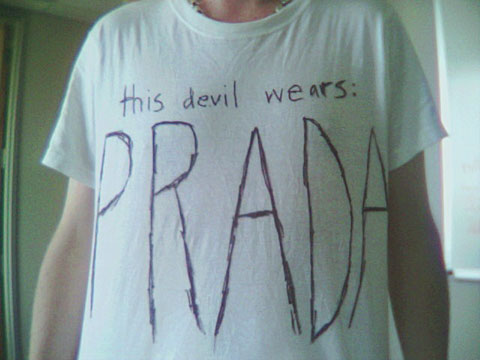
At the Uptown Bar, I whispered "You will need these to accessorize your mob" while shoving bubblegum into people's hands.
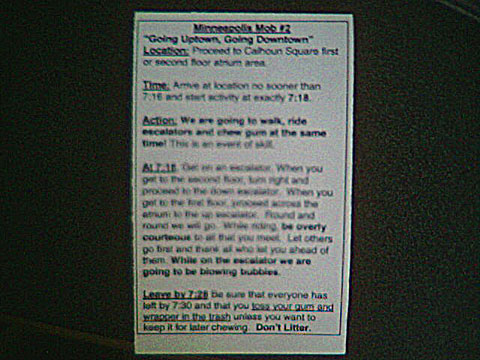
Despite hundreds of people congregating, Flash mobs are fairly anti-social. In some ways, they are anti-Meet-Ups -- you anonymously encounter strangers for 10 minutes and then disperse. But this event was different because the mob converged and the escelator broke. This slowed down the event, and the outcome was spontaneaous scenes of conversation with strangers.

Much less media and police attention than before. KSTP and KARE showed up after realizing WCCO scooped them last time, but I saw no one else. KSTP interviewed me, and I'm very happy they didn't air any of it because I couldn't answer their questions about the history of the mob. (I should've gone into performance art theory. That would've freaked them out.)
Actually, I think the most confused group were the people at the MCAD art gallery, which was holding an opening. I like the idea of confusing art students.

The turnout was both younger and older this time -- even more demographically diverse than Mob #1. I would estimate about 170 people.
Lately I've been thinking about the spectacle aspect of flash mobs. In an age where spectacle is owned by beer companies and shoe manufacturers, flash mobs are like anti-spectacle spectacles. The devils wearing anti-Prada.
WORDS
A must-own: Kerouac bobblehead.
SOCIETY
Nerve: Sex in the age of the cellcam phone.
The Smoking Gun: Legal Document of the Year. Fucker, fucker and fucking fag.
Flocksmart steps smart/flash mobs up a notch.
The Onion: Area Man Knows All The Shortcut Keys.
POP
Good god, I could spend a week here: The A List. It's just a list of celebrity personality rumors, but it's magnificent.
GreenCine has a post with dish on Tarantino's Kill Bill and two Buffy-alum Fox shows coming this fall.
MUSIC
Half-hour BBC interview (audio link) with Morrisey that is very, very, very good. He's so articulate. Recommended.
TV
Sex and the City update: First Duchovny now Baryshnikov. (Secret message: Mr. Big, sorry for petty self-involvement.)
MEDIA
The New York tabloids are all over this. The Times' Bob Hope obit was written by someone who has been dead since 2000.
The Antic Muse: What magazine ads say about you.
LOCAL
Minneapolis is in Friendster.
One year ago today, McSweeney's released The Graffiti of Minneapolis.
MEDIA
Howard Rheingold was on a good On The Media piece this weekend talking about smart mobs. Dan Gillmor was also on talking about "we journalism."
NPR's new show with Slate.com debuted yesterday: Day to Day.
Bride magazine has a same-sex article this month. Gasp!
MUSIC
One of my favorite sites for the past year has been the music community blog I Love Music. But I have been afraid to link to it because it's always heartbreaking to watch a good community go to hell when the freaks move in. Anyway, this thread killed me: Did you really feel "welcomed" to the jungle by axl rose, or do you think that was sort of just insincere, halfhearted graciousness?
TV
Futurama: dead.
STYLE
50 Cent is starting his own fashion line. I knew the bullet hole look would come back in.
Somewhat annoying Times piece about how Williamsburg has lost its cool.
LOCAL
I didn't make it to the new club opening this weekend on Block E. I still haven't been to Cosmos either, so maybe next weekend is a Block E weekend, dreadful as that sounds.
The new flash mob is set for Wednesday. If you want an invite, email me.
Go see Wattstax at St. Anthony Main. Pete's review and blog.
MEDIA
The Onion: The New New York Times.
ART
Finally, the news I've been waiting for. The Cremaster Cycle will be available on DVD August 26. (A trailer.)
WORDS
NYRB: Comics For Grown-Ups (starring Joe Sacco and Daniel Clowes).
ARCHITECTURE
Times piece on one of my favorite topics: Stadium Architecture. I didn't even know that Peter Eisenman was designing a new Arizona Cardinals stadium (Gizmodo thinks it looks like a cell phone). There's an audio slideshow too. (I have long wanted to do a multimedia piece on the history of the American sports stadium.)
TV
Roseanne Barr is returning to tv with a new reality show, The Real Roseanne Show.
MUSIC
Kinda weird Chicago Tribune piece: Indie Record Stores Surviving. Contains heavy mentions of Amoeba in San Francisco, which has been packed every time I've been there (three times in two years).
FILM
The trailer to the new Bruce Campbell movie, Bubba H-Tep, looks sufficiently funny. The new Crichton historical sci-fi, Timeline, might also be okay.
POLITICS
Crazy, Michael Huffington might run as the GOP candidate for California governer. His ex, Arianna, might run for the Democratic slot.
Voice: My crush on Condoleezza.
POP
VH1's stupid 200 Greatest Pop Culture Icons list.
GAMING
Decent Game Studies: Lara Croft: Feminist Icon or Cyberbimbo? See also: Interactive Nude Lara Croft Gallery.
INTERNET/TECH
Blog Change Bot IMs you when your favorite blog is updated.
From MIT Labs: "The Corporate Fallout Detector reads barcodes off of consumer products, and makes a noise similar to a gieger counter of varying intensity based on the social or environmental record of the company that produces the product"
New O'Reilly book: iPod: The Missing Manual.
Amazon.com adds RSS feeds.
LOCAL
Res has a review of the Michael Yonkers album on Sub Pop.
It's always interesting to see your city portrayed by the media. The newest Word (a British music/arts mag) has a profile Grandaddy that is set here (they opened for Pete Yorn at the State a few months ago). Here's the description of our fair city:
Minneapolis is an unusual place. Downtown is a network of shops and office blocks all joined by covered walkways on the first floor of each building. People with jobs walk from office to bank to shop without ever going out onto the planet's surface; meanwhile the streets are fool of poor people, lunatics and drunks. As if in compensations, Bose speakers mounted on lamp posts pipe Motown in the cold air. Bizarrest of all, there is the status of Mary Tyler Moore, whose 1960s sitcom was set here and whose most famous image -- Moore throwing her hat into the air -- is commemorated in bronze. As drunks sway to "Dancing in the Dark," Mary's statue waves stiffly at the sky, looking like a woman with jaw cancer catching a cowpat.
The Strib's Fringe Festival round-up.
WORDS
I saw Candace Bushnell read last week and haven't had time to write it up how annoying she was. But I have never, ever been to an event with so many hot, young, sex-driven single women in my life. Anyway, Gawker says Bushnell now claims she coined the word "metrosexual."
Nerve.com: Sexual innuendos found in the new Harry Potter.
MUSIC
Since I've linked to all the other ones, Rolling Stone's Liz Phair interview.
STYLE
Killer funny. Get a t-shirt with a random person's friendster profile. Or, if you prefer, some Sinn Fein tees.
Slate.com: Wine for Tightwads.
MEDIA
Batten Awards for interactive journalism.
Google adds an advanced news search.
INTERNET
LOCAL
NY Times's Circuits talks about a font developed locally which changes based upon the weather.
One of my first bosses, Mike Maidenberg is leaving the Grand Forks Herald.
Although I took pictures on the phone/pda (my excuse for their poor quality), the real excitement of Tuesday's Flash Mob was hearing not seeing.

Pre-mob, while hastily searching for a wide-brimmed hat, I was holding micro-debates with myself on the meaning of this type of activity. Historically speaking, I wanted to relate it to Situationist philosophies of performance, but it seemed to absolutely defy any kind of political reading. Then it hit me: the Mall of America -- perhaps humankind's greatest attempt to construct a politically void environment -- was the ideal setting for an event that we might call post-political. After all, the first time I was in the Mall (10+ years ago), it was the sound that I first noticed. If you stand at the top floor and listen over the railing, you'll hear this monotonous hummmmmmm... neither raising nor lowering in pitch. You eventually start to realize it's the sound of consumption, the engines of purchase power.

That sound was punctuated by the voices of confused shoppers on Tuesday. Here are some voices I overheard: "What are they doing?" "A what mob?" "Is someone famous in there?" "Why are they all watching Lord of the Rings in the Bose store?" "Are they actors?" "Are they dancers?" "Should we join them?"
So to all those people who have asked me about the "political" dimensions or the "meaning" of the event, I'll say this: I'm fairly certain there are no overtly ideological aspects to flash mobs -- they probably actually illustrate the erosion of the word "political" itself. But I do know it made a large number of people confused. Confusion is good.

Walking into Player's around 6:00 to hand out scripts, there was already a line of people looking for a wide-brimmed hat. I was proud of my hat -- heck, since I'm talking the talk, I'll be so bold as to call it "post-gangster." But MPR chose to taunt my head gear ("somewhat terry cloth-ish looking") in their piece (audio link). Unfortunately, MPR's report was probably the most clueless analysis of the event that the local press produced. They use the words "trendy" and "hip" and "cool" like they were just coming into style. Unless internet geeks, Target project managers, and lawyers are now the trend-setters (a theory which, come to think of it, isn't ridiculous -- but nonetheless not mainstream enough for an NPR affiliate to report), that's a poor reading of the crowd.
So what were the participants like? Some traits that surprised me: a lot of people in their late-'20s early-'30s, fewer drama nerds then you might expect, at least three guys in ties (two of them lawyers), and almost complete gender equality.

Although the robot scenario got most of the media attention, I think more passers-by noticed the Bose scene. But that might have been the more focused police presence.
Oh yeah, the cops. They weren't very happy with the event, but they stayed sufficiently distanced. Afterwards, they threatened legal action if -- get this! -- pictures of them showed up on the internet. The words "federal offense" were used. If anyone knows any kind of precedent for what sounds like preposterous babble, let me know.
So was it fun? I'd say yes. We were trying to guess beforehand how many people would show up. I was thinking about 100, but it was only about two-thirds of that. But any more would have been dangerous.
Stay tuned for round two.
Press Roundup:
Historical Links:
TECH/INTERNET
Slate on Friendster. And Wired News on Friendster. And The Stranger on Friendster. There are now a million Friendster members. See also: The Gothamist's lesson on writing Friendster messages.
Anil on Amazon.com's expanded web service model.
With Google Alert, you sign up to get a daily email of a particular search term from Google. The first time, it sends you 50 results, but every time thereafter it only sends items you haven't already seen.
MUSIC
A good Times interactive audio essay on Fela Kuti.
McSweeney's: Radiohead Song Titles Vetoed By Thom Yorke.
That prank Metallica story about copyrighting the chords E and F was picked up by many mainstream news sources like CNN and MSNBC.
TV
Matt of Metafilter launch a PVR blog.
WORDS
The NY Daily News thinks we have a new lit genre: fat chick lit.
STYLE
W.W.J.J.D. t-shirt at Bust: What Would Joan Jett Do?
Somewhat odd Sunday Times article on turning 30.
Adbuster's Black Spot campaign.
I'll be occasionally absent from here for the next couple weeks. Working on a big project at work...
On a scale of one to ten, I give today's links a 9.5. Get at it:
FILM
I heard this as a rumor first, but I guess it's really true. Tarantino's Kill Bill came into Miramax so long that they're cutting it into two movies. Double the Uma.
The L.A. Times disses UC Santa Barbara's film school for being contemporary.
U.S. News interviews Harry Knowles. Boring. (Why do I link to articles that I call "boring"? Cuz boring is the new black!)
Kiarostami is doing theater. Sounds radical and experimental.
INTERNET
Brooke has launched the final episode to Broken Saints. Great work, man, you're a superhero.
How many people emailed you Google's relations to the WMD 404 Page this week? I'm around a dozen. I linked to it three months ago, but none of my friends apparently noticed. Anyway, The Guardian has a story about the story of the page.
MEDIA
Michael Wolff reviews Steve Brill's new book.
I'm not sure why I bother with Slashdot threads anymore. This one about NYtimes vs. Google made me go insane. When did geeks become morons? Was it always like this? (Don't read it. Stupid is not the new black.)
Interview with Eric Umansky, the guy who does Today's Paper's for Slate.com.
MUSIC
The Sex Pistols want to play Baghdad. A few dozen punchlines come to mind here, but I'm resisting.
Judas Priest reuniting with Rob Halford. (On the right of that page are video links to "Breaking The Law" and "You've Got Another Thing Comin'." Rock out in your cubicle right now.)
Funny A.V. Club interview with Sir Mix-A-Lot. Includes crazy details, including the long-forgotten Metal Church song, the doubly-long-forgotten The Presidents Of The United States Of America song, and questions like "You were one of the first popular entertainers to talk about asses in a sexual way, whereas that happens all the time now. Do you feel validated by the current focus on asses?"
Alex Ross writes a lot about Pop Conference 2003 in The New Yorker, but I don't think he says anything. Or is that rock criticism?
I'm happy that The Washington Post profiled Punk Planet.
Greil on Liz Phair in CP: "it's like watching Barbies fucking."
I'm not sure why I'm linking to it, but here's the entire script to A Hard Day's Night.
WORDS
If for some reason you care, Traci Lords has a book coming out. Here's an interview and a book tour.
Erik Davis fake interviews Phillip K. Dick.
Eggers is the Samuel Richardson of today. (Applause if that reference makes any sense to you, and a million kudos if you actually read Clarissa.) He keeps "expanding" his last novel, now with additional downloadable chapters.
Today in Literature in 1951, The Catcher in the Rye was published.
STYLE
Phew, I own nothing on Hipster Bingo.
TV
I'm a little pissed that the Carson Daly roast was almost a little funny. But mostly because of my growing crush on Sarah Silverman.
LOCAL
You already knew this (cuz everyone is talking about it at the water cooler), but Minneapolis is America's most literate city.
All posts today have -- in one way or another -- a local angle, but that doesn't mean you foreigners will be out of place.
Covert weekend gossip item #1: BMW Films (which was masterminded by the mostly-Minneapolis-based Fallon) is considering branching the franchise into other arenas such as comic books.
Covert weekend gossip item #2: Elimidate is filming six episodes here this summer. Settings include Chino, Solera, Ground Zero...
It's a great week for authors in this city. On Tuesday, we have Eric Schlosser (Fast Food Nation) reading and Douglas Coupland (Generation X) reading, and Friday we have Zadie Smith (White Teeth) reading and Candace Bushnell (Sex in the City) reading.
I have this new theory about the thrill of blogging: the strangest aspect is when the blog crosses over into your personal life in concrete, physical ways. Like as I was leaving Chino Latino on Thursday, I waved at Peter Scholtes hustling into the Uptown Theater with a girl on his arm. And in a blurb on his site about Winged Migration, he makes passing reference to "making out through most of the movie." And now I've connected the dots, and know something you don't -- the identity of the girl. Silly internet.
Riemenschneider's best local CDs of the year (so far).
Old friend Catherine has started a music series at Theatre de la Jeune Lune.
Old friend Chuck was a guest on this week's This American Life. His new book is out next month, and you'll see a sneak preview of it here soon.
If you're interested in the Minneapolis Flash Mob (Wired story), drop me a note and I'll dish.
The Pittsburgh Post-Gazette looks at the Minneapolis theater scene, quoting a line that I always hear but could never verify: "More theaters per capita than anywhere outside New York."
My workplace gets mentioned in this Pioneer Press story about St. Paul Venture Capital: "Another Twin Cities firm backed by St. Paul Venture, Internet Broadcasting Systems, is flourishing. The company, now profitable, has 231 employees including 133 at its home office in Eagan."
The Blur show at First Ave last night was excellent. At first I was a little worried about Damon's, er, sobriety, but he pulled through just fine.
TV
Does anyone out there have Trio TV? Is it any good?
Good profile of Alyson Hannigan. Did you know she was marrying the guy who played Wesley in Buffy/Angel?
MUSIC
New Prince album, available only via download on MSN.
AOL to sell CDs and DVDs.
Some dumb study says that your music collection says alot about you. Yeah, like I buy too much music.
Jon Pareles at the Times follows up the WSJ report about Dylan's "plagiarism."
MEDIA
Reality tv and online dating services are forging partnerships.
I sat down and read an entire issue of Radar this weekend, surprised at how much I enjoyed it -- sort of a cross between Brill's Content and Entertainment Weekly and New York Daily News. I recommend Michael Savage's homoerotic past, the "Die, Hipster, Die" tirade, and Emily Nussbaum's analysis of IM and human interaction.
CJR's Rethinking Objectivity. Made waves, but pretty dull.
Crazy pics of Britney Spears in W magazine.
Raines on Charlie Rose: I was forced out.
Washington Post is launching one of those free weeklies too.
IDEAS
Not something we needed: The New Criterion Weblog. What would Eliot think?
Times on James Bond and Nietzsche: Thus Spake 007.
NY Daily News story on people who willfully don't use cell phones. Cretins.
Daniel Dennett really thinks he's bright.
FILM
CP last week had a good review of By Brakhage DVD.
The Guardian looks at the legacy of Bruce Lee in Hong Kong.
The Stranger: How To Watch The Cremaster Cycle. Plus another Matthew Barney interview.
ARCHITECTURE
Frank Lloyd Wright gas station breaks ground. No gas.
DRINK
Top 10 Summer Cocktails. No surprises.
FASHION
Whoa, Nike bought Converse. Swoosh Chuck Taylors?
$200 Murakami Dr. Scholl's / Louis Vuitton sandals on eBay.
MUSIC
This is kinda weird. The Wall Street Journal is basically accusing Dylan of plagarism. Here is a side-by-side comparison of Dylan's "Floater" and Junichi Saga "Confessions of a Yakuza."
A couple of links snagged from LargeHeartedBoy: Maxim's 30 Worst Albums of all Time | Miss Minx' 100 Women in Rock.
FILM
Two movies that would make my "Top 10 Of All Time" had DVDs recently released: Resnais' Hiroshima Mon Amour and Wenders' Wings of Desire.
WORDS
Salam Pax got a book deal.
INTERNET
Is there such a thing as a "map geek"? If so, I am one. So I'm glad to see The Map Room, a weblog about maps.
COMMUNITY
Emmanuelle has a little review of Half.com (the website and the town, formerly know as Halfway, a weird dot-com bubble story I had almost forgotten).
Has anyone ever mapped the psychographics of the synchronous ascendency of weblogs and reality tv? I'm serious, these phenomena are totally connected.
MEDIA
Video of what got Michael Savage fired from MSNBC.
FASHION
I like these t-shirts at Lamosca.com, especially the ones that make vague references to The Velvet Underground and The Ramones.
FILM
Dish on new Cassavetes movie.
It seems the "Film" category gets the most "holy shit, I didn't know that was happening" links. Like, there is a new film based on Joyce's Ulysses recently completed? Holy shit, I didn't know that was happening. There's even a trailer.
ART
Wired News on the Illegal Art exhibit at SF MoMA.
No surprise, the Voice didn't like the the Venice Biennale.
INTERNET
Dear Abby takes a letter from a blogger.
If this linkblog had a sideblog (does that make any sense? could this be a new form?), it would point to Clay Shirky's A Group Is Its Own Worst Enemy, which is only for people interested in the theory of online communities, but is highly recommended for those people.
MUSIC
Will you hate me if I link to that "Britney not a virgin" story? Okay, good.
As always, Onion A/V breaks the mold and interviews Evan Dando. Good questions, boring answers.
LOCAL
Blogumentary has a collection of Duluth/Minneapolis links today.
I tracked down an invite to the flash mob, but now that the Strib is talking about it, who knows how this could turn out. But I also saw a discussion about it on alt.law-enforcement, which maybe puts the thrill back in it.
FILM
Trailer to the new Larry Clark film. (Heavy traffic; might time out.)
On the complete opposite end of the spectrum, Dirty Dancing: Havana Nights trailer. Is there a word signifying worse than vile?
And somewhere in between, Mona Lisa Smile trailer, with three women who dominate about 90% of my personal fantasies: Kirsten Dunst, Julia Stiles, Maggie Gyllenhaal (plus some chump named Julia Roberts as their teacher).
MEDIA
Even if you're not a fan, the Tour de France map/app from NYTimes/AFP is cool.
Finally, some good news. The Guardian is coming to America. Oh, and Michael Savage was fired.
WORDS
Someone asked me the other day about my favorite writers, and I stumbled through saying Ron Rosenbaum was my favorite columnist, but only when he does culture instead of politics. His latest dissects the origin of the word dude. In other linguist notes, Geoff Nunberg discusses slippery slope (audio).
MUSIC
Metallica, Red Hot Chili Peppers, Green Day, and others are spurning Apple's iTunes, some because it contributes to "the demise of the album format." I like how people think they can stop change.
Jewel "sold out" to a razor ad.
The Bangles are back.
INTERNET/COMMUNITY
The comments that Anil generated with his atomic elements of a blog post are really good. A lot of what's said informs my thinking about this blog, which a) has been experimenting categories and b) implicitly posits the "day" as the atomic element rather than the "post."
Times: Blogging in the workplace.
Sneak peak at AOL 9.0.
One of those "candidate selector" applications.
Cool thing to play with: microsimulation of road traffic.
If you have some time, WashingtonPost.com has a massive project interviewing photographers who were in Iraq.
Steven Berlin Johnson has a column in Discover about There.com, which is gonna be an ultra-cool community site.
This story in the Times about multitaskers makes me feel all icky inside. I don't care how many studies tell me having three monitors, two phones, and one PDA is less productive -- go ahead, believe those LIES while you eat my hyperkinetic mental tread.
LOCAL
Yikes! Wired News has a story about moblogs, with this line: "In Minneapolis, a mob is planning to gather at an as-yet-undisclosed location on July 22 at 6:25 p.m., according to the group's organizer, who asked to remain anonymous." Discussion group.
On the newstand rack this weekend, I noticed that Aesthetic Apparatus (more info) has landed features in HOW and ReadyMade. Rumor is they're starting their own magazine too. Good job, fellas.
Was that a three-day weekend? Ouch, less of those. Sorry, no links today, because the Word of the Day let me off the hook.
TECH
Okay Guardian article on picture messaging. Contains a link to Celebs At Starbucks, a photoblog outta L.A. Also: Waxy has this idea to do a community celeb-photo/mob-blog, which is fine if you like in Cali or Gawker country. But out here in fly-over territory, I can only make so many jokes about Josh Hartnett, Prince, and Garrison Keiler (now wouldn't that be a party). So I'm still pondering the local scenester site, for which I have lots of ideas but feel unable to keep it updated myself. So if you're a localite interested in the concept, drop me a note, and try to talk me into it.
Comic book artist and theoretician Scott McCloud is experimenting with micropayments with his newest comic. He has talked about micropayments before.
COMMUNITY
Buzzmachine talks about being invited to see AOL's new blogging tool. The ability to blog via IM is impressive.
Gothamist has some Friendster protocol questions.
FASHION
Cool new girl stuff at Threadless. If I met that girl at Triple Rock...
I bought some Donald J Pliner shoes today. Did I just land on the set of Sex in the City?
TV
The Times Mag has an okay story about the rise and fall of baby names, but I point it out for this line: "Still, the effect is not as direct as it may seem. Buffy, despite a fanatic cult devotion to the vampire slayer, has not breached the Top 1,000 (although Willow has been climbing modestly since 1998)."
WORDS
MediaBistro interview with the guy who writes Ask a Former Professional Literary Agent for McSweeney's.
Michael Chabon, Jane Smiley and John Edgar Wideman on NPR's Morning Edition.
NEWS
Doonsbury on the dangers of internet communities.
That Japanese hotdog eater wins another match.
MUSIC
Snoop Dogg has decided he doesn't like "Girls Gone Wild" anymore. Because it's sleazy? No, because there aren't enough black women.
ART
Art Forum's Venice Biennale weblog.
LOCAL
I saw my first Segway in Minneapolis today. It was a middle-aged woman cruising around downtown in a long skirt. This seemed noteworthy.
I've started a Fotolog. It will only include illicit photos snapped in Minneapolis clubs and emailed on the new i700 pda/phone. Scenesters, hangers-on, and shysters: beware.
No time to blog today. Someone just told me the International Foosball Championships are being held at the downtown Hilton Hyatt. Must practice.
Okay, maybe just a little:
MUSIC
If you missed it, Liz Phair's Letter to the Editor to the Times in response to her getting torched is really... something. I don't think anyone has tracked back Liz's reference yet, but I think she probably Googled Meghan O'Rourke like I did and found this article in Slate. Make sense? I didn't think so.
So yeah, the new Spin.com... it looks almost bloggish, doesn't it? A calendar, comments, light graphics. It's even written in PHP. How... indie?
What rock critics have been waiting for: Christgau's Radiohead review in The Voice.
WORDS
Bookforum has relaunched with a Calvino cover. The Voice has details.
Harry Potter: gay.
Slate: What's Wrong With L.A. Lit?
Quiz: Famous First Words. Give me a gold star, I got every one right.
On this day in 1961, Hemingway committed suicide.
Book Magazine: Chick lit sucks. (I'm summarizing.)
FILM
Boston Globe: Girls Just Wanna Have Guns.
Marvel's Master of Kung Fu being made into movie by Woo-ping Yuen.
The hell? Eros is new "erotic ensemble drama" directed by three of my faves -- Steven Soderbergh, Wong Kar-wai, and Michelangelo Antonioni -- starring Robert Downey Jr. Out next year, apparently.
MEDIA
MediaLife Mag picks some really bad stuff for their list of Best of the Best. We'll let you by with Marketplace just cuz no one else would think of it, but c'mon, fucking Blender?
TV
VH1 has another goddamn list: 50 Greatest Teen Idols. See also: Chuck's 4,000-word tirade on watching VH1 for 24 hours.
TECH
USA Today goes to lunch with Bill Gates.
Amazon.com employee weblog. Dumb, so far.
Chicago Tribune architecture critic reviews the Apple store. Maybe these Apple stores can be the new Prada? Or not.
LOCAL
Chuck Olsen was interviewed by the Strib in an article on blogging.
If you missed it, the entire list of bars that will be open until 2:00 starting this weekend. Woo-hoo, we're not prudish Lutherans after all!
I blame you if I lose this foosball tourney.
Oh c'mon, there's no way you looked at all of yesterday's links, so take another gander. Oh, and Spin.com launched last night sans Yahoo.
Golly, there are a lot of links today. Kick it:
MEDIA
MagazinePriceSearch.com. Never ever subscribe to a magazine again without looking here first. The New Yorker for $19.46. Time for $4.67. Spin for $3.36.
Good Poynter.org convergence map.
FoxNews tried to shut down AgitProperties.com for their "Faux News" merchandise. I wonder if my Faux News t-shirt (ordered through Disinfo.com) is a collectors item?
Cyberjournalist's mammoth list of blogs published by journalists.
MUSIC
Zowie, Pitchfork is going mainstream. Or something like that.
SFGate: Hip-Hop Intellectuals: A Radical Generation Comes Of Age.
The video for Foo Fighter's "Low," starring Dave Grohl and Jack Black, is a little extreme. I think it was banned from MTV.
FILM
Someone translated that Baudrillard interview about The Matrix into English. GreenCine ponders it.
FASHION
Gothic Lolita is in this week.
WORDS
Someone has spend a long time cracking the code of the intro page of Neal Stephenson's Baroque Cycle. The conclusion is amusing.
Pre-order David Foster Wallace's newest: Everything and More: A Compact History of Infinity, which tells the story of Georg Cantor.
Guardian essay on irony: The Final Irony. Recommended.
That funny Onion: Ask Raymond Carver.
Recommended summer reading from dozens of authors.
INTERNET
Game: Dr. Strange Blix.
CityCreator.com. And an elaborate block-building application.
A syllabus to a class I'd like to take: CTCS 505: New Media and the Consumption Cycle.
Tom Friedman in the Times asks Is Google God?
Lame Times story on internet dating.
A zillion Amazon RSS Feeds.
ART
Zoom and explore the art of the Renaissance.
ARCHITECTURE
Frank Lloyd Wright's vision of Baghdad.
FILM
"I used to hate the Internet. I thought it was just a place where people stole our products. But I see how influential these fans can be when they build a consensus, which is what we seek. I now consider them filmmaking partners."
LOCAL
The Strib dissects Block E. See also, from a while back, Peter Ritter's City Pages critique.
The Rake has a decent converging history of Schell's and Grain Belt beer.
According to Alexa, 40% of CityPages.com's traffic is now through Babelogue.
Did you hear that Rock Star closed? It has even been nuked from the City Pages database. Great food, horrible location.
A fun Friendster excercise. Pick an author/musician/filmmaker and search Friendster for it. Of the 70,000 people registered, 38 list Plato and 1789 list Bjork. I could do this for days.
A mysterious list of items purchased in the last month on Amazon.com by you, the readers of Fimoc, after clicking through from this site (giving me a 5% referral payback):
One year ago today, I had an okay link-filled post about post-feminism, but most of the links are broken now.
I just had that unnerving six-degrees moment on Friendster where you realize that a bunch of people you know actually know each other. But absolutely shouldn't. This is all wrong. I blame it all on Har-Mar, who has listed 123 friends. Freak.
FILM
If my French didn't suck so bad nowadays, I might just try to translate this Baudrillard interview about The Matrix, his first public mention of the film that probably wouldn't exist without him. You can try the Babelfish translation. (Thanks greencine.)
TV
Proof that I should read Dissent more often, there's a new column looking at the anti-war subtext of the final episodes of Buffy. (Thanks Mark.)
Wanna be on reality tv? A nice collection of links to all the application websites.
WORDS
Interesting online writing exercise: One Word. You see one word and you have one minute to write about it.
Today in literature, the Pied Piper lured children away from Hamelin. With mention of Jethro Tull.
DeLillo interviewed twice on KCRW's Bookworm. Good stuff.
Slate.com: The Politics of Harry Potter. (Another one of those Slate.com dialogues.)
Gibson writes about Orwell on his 100th birthday in a Times op-ed piece. A quote: "Indeed, today, reliance on broadcasting is the very definition of a technologically backward society."
MUSIC
Tom Waits interview in Onion A.V.
Pitchfork gives Liz Phair a 0.0 outta 10. Yes, that's even worse than the 0.8 they gave the new Metallica.
Ya know, I just bought that Zeppelin DVD. This is really unlike me. From a taste perspective. I hope I don't like it. Here's a review.
Another Greil Marcus Real Life Rock Top Ten in City Pages.
INTERNET
Gawd I love the internet. DuckHuntingGirls.com. Yes, pictures and videos of... Girls. Hunting. Ducks. No, it's not dirty. It's totally... ducky.
Sure to make you cringe, Time names the 50 Best Websites.
Decent interview with the CEO of IDEO.
Slate.com found an accidentally-released live prototype of Bush's 2004 campaign website.
FASHION
Nike released a new division of skateboard shoes. And they did a whack website to promote them. Macromedia is showcasing it as a cool use of Flash.
Times Style article on those Tommy Bahama shirts. I actually bought one a couple weeks ago. Shut up, I'm not an aging hipster.
LIFE
Milken Institute's new list of 200 Best Performing Cities. Minneapolis: #99.
I just got the new cellphone/pda today -- the Samsung i700. I'll be absent briefly, while I conquer this monster.
I don't get many gifts through this site, so I like to give shout-outs when it happens. When Patricia noticed that I wanted a subscription to Brutus, she said she'd try to send me some from Japan. Today I got a wonderful stack of Japanese magz including Mono, Studio Voice, and a bunch o' Brutus. I'm the happiest white boy in the midwest right now.
ARCHITECTURE
Times article on the new Prada Tokyo, designed by Herzog + Meuron, the same dudes doing the new Walker going up in my neighborhood. (Sidenote: I love how architects use the + sign instead of the & sign. I am going to co-opt this as often as possible.)
MUSIC
Disinfo writes a bit about the Radiohead/1984 connections. In other news, Terry Eagleton has a George Orwell profile in LRB. (Sidenote: Eagleton must be releasing a book of intellectual profiles soon, right?)
Pic of Liz Phair doing her Britney pose, with hilarious caption. (Sidenote: it's interesting how most critics slammed the new Liz Phair album except Entertainment Weekly and Chuck in Spin. I almost think there could be a re-reading of the album as nouveau-pastiche irony by the end of the year. Or not.)
File under beyond post-modern: Two Japanese girls covering t.A.T.u. songs.
FILM
As a follow-up to yesterday's Times PBR link, Reason magazine's Hit & Run weblog (which I recommend) asks how the essay could overlook the obvious Blue Velvet cool factor.
I saw an early-draft screening of Chuck Olsen's Blogumentary on Sunday. I was a little disapointed that more locals didn't show up at the screening, but I also think he's got a cult success waiting to happen.
INTERNET
Wired News runs an interview with the guy behind HomestarRunner. Entertainment Weekly also just came out with their IT-List issue (subscription link), and he was named IT Web Cartoonist.
Very cool make-your-own-graph maker: NationMaster.com.
The Ethicist (yes, that guy from the Times Mag) was on All Things Considered talking about the ethics of stumbling across a friend's "private" blog. I wish ethics was always this no-brainer.
I'm feelin' categorical, so I'm sticking with the link categories for a while. Shakin up the faculties. Down with Kant, ya dig.
INTERNET/POLITICS
There goes the neighborhood. Ann Coulter: blogger. CoulterGeist, indeed.
Back-to-back stories about Orin Hatch's website that have nothing to do with each other. Wired News (who else?) calls him a software pirate, and Salon.com (who else?) calls him a pornographer. I guess someone should fry his PC.
WORDS
WhichBooks.net provides a unique way to choose a book. Play with the little sliders on the left.
ARCHITECTURE
Photo essay by Hugh Pearman on Zaha Hadid's Contemporary Arts Center in Cincinnati.
MARKETING
Sunday Times Mag has a long but very good story on the marketing (i.e., non-marketing) of Pabst Blue Ribbon beer. Recomended.
A condom ad (video).
MUSIC
Smack in the middle of this hilarious Onion article about college DJs is a June Panic reference.
A must. SixDifferentWays has an MP3 of t.A.T.u.'s cover of The Smith's "How Soon Is Now?" I am human and I need to be loved.
NPR's Motley Fool had a good interview with the founder of KaraokeNation.com, who apparently has a book out now too: Karaoke Nation: Or, How I Spent a Year in Search of Glamour, Fulfillment, and a Million Dollars.
Apple's iTunes coming to the indies.
FILM
Let's call it the new Ghost World that was the new Crumb: preview to American Splendor.
Somewhat random L.A. Times Parker Posey profile.
LIFE
Dream job? It's not often you see "an interest in Wheel of Fortune, Q*Bert or Charlie's Angels" in a job description. Pay: $10.00/hour.
Harry, Sabrina, and Buffy Help Paganism Grow.
One year ago today, I must have been smoking crack.
LOCAL
The excellent local juice company, Fresco Juice, has started distributing at Kowalski's. Check it out.
Beck writes about his appearance in Minneapolis, and the chance that maybe Prince would show up.
In the soon-to-be-defunk Lost Cause, people talking about the Lifter Puller show.
MEDIA:
Al Gore is looking to get into the liberal media.
Two meta-media columns on bad writing: WashPost columnist writes about the scourge of The List. Meanwhile, MediaBistro attacks the scourge of The [fill in the blank] Nation.
Adbusters: Early Signs of Fascism.
MUSIC:
Salon.com has familiar-sounding speculation that iTunes could kill album-oriented music. Although I didn't write it, it feels like a condensed version of the last 15 music conversations I've had.
WORDS:
WashPost asks if Harry Potter fan fic is stealing. Answer: no.
Al Franken has a new book out: Lies and the Lying Liars Who Tell Them. He's interviewed on AlterNet.
On this day in 1816, Percy Shelley, Lord Byron, and Mary Shelley gathered on Lake Geneva to tell ghost stories that would trigger Frankenstein. (I just love TodayInLiterature.com.)
TV:
If you missed it, video of Hillary on Letterman.
FILM:
Premiere and Playboy both have lists of the best sex scenes. Not one repeat in the top 10. See also: The Guardian's Sex on the Screen Quiz.
LOCAL:
Todd has posted a Fargo Forum story saying that Kirby's Bar is shutting down and that Ralph's might be next. (The City of Moorhead is on a buying spree.) This is even worse than the news the First Ave. might be on the way out.
WORDS:
Joy Press connects Hillary Clinton to Courtney Love in The Voice. (Same issue: Why Hillary Enrages Feminists.)
Slate.com has a risqué slideshow documenting how the lap-dance ruined the strip-tease, based upon the book Lapdancer. (I hope Slate isn't becoming Salon.)
City Pages' Summer Reading Supplement is out.
The Guardian profiles the philosopher Bernard-Henri Lévy, who is new to me but sounds provocative.
TV:
Amusing: a collection of MP3s of every song ever played on The Gilmore Girls. Actually, not a bad set.
Both Terry Gross and The Onion A.V. Club have interviewed Colin Quinn this week for his new show, Tough Crowd on Comedy Central. He's good; too bad the show sucks. Get some decent guests, Colin.
FILM:
Hitchhiker's Guide to the Galaxy being made into a movie.
Trailer to yet another edgy, punky English Australian film: Garage Days.
MUSIC:
Bjork has a new haircut.
All the members of Duran Duran are reuniting for a tour.
The Rapture signed to a major label.
LOCAL:
This week, Dara approaches local cuisine from the angle of the businessman versus the chef. If I'm not mistaken, it's a small meta-critique to the Strib recently focussing on the culinary big picture (I'm thinking of that "two-star city" criticism from a few weeks ago).
LIVING:
Tokyo surpasses Hong Kong as most expensive city to live. Top 10:
SEX/INTERNET:
Reuters: Prostitute Diary Tops Iran Web Hit. Besides being a horrible headline, it's interesting that the tone of the article is to chastise the Iranian government, but it doesn't provide a URL for the blog.
McGraw-Hill Human Sexuality Image Bank.
BBC: Will Porn Kick-Start The Video Phone Revolution? Answer: no.
Odd. A site that reviews (NSFW) porn banner ads.
POLITICS:
New blog: WatchBlog, 2004 U.S. Election News & Opinion, broken into three nice categories. It's the creation of Cam from Camworld.
TV:
L.A. Times story about TV scholarship at MIT.
The only Hillary interview I've watched the past two weeks was the one on Letterman last night. Booooooooring.
MUSIC:
Good June Panic interview in the new Agricouture.
Metafilter told me the video for Electric 5's "Gay Bar" is big in Europe.
In Pitchfork: The 20 Worst Post-Breakup Debacles.
WORDS:
McSweeney's says that the first-name-only business isn't true.
Except for two 4-hour Buffy-watching intermissions on the couch, I have been sleeping for the last 48 hours. I'm still a little woozy after Friday's party. Chuck was wise enough to snap some photos -- six pics in the middle of this page. Yeah, that's me, and I only vaguely remember that part of the evening. Thanks to everyone who came, especially that chick from San Francisco. Sorry the booze ran out before sunrise.
NEWS:
Photo of Bush falling off a Segway.
Weird Sunday Times story about gutter punks. Or, as the sociologists say, urban nomads.
INTERNET:
New blog: Amazon World highlights interesting user reviews found on Amazon.com.
Another new one: Tabloid Column, a collection of tabloid and celeb news.
Register: www.la
The elusive Plain Layne is back.
MOVIES:
Jack White just lost every stitch of cred he had.
Kottke made a silent film about the Chirac/Bush summit: Ceci n'est pas une guerre (c'est l'amour). Maybe he should have done it in the style of Woody Allen.
MEDIA:
Metropolis mag story on Nike that starts off quoting No Logo in the first graph.
Interview with Radar's editor-in-chief.
Adweek: 10 Lowest Moments in Advertising in the Last 10 Years.
WORDS:
Apparently Eggers wants to become Madonna. He's dropping his last name from his next novel. Maybe next he'll change his name to a symbol.
Someone's dissertation on the cultural history of the word cunt.
The Believer's Idea Share.
LOCAL:
Argh! StarTribune.com just made me register before reading.
Times story penned by Dylan Hicks on the Minneapolis Children's Theater Company winning a Tony.
Fargo Forum has a decent collections of stories on the Garrison Dam: The Unfinished Dream.
Music Links:
Top 10 Pictures of Thom Yorke Looking Pretentious.
Slate.com covers the U.S. Air Guitar Championships.
Radiohead.tv has launched. Awesome.
Video Game Links:
The Mob has taken over The Sims.
Media Links:
Wired was the comeback kid last year, scoring a number of good issues when it seemed like it was a magazine carcass. Newer issues are slipping a bit, with such things as The Wired 40, from the newest issue. Meanwhile, if you're wondering "hey, what current magazine will everyone look back on nostalgically?", the answer is Res. The new issue is excellent. (See also: Chicago Tribune's crappy list of the 50 Best Magazines. Neither Wired nor Res are even listed, Metropolis comes in at #45; Spin is listed under "Mags gone bad"; and just to prove their twisted middlebrow snobbiness, FHM made the list but not Maxim.)
The Times pans Hillary's book. Also, The New York Observer asked novelists to critique the book.
It's been a while since someone did a story on Romenesko.
Just Cool:
Somewhat Local News:
Oh wow. The story about the 28-year-old Japanese woman wandering around Fargo supposedly looking for the money from Fargo (the movie) never really spread outside of the upper-Midwest. But now London's Guardian picked it up and made a big deal about it. The author was even going to make a movie about her.
NY Times piece on MusicMavericks.org, produced by MPR. Also, Katherine Lanpher interviewed (audio) a Village Voice critic about the show on MPR's Midmorning today.
Local restaurant advertising controversy hits the daily. "Happy Hour: Cheaper Than A Bangkok Brothel."
OJR article about the business and content prospects of local weblogs.
Camille Paglia interviews Matt Drudge in Radar. Among many bon mots: "In the end I really don't care what I'm called, as long as it's not blogger."
Season Four of Buffy and Radiohead's Hail to the Thief are out today. (Also, new Radiohead.com.)
New David Sedaris in The New Yorker.
Random thought: The guy in Memento should have had a blog.
V the miniseries was awesome. V the series sucked. Unknown: how V returns will be.
I've been doing a lot of thinking about Apple iTunes killing album-oriented music. But BBC News has a story with leaked statistics that show half of the songs sold on iTunes are full albums. So maybe not.
Dumb link of the day: The Office Space sound board.
Season Four of Buffy comes out on DVD tomorrow.
Times update on the Jesse Ventura show on MSNBC.
Creepy or artful? In MeAndBillyBob.com, artist Jillian Mcdonald takes scenes from Billy Bob Thornton movies and splices in videos of herself.
Guardian: Blogging's Too Good For Them.
Onion A.V. Club interviews Steve Malkmus. He's a little more culturally introspective than usual; he hints that he might be heading downhill musically and even even suggests that you could attribute Pavement's success to good press connections at Matador.
The Webby Awards were announced this weekend. The world yawned.
Did you miss the t.A.T.u. performance on MTV last week? If so, go see it on MTV.com.
Gizmodo has a funny little post about reviewing gadgets from 1983.
Voice: Make Up Your Own New York Times Story. (Fine for print; should've been made interactive online.)
I've been lightly thinking about creating a Gawker for the Twin Cities (see rant below). But I don't think I could maintain it solo. Anyway, Gaper's Block is a new Gawker-ish blog for Chicago.
The Voice has a story about Friendster.com. (Scanning this week's issue, it occurs to me that The Voice should really buy Gawker.com. I don't know if Nick is selling, and it might be difficult for Gawker to keep its "integrity" [an odd word for what is essentially a gossip blog, but still somehow apropos] with a merger. But The Voice needs something to make it feel more... now. I don't even live in NYC, but my favorite part about Gawker is the daily round-up of local events. It feels so much more fresh than that weekly calendar stuffed in the middle of alt-weeklies and the first 20 "Goings On" pages of the cool-clueless New Yorker. Here in Minneapolis, Babelogue [a collection of writers/editors from the Voice-owned alt-weekly, City Pages] is trying to figure this out. It is a good -- sometimes great -- resource for the community, but it occasionally feels like, well, a cabal of alt-weekly writers [I say that as a former one]. Babelogue excels when it feels like a cross-sectional representation of the city in which I live; it's less than great when it feels like a strip mall of blogs [à la Salon]. It's an experiment of local voices that might just be the key to this global-local puzzle some of the most creative internet minds still haven't figured out yet. Or maybe Anil had an answer, and now we'll never know.) Whew, that was a long parenthetical. Bad Rex, no links today.
Weird, crazy small world. So Peter Maas goes to Iraq to cover the war for the NY Times Mag. While there, he hears about this Salam Pax guy. When he gets back, he realizes Salam Pax was his interpreter. Crazy. (Nick Denton adds more tidbits.)
Also in Slate, this week Sasha Frere-Jones and Gerald Marzorati are going head to head. They start off talking about Radiohead.
I asked Melissa one of my better music questions a few days ago: What song would you want played at your funeral? (My answer: "Sweet and Tender Hooligan," The Smiths.) Here's her death-defying indie rock response.
Howard Dean weblog.
This profile of a wine critic in The Atlantic Monthly is worth it.
Another decent McSweeney's parody: Unused Audio Commentary By Dinesh D'Souza and Ann Coulter, etc.
If you're feeling like some legalese reading, here's the official document from the FCC on the new media ownership rules.
Transcript: The Neo & Architect Talk.
Another new Murakami short story in The New Yorker.
The Guardian tracks down Salam Pax and gives him a column.
Slate's Paul Boutin writes about geography-based instant messaging (Trepia).
Post praise for Zaha Hadid's Cincinnati Arts Center. (I haven't seen it yet, but I might route a trip through Ohio just for the chance.)
PDF of Sean Penn's full-page NY Times ad.
Frauenfelder on Moblogging.
Fiendster.com (without an r).
New bookmark: GreenCine's Blog.
Not many people know this (not that I hide it), but in a previous life I was an editor at FATE magazine. I was reminded of this totally surreal period of my life while reading a column from a former editor of Buffy magazine.
I thought for sure it was a joke, but it's a true: Avril Lavigne's Song To Be Made Into Movie. Can you imagine being the guy who has to "translate" that three minutes of bilge into a 90-minute movie?
Blast from the past: CNN.com Is One Year Old (1996).
TIME writes about Friendster.com.
Village Voice: A Short Cultural History of Wedding Rings.
Can anyone logically explain Boing-Boing's fascination with SARS the past month?
Video: that geek/supermodel ad from GE. (See also: Geek Test.)
Blogumentary's most recent video post is great again: Jeff Jarvis (Entertainment Weekly creator and Buzzmachine proprietor) on blogs, journalism and democracy.
Slow blog day.
Wrong Turn (Eliza Dushka of Buffy) trailer.
This CP column about men recently finding themselves purchasing $90 shirts and $175 pants feels strangely familiar.
I'm 80% an e-bore.
Chronicle of Higher Ed: Office-Hour Habits of the North American Professor.
Sunday Times story on photobloggers.
Track listing for the CD wrapped in the new issue of Adbuster.
More crazy Christians: Scooby Doo: Turning Kids On to the Occult!
A fine collection of '80s commercials.
Spin magazine always puts up a smattering of its print content a month late. Right now, for instance, there's the 20 Sleaziest Rock Moments piece, which doesn't even give you #1. It instead says "For Spin's top sleazy moment, pick up a copy of the June issue, on newsstands now." Now, that's sleazy. (And not to mention a lie -- the issue is already off the newsstands.)
And to extend the magazine bashing.... Entertainment Weekly's cover story this week was the top 50 Cult Movies Of All Time. Good idea, questionable outcome:
Martin Scorsese to interview Bob Dylan for documentary.
Amazon.com and Microsoft in streaming deal.
And why/how is Amazon selling the "authorized edition" of the 'Iraq Most Wanted' Playing Cards?
The Onion: '90s Punk Decries Punks Of Today.
Diesel-U-Music just launched. There's also some new Diesel watches.
Email-writing campaign to bring former New Media Director Mark Dietz back to the Walker. (The signers are a who's who of digital art.)
Gibson on the future of media and arts (talk given to the Director's Guild).
How ironic -- nah, fuck it, how depressing -- is it for UPN to follow up the girl-power finale of Buffy with the premier of America's Next Top Model? Two steps forward, one step back.
Chuck Olsen has put up a trailer for Blogumentary.
Cornel West talks about The Matrix. (He has a cameo.) (Sniped from AmysRobot.) Also, here are the Official Matrix sunglasses ($240).
I'm as tired of the Times links as you are, but there have been so many good tech and arts stories lately -- Jayson Blair be damned (that Observer link might be his first interview post-controversy). Here's a Times story on Wikis which isn't by any means enlightening but is a good overview.
Oh yeah, Jayson Blair's student website. With poetry!
Here's that New Yorker of Slavoj Zizek profile from the last month that they didn't post on their site.
MediaBistro interview with Spin editor Sia Michel.
Have I told you about the Trachtenburg Family Slideshow Players yet? If I haven't, I should have. Anyway, Sylloge has some videoclips.
The Times has a story about Peter Greenaway's upcoming megalomaniacal multimedia movie/tv/theater/book/website/game thing. In other news, NYTimes.com launches new movie section.
Popdex, the game. The goal: pick links that you think will become popular amongst bloggers in the next 48 hours.
Around mid-afternoon yesterday, Waxy said they had already raised $2000 for Ghyslain. I told him he's truly a philanthropist.
The Guardian asks when is Harry Potter gonna get laid, anyway? There's also a new Murakami profile.
Today is the day the world ends. If you don't know what that means, you don't deserve to read 10 Questions For Joss Whedon. (Of course Whedonesque has a billion more links if you're not feelin' glum.)
Times Mag topic this week is architecture. Good stuff.
BuzzMachine has a Salam Pax interview (translated from an Austrian magazine). And the Ottawa Citizen gathers lots of details about the author by merely doing a close reading.
Two Times stories about blogging: Dating a Blogger, Reading All About It (cough, cough) | A New York State of Blog (about Gawker.com).
Story on City Pages' Babelogue.
Coming soon from O'Reilly: TiVo Hacks.
This week I'm trading in the Nokia 9290 (which never caught on like it should have) for a new Samsung I-700 (which has everything I want in a pda-phone except WiFi). It's no Matrix Phone, but this boy needs a new toy.
Steven Johnson's contribution on blogging to the Rem Koolhaus-curated Wired.
This sucks. I just found out that my neighborhood museum, The Walker Arts Center, which was a pioneer in digital arts and cross-platform arts initiatives, decided last week to dismantle most of the new media team. I hope Steve Dietz doesn't leave town, as he was a great asset to this community.
Adam Gopnick's Matrix Reloaded review in The New Yorker. (There are a million others out there. Critics.com has some.)
Have you seen the new Wired (in print)? It's pretty awesome. Rem Koolhaas plays the role of something like "Guest Editor / Impresario." You can see some of it online, but it's much more elaborate in magazine form.
Guns 'N Roses cover band (heh) will feature Slash, Duff, Matt, and.... Scott Weiland.
Of course I gotta link to it. The Official Buffy Auction. Gawd it would be so cool to trade in my Diesel boy bag for Giles' Leather Satchel (curently $1,725).
I won't give you all my opinions about the recent FCC proposals (god knows you don't come here to hear that), but I'll say this: I disagree with the pundits; I doubt you'll see that many big merger deals in the next few years. The reason: local TV stations are already owned by big companies. And trust me, you're gonna pay a pretty penny to pry one away. Check back in three years and see if I'm right.
Everyone's watching the new Radiohead video ("There, There").
No one noticed the new glasses when I wore them to work. No one even mentioned the new haircut. No one apparently liked the new pants. But that new t-shirt drew gobs of attention today.
Good idea from Nick: get Salam Pax a lit agent.
Sci-Fi author Samuel R. Delany profiled in L.A. Weekly. (I recommend Dhalgren.)
Edward Tufte's "The Cognitive Style of Powerpoint".
The Conan Claymation episode airs tomorrow.
Media slut? Moi? Apparently so, judging from the MediaBistro.com party slideshow from the Interactive Media Conference in San Diego. I'm in one-third of the pics -- and look sufficiently wasted on Bombay tonics.
For a long time, there was only one performer who wouldn't allow Weird Al to produce parody pieces of source work. Nope, not Nirvana, not Madonna, not Nelly (all of whom have allowed Weird Al to profit from parodies). The one hold-out had been: Prince. But now there's another: Eminem.
Neil Stephenson's newest, Quicksilver, comes out this summer and is available for pre-order on Amazon.
I read half of the new DeLillo, Cosmopolis, and stopped. It's not bad, but it's also not great, and that's what I've come to expect.
Fun extreme GoogleNews searching: homely | smack | fucker | cocksucker. Wheeee!
I'm home! How was it, you ask? Mostly good. San Diego is a beautiful city I didn't expect to like. I also had lunch with the new president of TiVo which was really weird. I'm still fast-forwarding.
And it's lucky for you that I'm back, or else you'd miss Britney as Barbarella in Japanese tea tv commercial.
Yet another t-shirt I need.
While researching for an upcoming review of The Matrix: Reloaded, Melissa Maerz gathers Everything You Never Wanted to Know About the Matrix, a collection of trivia, including the director's fascination with Cornell West.
National Magazine Award Winners.
Is it my imagination, or is the Times obsessed with North Dakota lately? Here's one from the Sunday Arts section on the classical music scene.
Slate.com on Aphex Twin.
I saw The Shape of Things last night. I was bored through the first half, but it picks up in the end with an surprising conclusion. Here are Ebert's review and Slate.com's review. I'm pretty sure I hated it, but I'd actually recommend it as a date movie because there's a lot to talk about.
Dan Savage on Bill Bennett (including playing cards).
Paul Boutin on the new NYC Google offices.
I didn't have time to blog the E&P Conference (and you'd think there would be more internet connection availability at an internet conference), but here are the award-winners. Among other news, Marty Yudkovitz (formerly of NBC, recently hired as President of TiVo) tried to woo the networks to limited success.
I'm at the E&P Mediaweek Interactive Media Conference in San Diego for the rest of the week. It looks like a great itinerary. Time permitting, I'll try blogging some of it.
Last night was a big night. Third-to-last Buffy at 7:00 (war metaphors galore!). Matthew Barney dialogue @ The Walker at 8:00 (brilliant and inarticulate!). And The Rapture @ First Ave at 10:00 (war metaphors, brilliant, and articulate!). Best night of the year.
In the middle of an average Times story surveying Ashleigh Banfield's career is this sentence about her days at the Dallas Fox affiliate: "She was also known in the city's gossip pages for singing in a rock band and for holding late-night parties at her loft apartment." Whah-what!? Rock band? I would pay top-dollar for those MP3s. One of our editors in Dallas (Bill, who is also the proprietor of WXnation.com) hunted down the band name: Tommy Hyatt and the Haywires. But no MP3s. I'm paying $10 to anyone who can find me an MP3.
This William Bennett news truly is a self-righteous morsel to relish. Michael Kinsley wants to give to give the investigators a Pulitzer Prize for Schadenfreude.
My pal Simon Peter's bye-bye Buffy story.
Article about Blogshares.com.
Chuck's Blogumentary is gonna be great. He has a clip staring Anil, Katherine Narducci of The Soprano's, and an angry Starbucks mobster.
Charles Bukowski (or Bill Gates) poem generator.
Circulation of Nation's Biggest Papers.
Radiohead via Sony Classical piano.
I was on the road this weekend, driving north toward the Iron Range of Minnesota, when I decided to call my friend Peter on the cell. The phone started angrily beeping at me, and I quickly hung up. Tried again. More maniacal beeping. On the third try, I realized the nature of the beeping: it was a busy signal. A fucking busy signal? Such things still exist? When was the last time I heard one of those? A decade? Naw, couldn't be that long ago, but it sounded as antiquated as "Pac-Man Fever." But this brings up an important question: Should there be a museum for non-music sounds -- the beeps and blurps of post-industriality?
During the long drive, I read the New Yorker's Slavoj Zizek profile, but now I see they didn't put it online. So I guess I have to tell you to go to the newsstands and read it. Driving 90 mph and reading the profile at the same time made me say this sentence to myself: Camille Paglia is the Slavoj Zizek that America doesn't have the balls to produce. Ouch, bad me.
Still on the road, Zizek expunged, I picked up the Sunday edition of the Star Tribune, which had a huge full-page advert for the Star Tribune Electronic Edition. The Star Tribune was a pioneer in the online news world, but I'm a little suspicious of this endeavor. And I quote: "The eEdition of the Star Tribune has the exact same stories, headlines, and advertising as the Metro Edition of the Star Tribune, in the same familiar format that you are used to." You have to pay a bunch of money and download a huge application called the NewsStand Reader to get it. See ya.
Third William Gibson post in as many days. He talks to The Guardian about blogging (a sidebar from this profile).
I like the idea of Friendster.com, but I didn't become addicted like some people. It has become so popular that I could probably auction my sub-5000 user-id number. Okay, maybe not.
More al-Sahaf news: dance remixes.
I am also one of those people who thinks the keyboard reached its apotheosis in around 1990 with the IBM 101-key keyboard. All it needs is a color remake (gosh, beige was futuristic at one time), and I'd buy one instantly.
Pynchon writes (!) a piece on Orwell (!) for The Guardian (!).
Los Angeles Magazine's Jack Chick profile.
William Gibson talks about yesterday's '60s hippie siting.
New trailer: Underworld. Looks like a cross between The Matrix, X-Men, and The Crow, which I realize sounds aweful, but it stars Kate Beckinsale.
Everyone saw this this week, but I waited until Friday to link to it: Bible Sex Stories.
Ten bucks to the blogger who gets a link on the Geraldo Blog first.
It's time for your dose of Iraqi Information Minister Mohammed Saeed al-Sahhaf news: He wants to surrender but we don't want him, an Arab TV news channel wants to employ him, and he's not even in the Iraqi Most Wanted Solitaire Game.
The best director of my generation (why does that sound stupid to say, but didn't 10 years ago?) is moving to HBO.
I'm pretty jaded, but this story freaked me out.
Josh Whedon picks his own Top 10 Buffy episodes, which is a little predictable but still wonderful. (The conclusion to last week's episode was a little forced, but there are only three left, so I guess that's what happens.)
City Pages Best of the Twin Cities is out.
Jean-Luc Godard drinking game. Drink!
I don't go to Metafilter much anymore, but today they pointed at this cool archive video from a 1967 CBC piece on a hippy enclave in Canada. So? Well, the main character is a 19-year-old William Gibson. Yes, that William Gibson.
Howard Kurtz wonders if blogs might just determine the next president.
Fresh Air linguist Geoff Nunberg has a interesting analysis of the stylistic differences between the writers on the left and right (audio link). It's all about polysyndeton.
A couple people have emailed me recently to ask how many visitors I get here. The answer: about 2,000 per day. I'm sorry that you're just a statistic.
Big news in sorta-local-but-really-national magazine publishing: Utne revamps (in which Cursor.org's Mike Tronnes is quoted). Big news in sorta-local-but-really-national indie rock: Low's Zak Sally has left the band (natch, because the story is broken by a journalist-blogger writing for his employer's weblog community).
Blockbuster is going head-to-head with Netflix in the online rental game. And if you've been under a rock for the last 24 hours, Apple launched iTunes. (But check out the new ads -- everyone knew this guy and this girl in college.)
Is this new? The new Blur album isn't out until May 6, but if you pre-order it on Amazon.com you get a free audio stream of the album right away. Here are more albums with audio stream access if you buy first. This is seemingly a good idea since it convinced me to order the album that I probably wouldn't have purchased online. (BTW, new cool live Blur video here.)
After William Gibson gave a local reading a couple months ago, I told you he would eventually stop updating his blog. This off-hand comment is now a Wired story months later.
New Ann Coulter book coming out June 24: Treason. Boy oh boy, I can't wait.
Punk Planet continues to push the topical boundries with a literary issue (available online for purchase only). In other lit news, a new David Foster Wallace profile in the L.A. Times.
Available at the Google store: Blogger t-shirt.
The complete set of Michael Moore's The Awful Truth on DVD came out today.
Tee-hee. Tom Brokaw discusses "tax cunts."
Gosh, this one's tough. A free subscription to Maxim. Maybe if I had it delivered to a secret P.O. box.
Gobs of new movie trailers: The Shape of Things, Neil LaBute's latest with Gretchen Mol and Rachel Weisz | People I Know, with Al Pacino, Kim Basinger and Tea Leoni | Spellbound, the documentary about the spelling bee | Till Human Voices Wake Us, a thriller with Guy Pearce and Helena Bonham Carter | Owning Mahowny, a goofy crime thriller with Philip Seymour Hoffman and Minnie Driver.
Bush is a fan of the Iraqi Information Minister too.
Good. Funny. Almost brilliant. McSweeney's: Unused Audio Commentary By Howard Zinn And Noam Chomksy, Recorded Summer, 2002, For The Fellowship Of The Ring (Platinum Series Extended Edition) DVD, Part One.
Fark photoshops Google logo.
Dan Savage writes an op-ed piece in the Times about Rick Santorum.
I somehow missed all those White Stripes shows on Conan last week. They were the topic of conversation at every cocktail party this weekend. I'm glad that Chuck Olsen posted one.
The Rake's Kurt Anderson interview.
Hmm, should I get a Vulcan?
Chuck tells the story in the Times about moving from North Dakota to NYC.
The Parents Television Council (how Orwellian does that sound?) is ticked at Buffy.
The real deck o' cards: Iraq's Most Wanted Looted Treasures.
Beck has a blog. No shift key though.
June Panic started his tour here yesterday with a bunch of my college friends. In other music news, the White Stripes played Conan all damn week. And Playboy has a Sexiest Babe Of Indie Rock poll. Keep on rockin, geezers.
Hmmmm. Windows XP Creativity Fun Pack: Windows Media Player 9 Series Blogging Plug-in.
"The fact that dealing marijuana and controlled substances is illegal does not exempt it from taxation. Therefore drug dealers are required by law to purchase drug tax stamps." In Kansas.
It's no New York here, but I had another celebrity siting yesterday: Garrison Keillor outside the Lagoon Theater. He was wearing Birkestocks with outrageous red socks underneath. I think I've completely expired my Minnesota celebrities. (Well, except for Prince, of course.) See ya at the Josh Hartnett Meetup!
Quite excellent special supplement on Baghdad culture in al-Ahram. Spend some time there.
But really, who needs culture when you have Freedom! Freedom! Freedom! And Pizza Hut and Burger King are setting up franchises!
Unknown photos from Blow-Up, my favorite '60s art film, suddenly discovered.
Real bought Listen.com for $36 million. I'm mystified.
Good Slate.com: Rating News Networks War Theme Songs.
More juicy info on those CNN.com obits. The funny thing is that the experimental site Lab404.com can claim indirect credit for the leaks. Semi-related: "classic" digital art on display in NYC.
The Post claims Pabst Blue Ribbon has staged a comeback "led by colleagues such as snowboarders and indie filmmakers." Whatevva.
I haven't talked about Chuck for a while. Because he refuses to get a blog, I'm licensed to say whatever I want about him. If you're new around here, Chuck is a college friend, now at Spin, who recorded his college and high school memories in this book, which I hated the first time I read, probably because he doesn't talk about me enough. He recently interviewed Radiohead in England, and had this to say about Thom Yorke: "He is very unshaven and does not appear to comb his hair; he was very nice, though, and quite interesting (not difficult at all)." You can read the rest in Spin next month. And Chuck's new book, Sex, Drugs, and Cocoa Puffs (available for pre-order), is out in August. Over Christmas, while drunk, he said there's an essay in there about the summer we lived on University Avenue and discovered Slacker, which, well, changed everything for me. And, oh yeah, he's on my Amazon list of people who have punched me.
I was really gonna redesign this dumb blog this weekend. It needs a makeover so bad. But then I got drunk at the post-Fisherspooner party, stumbled home at 4 a.m., and watched DVDs on the red couch the rest of the weekend. Blame decadence.
The DVD for Disinformation, the Sci-Fi Channel miniseries that includes interviews with weirdos like Grant Morrison, Howard Bloom, Genesis P-Orridge, and Douglas Rushkoff, is now available.
Complete collection of the NY Times audio commentary album showcases.
Madonna's new children's books: moral tales based upon the Cabbala. Mama don't preach.
Newly-discovered sites devoted to authors: JG Ballard | Brett Easton Ellis.
L.A. Times piece on the history of the remote control.
Well-known Iranian blogger/journalist arrested.
Metafilter thread on the whereabouts of Salam Pax.
The Times pays last rites to Buffy. Also, pics from the wrap party (which, somewhat suspiciously, lack Sarah Michelle).
Nokia to put digital artists on cell phones.
Google's PageRank formula: PR(A) = (1-d) + d (PR(T1) /C(T1) + ... + PR(Tn) /C(Tn) ). Also, The Google AdWords Happening.
Headline filter: Irish pub kickstarts Kabul nightlife.
Is it true? Grand Theft Auto, multiplayer. From the site: "When Grand Theft Auto 3 was in development it's makers wanted to have a multiplayer function included in the game. Sadly and due to unknown reasons the multiplayer function was not implemented in the retail version of Grand Theft Auto 3. Although the feature was not in the product, the lines of code for the multiplayer were not removed. This opened possibilities for us to enable a multiplayer feature."
My pal Andy likes to read ESPN.com at work. But I don't yell at him for being a slacker, because he's pretty crafty. For instance, he's a little angry that ESPN.com wants him to pay for some of its online content -- what is this, cable? Here, for instance, is a story (headline: "Top 5 Overrated NFL Prospects") that he wanted to see, which he clicked on from the homepage:
http://insider.espn.go.com/insider/benefits?redir=Finsider&id=1538808
That doesn't work -- it asks him to register. And pay. But he grabbed the content id from that URL and tagged it on a story that does work, to come up with this URL:
http://sports.espn.go.com/nfldraft/columnist?id=1538808
That's the story he wanted to read. That Andy. Now he knows the top 5 overrated NFL prospects.
In other online hackery news, almost exactly a year ago, we had a laugh when Matt @ Metafiler discovered the 12-page Reagan obit newspaper insert that was readily available at the Scripps-Howard site. Today, someone at Fark.com found CNN.com's Reagan obit, plus Cheney, Fidel, Mandela, Bob Hope, and Nelson Mandela -- all dead. Of course it's gone now, but The Smoking Gun got screengrabs.
I think this is new. The Amazon.com homepage has a box for "Web Search" that searches Google, but returns results in the Amazon environment.
According to this Time article, Uday Hussein's email address is (was?) udaysaddamhussein@yahoo.com.
Was I the only confused one to recently see the Mars Blackmon / Michael Jordan commercial? Looks like Nike is re-releasing the series (video).
Slate's really on the ball with a piece on those fake Puma ads from three millenia ago. However, the news about the demise of the Partisan Review is new (and concisely written).
Three new Liz Phair songs from her forthcoming self-titled album on her site.
That's so nice. The army is celebrating Earth Day (for real).
If you worked at Google, your chef would be the former chef for the Grateful Dead, Charlie Ayers. And here's what your lunch and dinner menus would look like. Gluttons.
CIA psyops created a version of Coolio's "Gangster's Paradise" with a "satirical" rap about Saddam over the top. Those funny psyops! Radio Tikrit has been playing it, and now you can hear it. This... this... this is freedom.
Is it interesting that the media has chosen to not talk about The Onion during the war? After 9/11, there was a slew of pro-Onion media analysis, but there hasn't been a single Onion story during the war. Instead, The Daily Show seems to be getting the attention.
I wonder if Saddam used to subscribe to Dragon magazine? I think so. Maybe in between gigs as a gay porn star. Guys with mustaches get no respect.
A gallery of chicks with guitars. Just cuz.
Someone is trying to create a weblog tv pilot.
Has anyone else noticed that A&L Daily is really dull since The Chronicle took over? Just saying.
My own personal Minnesota celeb siting: Josh Hartnett drinks coffee at the same Starbucks I do. Straight, black coffee and an OJ to go. Drives an Audi. I used to see him around town a lot in his medium-famous days, but it's been a while. Looks like he was back in town for this.
Decks of those Iraqi playing cards are actually pretty cheap on eBay. The mousepad is nice too. And the poster -- wow, this war has simply been one fun game, hasn't it?
Brooke has launched the second-to-last episode (#23) of Broken Saints. He says #24 is out in June.
City Pages has launched Babelogue, which I'll hereby declare the first alt-press blogging community. I like it, but some things confuse me: Is the front page a collection of posts or a blog itself? What kind of relationship does CP have to those "Freelance Webloggers"? Why doesn't Melissa Maerz post more? Since they've surprisingly landed Greil Marcus as a writer again, can they get him to do a blog?
NYTimes compiles a slideshow of Saddam's image being defaced. And BBC had decoded Iraq's symbols of celebration.
The Times thinks Six Feet Under has jumped the shark. I've only see the first season (on DVD), and I'll say the show is both very brilliant and pompously irritating -- just like American Beauty. The most telling moment was the last episode, where one character has the gall to ask "Why do people have to die?" And, get this -- there's an answer. A serious answer, not a joke answer. When Nate replies "To make life more important," that's when this show jumped the shark.
Not to be outdone by Apple, now Microsoft wants Universal Music.
Bukowski: Nazi. That's probably less of a shocker than it should be.
Roger Ebert trashes Kiarostami's Ten.
I'm pissed I owe Kottke nothing.
Pick your story: General Motors Should Pay CNN For Hummer Placement | CNN Joins Attack On Iraq.
Obligatory Z Magazine Chomsky interview link.
Sony nabs video game rights to the phrase "Shock and Awe."
Did you see the story today about the Department of Defense making a deck of playing cards of "Wanted Iraqi Leaders" which are being distributed around Iraq? I made a slideshow of all 55 cards for work. The Eight of Spades will, of course, be the collector item du jour, but I suspect the Five of Hearts will be the gem for the "true fan" of despotism.
WeLoveTheIraqiInformationMinister.com crashed about 4 seconds after its release.
Salon: The Return of the Mustache.
Wired's piece on the fall of the MIT Media Lab.
Despite (or because of) how much damn media I've been forced to consume in the past month, I have become a late-comer fan of The Daily Show. Salon's Laura Miller has a new piece on Jon Stewart.
Donald Rumsfeld: poet or sex columnist?
Retrocrush's collection of Sexiest Album Covers.
TNR's review of the new DeLillo.
Ethics in Video Game Journalism.
I haven't heard this kind of crazy talk since AOL-TimeWarner. Apple might buy Universal Music, the biggest record label in the world. Ya know, I always knew that Apple wanted to be like Sony.
Two completely random predictions: 1) SNL this weekend has a bit on Saddam and Osama hanging out at a frat on the University of Wisconsin campus and 2) The U.S. invades Iran within three years. (We have troops on their west border and east border -- Iraq and Afghanistan. It's only a matter of time. I say this as someone who didn't think that Bush would be stupid enough to invade Iraq.)
What a dull day. This is all I've got:
The Pioneer Press does a list of local bloggers. Guess which former Knight-Ridder employee is not a included. (Yes, I mean me.)
Got Wi-Fi? Wired's Unwired issue.
Mediapost calls IBS (where I toil all day) an "esoteric online giant." I'll take that as a compliment.
I predict buzz: Soft Pink Truth's Do You Party.
It's the solo album from Drew Daneil of Matmos, which doesn't sound buzzworthy, but here's what the new Wired writes: "Daniel cuts up Yiddish comedy records, '70s public-service announcements, phone sex pranks, and other found material to produce and amazing, totally schizo album."
Roger Ebert was complaining the other day that no movie critic has won the Pulitizer for Criticism since he did in 1975. And then yesterday the Pulitzers were announced and Stephen Hunter from the Post won this year.
Semi-highbrow digital conference worth considering: Digital Genres: Semiotic Technologies this Side of the Millennium. And Berkeley is having another: Weblogs: Information & Society. If you're going to either one, let me know.
Videos are up from the "Connecting with the Wired Generation" conference I attended last week at Berkeley. I would recommend two items: 1) John Seely Brown's keynote gave an invigorating critique of the social life in the digital age. Brown, former director of Xerox Palo Alto Research Center (PARC), used the post-structural concept of bricolage to assemble and re-assemble a hermeneutics of the digital age. And 2) Playing Games and Gaming the News saw the world of game-makers (including Will Wright of SimCity fame) interface with journalists who have been using game-like environments to deliver news. (In addition, here's more recently archived video: Berkeley Multimedia Reporting Workshop and U of Texas Online Journalism Symposium.)
Waxy.org threatened to not read my site ever again if I didn't finally make an RSS feed. So here ya go. There might be some flaws in that XML -- if so, let me know. (I've been using the RSS-reader Syndirella, but Waxy says he now prefers SharpReader.)
The Guardian has an episode of Cribs with Saddam.
Today in Literature: On this day in 1950, J. D. Salinger's "For Esmé -- With Love and Squalor" was published in The New Yorker.
Music Notes:
Just cuz: Sigor Ros video.
Interview with Spike Jonze.
David Lee Roth to release solo album with covers of Jimi Hendrix, The Doors, The Beatles, and the Steve Miller Band.
Ok, this Fark thread is pretty funny. What if Fox News were around during other historical events? (My fave, a response to this story.)
Good interview with Joanne Tucker, who left BBC to become the managing editor of al-Jazeera's English-language website.
Gaytona.com, for gay NASCAR fans. (By the way, Google has zero matches for the phrase "Vegan Republican". This seems somehow relevant.)
I saw Kiaromstami's Ten last night. Amazing. In many ways, the female inverse of his Cannes-winng film, Taste of Cherry. Already the best film of the year.
Third episode of the Animatrix is out.
In Minot (yes, North Dakota), Clear Channel owns all six commercial radio stations. "Among the six stations, Clear Channel now has only one full-time news employee, who is often heard reading statewide and national wire service dispatches," reports the New York Times in this story.
Questions for Iraqi pop star Ismail Hussain. Includes great detail about Uday Hussein's debauchery. In other news, Osama bin Laden's niece, Waffa, is having a difficult time kick-starting her pop music career.
Suzanne Vega is hosting "American Mavericks," a 13-part MPR series that "features the iconoclastic, tradition-breaking composers who shaped the development of American music-from Charles Ives, Henry Brant, Harry Partch, Laurie Anderson, Steve Reich and more." Episode 1, which which sets up the definition for "music maverick," includes music by John Cage, Charles Ives, and Steve Reich. The website includes a huge listening room, a huge collection of Harry Partch's instruments, an interactive Rhythmicon, and a Charles Ives blender. Good stuff so far.
This is really quite cool. A comparison of street shots from Vertigo (1958) to what they look like now: Vertigo: Then And Now.
Essential Field Guide to Fox Blondes.
I'd really like a subscription to the Japanese magazine Brutus. So I checked Amazon. Wow, it's there. Uh, for $173.73/year. Maybe not.
This video from Death in Vegas is pretty rad.
New
MIT Mediaworks
pamphlet: Writing
Machines.
This is scary as hell. The army is adapting retail video games as military action simulators. "Some military trainers worry that the more the games seem like war, the more war may start to seem like a game." Ender's Game is even quoted as an influence.
Lucian James looks at the Billboard Top 20 every week and breaks down the brand shout-outs in each song on American Brandstand.
City Pages' War TV Glossary.
Have fun: CreateBands.com. I think this is how Creed came about.
Sorta odd for the NY Times Mag is this long cover piece on the Donald Judd / Andy Warhol / Sol Le Witt / Bruce Nauman generation of artists. Includes an audio slideshow.
Apple releases Final Cut Pro 4.0.
An addendum to Friday's puff about Goole News: Press Releases Now News For Google News. Press releases make it but blogs don't? Now I'm flustered.
While searching Google News a few day ago, I started wondering when someone would start asking the question "what constitutes a news website?" in this age of DIY online news-making. I know, for instance, that Slashdot is spidered, but I don't think many other blogs are. (Quick search: Drudge ain't; neither is Romenesko; nope, not Metafilter.) Then today, I see this item in Poynter's E-mail Tidbits, which says the blog Infoshop News is in a tussle with Google because they want to be included in Google News' search results. My guess is that in the long run Google will use their acquisition of Blogger to draw a line in the sand between "blog search" and "news search." (In other words, in addition to those familiar tabs for "Web," "Images," "Groups," "Directory," and "News," you'll see one for "Blogs.") Of course, this line will be increasingly hard to decipher in the coming years, but it might accidently force an answer to "blogging as news" debates by declaring them separate but equal. We'll see.
I'm not sure quite how this fits in, but Columbia Journalism Review interviewing Jon Stewart (from a couple months ago) also seems somehow relevant.
Okay, weird. Not only does the National Cattlemen's Beef Association have the disgustingly pink website Cool-2B-Real.com that tries to ensare kids into a pro-meat lifestyle, there's also Pork4Kids.com from the National Pork Board. What's next, Vegan8Spam.com from Hormel?
You just knew they'd turn those masks into a fashion statement. Sorta like, er, face plates.
Salon has the Madonna video that she pulled from MTV. (Server load is timing it out right now though.) This is the weirdest Madonna video ever.
Great collection of the leaflets dropped in Iraq. (See also: MSNBC/Newsweek Flash slideshow.)
Dan Gillmour says that SMS caused the news about SARS to spread so fast. NPR instead points to online message boards. Meanwhile, try to figure out this CDC graphic on how SARS spread.
Amazon will start displaying those Google ads now too. Metafilter already is.
Iraq.com is for sale. Buy high, sell low.
I wanted to create a rhyme for this, but my verbal skillz suck: Ol' Dirty Bastard in mental hospital.
I bought $500 glasses in Haight-Ashbury last weekend. I hate myself and I want to die. You can see them by clicking on the webcam, over there -->
TeeVee.org has a reality tv parody. But, ya know, when Donald Trump is doing reality tv pilots, satire really loses its effect.
Anil has a swell post on the future of self-chronicling technology: A Personal Panopticon. Imagine, if you will, a TiVo of your life.
Interview with Don DeLillo from Inside Border's mag.
Word on the street is that the Radiohead album you've been downloading was actually planted by the record label, and the "official" album has only been given to a few journalists. Also, the label is flooding file-sharing apps with noise. UPDATE: Radiohead says the tracks were stolen, and doesn't blame the kids.
Donald Rumsfeld: poet.
Gary Hart has a blog now too. He wants to run for president again.
Three new coolish new media books published recently by MIT: The New Media Reader | Uncanny Networks: Dialogues with the Virtual Intelligentsia | Improvisational Design. Designers might also like this new Taschen tome.
New decent-looking Philip Seymour Hoffman movie: Owning Mahowny (trailer).
I know way too many people who wish they had done this for their senior honors thesis: "Debates of Artistic Value in Rock Music: A Case Study of the Band Weezer, 1994-2001".
New Metropolis mag piece on new Tokyo architecture.
There seems to be a flood of Minnesota news in the blogosphere today. Kuro5hin is talking about Owatonna's Somali Dilemma. Wired News has a story on a Minnesota kid who's making and selling a low-cost, upgradeable Mac called the iBox. And from a New Republic review of a new Kruschev bio: When Hubert Humphrey was dispatched to Moscow to divine the Soviet leader's intentions--good luck!--Khrushchev inquired about the senator's hometown and, hearing the answer, approached a wall-sized map, circled Minneapolis, and said he would spare that city when the rockets started flying.
I hope no one in downtown Oakland saw me waving the new laptop around like a couple of rabbit ears looking for a wifi spot. I also hope that you didn't see me wandering down Valencia in San Fran, looking for 826 Valencia, but unable to remember the numbers "826." And I would be pleased if you didn't notice me on the plane watching episode after episode of Six Feet Under on DVD while simultaneously reading Google Hacks. It's good to be home.
I don't even know where to categorize this in my feeble blog mind. The Gannett tv station in Cleveland did a story about a military firefighter who legally changed his named to Optimus Prime. That would warrant a link on Fark.com. But now, the website for that tv station has given him a blog. The hell?
Stop the presses. The Pope published a book of poetry.
Transcript to the interview that got Peter Arnett fired. Maybe he and Geraldo can get a gig together. (Actually, here's his debut column for the Daily Mirror, where he says, "I am still in shock and awe at being fired.")
USA Today thinks education is going to hell because of IM.
Eggers new magazine: Believer. Here's a L.A. Times article.
An oddly-detailed but appropriate photo correction from the L.A. Times that led to the photographer's dismissal.
I wonder if Maxim killed Gear.
Oh hell. The Minneapolis International Film Festival started today. I've got absolutely no time for this.
Wilco documentary I Am Trying to Break Your Heart is now out on DVD.
I highly recommend this Terry Gross interview with Joseph Cirincione from the Non-Proliferation Project. And if you don't believe those fuzzy-headed liberals, try this Time piece, which backtracks the Bush agenda to Dick Cheney and Paul Wolfowitz' philosophy. Scary shit.
I'm at this Berkeley Internet Conference this weekend. If I can find a wifi connection, I'll blog the event.
Where embedded journalists are stationed: Media Map of Iraq.
New Macromedia product: Central. It isn't offically out for a couple months, but it looks like it will be a desktop application development platform using Flash. That sounds cool, but the emphasis on the "occasionally-connected user" makes me wonder what I'll be able to develop on it.
Lenny Kravitz does his anti-war song. With Iraqi pop star Kadim Al Sahir
The Onion: Maxim Reader Eager to Put Newly Acquired Knowledge of Women To Use. If you don't like that one, try this point-counterpoint on Iraq.
Some sort of XBox broadband portal or something: PlayMore.com.
Microsoft unveils OS for automobiles.
Slate's Paul Boutin: How to watch Iraqi TV on the Web.
Heh, CNN.com Goes To Font Size 72. There's also Waxy's remixed decapitation version of CNN.com.
New York Press' 50 Most Loathsome New Yorkers. Includes easy ones like Carson Daly, Martha Stewart, Naomi Campbell, and Ann Coulter and lesser-thought-of's like Jonathan Franzen, Jeff Koons, Tina Brown, and John Negroponte.
Nerve interview with Thomas Laqueur, the author of Solitary Sex: A History of Masturbation.
Good J. Hoberman Voice piece on the history of the Oscars during times of war.
New Italo Calvino posthumous autobiographical collection: The Hermit in Paris.
MUSIC NOTES:
A collection of Protest Song MP3s, currated by Thurston Moore and Chris Habib.
Also, R.E.M. has their own protest MP3.
Internal memo from MTV Europe recommending videos not to air during war.
Photo: The Strokes hanging with Justin Timberlake.
It didn't occur to me right away, but I think I've been blogging for work lately. I'm occupying most of my day with keeping this Military Action Map and this Baghdad Map updated. I gather information from wire reports and present it in blurb style in reverse-chronological order -- how bloggy.
Culture Shock! Okay, finding out Nora Ephron writes poetry (in the Times!) was a bit much, but Matt Dillon is directing? Since when? His new movie is out next month, starring him, Natascha McElhone, and Gerard Depardieu: City of Ghosts (trailer). Jeesh, next you'll tell me that Playboy is interviewing Steve Malkmus.
English-language version of Al-Jazeera's website just launched. Also, here's a Al-Jazeera video livestream.
Wow, everyone is talking about Where Is Raed? lately. Paul Boutin even sends out the sysadmin brigade on him. Dudes, I talked to him three months ago; he's legit.
New trivia challenge on Amazon.com. Kinda dumb.
Amy's Robot is one of many out there with an MP3 of Michael Moore's Oscar acceptance speech.
I didn't buy the Sony V-1 like I said I would. I got the Toshiba M10 instead. I was in a hurry to get a Centrino, and it was the only one available in town. C|Net gave it a good review in their Centrino roundup though. I also thought about the Tablet PC (good PC Mag roundup) but decided it wasn't practical for my needs.
MUSIC NOTES:
Godspeed You! Black Emperor Questioned as Suspected Terrorists in Oklahoma.
Zack De La Rocha and DJ Shadow anti-war MP3: "March of Death".
New Radiohead album to be titled Hail to the Theif.
You call that a weekend?
Kate Brigham did her MFA thesis at the Massachusetts College of Art on Decoding
Visual Language Elements in News Content. It examines how image selection, cropping, and rendering affect news pereception. The interactive demo is cool.
Even the Times has caught on to that Nebraska scene.
From the Department of Defense, the ground rules for being embedded (pdf).
That Ms. Barb Palser is quoted in this Wired article about trans-national media. Here is that great thinker's most recent AJR column, about internet style.
The new Don DeLillo novel is out: Cosmopolis.
I have recently discovered a micro-personality in the blogosphere. There is a certain type of person out there who blanches upon seeing web pages with white text on black backgrounds. I don't know exactly why they feel this way (I call it dogma, but most of these people are atheists too, so maybe not). Here is the typology of this person: 1) very perceptive, 2) spends a lot of time on the internet, but 3) doesn't actually make anything on the internet (they have no immediate idea what it means to have an "onclick action in an onload event," but they'll guess right on the meaning 90 percent of the time). They're also people that really enjoy saying how much they don't like white text on a dark background. It just so happens that I'm the kind of person who enjoys challenging these types of people, by citing studies that say it's actually easier to read white on black on most monitors. So bring it on, you white-on-black haters! (This "debate" sounds so 1997 that it makes me want to puke purple webpages.)
I feel like I've been trapped behind enemy lines the last few days. Here are the work things I've been working on: Military Strike Maps | Mapping Baghdad | Mapping Iraq | International Views Weblog | America's Arsenal. If you can't see them, you need Flash 6.0 (a broadband connection is also recommended).
Here's a weird observation for you: I have watched and read more news in the past three days than I've read in years. However, I've never felt less informed because there has been zero time to read a single weblog.
Anyway, we should be back to normal this weekend.
Random thought: Vincent Gallo & Crispin Glover should do a movie together. Maybe a biopic of Siegfriend & Roy or Penn & Teller.
This architecture conference at Columbia has all the heavy-hitters.
Gallery of Weight Watchers recipe cards from 1974.
New System of a Down video directed by Michael Moore.
Iranian film critic Kambiz Kahe and four other journalists arrested.
Surprisingly candid interview with Nobuyuki Idei, Sony's CEO.
So far, the Dune miniseries is alright. But maybe the mammoth online campaign got to me. A few times it reminded my of the defunct Firefly. Then it hit me: how great would it have been if Josh Whedon directed it? Bigger than the David Lynch movie coup, I'd say.
Oh, the HotOrNot.com guys are considering a lawsuit too. And there's another Get Your War On.
Good Salon.com story on just how crazy Kim Jong-Il is. In 1978, he kidnapped his favorite South Korean director and his movie-star wife to do a Godzilla knockoff.
A Camille Paglia essay in Boston University's Arion (pdf) traces Scientology back to Alistair Crowley's Satanism. The NY Post has some details.
FastCompany article on Google's growth.
Christopher Guest new parody target: folk music.
Cronenberg interviewed in Onion A.V. Club.
J. Hoberman's Matthew Barney review.
Gawker gets a bit ponderous: Susan Sontag into Electroclash.
Sorry to have been away so long (and to have turned this into a dark place that quotes Belle And Sebastian -- Jack Black would knife me if he knew). No, I wasn't at SXSW with all the other miscreants, but here are the web award winners if you somehow missed them. And, oh yeah, those Puma ads were fake. Blame bloggers!
New blogs of note: Marilyn Manson | Fast Food Fever | Kevin Sites (CNN foreign correspondent).
Cool future wearable electronics.
Times on Meetup.com as a political organization tool.
Saw a screener of Phone Booth last night. Structural movies like this can never be great, and can very easily be wretched, so it succeeds in being mediocre.
I need a new laptop, and I'll probably buy a new Sony Z1 (with Centrino, Wifi, six-hour battery, and DVD), unless you talk me out of it.
Cat Power live on KCRW's Morning Becomes Eclectic (audio).
Local retail hipsters rejoice: Ikea To Open Minneapolis Store.
Howard Stern is suing ABC because he thinks they stole his realty tv idea, "Are You Hot?" Uh-huh, you don't find brilliant ideas like that growing on trees. No word yet from the boys at HotOrNot.com.
If you've actually never seen a Mathew Barney movie, there's now a Cremaster website with trailers; here's one that gives a good sense of scope. If you live in NYC, you can see the entire cycle at at Film Forum next month. (It just occurred to me that he should work with Fisherspooner. But why bother collaborating when you live with Bjork?)
Sorry, life just ain't slowing down enough for me to blog. All I have today is a Belle and Sebastian lyric:
It's busy time right now, so today I only give you a short list of celebrities I hate: Renée Zellweger, Kevin Smith, Adam Carolla, Kevin Costner, and Craig Kilborn. That's all. Bye, bye.
New provocative Puma ads (some history).
Stan Brakhage has died.
Ideo does some crazy R&D on cell phones: Social Mobiles.
Slate is running an episodic piece ("Superman") on human enhancing therapies.
I got bored pretty fast with Spin's Ultimate Lists issue (on newsstands). Here's the Top 40 Most Important Artists Making Music Right Now.
Jordanian: Loves Microsoft, Hates America.
Good Stephen Johnson piece on Google's Memory Upgrade, based upon this seminal 1945 essay.
Matador Records says they're sorry for everything they've ever done.
Times Mag article on Smart Mobbing.
Reservoir Dogs to become videogame.
I'm AWOL for a couple days. Getting my wisdom teeth pulled. I've put this off for nearly a decade.
Um yeah, that Saddam translation. Good voice.
David Lynch is selling Eraserhead on DVD on his site (long wait to load), but I don't see it available elsewhere.
I know, I said it was the last Eggers link. But it looks like he's starting a new magazine.
The Matisse-Picasso exhibit at Moma has generated some interesting reviews. Here's a few: Slate.com | The NY Times | The New Republic | Salon | NPR. The New Yorker was probably the best, but it ain't online.
The EW exuent interview with Sarah Michelle is surprisingly good. The same issue also has a shockingly long Sonic Youth spread (not online).
After talking about Netflix a couple days ago, I was pointed to GreenCine.com by Spazgirl. It's like Netflix, with these exceptions: slower delivery, better selection, and social consciousness. Thus the important question: can quality and ethics make up for lost speed? We'll see.
A few months ago, our very own alt-weekly, City Pages, became the first of its kind to add blogs. Now I find this: babelogue.citypages.com. Hmm, something is afoot in alternative publishing land.
Episode 2 of Animatrix is out.
AllTheWeb.com has redesigned. It looks just a little like another search engine. I guess you can always skin it. (See also: Macromedia.com redesign.)
We've been playing around with this new Google Advertising Program on our sites. Interesting.
Permission to embed Ashleigh Banfield, sir?
Decent Metafilter post parody. (And the response.)
NME names its Top 100 Albums of All Time. Go ahead and try to guess #1. In fact, I'll give you 100 guess. You're wrong. (I'm a huge Stone Roses fan, but this is surely a surprise.)
I have been telling Peter for the past month that I think the metaphor of "the desktop" for personal computing should die. Then he sends me this article saying that others out there also think the metaphor is "outdated." My seemingly original thought is already obsolete.
Looks like Google Hacks is out.
Kieslowski's Three Colors on DVD came out today. Not too bad a deal either -- $30 for all three.
Weird. James Marster (Spike on Buffy) has a band called Ghost of the Robot who sings a song called "David Letterman" (audio).
The Most Significant SF & Fantasy Books of the Last 50 Years, according to the Science Fiction Book Club. (A Wizard of Earthsea [#5] seems high; The Man in the High Castle [#33] seems low.)
"Get Your War" Mr. Rogers tribute.
Ad Exec Hired to Improve U.S. Image Resigns. In other government PR news, Logo-contest.com has whittled it down to nine finalist Dept. of Homeland Security logos.
Tricky W? Everyone's talking about The Guardian's scoop of "dirty tricks" that the U.S. pulled on Security Council members.
Bill Clinton called up for jury duty.
Studio 360's episode on improvisation was good this week.
Looks like there's a new Linklater film in production starring Jack Black and Joan Cusack.
I can't believe I'm continuing this thread, but Fred Durst talks to Howard Stern about sex with Britney.
2003 World's Richest People from Forbes.
Massive Attack's Robert Del Naja arrested on alleged possession of child pornography.
More good Slate.com questions: Did Eminem Ruin 50 Cent? & Who Will Run Iraq After The War?
I was spotted at 2:43 p.m., Sunday, March 2, reading The Hipster Handbook at a local Barnes 'n Noble. Forgive my indiscretions.
Article about Netflix Queue obsession: You Are What You Queue. I just got a membership a week ago, and my queue is already at 28 films and growing. The queue truly is brilliant -- a more manifest version of the Amazon Wishlist. My only recommendation to Netflix would be to add more editorial voice. The lame pages for '70s Cinema and Indie's Greatest Hits are dry and static. Which brings up another idea to steal from Amazon -- user-created lists.
Interview with Drew from Fark.
Video of the Dan Rather interview with Saddam.
Okay Times piece on the Interactive Music Exchange, which has actual interactive online programming.
Did you miss an episode of The Young and the Restless? For two bucks, you can download it from SoapCity.com, a new site from Sony that offers this service for a couple soap operas. I suspect this business will actually take off.
Microsoft's Three Degrees, a mix of P2P and IM for kids, is out. Why does it feel sinister?
Atlantic: Caring for Your Introvert.
Melissa Maerz of City Pages has a long, personal piece on Sims addiction and the breakdown of real and virtual worlds.
Those in the content industry (blech, what a dirty phrase!) will like Michael Wolff's column this week: Stop, Thief!
Buffy was so excellent last night. It's a sad thing too, because it looks like there's no future.
Did you know you can get the entire My So-Called Life series on DVD? Tempting.
Meetup is catching on in Islamabad. Not so bad in Brainerd, MN either.
I haven't talked about Today In Literature yet, but I've become a recent fan. Today, for instance, is the day Sylvia Plath met Ted Hughes.
Interview with the Dell Dude, post-arrest.
It'll never happen, but I like Saddam's proposition to "debate" Bush. That's reality tv I'd watch.
Guggenheim's Matthew Barney exhibit. (Here's some stuff for sale. Patches?) Why do I have no trips to NYC planned this Spring?
And here I thought NASCAR was a dumb activity for under-sexed southerners. In reality, it's a testing grounds for complexity theory, social network analysis, and game theory.
10 Ways in which Buffy has toyed with TV conventions.
Hey, Steve Malkmus has a new album out next month. The new issue of Spin gave it an "A" rating. Also the new Radiohead album is scheduled for June 10 release.
New interesting semantic web Daypop idea: Top Word Bursts.
The Economist asks: Is there really a market for a $20,000 mobile phone?
The Saddameter adds historical charts. Remember the days when it was around 50%? The Iraq Attack Pool says it will happen March 3.
My new t-shirt arrived. It rules.
Now that's a monitor.
David Weinberger on NPR talking about the "not-very-distant future." See also: How the Protesters Mobilized in the Times.
I kept hearing a promo on CNN (or maybe MSNBC) tonight about an upcoming interview with the then-teenage girl that Roman Polanski had sex with a million years ago. Here she is coming out. She even has an editorial in the L.A. Times.
Everyone's asking why Google bought Blogger, but this is the best answer so far: we dunno.
Getting paid to blog is one thing, but getting paid to blog about Christina Ricci just isn't fair.
Occasionally, I come up with a good one.
Most. Frustrating. Game. Ever. Type, type, TYPE!
Buffy stuff: Season Four DVD has been announced for June 10; top 10 best episodes debate; 100 Questions for Joss.
Times piece on the convergence of Matrix the game and Matrix the movie.
I'm going on tour. I'll be visiting the Bay area next month (for this conference) and San Diego in May (for this conference). Let me know if you live in Cali and want to buy me a beer...
At the William Gibson reading tonight, someone in the crowd asked about his blog. He said he would probably continue updating it for the near-term, but when it comes time to write a new novel again, he'll have to give it up. Not because of the work, but because it's a different "ecology" (his word). He said the blog ecology -- with its easily-pleased masses -- would hinder the hellish process of writing a novel. I think there's something to this differntiation of faculties (my word). Anyway, if you're reading Pattern Recognition, you'll want to check out this attempt to annotate the book.
The Slate 60 is out. It's a collection of the 60 biggest charitable contributions in 2002. Some possible surprises: David Geffen, #4; Ted Turner, #12; Steven Spielberg, #51.
Times piece on Arab-American writers.
Slate.com's war survey includes Nicholson Baker, Arianna Huffington, Spike Lee, and Sarah Vowell.
Tyson has a new face tattoo!
I just knew Gizmodo would come through for me. Yesterday, I said I wanted a Pocket PC with wireless and a cell phone, and today they have an answer. But where's my pony? Seriously, Gizmodo, you should do a help column ("Dear Gizzy") for things like this. Or maybe just open-source it into a community question-and-answer discussion room, like answers.google.com but more cozy. Question: "Can someone explain multi-region DVD players to me?" Answer: "Sure!"
Adbusters: celebrity endorsement.
Who's going to be at the Barnes & Noble in Edina, MN tonight? Me. And William Gibson.
Newsweek is talking about a new Microsoft peer community application for kids coming out next week.
Shift magazine has published its last issue.
Bono is a finalist for a Nobel. Right, next you'll tell me Kissinger got one.
There are two kinds of people in this world: those who care about the Sports Illustrated Swimsuit Issue and those who care about the new Cat Power album. (I just made that up. Can you tell?) Luckily for you, I'm pleasing both contingents. 2003 SI Swimsuit Issue came out today. SALTYT has the scoop, with pics of the cover model pre-boobjob. And the new Cat Power just came out too. It's being streamed here.
Between war protests and Google-Blogger, there's not much to talk about. But the kids at Moveable Type got a fax machine!
The 10th issue of McSweeney's is out, and this is offically the last time I'll link to a Dave Eggers article (Guardian).
Everyone in the neighborhood is talking about the new exhibit at The Walker: Translocations. If I were in L.A., we'd be talking about the new Bill Viola exhibit at the Getty.
Gadget call. It sounds so simple, but it doesn't exist: a handheld PC with both a phone and wi-fi. That's what I want. That's it. (Bonus points: color screen, flash player, 2+ mega-pixel camera, AIM, a good browser and email client). Does such a thing exist? HP, Handspring, Sony, Nokia: now's your chance to get my money. Gizmodo, I expect you to tell me when I can get it.
The blog nation's version of breaking news: Google has purchased Blogger. Buzzmachine and Anil and BoingBoing have opinions. Running conjecture on Mefi. In other news AudBlog allows you to update your blog via phone.
Raed is quoted in a Wired piece, and gets nervous.
Salon.com might go under (again).
L.A. Weekly: Where are the new protest songs?
Sputnik 7 has a nice collection of music videos and films.
You'll be seeing me wear this t-shirt in 3 to 5 days.
Who you callin a link blog?
Times piece on Xbox versus Playstation.
Yeah, might as well link to it: Voice Pazz And Jop 2002.
Big Václav Havel profile in the New Yorker.
Who could you take in a fight?
Where is Raed? (the Iraqi blog I linked to a while back) has been good lately. Go read it for an inside look at Iraq.
Slate argues that The Simpsons have jumped the shark.
The new Wired (print) magazine showed up in the mail today. The cover is "Speed Freaks," and it looks like it went to print before they could stop this deck from appearing on the cover: "SURVIVING NASA'S INSANE 7G EXPERIMENT." Ha-ha, old media.
Woo-hoo! Gaming as a form of activism, says this AP story.
Anderson Cooper Trivia. Son of Gloria Vanderbilt. Was almost Ricky Shroder. Hosted The Mole.
Worried about the repercussions of war? Consider buying your own hazmat suit from Yahoo Stores.
Taschen has a new book about the Jaybird naked revolution.
New Yorker Google cartoon.
For info-graphic geeks, the NYSE MarkeTrac from Asymptote has launched.
Times: Amazon.com gives up on tv ads.
Yet another William Gibson interview (Globe & Mail).
Coming to the Sci-Fi channel: Children of Dune.
From the Church of Jesus Christ Latter-Day Saints: HotSaints.com. Amen.
If you ask me what my favorite movie is, you're likely to hear a different answer every time, but the Criterion Contempt DVD that I watched this weekend puts Godard back in the front. Brigitte Bardot, please come back and save the world.
The cast of The Simpsons is on Bravo tonight.
NY Times reviews The Hipster Handbook.
Real is now positioning itself to sell "guy content." Meanwhile, Yahoo is getting into the subscription video biz.
The Saddameter is up to 95%.
Funny Times piece on the eyeware of architects.
James Gleick on spam in the Times Mag.
Watch the final Kasparov vs. Deep Junior match in Flash. (It was a tie.)
Clear Channel Concerts plans to record concerts and sell them on CD to you as you walk out of the arena. Any chance Clear Channel surfs ShouldExist?
You deserve $20. Fill out this music settlement form if you purched a CD from 1995 to 2000. Defendants, who are distributing $67,375,000 because they "conspired to illegally raise the prices of prerecorded music products by implementing minimum advertised price policies," include Capitol, Virgin, Warner Bros, Atlantic, Elektra, Rhino, Universal, Bertelsmann, Sony, Tower Records, Musicland and BMG.
Guardian Quiz: Model, Writer, Whatever. "Which supermodel wrote a novel about a supermodel?"
It's one of those weeks where you're pretty sure hanging up the profession and working in a coffee shop is a good idea. Just saying.
Romenesko's MediaNews is changing its named to just Romenesko because of some fascist newspaper owners. (Why didn't they just go back to MediaGossip?)
The jig is up, North Dakota boys.
Animatrix. First of nine episodes, four of which will be available online (the rest available on DVD).
Slate eulogizes Leslie Fiedler, who, to be honest, I sorta forgot about. Salon had an interview with him a couple months ago.
This article in The Register talks about Akamai's push with something called EdgeSuite. We have actually been one of the companies leading the charge in using and testing their product, which has some marvellous potential.
William Gibson's new book is out.
Slate: Why economists are obsessed with online role-playing games.
I knew the day would come when some newspaper exec would compare ad size holes in newspapers to the online world. (They're very disproportionate, if you think about it.) I just didn't think NYTimes.com would be the first.
New Murakami fiction in the New Yorker.
ObscureStore is five years old. Soundbitten has an interview with Romenesko.
Rolling Stone: The Lost Beatles Album.
iFilm: Vin Diesel Breakdancing.
Judging from Entertainment Weekly's Top 25 Simpsons episodes, it looks like 1993 was the hey-day.
Fascinating story on how Carson Daly's voice is cut up and put into a database of sound which is then recomposed into a radio program ("Carson Daly Most Requested") that is broadcast to 140 radio stations -- 11 of them as a "local" program.
L.A. Times thinks the indie film is dead.
New Yorker on Tokyo Toys.
Hunter S. Thompson has a new book. He's interviewed in Salon.
The naked Courtney Love photo shoot for Q magazine.
Conservative rag National Review tears into Derrida, the film and the man. "He is not now, nor has he ever been, a philosopher in any recognizable sense of the word, nor even a trafficker in significant ideas; he is rather a intellectual con artist, a polysyllabic grifter who has duped roughly half the humanities professors in the United States."
Only locals will get this one, but I have to post it anyway: Boycott Chino Latino Online Petition. People are still apparently angry about the "Happy Hour: Cheaper than a Bangkok Brothel" billboards around town.
Kevin Lynch (Chief Software Architect at Macromedia) joins Jeremy Allaire (Chief Technology Officer) with his own blog.
BigChampagne.com measures what music people are downloading on the internet.
On attending the DVD Premiere Awards.
Long Boston Globe Mag story about how Google is changing inter-personal relations.
Apparently, an upcoming new media/economy magazine: Tekka.
The American Prospect calls us the the "McSweeney's generation" in this piece about Dave Eggers.
We're the "Maxim generation" in this Times piece from last week about writing a beer ad song.
Pitchfork douses the new Zwan album with a 4.8 outta 10.
Forget the Segway, I want a Corbin.
Chronicle of Higher Education: Cyborgs in the humanities.
The Guide To Fascist Websites For Children.
Well, this won't be Crispin Glover's big come-back movie: Willard. Also starring Laura Elena Harring (the brunette in Mulholland Drive).
Real.com used to just produce a crappy piece of streaming video software (and, don't worry, they still do that), but they're also now taking a shot at producing their own content. The Next, directed by Kevin Kerslake (who did a few Sonic Youth and Nirvana vids), is a music show webcast every two weeks. Blackalicious is currently available, with upcoming shows from Beth Orton and Peter Yorn.
Sundance Online Film Festival winners announced. Brooke wrote to say that Broken Saints won yet another award. Brooke, I'm counting the hours till I can buy the DVD at Best Buy. Just don't get high on smack and shoot yourself when it happens, 'kay?
Finally, Res has put up the Spike Jonze videography player. (I forgot how good that Dinosaur Jr. song is, but, christ, Velocity Girl certainly don't get better with age, do they?)
Everyone I know spent the day laughing at the idea that Jesse Ventura is MSNBC's last hope. Ba-bye.
I think Cronenberg has a winner again: Spider trailer.
Couple Iranian blogs: BlogIran & Notes of an Iranian Girl.
In Wired: Rudy Rucker reviews the new William Gibson. By the way, for localites, Gibson is reading at the Edina B&N Feb. 19.
Work of Saws (who recorded their album in the exact spot I'm sitting right now) got written up in BlogCritics today.
A trailer to a new documentary starring the woman who was Hitler's secretary right up until the final days: Blind Spot: Hitler's Secretary. After years of silence, she tells all.
Britney: "Sundance is weird."
Dang, the new Strokes album is already done? LastPlaneToJakarta.com somehow got ahold of it. Me? Jealous?
I'm utterly shocked that I didn't make CJR's Ten Young Editors To Watch list. (Not that I'm really an editor any more.)
According to The Observer, the new lit wonder to watch is James Frey.
Someone at the office today came around with Buffy Season Four on DVD. Those who know their shit know there's no such thing yet. Not in America, anyway. But, yes, you can get it in England. He even bought an all-region DVD player just to play it. I've been out-geeked.
Times: War of the Words at Hip-Hop Magazines.
New magazine (from Canada, but don't let that get you down): Numb.
A Clockwork Orange script.
Encyclopedia of the Marvelous, the Monstrous, and the Grotesque.
Have fun, kids: The Fake CNN.com News Generator. (Update: looks like it got removed after a few journalists fell for a fake Olsen Twins story today.)
Stuck in a snowy traffic jam yesterday, I was thinking "What ever happened to LiquidAudio?" Perhaps this shows too much about what rattles around in my consciousness, but, yes, I really was wondering what happened to dot-com music company which has been inconsequential since the mid-90s. Oddly enough, I get home and see the Times reporting that Wal-Mart (!?) has bought some of Liquid Audio. Unbelievable.
In other Times-generated tech news, it looks like major-league baseball games will be streamed via Real this year.
The first words out of Nick Nolte's mouth in the trailer to the new Neil Jordan movie, The Good Thief, are "I've hit rock bottom. I have to change my ways." Coincidence?
Maxim is in trouble for depicting Gandhi getting the shit kicked out of him in a cartoon.
Interesting interview with Amazon's eDocs Director, Curtis Kopf, who off-handedly predicts that Amazon.com might one day sell subscriptions to websites or email newsletters.
Onion A.V. Club has a good interview with the Daily Show writers.
Garry Kasparov played his first public game against a computer in close to six years, and I didn't see any press about it. Chessbase.com has the play-by-play of him pummelling Deep Junior.
Q13-TV in Seattle featured Phillip Torrone commuting to work on his Segway. (Phillip works for Fallon, runs BookOfSeg.com, and is a wireless and Flash pioneer.)
Ever wondered what William Gibson thought about The Matrix? He liked it.
Raise your eyebrows fellow file-sharing music fans: Echo.com.
Thank god, I don't have to scrounge around in Usenet postings to figure out how to copy a DVD with my PC. DVD X Copy allows you to copy DVDs, which, I think, is a first for a software product.
New designer phone from Siemens.
Transcript of Sean Penn, Janeane Garofalo, and Howard Kurtz talking about Iraq.
Oh no, dear god, please don't make him cool. Justin Timberlake Jams With Flaming Lips.
Dave Barry officially gets a blog.
"I Want To Have Your Abortion," on the writing of Chuck Palahniuk.
On a random day here last year, you could find me saying "The Onion proper gets all the poppy press and gloppy glee, but from a pop-culture criticism point of view, The A.V. Club might honestly be the best alt-culture publication out there." The Rake is the first I've seen to also take notice.
The New Yorker has a funny piece on surfing with post-parole Mitnick.
I'll be playing the State of the Union Drinking Game tonight.
Work thing I made: Watch The Super Bowl Ads And Vote For Your Favorite.
In Wired: Killing Kazaa.
Interview with Phillip K. Dick's son.
Richard Linklater (Slacker and Dazed and Confused) has a new short film, Live From Shiva's Dancefloor, which debuted at Sundance. In it, Timothy Levitch (famous from The Cruise, the best essay on NYC since Delirious New York) says the WTC site should be turned into a park full of free-roaming bison.
Review of new Sam Fuller autobio, A Third Face.
David Fincher will direct Lords of Dogtown, originally a skateboarding feature story published in Spin that Soundbitten has posted.
Witold Rybczynski on Why We're All Venetians Now.
Coming soon: eBay-TV.
Coolest person in the world, Dan The Automator, teams up with second-coolest person in the world, Iron Chef Morimoto.
I sometimes feel guilty about pointing to file-sharing sites, but I really hate Billy Corgan and his new band, so here is a site that has uploaded every song from the upcoming Zwan album.
Brian Eno on America in Time.
Neal Pollack was Slate's diariest this week.
A list that I wish I had made: 100 Greatest Music Videos.
Ken Layne thinks this is Dave Barry's blog.
Doonsbury weighs in on file-sharing.
Wow, you think TiVo is cool, just think if you could wildfeed Buffy and Iron Chef. I want my wildfeed!
Jeesh, Kronos Quartet turned 30.
Michael Kelly gets un-radical. "The left in America has for a long time now resembled not so much a political movement as a contest to see how many schismatics could dance on the head of a pin, a conversation that has gone from being national to factional to simply eccentric. At some point, progressive politics reached a state where freeing Mumia was considered critical and electing a Democratic president was considered optional."
Trailer: View From The Top: new crummy-looking comedy starring Gwyneth Paltrow and Christina Applegate.
I can't think of a good business reason why I should go to the South By South West Interactive conference, but of all the options on the conference menu this year, it is the most enticing. Instead, I think I'll be going to Editor & Publisher's Interactive Media conference.
Local music: Todd's band, Anchorhead, interviewed in City Pages.
Freed. (What he did today. Can you imagine seeing IMDB for the first time in 2003?)
Fred Durst continues to prove his literary brilliance when it comes to landing pop nymphets. If only Britney would write back we'd have a modern Abelard and Heloise on our hands.
Waxy's Mickey Mouse satire landed him in the Boston Globe and the NY Times.
New rumor: Joe Millionaire is actually a millionaire.
These online marker things are always fun to play with. I'm not sure why.
If you haven't read enough about Get Your War On, then here's one interview (NY Press) and another (L.A. Weekly).
Republican Babes of the Week. Past winners: Bo Derek, Laura Ingraham, Shannen Doherty, Ashley Judd, Kathy Ireland, and Emma Caulfield. Sorry, this really amuses me.
New Taschen book: Movies of the 80s.
Instapundit now on MSNBC.com.
Read or listen to Walter Isaacson on On The Media.
Voice: How 'Reason' Came to 'Suck'.
Just in time to save the revolution: Weblogs For Dummies.
Some sort of political Space Invaders that I don't understand. However, Icon War makes complete sense.
VanGoghGaugain.com traces the relationship between the two artists.
Vonnegut turns 80. "I'm mad about being old and I'm mad about being American. Apart from that, OK."
Hmmm.... another Inside.com? Well, we'll see what becomes of AlwaysOn-Network, from Red Herring's Tony Perkins.
Cybill Shepherd to play Martha Stewart.
Into feral children? MeFi has a post for you today.
Looks like Douglas Coupland's new book, Hey Nostradamus!, is out in June. Perhaps it will provide an explanation for this sculpture.
Photoshop Moby on Fark. Of course, Moby acts humbled.
Work stuff: we've finally announced our deal with Cox Television. That puts us over 60 websites.
Buffy search engine: I Call It Mr. Pointy. Speaking of which, last night I downloaded Kazaa for the first time. Did a search for "Buffy" and found the un-aired pilot episode which starred a different Willow (a hefty brunette). File-sharing is so lush.
Hmmm, which to buy, the $185 Dante Encyclopedia or the $150 Beckett on Film DVD Set? Oh, who am I kidding, the next month is dedicated to SimCity4.
The company I work for runs 60+ tv websites across the nation, and not one meteorologist showed up in Playboy's Hottest Weather Girl survey.
Last year, Ween was hired to write a jingle for Pizza Hut, which of course was rejected. But you knew it would eventually show up online.
New York Times Book Review on William Gibson's new book, Pattern Recognition. Don't forget the blog.
The Times and Salon are both using pop culture as a metaphor for class structure. The Times chooses Maid in Manhattan and Salon nabs Joe Millionaire.
Ken Courtney is being sued for his "I Fucked Gisele" t-shirts.
Hewlitt-Packard ad with the Flaming Lips, Abe Vigoda, and Rachel Hunter. Also, the Gatorade 23 vs. 39 ad (and ESPN has a piece on how they made that ad).
Kylie Minogue is locomoting to the U.S. scene.
Fox Renews 'Simpsons' Through 2005.
Reason interviews Mickey Mouse on the Supreme Court ruling to extend the Sonny Bono Copyright Act of 1998.
SF Gate on the upcoming Jimmy Kimmell show.
Gawker gets drugged: The Quest For The Perfect Coke Dealer.
Splendid. The video of Johnny Cash's cover of Nine Inch Nails' "Hurt," directed by Mark Romanek.
Sports Illustrated named their Top 100 Sports Books of All Time last month. I've read exactly one of them: End Zone, by Don DeLillo (#45).
I just noticed that Amazon.com seems to have started their "in-store pickup" idea. At least it's available for Get Your War On.
Guardian: Samuel Beckett quiz.
New Cory Doctorow short story in Salon. Doctorow's free download novel is also being touted.
Speaking of which, Future Tense has been pretty good lately.
Pitchfork gives a 9.0 rating to Out Hud's S.T.R.E.E.T. D.A.D., which makes me happy.
I just randomly clicked on one of the films at the Sundance site, but my completely random choice is a marvelous attempt at hip-hop tv.
You want sign o' the times? I'll give you sign o' the times: Fred Durst spills his heart for Britney Spears on the Limp Bizkit website. "i am a good judge of character and so is she. it just happens to be a person that i would have thought could make me feel this way. and believe that i have never felt this way, so there." Uh-huh, so there. Dude, try embarrassing yourself with something less permanent than a website, like a "Britney Forever" tattoo.
Five years ago yesterday, Drudge broke the Lewinsky story.
VW Bubble advert with an ELO song.
NPR interview with Nicholson Baker.
Word on the street is that tech trade magazine New Architect is dead.
Ad Week: Top 20 Ad Campaigns Of The Last 20 Years.
Proof that I'll never understand high fashion.
I should think it's cool that a 27-year-old from a dot-com mag could end up running the Times Arts section, right?
Local yokels will like Dara's review of Café Lurcat, the replacement for The Loring. Her feelings about the change? "C'est la vie. Que sera sera. And such."
John Le Carré in the London Times: The United States of America Has Gone Mad
Movies and audio of Michael Moore on the Daily Show.
Smoking Gun has the document that might reprieve Townshend.
In this clever interview, hacker icon Kevin Mitnick talks about his guest appearance on Alias, his time in prison, and the the first website he'll visit when his three-year no-internet probation ends this month (LabMistress, his girlfriend's site).
Slate is having one of those week-long e-mail face-offs, this time under the topic Will the Internet Become a Significant Advertising Medium?
Did you know that Nick Hornby has adapted Eggers' Heartbreaking Work into a movie? Apparently this is old news, but I didn't know...
Excellent new Low video about crossing the border to "Canada".
Strange thing to see in the industry press: TV News In a Postmodern World.
Journalists discuss guilty pleasures.
I just received a new issue of The Baffler in the mail, which is totally weird because I thought the were toast after that fire a couple summers ago.
Looks like Jesse Ventura will officially end up on MSNBC.
Adbusters has launched ProzacSpotlight.
CJR asked 67 young journalists to imagine their dream newspaper.
ouch. ouch ouch. ouch ouch ouch.
North Dakota has a bill in front of its legislature to outlaw smoking.
The Advertising Artwork of Dr. Seuss.
Man arrested nearly a decade after the death of Mia Zapata.
Couple good Iraqi finds: Saddam's son's newspaper, which is full of propaganda. And a cool Iraqi blogger, which provides a great insider view to the daily life in Iraq.
There's a rumor that the new Massive Attack album is out there for download on this crazy little internet somewhere. I won't say where, but I gotta point you to the hard-to-find Todd Haynes Superstar: The Karen Carpenter Story MPEGs. Illegal-Art.org has other amazing vids and audio.
TV news: WB has a reality show coming up that stars Corey Feldman, MC Hammer, Emmanuel Lewis, and Vince Neil. UPN isn't picking up Firefly. And WB is working on a commercial-free live variety show.
Microsoft gets into the watch market. Here's what they'll look like and here's what they'll do. Looks like it's time to retire my Diesel.
Incidentally, Some sort of new Diesel + Music thing that I don't get.
All the Britney gossip you could need in four simple paragraphs: she's hanging out with Vin Diesel, she's recording with Fred Durst, and she gets mobbed at the deli. Ahem, what is wrong with the state of music journalism?
There.com. For those still waiting for The Sims Online
Created by Kevin Spacey, Trigger Street allows independent filmmakers and screenwriters to upload movies and screenplays that get reviewed and critiqued by the others in the community. There's a festival going on right now which is judged by Mike Myers, Annette Bening, and Bono. The registration process is torturous, but inside are some hidden finds.
William Gibson has a blog.
Fortune: 100 Best Companies To Work For.
Here's two points of view to oppose to each other: Pierre Bennu says Fuck Hip Hop; The Voice turns Hip Hop over to Harvard.
I'm looking for movie posters to decorate my house. I'm pretty sure I'll get something from this list of Egyptian Posters of American Movies.
Slate: Virginia Woolf Would Have Hated The Hours.
50 years ago, Beckett's Waiting for Godot debuted to much derision. The Guardian looks back: Godotmania.
The Matt Groening-curated 2002 L.A. All Tomorrow's Parties will include Boredoms, Breeders, Danielson Famile, Yo La Tengo, and more.
PBS's Media Matters site has launched. First episode is Jan. 16.
I was going to link to this story a couple weeks ago about an upcoming Andre Breton garage sale. But it's more interesting now that there's a protest.
Nice-Tits.org (not what you think).
The New Yorker and Slate are among those being prepped for the Tablet PC.
Odd? Norman Mailer in The American Conservative on "why he is a Left-Conservative."
We've tried everything else, so maybe porn can establish peace in the Middle East (don't worry, safe link).
Follow-up: Why I Turned Pepys' Diary Into a Weblog.
One of the geekiest things I've ever seen: Minneapolis Trekies have created an entire episode of Star Trek that looks remarkably like the original series.
Times: New York's Best Traffic Cop.
Advocate: Top 10 Gayest Moments on TV in 2002.
Metafilter has a post about Chuck's Times Mag piece comparing the deaths of Dee Dee Ramone and Robbin Crosby. I got plastered with Chuck three nights in a row last weekend and not once did we argue about the balance of populism and criticism, but he did say Sex, Drugs, and Cocoa Puffs, his next book, a series of essays about junk culture, will be out this summer.
Awesome. The Kill Bill site is up. For the forgetful, that's Tarantino's new movie. The trailer is wicked.
William Gibson's new book isn't out yet but you can get a reviewer copy on eBay for $100+.
Neat Slate.com photo-essay critiquing Target: Design Within Reach.
It-girl Barb Palser has a new AJR column about publishing transcripts of stories online.
Times: Questions for Frank Gehry.
Neal Pollack's Best Books of the Year is moderately funny.
Yah! Season Three of Buffy on DVD came out today. (UPDATE: Now wait one darn minute. Just 60 seconds ago it said "Available January 3," and now it says January 7. I even have a receipt saying it has been sent to me. I feel a tantrum of evil-Willow proportion coming on.)
Is everyone else watching VH1's I Love The '80s? I honestly hated the '80s, and I'm totally surprised how much I love this series.
Nick Denton has posted an opportunity for what must be somebody's dream job: erotic blogger. I can't imagine looking through those resumes. Maybe someone at MyMasturbation.com will apply.
Dan Gilmour's Tech Forecast for 2003 and Salon's Top 10 Technology Predictions for 2003.
Times: review of the new Microsoft Smart Display and how it isn't the Tablet PC.
I haven't browsed Google Catalogs for a while, but I just noticed they have a bunch of old Facets catalogs.
Matt of Metafilter has launched the site he's been talking about for years: Ticketstubs. The idea is that the material residue of an event is the stub, which coincides with a memory, both of which you can share on the site.
The City Pages "Artist of the Year" issues is always the best of its kind because it has no pretense to being comprehensive.
If you were planning to skip all the Top 10 lists this year, I ask you to try just this one: Smoking Gun's Favorite Mug Shots of 2002. My favorite will be the cover of my first novel.
The Nation asks Boots Riley of The Coup, Tom Morello of Rage, Eddie Vedder of Pearl Jam, Amy Ray of the Indigo Girls, and Carrie Brownstein of Sleater-Kinney to talk about the tradition of protest music.
Schlotzsky's joins the wi-fi masses by adding free wireless.
I've been trying to convince people to stop capitalizing internet for a while. Pleased to see M.I.T. is on my side.
AdAge: The 20 Most Effective Ads Of 2002. (Toys R Us lands 3 of top 5.)
Flyguy -- is it a story? is it a game? -- is da bomb.
This year's Time Best And Worst includes a category for design, which I think is new, although comics is not.
The Diary of Samuel Pepys. If you need a refresher, the one at The New Yorker will help. See also: The Pepys Project.
A Collection of Word Oddities and Trivia, such as "The longest word with the five vowels in alphabetical order is PHRAGELLIORHYNCHUS".
Not sure what to make of NewsKnife yet.
Metropolis has finally posted their Fiction Issue. The idea is that writers create narratives around pieces of architecture. Includes stories by Kurt Andersen, Bruce Sterling, and Rick Moody.
The big Voice Film Critics Poll this year has this top 10:
I just took a look at last year's blog resolutions and it appears as though I did absolutely none of them in 2002. Except, perhaps, for "less talk, more rock."
The 14 Best Movies of 2002, cuz I said so:
The 23 Best Blogs of 2002, cuz I said so:
Bookmuch has a "world exclusive" review of the new DeLillo novel, Cosmopolis, which isn't out until April.
In one of the worst pieces of speculative tech reportage I've seen in a while, The Register is predicting that Microsoft will buy Macromedia.
Decent photo-essaying: Lauren Greenfield's Girl Culture. My favorite is a Time essay with some girls from Edina.
In college, "The State" was a big deal. It disappeared, but this site has every skit.
Ian McKellen and Patrick Stewart play chess in the trailer to X-2.
Fouad Ajami is everywhere lately. Long Foreign Affairs piece on Iraq and the Arabs' Future.
UrbanSimulation.com, a place for realtime visualizations community.
I was recently thinking of giving Fimoculous a subtitle: not a media blog. It's a snarky attempt to differentiate myself from the spate of them lately. I was blogging before "blog" was a word, and as I see people turn their blogs into career moves, there has been a self-imposed pressure to turn Fimoc into a "new media" space. But, no, I remain committed to exposing arcane internet subcultures, musing on Tina Fey's eyeware, and blabbing about post-modern architectural theory, thereby guaranteeing that the 1,500 of you who come here every day doesn't turn into 15,000 and I don't start to take this too seriously. Populism be damned.
This is awesome. In a narrative much better than it sounds, Creative Commons uses the example of adding a bassist to the White Stripes as a metaphor for the internet and copyright.
It's funny how the mainstream press completely missed (or ignored) Trent Lott's racism the first time around, but they're absolutely not going to miss the story about bloggers bringin on the noise the second time. Here's one and another and another and another and another and another and.... And none of them see the irony of this.
Res finally has its Spike Jonze feature up. (The video collection isn't there, despite the promise of the print mag.) Spike also directed Ikea's new Unboring campaign (click on the tv).
More ads: Nike Bike Messenger series.
Post has a piece about the legal dangers of blogging at work.
Wired News adds its version of a "weird news" category (which are showing up on all news websites lately): Furthermore.
New Times multimedia: Envisioning Downtown.
Usually one of the best Year In Review pieces of the year (how's that for meta?), Salon's year in tech is ho-hum this year.
CyberJournalist: Top Online Journalism Stories of 2002.
Todd Haynes is working on a Dylan biopic, according to AICN.
The Beast: 2002 Most Loathsome People in America.
Pitchfork's Top 50 Albums and Tiny Mixed Tapes' Top 20 Albums of 2002.
These are the 16 best albums of 2002, cuz I said so:
And, yeah, just What Is It that makes Minnesota music critics so different, so appealing?
You want dot.com fall-out, I'll give you dot.com fall-out. The company Christmas party this year is in a bowling alley. Wait, maybe that's cool dot-com chic? Hook it up:
After seeing Personal Velocity last weekend, I truly hope it provides the opportunity to re-appropriate the term "chick flick" and turn it into riot grrl cinema. Go see it.
McSweeney's: Items from the Neiman Marcus 2002 Christmas Book.
You've probably seen Slate.com's Saddameter, but I'm actually a little surprised it hasn't gotten more attention. (But I do think the percentage is a little high.)
Oh, you didn't get me anything for Chistmas? Why, yes, I'd love the Beckett on Film DVD set. Gimme.
Visionary architectural drawings over at MoMA: Changing of the Avant-Garde.
Amazon's best music of 2002.
From The Philosopher's Magazine: How To Be A Philosopher.
Flash movie for art history majors.
For local hipsters, I highly recommend Mel's Beauty Bar, which I crashed this weekend.
Somewhere in the middle of 2.5 bottles of wine, I said "Al Gore is the Axl Rose of politics," so I knew it was time to stop. Let's get on with the links.
The past just won't die. New Mad Max? Rocky VI? Ugh.
Not exactly a sea change: limited-edition Beck iPod.
New DJ Shadow video for "Walkie Talkie".
McSweeney's is publishing the next William Vollman novel. Eggers is probably the only one who wouldn't force an edit down from six volumes and 3,500 pages.
Cronenberg's new movie: Spider. (The trailer.) The Guardian interviews him.
The Times Ethicist on Googling. New Yorker cartoon on "being Googled".
International Museum of Flight Attendant Uniforms.
Why Axl, why?
Post: 10 Critical Flaws.
...and the award for Biggest Zip File I've Downloaded this year goes to: Matrix Reloaded trailer. (Trust me, don't bother.)
If you're in the biz, you know that Reuters does some of the best infographics in the industry. Their hidden "pick of the week" graphic this week is an odd one, which is why I link to it: The Lord of the Rings Map.
For those who missed it, Firefly has been cancelled. Joss vents here.
Yeah, duh, I'll link to it. Times Mag Year In Ideas.
Yup. Entertainement Weekly Best And Worst of 2002.
Voice 25 Favorite Books of 2002.
City Pages becomes (I think) the first alt-weekly to add blogs.
For geeks, Slate.com has speculation about the desktop metaphor for computer operating system UIs dying.
The Times is late to the story about Aspen.
Google has added a couple new experimental "labs": Google Viewer | Google Webquotes.
It's digital art festival day.
A dozen artists "free" the source image of a stock character used by advertising agencies. Annlee comes to life in No Ghost Just A Shell.
Take a Tablet PC with GPS to 34 North 118 West in L.A. and you can wander "through a space inhabited with the sonic ghosts of another era."
TextArc is like sorta like a beautiful visualized concordance. It takes works like Hamlet and Alice In Wonderland and draws gigantic word diagrams.
Yeah, I don't even know what this is.
The text from "Arsewoman in Wonderland", a paintings consisting of the textual narration of a porn film involving Alice In Wonderland. (The artist has been shortlisted for the UK's Turner Prize this year.)
An extremely complicated 3-D sound mixer thing.
Unmovie is almost too hard for me to describe, so here it is from Rhizome.org: Described as hypercinema, Unmovie is an exercise in chatter-bot and human collaborative screenwriting. Fuzzy philosopher bots engage in real-time chat with humans, and words from the chat log are trigger edits in footage from a database of found video. These trigger words appear over the video stream to partially contextualise the edits while leaving much open to interpretation. If your screen is big enough, you can become both auteur and spectator (although the audio streams might fight) -- watching the video stream while chatting to the bots and pondering just how your words may be influencing the narrative.
And finally, hot off the presses, MNartists.org is a very cool local artist resource.
I spent many hours this weekend making my own DVR (I don't want to buy a TiVo). After all the new software and two more PCI cards, I was almost there. Now I can't seem to find a codec that will play MPEG-2.
Strom Thurmond is 100. Here he is defending segregation (audio).
Preview to the new Gus Van Sant: Gerry. And a new John Cusack: Identity.
Stunning panorama shots.
New Extreme Stick Death (episode 9).
Phillip Torrone (of Fallon fame) has a new website dedicated to the Segway.
Okay profile of DigPen, a four-year accredited school for video game design.
While all the cool kidz are obsessing about obsession, you might want to check out the original New Yorker story that sparked the movie.
Law & Order: The Online Game.
Yahoo! Year In Review.
Hey, someone actually read and reviewed The Matrix and Philosophy.
CDnow.com, not really any longer.
New Bjork video, directed by Spike Jonze, in MPEG-4 format.
Face transplants "possible within a year".
The best piece is this week's New Yorker is about the Information Awareness Office. Scary stuff.
Over the weekend, I started to watch my new-found favorite anime: Serial Experiments Lain. Skip Ghost in the Shell and head here for complex anime.
Gamespot has a lengthy Sims Online feature.
Forget everything I said before about the design fad, because the Times Magazine has a special issue this week: Design.
Interview with Mark Frauenfelder.
Wired: In Search of a Better MapQuest.
Transcript of Johnny Cash on Larry King.
The Spin Year in Music issue just arrived. Here are their Top 40 Albums:
This Metafilter thread on comedian David Cross, who has a new album out on Sub Pop, caused me to coin a totally new concept: grunge comedy.
I thought maybe the design craze was winding down, but then Donald Norman, Henry Petroski, and Michael Graves showed up on NPR.
The original Solaris is on TCM tonight, which is swell because now I don't have to buy the DVD. I enjoyed the remake, but Jonathan Rosenbaum trashed it. The Times review has the best sentence I've read so far: Retooled into a sleek pop fable that doesn't bother to connect all its dots, the movie aspires to fuse the mystical intellectual gamesmanship of "2001: A Space Odyssey" with the love-beyond-the-grave romantic schmaltz of "Titanic," without losing its cool. It's a tricky balancing act that doesn't quite come off.
Now the kiddies can ransack civilian dwellings just like their heroes! (Ages 5 and up.)
Wall Street Journal has on okay story on online personalization models, which touches on privacy and paranoia. Includes bits on TiVo, Amazon, and NetFlix.
From the new issue of Film Comment: "Oliver Stone is working on a trilogy of documentaries on political leaders who oppose Western hegemony: the first on Fidel Castro (already completed), the second on Yasser Arafat, and the third on Kim Jung-il. For the second film, Stone has interviewed not only Arafat by Shimon Peres, Ariel Sharon, Benjamin Netanyahu, Ehud Barak, and members of Al-Aqsa."
The Museum of Black Superheroes.
Decent online comic: Nowhere Girl.
Hard-to-Find Magazine Subscriptions on Amazon.com
The Voice on the $10 million donation to Poetry.
Hmmmm.... is this the new editorial direction of City Pages? This was news two months ago, and only marginally interesting then. I guess I'm glad Steve Perry is back though.
I spent part of Day Off #1 reading and re-reading the full text of Bin Laden's "Letter To America." It's a marvelous work of propaganda and counter-propaganda. While it does (almost regrettably) contain moments of truth, by the time I was done with it I was convinced that Osama had mastered the technique of appropriating the occasional liberal-democratic philosophy to propel his own twisted agenda.
A truly horrible use of Flash for a truly horrible song. Okay, a little amusing.
David Eggers is a dick, according to David Sedaris. You have to jump to the second page to get this quote: "Dave Eggers is a huge pain in the ass. A huge pain in the ass... He's a horrible person... but he's a really good writer."
I've linked to all the other ones, so what why stop now? The newest from BMWfilms.com, staring Gary Oldman and James Brown with a guest appearance by Marilyn Manson: Beat The Devil.
The Onion: Modern-Day Proust E-Mails Friend Six Times A Day.
SomaFM appears to be back. (For those who missed it, new digital radio legislation nearly killed it and many other internet radio stations a couple months ago.)
The New Yorker has a piece on the overlooked composer Arvo Pärt.
Apple self-parodies their own Switch campaign.
In a conversation about blogging last night, Chuck said this: I think the pseudo-compliment "You should have a blog" is the new "You should try to get on the 'Real World'." This seems incredibly accurate.
I'm not working this week -- my first vacation since September 2001. What will I do with myself? Probably watch movies and play with FlashComm. Maybe buy an xBox. I'm such a nerd. But that also means it's a week of link crack:
A few weeks ago, I had dinner with Nathan Shedroff, one of the big voices behind the Experience Design movement (this interview is a good introduction). I enjoyed his book, but if I were to recommend one in the field, it would be Trains of Thought, which is a mix of cognitive psychology, structural thinking, and phenomenology. The experience designers have boldly attacked the field of information architecture, and a recent spat between Shedroff and a leading IA proponent is full of frisson. My take on this dispute is that it's exhilarating to finally witness something in this industry that actually gets people excited enough to use exclamation points.
This is cool. A Dutch film called Necrocam is available in entirety online. The website gives you the tone, but the Times article gives the context.
More on The Sims, this time from NY Times Mag. Same issue has a Steve Ballmer profile.
The new Tate Magazine has an interview with Matthew Barney.
Archive Your Life, brought to you by Microsoft.
I know, this is totally old news from last week, but I gotta get in the Ellen Fleiss interview somewhere. What a cool kid.
Nerve and Film Comment both have Parker Posey features this month. Nerve is more funny (Note: The word "indie" will not be used in the following introductory paragraphs about Parker Posey. When the word's usage cannot be avoided, a small picture of Jim Jarmusch will appear instead.) but Film Comment is more poignant (She played indie film itself in You've Got Mail and Scream 3. She was the pin puncturing the sentimental or idiotic, seemingly hell-bent on teaching those complacent big stars who surrounded her a thing or two about the value of irony.)
More dot.com destruction news. The once mighty Razorfish has been purchased by some design firm in Salt Lake City called SBI.
Finally, the Bush Twins can throw away their fake IDs.
Goodie. The Right is getting back into the cultural wars! Here's the Wall Street Journal's utterly petty attack on Kurt Cobain and here's The American Prospect's showing its contempt for Michael Moore.
If you're into chess, check out The Atlantic's recent article on Bobby Fisher's Endgame.
Terminator 3 site is up.
Darwin Mag has another Jeff Bezos interview.
Lou Reed's next album will consist entirely of Edgar Allan Poe's words.
The new Sonic Youth video for "The Empty Page" debuted on 120 Minutes tonight. I'm pretty sure the club scenes were filmed at the First Avenue show I was at a few months ago.
The lineup on the Discovery Channel tonight: 9:00, "Changing Sexes: Male to Female"; 10:00, "Big as Life: Obesity in America"; 11:00, "Dwarfs: Little People, Big Steps". Discover, fer sure.
I never link to just one thing in a day, but it's Friday and it's special: Donkey Kong.
The should-be-infamous Darin Kerr provides today's Fimoc Band Name of the Day: One Trick Vagina. That trickster.
Interesting new genre with spectacular production: Life of Pi. The Booker Prize winner this year is the first of five novels to be turned into a Flash promo. The Guardian has the full story.
I've probably linked to this before, but I always get a thrill when I go there: Bjork video gallery.
A nice collection of authors reading their own poetry, which includes pretty much everyone in the modern canon. The one that jumped out at me was Oscar Wilde -- like, we have audio of Oscar? Apparently so.
It's good to see that I'm not the only one following every step of the new Solaris.
Fimoc Band Name Of The Day: Cash.
I'm not sure what is the weirdest thing about the new Johnny Cash album -- the Nine Inch Nails cover, the "Bridge Over Troubled Water" duet with Fiona Apple, "Desperado" (fucking "Desperado"!), hearing Nick Cave sing "I'm So Lonesome I Could Cry," or the "Personal Jesus" cover with John Frusciante on guitar. I'll go for the latter, and even give you an MP3.
Edwin Schlossberg got tons of press this year in design and mainstream publications. I've become interested in his work with Reuters in Times Square, especially this "News Index" idea that will rate the news day on a scale of 1 to 10. There's an essay in me somewhere that compares it with Asymptote's 3-D New York Stock Exchange.
Pitchfork finished up their Top 100 Albums of the '80s. I'm totally enthralled by #1: Daydream Nation.
I really want to be a gamer, but I'm not. I read everything I can about about The Sims -- and look forward to the online version next month. I get giddy at the new Xbox Live, and I made a special trip downtown to see the new GameWorks here. Yet I haven't played an actual game in four years. Are there others like me?
For the agitprop designers and anti-globalization crew, feast on spectacle of NikeLab.com. Zowie! Contains design work by RGA, eboy, uncontrol, nosleep.
Waxy has some stellar doomsday MP3s. Can you resist something called "The Invocation For Judgement Against And Destruction of Rock Music"?
IHT gives Audible.com a rave review.
Fimoc Band Name Of The Day: Anarchist Parent. They're the Sonic Youth that your big sister listened to.
Okay, I stole it. AnarchistParenting.com.
Proof that science fiction has a lot of catching up to do: the modern wedding portrait.
Uh-oh. The Justice Department is investigating the two big alt-weekly companies, Village Voice Media and New Times Media, for antitrust. (Can you imagine that sentence being written 30 years ago?)
Or how about this one: Army Dismisses Six Gay Arabic-Speaking Linguists.
I saw Far From Heaven over the weekend. It reminded me of this cool site: EphemeraNow.com. The ads are the best.
The Times notices BlackPeopleLoveUs.com.
I'm still not completely sold on Whedon's newest, Firefly, but I like the blog.
Ben Sherman has a new webiste. (If you know me in the physical world, you know I wear too many Ben Sherman shirts.)
If for some reason you want to read another Dave Eggers profile, The Guardian has one.
NY Times Mag interviews Dean Barkley, who is a senator from Minnesota for a couple weeks. "Running a car wash was probably the most difficult job I ever had in my life."
Spielberg is remaking Kurosawa's Ikura? I don't even understand this story. "It will be the third Kurosawa film to be remade after The Seven Samurai and High And Low." Huh? When? What?
Pitchfork posted 50 of its top 100 albums of the '80s. The other 50 arrive tomorrow.
An advance copy of the new Foo Fighters album landed on my desk a couple months ago. After a long day of work, I lazily slid it into the car stereo on the way home, whispering to myself, "I'm afraid I'll like this." Eight minutes later I took it out, and breathed aloud, "Wheh." Same scenario last night seeing Pearl Jam on Letterman, except this time I liked it. Damn. Fimoc Band Name Of The Day: The Liking
On the newstand this month, I noticed that Punk Planet is retaliating the surge of goth porn with punk porn. Or maybe it's the same genre.
Since I'm being racy today, a spam about "becoming a phone actress" today led me to PhoneActress.com. Well, of course a telephone porn company would have a website looking for talent, but I didn't imagine it would be so friendly. You can even check your financial reports.
Looks like A Confederacy of Dunces will finally become a movie.
I'm not much of a video game player anymore, but I'm seriously thinking about getting an xBox just to play around with the new xBox Live, an internet gaming environment.
New Beck video: "Lost Cause".
The person behind the marvelous Making Sense Of Duchamp has created an online version of Aspen, a multimedia art mag published from 1965 to 1971. Issue 3 is Warholian; issue 4, McLuhanesque; issue 8, Fluxus, issue 9, psychedelic. Here's some Burroughs and Robbe-Grillet audio to whet the whistle.
Howdy hombres. How many people forwarded you that godfreakingweird Michael Jackson picture today? I win. Nine. Anyway, today's the day to introduce a new permanent feature: Fimoc Band Name Of The Day. Today's: Pelosi Overdrive. On with the show...
2002 Ultimate Space Holiday Gift Guide. Or perhaps for the one you love, a defibrilator.
If only I knew about these in high school shop class.
Steven Johnson, of Feed.com/Suck.com/Plastic.com fame, has his own blog.
Another crazy Nokia.
Linking to a new Jakob Nielsen interview is sorta like, oh, I dunno, linking to a new Guns 'N Roses song.
"ThriftDeluxe is a non-commercial contemporary DIY zine which strives to enthuse and arouse creativity that we believe lies in all of us."
Some people drop the noise with two turntables and a microphone; others, a barcode scanner, google and wireless internet.
Saw Sigur Ros last night. Despite declaring them the best band of 2001, I also worried they might be a flash-in-the-pan indie band, around for an album or two until the novelty of a screaching Icelandic kid wore off. But I think there might be longevity in the works here, a la Radiohead. That's not a prediction, but I'd bet on it.
Salon is offering a free one-day subscription to its premium content if you view a Mercedes advert. It might be worth it, to get ahold of this Steve Earle profile and Deconstructing Buffy.
Speaking of Buffy, Tuesday night's episode was in my top five of all time -- even better than last week's appearance by The Breeders. USA Today gave it four outta four.
Slate: Is Nancy Pelosi Really That Liberal?
New Kevin Spacey / Kate Winslet movie: The Life Of David Gale.
It's not often that I call New Yorker articles important anymore, but I think David Remnick's take on Turkey and Orhan Pamuk is really worth your time. Print it, snuggle into bed with it, and dream, dream, dream.
Parker Posey sound files. "huh huh hello!"
Derrida, the movie, made its stop through town this weekend. As you'd expect, it falls short on insight into the mind or the matter, but it's also far from dismissible. It's goofy enough to avoid being pedantic (absent narratorial quips about Seinfeld and Anne Rice), and smart enough to get your prof in the door (voice-over excerpts of Derrida's work as he preps toast in the morning). Besides dwelling too much on his relationship to biographical critique (it's an easy handle for this film to grab), it's otherwise an important "minor work" in the collected works -- and, according to this surprisingly good interview in the L.A. Weekly, even Derrida liked it. Here's a page of reviews.
Did you know there was such a thing as the Billboard Independent Albums Chart? I didn't, and what's even more strange is I only know 5 of the albums in the top 20.
It had to happen: Which Winona Are You?
The 25-year anniversary issue of AJR is out, and Ms. Barbara Palser has an article looking at the history of online news.
For Kubrick fans: Terry Southern on a lost Dr. Strangelove scene.
Bill Mahar was on Fresh Air last week.
Movielink, the attempt by five major studios to rent videos online, has launched. The selection sucks, but having Under the Cherry Moon and Parralax View at my fingertips is somehow reassuring.
Today's theme: The Past And The Future.
I come from a family of bankers, so some of my most vivid childhood memories are centered on financial activities in the bank -- watching the check-sorting machine, learning to count change before anyone in second grade, investigating the secret compartments of the vault. So photographer Arthur Levine's collection of photographs for Chase Manhattan Bank is like trip down financial memory lane.
Between the new BMW film, the Foxlight short films series, and the local documentary festival going on this weekend, I'm not sure I'll ever watch a full-length movie again.
The "new" Rolling Stone might surprise us yet. The most recent cover is The Simpson's, and there's even a link to the 1990 Bart cover story which as a midwestern high-schooler I recall reading in a B. Dalton checkout lane.
The Times: Edgard Allan Poe was a cosmological genius.
How retro. GNR fans riot.
I've been thinking about getting one of those new Tablet PCs just to play around with it. C|Net reviews the whole new lot.
The entire video of the blogs-as-media summit at Berkeley, which received a lot of press a few months ago.
Full Solaris trailer.
Nokia's new game phone.
Tetris championship MPEG (large download).
God, that sucked. And my former progressive state has become a Republican hot bed. Oh, who am I kidding. Since Jesse, I've completely given up. What else has happened? Let's see:
The Economist hypothesized the death of the video store.
The NY Observer dared you to go and boo at Al Pacino in the new Brecht play.
MetaFilter released custom t-shirts.
Popular Science gave BMW's iDrive cockpit-of-the-future a drubbing.
A new Kylie Monogue video came out that has some neat digital tricks.
The preview for the new Atom Egoyan film came out.
Pete Townshend reviewed the Cobain diaries, which are full of the phrase "I hope I die before I become Pete Townshend."
Tony Pierce came out with another great photo essay to the tune of a verse-chorus-verse post-political world.
Anthony Lane did a good Bond piece in the New Yorker. (See also: The Art of James Bond.)
Dems got angry. Dot-com.
There. Forgive me?
I'm AWOL for a few more days. Elections in 48 cities is not something fun to manage.
Sonic Youth is on World Cafe today and they were featured on a Fresh Air piece (audio link) last night.
Bagotronics, IBM's idea of a joke.
Kevin Smith is keeping an online diary as he films his new movie, Jersey Girl. Joy.
Rolling Stone pretends to act high-mined about file-sharing.
Web interpretation of Borges: The Secret Books.
Amazon launched a gigantic apparel wing today: Ruby. It includes a kjillion brands.
Apologies, this space might be a little slow on updates until after the elections next week. Busy time in the news business.
Shift has an okay Top 10 Defining Moments In Digital Culture. Attaching dates to events that seem long ago is probably the most interesting aspect (Aug 1995: Suck.com launches; 1997: first MP3 online; July 31, 1998: Jenni on Letterman).
Umberto Eco interview in the new Bookforum.
I hadn't heard that Dan Savage has a new book out.
More scary attempts by Republicans to use Flash.
McSweeney's: Windows Messages, As If Rewritten By Scott, This Guy Who Bullied Me In Second Grade.
I remember not too long ago when those handheld DVD players came out, priced around $1200. Now there's one for $200.
I'm back again. Paul's death rattled me. Thank you, Paul, for being the most human politician of our times. (Cursor has all the reading material, if you need to catch up.)
I finally saw Bowling for Columbine last night. The best part is the critique of fear culture. Anyway, an hour later I found this site by accident.
I just give the headlines, you make up your own mind whether to gasp: Mariah Carey Covers Def Leppard On New Album.
IGN has the actual full cursed video from The Ring that causes death. Looks like Buñuel's senior thesis.
I met a couple local bloggers over the weekend: Incoming Signals and Blogumentary. Good stuff. And for those who keep up with their blog brethren: Anil chooses life, and Arts & Letters Daily is back from the dead, Dack has gone back to the future.
City Pages looks at the the Lizzie Borden porn oeuvre, which Salon and PBS's Frontline chirped about a few months ago. Apparently, Lizzie is popular enough to be in the Top 10.
The Times has its way with Grand Theft Auto.
Things overheard at the STD clinic.
The Solaris remake website has launched.
The text archive, textZ has relaunched. 677 experimental, avant-garde, and theory-driven texts.
I missed this story from last week: North Dakota is considering paying college grads $10,000 to stay in the state for five years after graduating.
I received my very first PayPal donation today. Thanks Waxy! If you feel like contributing to the cause that is Fimoculous, here are your options.
I saw They Might Be Giants last night. That's weird.
The first BMW film of the second season is out: Hostage, directed by John Woo.
Wow, ever wanted to know what Kabukicho (the sex district of Tokyo) was like? Well, here ya go. (As they say in the chat rooms: sorta not safe for work.)
I need a last-minute Halloween getup.
42 hours of Buckminster Fuller online video: Everything I Know.
Betamax videoboxes and shells.
Japanase kids are suffering from an isolated psychological disease -- modern hermits. Weird.
Buffy fans are all bubbly over the new Once More With Feeling CD. I'm not biting, but here's a medley if you're curious. While you're at it, rate the buffy look-alike.
Datecam is using the Flash Comm Server to interesting success.
Black People Love Us. Dot-com.
Lots of smack for the minions today. In triplicate. Feast:
MOVIES:
Oh my god. Oh my god. Oh. My. God. Kyra Sedgwick & Parker Posey & Fairuza Balik in the same movie?
Nerve interviews Brett Easton Ellis on the movie version of Rules of Attraction. "One of my only complaints about the movie was that it was so much colder and harsher than the book. It's like Kubrick directing a college film."
Protest: Tolkien Towers vs. Twin Towers.
INTERNET:
Republicans copy the Switch campaign. Also: some new Switch people: Gianni Jacklone | DJ Qbert | Fabiola Torres.
Interview: Marissa Mayer, Product Manager, Google.
I thought about going to PopTech this year, but didn't. WiredNews reviews it.
MUSIC:
Nick Hornby, the author of High Fidelity and About a Boy, picks his 10 record tracks he could not imagine living without. It includes Teenage Fanclub, Springsteen, and Prince's "Sexy MF."
Music geeks use Lost in Translation to esoteric results.
TV:
ConspiracyChick.com was mentioned on this week's Alias, and a geocities site was faked for last week's Buffy.
Watching The Simpsons in Thailand.
Final episode of Push, Nevada airs this week. That million is so mine.
RADIO:
The excellent recent "Classifieds" episode of This American Life is available (audio).
Lynn Hirschberg of Rolling Stone hosts this week's Studio 360.
All Thing's Considered (NPR) had a 13-minute piece (audio link) on Minnesota's senatorial race between Paul Wellstone and Norm Coleman.
BOOKS:
A Canuck won the Booker Prize. (Three Canadians were nominated this year.)
Michel Houellebecq: innocent.
Penguin Classics is being redesigned.
In the rat-a-tat-tat of new post-industrial cultural forms, I had never heard of machinima (despite the Wired story I somehow missed). Although the elision of machine and cinema sounds like a Debordian/Cronenbergian hybrid, machinima is actually more fimoculean. (That is officially the first use of the adjective form of fimoculous. OED, here I come.) It refers generally to short films that are recorded and viewed in real time on a computer. Specifically, machinima is playing a video game in such a way as to create narrative scenes which are recorded and played back as legit movies. Excavating popular interactive forms (games, digital media) for traditional narrative (character, plot) is mind-bogglingly cool to me. Over the weekend, I watched a dozen of these filmlets at a Walker festival, Quake! Doom! Sims!, Transforming Play: Family Albums and Monster Movies. The curator, Katie Salen -- who worked on Linklater's Waking Life, is a contributing editor at Res, and is currently working on a new release for the Xbox Broadband initiative -- guided the audience of digi-film fans and gamers through various forms of Jackassian juvenalia and Warholian ennui. I want more.
p.s. Sorry, today it was either talk about machinima, or ceaseless Cobain memorbillia and the new the new Doonesbury blogger. Machinima won.
120 Minutes (Sundays on MTV2) played the new "You Know You're Right" Nirvana video last night. It was a boring montage of Kurt photos, but I think they were being cheeky by following it up with an old Vines video. Oh yeah, The Guardian somehow scored the rights to print the Cobain Diaries. Lots of stuff there.
It's "likely" that I become a millionaire. How about you?
I was looking around a few nights ago for a good subscription online video source. I like my new Vaio so much I thought about watching whole movies on it. Intertainer seemed to be the placed to go. Well, good thing I didn't subscribe.
NY Times Review of Books disses the new Umberto Eco novel.
Powerpoint Anthology of Literature.
The Japanese Apple Switch Campaign proves bodily language and Microsoft distrust are universal.
Boing Boing has a link to a surreal Urdu advert implicating Coke as "drinking the blood of martyred Palestinians."
New unreleased Morrissey songs.
Coming out on DVD tomorrow: Pavement's Slow Century and Jarmusch's Down By Law.
I try not to fill this blog with too much industry verbiage, but today I decided to point out some good internet news applications.
For those of you of that persuasion, a very large amount of the Stanford Encyclopedia of Philosophy is available online. Here's the entry for game theory.
I can't believe Web Developer didn't make the list of Top 10 Most Dangerous Jobs.
30 Worst Atrocities of the 20th Century
Another interesting community blog: I Used To Believe is "a collection of ideas that adults thought were true when they were children."
I wonder what would happen if Google News tried to implement a World News Map.
This is extreme lingual fun. Type in a phrase and watch it be translated from English to French to English to German to English to Italian to English to Portuguese to English to Spanish to English.
Six Feet Under: A DIY Guide To Gothic Fashion.
3am has the final word on that weird Hunter S. Thompson / Jerry Seinfeld / Asterisk thing, which is impossible to explain in a sentence. This is the lit prank of the decade, so read up. (According to this, Hunter "applauds" the entire stunt.) [Sidenote: Beck and Seinfield were both on the Tonight Show some night last week. When Beck came over for his 10-seconds of face-time with Leno after playing, he off-the-cuff asked Seinfeld "who's Asterisk?" Seinfeld stuttered through saying he knew but didn't know.]
The Rules of Attraction (movie based on the Bret Easton Ellis novel) website is alright.
Slate.com is so good at answering the questions of the day: What Happens to Recalled Meat? and Why Are Congressional Web Sites (Usually) Worthless?
National Post looks at Eggers and selling out.
Krispy Kreme nutritional information (PDF).
The Voice has a good article about tattoos, which isn't really an article so much as a series of blurbs. There's also a short piece about Resfest, which a few people have emailed me about, since mentioning Res magazine a few days ago.
The preview to the first film in the second season of BMWfilms, Hostage, directed by John Woo, is out.
Back in my college days, I would occasionally book bands. There was this undiscovered band from Duluth called Low that I really liked to bring to town. Now, they do Gap commercials and Thom York plugs them, so me saying their new album, Trust, is really great doesn't really matter anymore.
Buffy postage stamp from Altay on eBay.
Radio K is one of the crowned jewels of Twin Cities music -- esteemed next to the Replacements and that purple guy. For as long as they've been on the dial, there has been the rumor that there was an FM signal on the way. And it looks like there finally will be. Well, sorta.
NPR has a History of Breakdancing.
When testing a new online application on various devices, I commonly make the joke at work "yeah, but does it work on my fucking refrigerator?" Looking at the refrigerator of the future, I guess it won't be a joke in too much longer. ("You expect me to user-test that?")
I'm not sure why Slate.com thinks celebrating Miles Davis' late period is unique (everyone except Stanley Crouch has been doing that for a half-decade), but they do. Still, I doubt I'll fork out $250 for the 20-CD box set.
Ball State has a theatrical production about Lizzy Borden in which you vote for the outcome with a wireless e-book given to you when you enter. You also use it to research background of the play during the play.
Facets, the best VHS/DVD source in the world, has redesigned their website. It needed it.
Overly-long article about Ikea from Business 2.0.
Times photo-sound-essay of the Strokes.
So fucking good. The Onion asks a bunch of people Is There A God? Includes answers from Conan, Bill Mahar, Michael Moore, Laurie Anderson, David Byrne, Chuck Palahniuk, and many more.
Fugazi gives the first mainstream press interview I've ever seen. Choosing the Washington Post to allow this to happen is interesting. Ian MacKaye even provides a list of his Top 10 Songs Of All Time, which is completely odd:
I went to high school outside Bismark, ND, and I can tell you no one ever played "Slip". Maybe if more parents used Pomals this wouldn't happen.
Stephen Ambrose has died.
Nerve has an interview with Irvine Welsh about his new book, Porno.
There have been some rumors that Apple will be releasing its own phone-pda soon. Not that this substantiates those rumors but at this moment, if you got to iphone.org, you'll see apple.com.
A.S. Byatt asks what constitutes a European identity? in The Times.
Ron Rosenbaum flees a peace demonstration in Central Park.
Just one more Times link: a profile of the Slashdot gang. You might expect to get one of those cool inside looks at the making of medium (there are a quite a few Onion articles like that), but you'll find this one sadly gives little inside insight.
Madonna is doing the single for the newest James Bond flick, Die Another Day. It's one of the worst pop-techno songs I've ever heard.
Someone named Imre Kertész won this year's Nobel Prize For Literature.
ABC cancels Push, Nevada, the only new show on tv I like.
Your Friday fun: Stick Figure Kung-Fu.
I've finished setting up the wireless network (Wi-Fi) at home, so if you live in the Kenwood area of Minneapolis, you can probably score some from free broadband from me.
For PJ Harvey or Norman architecture fans (and everyone in between!): The Sheela Na Gig Project.
David Sedaris is on tour, and coming to a town near you.
Wired News is covering Howard Reingold's Smart Mobs. frontwheeldrive.com also has an interview with him.
Large collection of gay ads: The Commercial Closet.
You know how people complain that the internet is really turning into stupid flash animations and real content is disapearing? This is what they're talking about.
Rikki Rockett of Poison now decorates toilets for fun.
Scary! When Republicans Use Flash.
Ferris Bueller's Day Off original script.
Conan O'Brien Celebrity Secrets from Slash, Shatner, Gwyneth, Fabio, and Snoop.
Where's Cronenberg when you need him? Exotic car crashes.
I picked up a copy of Res magazine for the first time in forever, and was pleased to see that it's really transformed itself in the last year or two. The camera geekfest that was Res has been turned into a "Film, Music, Art, Design, Culture" rag. Profiles of Godfrey Reggio and Chris Cunningham and the music video player are worthwhile dips into digi-film culture.
I think this is new. I'm not even sure. It looks like Amazon.com has "beta" categories for "Industrial Suppplies" and "Car Parts" and "Medical Supplies".
New benefit album featuring Black Flag covers is out. Includes Exene Cervenka, Ween, Mike Patton, Ice T, Slayer, Lemmy, Rancid, Chuck D, and of course lots of Henry Rollins.
New Voice Literary Supplement.
The Guardian investigates the radical Iranian underground.
Ben Katchor's comic strip in Metropolis magazine is one of my favorite obscure media delights. Here's the most recent. Also of architectural note: The New Yorker asks if this is the ugliest building in NYC. If this rattles your ionic columns, this is also worth a visit: The Architecture Hate Page.
Matthew Barney's Cremaster Cycle has never been played in entirety in one place. But if you live in Paris, you could witness the first time.
Slashdot thread on Alternative Media Art.
This is not The Onion: Punk fans set rock critic straight about their scene.
New trailers: Michael Moore attacks guns with bare fists in Bowling for Columbine, Salma Hayek goes monobrow in Frida, and Mike Leigh does his best Woody Allen impression with All Or Nothing.
The New Republic has a Guide to the Iraq Debate. The same issue also asks is Zadie Smith a pseudonym for Dave Eggers?
City Paper in Philly has a couple okay articles: Blue Books: talking with the 'sex worker literati' and Designer Labeled: a new book and exhibit ask 'What Is Design Today?'
Lit notes: Milan Kundera's new book, Ignorance, was released last week. And Umberto Eco's third novel, Baudolino, is out next week.
I was going to say that I didn't have any good links today, but then I found the Top 40 Conservative Pop Songs. The Beatles' Revolution is #2, and Skynard doesn't show up until #29.
Which nicely leads into the National Review giving a shout-out to prog rock. Who says the culture wars are dead?
Nonce Words in the Oxford English Dictionary.
Quiz: What movies did we take these computer screen snaps from?
Here's a cool find. In January of 1996, a student at Stanford was asking the comp.lang.java group for advice on setting HTTP headers for a "web robot." That student was Larry Page, who is now president of a very big web robot known as Google. Some guy named Joseph Millar provided an answer on the newsgroup, but, well, he ain't famous now.
Decent Wall Street Journal interview with Shawn Fanning, the creator of Napster.
You won't get it unless you're part of the community, but this is the best Metafilter thread of all time.
In college we all loved John Frusciante and hated the Red Hot Chile Peppers. Slate.com gets close to understanding why.
Cleveland Free Times and New Times Los Angeles shut down by Village Voice Media and New Times, respectively.
Tina Brown's debut column in the Times of London.
New Scientist has a good design/usability interview with Donald Norman, the author of The Design of Everyday Things.
Matos reviews Lifter Puller in Village Voice and nails the Minneapolis aesthetic perfectly at the same time.
Really good new issue of Shift, which contains a BrokenSaints article.
Awesome: Tron, the game.
Ashleigh Banfield is single again!
In 1966 while on tour with Bob Dylan, drummer Mickey Jones toted around a video camera. He's now released the home movies: 1966tourhomemovies.
ShashDot turns 5.
Village Voice's Best of NYC is out.
I missed this article from the Sunday L.A. Times about indie cred in 2002. How retro!
Barb has a new AJR column about writing for the web.
Times op-ed: Think You Have a Book in You? Think Again.
More Buffy stuff: The Door Theologian of the Year. And season three on DVD finally has a release date: Jan. 7, 2003.
Should the media refer to Iraqi president as 'Saddam' or 'Hussein'?
Yikes, the Times Mag is gonna run a 68-page bank ad next week.
Pretend it's Friday, and spend your afternoon with the Theban Mapping Project.
Or just Hold The Button.
It's Microsoft Day here at Fimoculous. First, the office of the future. And Windows MediaPlayer 9 (beta) is out. And finally: pressthegreenbutton, the official band of the Microsoft Windows XP Media Center Edition.
I had this very idea a few months ago. Glad someone made it: Make Your Own Bush Speech.
Get ready to adjust the pop culture lexicon, cuz you're gonna start hearing this word over and over: Crave. I unboldly predict Calvin Klein's new cologne will be enormously ridiculed and adored by millions.
What's the font called? You know what it looks like, but you don't know what it's called. Answer questions at IndentiFont to identify font names.
Ten Things I Hate About Tom Cruise.
New Ring trailer.
McSweeney's has a new Kurt Vonnegut interview Part 1 | Part 2 | Part 3.
I like getting asked to recommend books to people. A favorite answer of mine is Kenneth Anger's Hollywood Babylon. A visitor passed on a new book that made me think of it: Reel Shame. It has its own website.
Abbas Kiarostami denied U.S. visa to attend New York Film Festival and speak at Harvard.
Times Mag interviews Chuck Palahniuk
Christopher Hitchens' final Minority Report column for The Nation.
Time has a long biography of John Walker Lindh.
NPR has a long Peter Gabriel interview.
L.A. Weekly jumps on the wireless broadband bandwagon.
I dropped $2G on a new Sony Vaio today. This means I'll probably be in hiding for a while.
The Guardian compares the Roman Empire to the American Empire. Meanwhile, Saddam pulls the plug on Survivor: Baghdad. And the Atlantic Monthly looks at possible outcomes of a war with Iraq.
The Mike Tyson spot that FOX pulled off the air, plus other current commercials of note.
Just Switch, monkey.
TalkingPoints says Christopher Hitchens is leaving The Nation.
The New York Press annual "Best Of" issue is out, and rather than actually organize the content, they put it all one one gigantic page.
The New York City Anti-Hipster Forum, "a blog dedicated to all the absurd and annoying things New York City hipsters do, say, wear, and probably, think." Nate questions his placement.
One Year Ago Today I had three links on my blog about how America was reacting post-9/11. Interesting to look at upon reflection.
I had fun stumbling through my mediocre French skills while reading Emmanuelle's Beck article.
A few days ago I linked to HelpMeLeaveMyHusband.com. Now there's a parody: HelpJesusSavePenny.com
Is this becoming a Beck blog? Anyway, he's on Leno tonight.
Slate writes about the new Ikea ad.
I missed Buffy last night. My stupid VCR recorded the History channel instead of UPN. Is it trying to tell me something? Yourish has the blog roundup.
Voice: Haruki Murakami vs. the End of the World
Metafilter has a post on Nawal El Saadawi, which is worth a look if you're unfamiliar with her.
For local yokels, Dara looks at Minneapolis' sweet sushi scene.
The 2002 MacArthur Fellowships were just announced. If you happen to get one, you get $500,000 over five years. The only names I recognize are Katherine Boo and Colson Whitehead.
Jonathan Franzen interviewed in The New Yorker. Also, long Zacarias Moussaoui piece.
NY Times: Science's 10 Most Beautiful Experiments
New Nirvana album will actually be released.
Buffy season premiere is tonight. I could give you tons of links to tons of spoilers, but let's not bother this time.
Beck is on Morning Becomes Eclectic this morning. Also, Emmanuelle has hedged her assessment about Beck and Scientology. Read the interview. Q: "So, are you a member?" A: "As I said, I've been around it my whole life." Beck is on the Tonight show tomorrow night.
For the digi-art set, Mark Amerika has a new piece up: Film Text. Interesting use of placing chrome Flash interfaces over real landscapes.
"The Bomb Project is a comprehensive on-line compendium of nuclear-related links, imagery and documentation."
I missed the local Blog Meetup and the Slashdot Meetup, but by the looks of the latter, it was a geek emporium.
For geeks: the new specs for XHTML 2.0 are almost finished, and there's a lot to start thinking about, such as no more <br> and <b>, and adding href to common attribute collection, which enables things like <li href="http://www.fimoculous.com">.
NBC might buy Bravo.
GoogleNews has redesigned. Footers on pages say "This page was generated entirely by computer algorithms without human editors. No humans were harmed or even used in the creation of this page."
The very popular link Things My Girlfriend and I Have Argued About has been turned into a novel.
Time has a pretty good Tarantino story, looking at his upcoming film Kill Bill.
Salon has a piece about big-name genre writers like Michael Chabon, Neil Gaiman, Carl Hiaasen and Isabel Allende who are also doing children's lit.
The guy who made rock criticism relevant in the sociological sense, Simon Frith is interviewed over at RockCritics.com.
Times Mag has Emily Nussbaum profile Joss Whedon. (Tidbit: Whedon's "big break" was as a Roseanne writer, and also script-doctored Toy Story and Waterworld.)
There's also an interview with Garry Kasparov.
Onion A/V: Sarah Vowell interview. Meanwhile, blogger Dawn Olsen has a Neal Pollack interview.
Jeanette Winterson on 007. She says James Bond is a girl.
Hurry, hurry, get there. Analogue Roam has some new Radiohead tracks.
A couple weeks ago, I mentioned that Jeremy Allaire had started his own blog, but I expected what you usually get from most celeb blogs: a flury of updates for a couple days followed by nothing, and then a dead website within a week. But not only has he kept it updated, but he's already inventing new tools for bloggers to use. AudioBlog allows you to quickly add audio compontents to your blog. For those not familiar with the new Communications Server, here is how AudioBlog works.
Slate.com loves the new Beck.
New claustrophobic trailer: Phone Booth.
Giving the finger to... who?
Darn. Anthony Lane is reading tonight at the Ruminator, but I have other plans.
Drudge: FOX planning Pop Idol President.
If you haven't caught it yet, most of the new Wired is about wireless tech.
Take 40 percent Twin Peaks, 40 percent X-Files, and 20 percent Traffic, and there you have Push, Nevada. The second episode was last night, and I found myself jogging to the computer to look at websites related to the show. The newest find: Sprint's Push, Nevada website, which says it will publish a wireless version of The Push Times. There's also a elliptical yet "official" arty website, a book coming out next month, a Yahoo Groups email list, and an unofficial community website collecting secrets and clues to the million-dollar prize. What is in that coffee?
Joss Whedon's new show, Firefly, premiers tonight. (Spoilers.)
All the Buffy spoilers you could want (scroll down half-way). Also, from Christianity Today: "Don't Let Your Kids Watch Buffy the Vampire Slayer (but you can tape it and watch after they go to bed)"
For locals, Sound Unseen starts tonight.
Creepy digi-art: R-A-N-D-O-M-com
You know, I've been wondering where the hell Dirty Vegas came from. Finally, Slate.com explained it to me.
Hilarious parody of the new Rollings Stone.
I don't think there's one "serious" link in the bunch today. I'm not sure if that's success or not.
HelpMeLeaveMyHusband.com. (The story.)
American Military Operation Name Generating Device.
You've seen the trading cards; now there's the Legos: Michel Foucault and Judith Butler in Lego. And Anthony Giddens in his study.
A gargantuan collection of Calvin Klein ads.
Lots Of Robots Two (video).
MIT Random Hall Bathroom Server
Inexplicable gifts from Ethiopia: Johnnie Walker Red Lable plus Medium Sheep.
Here's a obscure fact about me: I've never read The Hitchhiker's Guide to the Galaxy. I know that's not very interesting to most of you, but to those who know my geeky lit tendencies, that might seem odd. My friend Peter just gave me the original BBC radio show from 1978, and I'm half-way through the 10 hours. Anyway, it looks like The Hitchhiker's Guide to the Galaxy will be made into a movie too.
Warning: stay away from MTV2 this weekend.
Salon.com profiles Trent Reznor.
AgeOfConsent.com. Country-by-country and state-by-state breakdown. It's even bilingual -- of course, the other language is French.
Puffy's Fall Collection: SeanJean.com.
The Onion: Bush Sends Troops To West Nile.
French novelist, Michel Houellebecq, on trial for Islam slurs.
Bubba's blondes. And in other gossip, are Jane and Ted back together?
Yope, I scored smack Beck/Flaming Lips tix this morn. Emmanuelle interviewed him recently and has a tidbit about the indie prince: he's now a scientologist. I'm not sure what to do with this scrap of knowledge. I'm just shrugging now.
"Badass" and "Ass-Backwards" make the OED.
Waxy.org has a post about Eggers' 826 Valencia, which I've been wondering about. Every issue of Might on sale for $10? Dude, I'm so there. I lost everything I owned in a fire in '97, and the Might collection is currently #6 on the list of things I'd like to have back. (Some things that beat it: every Beatles album on original vinyl and a crappy novel.)
E! interviews Tina Fey, plus a short video clip of her talking about being given the head writer slot on SNL.
Push, NV premiers tonight. The Push Times is a fake newspaper for the titular city, complete with fake skyscraper ads that go to the Push Toyota dealer website. This is gonna be fun... (NYTimes story.)
Koyaanisqatsi and Powaqqatsi are released on DVD today. The final film in the trilogy, Naqoyqatsi, opens in theaters Oct. 18.
I missed this one on 9/11, but I luv it: A modest proposal to change the national anthem to Curtis Mayfield's "Don't Worry (If There's a Hell Below We're All Going To Go)."
Margaret Atwood reviews Ursula Le Guin's new story collection: "She demonstrates once again why she is the reigning queen of... but immediately we come to a difficulty, for what is the fitting name of her kingdom?"
All the bigshots are in Berkeley today.
Online Journalism Awards Finalists announced.
Pst, Morrissey's back.
When I Grow Up (video).
Gwyneth Paltrow to play Sylvia Plath in new biopic.
Netanyahu: U.S. should attack Iran with Melrose Place and Beverly Hills 90210.
New trailer: Paul Thomas Anderson's Punch-Drunk Love (with Adam Sandler and Emily Watson).
Probably the best example of blogs as an effective medium for journalism (a phrase I've been known to cringe at) is In Search Of Al Queda, from PBS's Frontline. It's halfway into a two-month journey through the Near East. Currently, they're in Pakistan.
Fortune: 40 Richest People Under 40. Eight of the top 10 are internet/software people, and the other two are sports-related. (Master P and P. Diddy are the first entertainers on the list, at 11 and 12.)
New ads in the Apple Switch campaign. Janie Porche saved Christmas.
That Cobain house on eBay is up to $210,000.
Chuck has a long Billy Joel profile in the NY Times Mag. In college, Chuck used to try to convince me that Billy Joel was brilliant. This was hard for me to handle.
The print issue of Wired has a story about the unwired campus of Dartmouth.
I've been there.
Literary theoreticians take on The Sopranos.
The Shortlist Organization is a yearly prize created to "expose and illuminate the most creative and adventurous albums of the year." The ten finalists have just been announced: Aphex Twin's Drukqs, The Avalanches' Since I Left You, Bjork's Vespertine, Cee-Lo's Cee-Lo Green and His Perfect Imperfections, DJ Shadow's The Private Press, Doves' Last Broadcast, The Flaming Lips' Yoshimi Battles The Pink Robots, The Hives' Veni Vidi Vicious, N*E*R*D's In Search Of..., and Zero 7's Simple Things. (Here was the longlist.)
All Local Today:
Tom Stoppard's newest, Hapgood, started yesterday at The Jungle Theater here in Minneapolis.
The Rake has a short piece about Minnesota geocachers. No mention made, however, of the Minnesota Geocaching League.
A few weeks ago, City Pages did a parody piece on Jesse Ventura, which apparently many people didn't understand as a parody. This month, The Rake did a parody piece on Garrison Keillor, which apparently many people didn't understand as a parody of the City Pages. I think.
Minneapolis photo blogger: EricNeely.com.
A guy I work with does this site: CrappyCelebrity.com.
Minnesota Bloggers list is growing.
Sarah Vowell was on Conan a couple nights ago, and mentioned the famous Pitchfork Fondue in Medora, ND. Today, Chuck Haga at The Strib has a story about western North Dakota, which includes a slideshow with the Pitchfork Fondue. (Sidenote: Is Sarah Vowell cute? This is a question that I've been debating with a few friends. I should make a poll.)
I watched Clinton on Letterman last night. He was great. I think it took a dolt like Bush to make me appreciate Clinton, who now more than ever seems to "get it." When I see Bush speak, I always worry that I know about whatever topic is being discussed. (The Post has a round-up.)
All the critics are talking about The Rise of Anthony Lane today.
Jeremy Allaire, the guy who created ColdFusion and the current CTO of Macromedia (and the guy whose software I use all day), has his own blog.
Jacques Herzog, who designed the new Tate and the Walker expansion here in town, attacks the MoMA and the Gehry Bilbao Guggenheim.
Wow. Cup Stacking Champion Video.
Beck and Flaming Lips announce tour dates. The tour opens here in Minneapolis.
Audio: Wallace Steven's "The Snowman" recited into voice-mail from a cell phone while parked at various locations.
I don't know if the original 9/11 thread at Metafilter was the largest (492 comments), but the new thread on The Great Pop vs. Soda Controversy (which I blogged in friggin March) looks like it could be a contender.
Here are some work things I made for the Sept. 11 anniversary: Virtual Memorial | Timeline: Day Of | Timeline: Past Year | Victim Database | Full Section. Okay, now I'm going to sleep. Until November.
Saddam as Britney? According to PBS Frontline, every night Iraqi television broadcasts a Saddam Hussein music video. The site has actual video for two of them. Stunning.
Internet = Weird. Barbie dolls dressed up as movie stars. "My Shirley Temple" is creepy. Ultimately weird, is the faux Sharon Stone with a link to "Adult Content" at the bottom of the page.
Salon: Forbidden Thoughts About 9/11.
Jeff Tweedy and Jim O'Rourke recorded album together.
For edgy lit types, BookPunk has videos from So New Media Punk/Lit Jam.
Gawd, I can remember the first issue of USA Today, and it turns 20 years old this week. Interview with the publisher.
If you're looking to surf the blogosphere, I suppose this is the place to go.
Kurt Cobain's Childhood Home on sale at eBay.
One year ago today, I got on a plane headed toward Hong Kong. While over the Pacific, airplanes were flying into skyscrapers back home. Hong Kong, already a mysterious and contradictory place, came to signify all things ponderous about the world.
Robert Pinsky 9/11 poem.
A few months ago, I was at a conference with Sue Johnson from 360degrees.org / PictureProjects. She was just getting started on a new project, an online audio 9/11 memorial for NPR. We had a nice chat about online audio/visual techniques, and her project is now available: The Sonic Memorial Project. The Sonic Browser is probably the most innovative part.
More 9/11: Walter Kirn reviews all those books you've seen, and makes sure to slam Baudrillard and Harlan Ellison along the way.
Ad Age magazine ran a poll a couple weeks ago about fashion, food, and technology preferences among ad people. The results. (See also on Ad Age: Aeropostale's music-video-length advertisement shown on MTV [video].)
Two good McSweeney's lists this week: Crayola Crayons Included in Its New Hollywood Box and Vocabulary Words We Learned by Playing Dungeons & Dragons.
I really don't talk about The Onion A.V. Club enough. The Onion proper gets all the poppy press and gloppy glee, but from a pop-culture criticism point of view, The A.V. Club might honestly be the best alt-culture publication out there (oftentimes better than Village Voice, Spin, and City Pages.) Just a sample: this week The A.V. Club reviews commentary tracks on DVDs.
Hard-to-find Tarkovsky diploma film: The Steamroller and the Violin. It's 43 minutes long, and some consider it Tarkovsky's greatest work (and, unquestionably, his shortest). It occurs to me that it would be cool to create a DVD titled The Senior Thesis Projects Of The Great Directors. Get the first works from Scorsese, Lynch, Wilder, Spielberg, Greenaway, Allen, Kiarostami, Kar-Wai and whoever else all on one DVD set.
I wonder who thought up the action-adventure sci-fi flick based the idea that apocalypse is eminent because the earth's core has stopped rotating: The Core, starring Hillary Swank. And I thought the wayward asteroid was a stretch.
I'm very excited. I just got June Panic's new album in the mail. (Previously: college friends who've punched me.)
According to the Sun Times in New Zealand (you can figure out how valid that makes it), Britney Loves Lesbian Porn. (I'm a little embarrassed to link to that, but I'm telling myself it's really an investigation into tabloid journalism and not another damn Britney link.)
The Guardian has an excerpt of the new Zadie Smith novel, The Autograph Man. And an interview.
Sunday Times Mag has a huge spread on the Twin Towers. You can spend all afternoon there.
The L.A. Times almost flatly says Biggie paid for Tupac's murder. Good long-form investigative journalism. Spend your evening there.
New Almodovar flick.
New Stereolab site.
I haven't talked too much about it here, but the "new" Rolling Stone has been the lips of most people I hang with lately. The new editor, Ed Needham formerly at FHM, has been getting slammed by most industry press, almost as much as that dumb Maxim guy. Anyway, John Scalzi has an interesting critique of the new RS.
Times op-ed declares settling the Great Plains one of America's biggest mistakes. "In North Dakota, 47 of 53 counties lost population, and at this rate it'll eventually have to merge again with South Dakota to create a single state of Dakota."
Slate reviews chain restaurants (Cheesecake Factory, Outback Steakhouse, Olive Garden, P.F. Chang's, Wolfgang Puck Café, and Chevy's).
Super deal on the Pocket PC Phone at Amazon.com. And Nokia has announced a new camera phone.
Sullivan replies: "Hi Kurtie, Does anyone ever call you Kurtie? I assume not."
The non-fisticuffs continue in the Andrew Sullivan / Kurt Andersen celebrity blog death match. Sullivan: "But will bloggers actually deeply undermine editorial and corporate power in the media? So far I think the answer is no. Blogs aren't replacing mainstream media; they're infiltrating, supplementing, and buttressing it." Andersen: "Hey, Andy! Does anyone ever call you Andy? I assume not." And also this parenthetical, which I totally concur with: "(By the way, why doesn't Michael Kinsley blog here under the Slate umbrella? I'd PayPal for that.)"
CP thinks the Xenakis remix album (and I had to search in the "Classical" section of Amazon to find it) is good.
I guess I shouldn't be so befuddled by AJR profiling The Onion, but yet I am.
For local-yocals, mark your calendars (Sept. 20-27) for one of the events that makes these twin cities great: Sound Unseen.
Also for locals, my pal Brooke Burgess of Broken Saints is speaking at the Walker tonight. Broken Saints just finished up chapter 20, and it's become an amazing story.
Absolutely excellent: Classic Video Game TV Commercials. Nothing will take you back like 1983's Mario Bros and 1981's Discover Atari and 1982's ET Christmas Atari.
Will Self thinks John Gray is a genius.
Parody: GroundZeroThemePark.com
Cultural Maps in American Studies. "Cultural Maps is dedicated to the graphical presentation of non-graphical information -- whatever that turns out to mean."
Anthony Lane, the movie critic for the New Yorker, has a new book out: Nobody's Perfect. The Times' Laura Miller reviews it.
Andrew Sullivan and Kurt Andersen go head-to-head over the nature of blogging. Sullivan: "The one wonderful thing about blogging from your laptop is that you don't have to deal with other people. You can broadcast alienated, disembodied, disassociated murmurings into a people-free void. You don't have to run something past an editor, or frame your argument to an established group of subscribers. You just say what the hell you want." Andersen: "Too many bloggers remind me of Dennis Millers manqué or the comic-book store owner on The Simpsons... combined, in the Rebecca Bloods of the world, with Mr. Van Driessen, Beavis and Butt-head's hippie teacher. In other words, passionate and smart but also irritating and smug and faintly, inescapably sad."
Speaking of blogs, BloggingNetwork is one damn stupid idea. Basically, it's a subscription model for reading your favorite blogs -- $3/month.
Gay Robots? (Includes HAL, C3PO, Rosie, KITT, and Data.)
Life of Numbers is an amazing synthesis of symbolic logic, mathematical design, and interactive technology. It maps the popularity of all integers between zero and one million. "The resulting information exhibits an extraordinary variety of patterns which reflect and refract our culture, our minds, and our bodies." If you dig it, dive into the other works at Turbulence.org.
2002 Hugo Award Winners announced. Neil Gaiman wins.
The other day, I was searching for an ACLU logo. Believe it or not, I don't think there is one, but I did stumble across a funny flash animation from Working Assets, about privacy in a post-9/11 era. Although I'm politically aligned with them, the animation (with sweeping strings and frowning statues) seems a little heavy-handed.
120 Years of Electronic Music: Electronic Musical Instrument 1870-1990.
I just noticed that MCAD (Minneapolis College of Art & Design) has an extra-cool session coming up on anime and manga: Schoolgirls and Mobilesuits.
New Flaming Lips video: "Do You Realize?"
"Sorgatz is the 67,680th most popular last name (surname) in the United States."
Shazam is so cool. If you live in the UK, hit "2580" on your cell phone, play 15 seconds of music into the phone, and Shazamm will SMS you back the name of the song and the artist behind it. Amazing, methinks.
Somewhere along the way, I missed that the London Review of Books has redesigned its website. It looks very bloggy. (LRB is the best book periodical out there right now, but I've shamefully let my subscription die out.)
Tony Pierce has something like a Sonic Youth review.
A new Danny Boyle film, 28 Days Later, has a soundtrack by one of my favorite bands, Godspeed You Black Emperor!.
Robert Smithson's "Spiral Jetty" has been submerged for over a decade, but falling water levels of the Great Salt Lake have caused it to re-emerge.
Gallery of Imagined Sci-Fi Cities.
For Buffy fans: Faith (Eliza Dushku) is returning. Because Sarah Michelle Gellar may be ending her tenure as the slayer this season, the return of Faith has interesting consequences. The season starts Sept. 24 (spoiler). In other news, here's some gossip on Joss Whedon's new show, Firefly. The Firefly site not only has spoilers, but there's even a blog. (It just occurred to me that Whedon now has a show on three networks: Buffy on UPN, Angel on WB, and Firefly on FOX.) I've watched a dozen episodes of Buffy in the last 3 days, finishing the second season on DVD. Now I've tuned in Radio Buffy Live.
Some new trailers: Certain to rekindle JFK assassination nostalgia, Interview With The Assassin. That upcoming Meryl Streep, Julianne Moore, Nicole Kidman flick. Another Brett Easton Ellis book-made-movie. And the birth of rave culture, 24-Hour Party People.
"Super Osama Bin Laden Kulfa Balls"
I haven't read it, but I like the headline from Slate: How Deadheads Ruined the Grateful Dead.
I've been upset with editors, but never this upset.
The White Stripes video I would have made.
I'm only pointing it out cuz maybe you didn't go to The Onion this week: Local Teen Definitely Going To Burning Man Next Year.
I pretty sure I've never said this in my life, so here goes: I need a vacation. So where should I go? I'm leaning toward either Paris or Japan. Yeah, like usual with me: culture or technology?
Barb has a new AJR column, a comparison between tv and newspaper websites. It was the first time she's actually asked me to read it before sending it to the editors. (I've pretened to not be offended by this, but she claims it was because I give critcism that destroys entire tracts.) At this very moment, Barb is somewhere in Kentucky, en route to Minneapolis after leaving her one-year stint at Poynter.org and coming home.
There's been a lot of buzz about the new Tablet PC coming out this Fall. They're expensive, but Anil Dash thinks they'll survive, so I do now too.
Hah, I just caught a flash of a re-run of the MTV Music Video Awards, and they have removed the Eminem-Moby death match.
If I were still a music writer, I'd be typing away right now about the Moby and Eminen head-to-head on the Music Video Awards last night. Point one: is it just me or is Eminem the Axl of today? Point two: Remember Courtney Love and Axl Rose fighting at the MTV Video Awards a decade ago? In this parrallel universe that makes Moby.... well, I dunno, but Axl sure wouldn't have wigged at a puppet like Eminem did. Of all the evening's participants who could have fought (Puffy and J-Lo; Britney and Justin; Carson and Jennifer; Mary-Kate and Ashley), I'm glad we saw the Eminem-Moby match. Or was that Eminem and the puppet?
I dropped off my roommate at the airport this morning. He got on a plane, and headed toward Burning Man. This year, he's the only person I know who's going. Previous years, I've known dozens. But why enrollment decreased at a place with Burning Man Girls Gone Wild tapes and extreme media regulations is a mystery to me.
Salon is running a Cory Doctorow short story.
If the SF Gate is recommending the new Gene Simmons magazine, we've truly hit a new low in the quality of magazine publishing.
Ever wondered why people walk up/down stairs, but when they get on an escalator, they suddenly stop? If you're an economist, you might seriously dwell on this question.
New Yorker article looks at the phenom of traffic.
I've seen the future, and the future is... Sacramento?
Josh gets cred for both of today's links. Josh is attending architecture school in upstate New York right now, and I'm jealous as sin.
Although it seemed to have the potential of being a hoax on scale with the Sokal, Derrida, the movie, is apparently real. Festival notes from SF and Sundance point to the philosopher's earlier work, and the film as a legit human portrait. Watch a clip or a Sundance preview (large downloads). I just found an Elvis Mitchell Times review from January. How the hell did I miss this? (More reviews here.)
I know, Onion links are gauche, but this one has "regional significance": Stoner Architect Drafts All-Foyer Mansion.
Last Nov. 4, I made reference to an article in the sci-fi zine Ansible about the title of Asimov's Foundation being translated to Arabic as "Al-Qaeda." The potential significance of this discovery first sprung from a Russian sci-fi website (!) in October (article here). I followed that up two days later with comments from a Jordanian journalist. Then, a couple weeks ago, I received an email from a journalist at The Guardian named Giles (this seemed noteworthy to me: a journalist from England named Giles -- of course!), asking about the connection. I put him in contact with the Jordanian acquantance. And now, his article has just come out in The Guardian. I highly recommend you read it, not only because it's a fascinating tale of language and literature and terror, but also because I feel as though I'm a very small part of this whole epic, like a lesser monk in an Umberto Eco story. (Late add: Colin Brayton, a blogger and Arabic speaker, has a strongly worded critique of this connection.)
It's gonna be a bad week for blogging. Busy working on a big Sept. 11 memorial project.
L.A. New Times on the Geek Squad: "It was amazing," says 101, "we went to club after club. We never paid a cover, we never paid for drinks. We were escorted to the VIP tables. In Minneapolis the Geek Squad has been around for 10 years -- they're treated like rock stars. I mean, when has a computer tech ever been treated like a rock star?"
Layne has a killer assessment of American Psycho today. The trajectory of my relationship to Ellis is the opposite. I first found his book perfectly representative of the 80s, and then later I sadly realized that it was perfectly representative of the 80s.
Holy Cow! Hindus Eat Meat.
Are You A Living Computer Simulation? --Nick Bostrom, Department of Philosophy, Yale University.
Take the Google Quiz!
Sigur Ros' next album: ..
Have a special song that you're absolutely certain contains hidden knowledge which only you are privy to? Then go to SongMeanings.net and spill the truth. Picking out some groups randomly, here's Beck, Wilco, Sonic Youth. The place is full of meaningless comments, but also some great one's such as a post about Nirvana's "About A Girl" where one person postulates the song is... about a girl.
Where were you when I needed you? DrugTestHelp.com.
I never would've thought the first entirely Flash news website would be a newspaper, much less the Washington Post. If you bother to register for the trial offer, you'll see that it gives you access to the entire paper as it was designed in print. Like, even the ads. In itself, that's been done before, but it was always as a PDF. This one's entirely in Flash. The naysayers will simply say "replicating your old media product isn't what the internet is about." However, this thing does work remarkably well.
Much of Jimmy Fallon's new album is available at MTV. I'd describe it as the worst Beck album ever -- which is still better than the best possible Adam Sandler album.
Email google@capeclear.com with words in the subject line that you want Google to search and it will instantly email you back with search results.
You know that feeling you get when you discover your favorite unknown band suddently turns out to be famous? That's the way I felt when the Tina Fey fan sites started appearing, and that's now the way I feel about Ellen Feiss. There are even T-Shirts.
I've always wanted to do a movie trailer that stars the guy who does the voices for all movie trailers. No, really, I have. I'm not sure if I should feel good or bad that Jerry Seinfeld apparently had the same idea.
The Guardian's 1939 review of Finnegans Wake. Last line: "He alone could explain his book and, I suppose, he alone review it."
Ron Rosenbaum has a good column in The Observer about journalism today.
I link to e-Sheep to every time they put up a new comic (which isn't very often), so here's Barracuda, "a look back on the rise and fall of Dot Com San Francisco."
At the Sonic Youth show last night, I kept wondering what 18-year-olds think of this band. Is it the same way I think of Springsteen and the Dead and the Sex Pistols or is it the same way as I think of Neil Young and Dylan and the Minutemen. (Know what I mean?) Anyway, I don't give a damn what Amy Phillips says (or, for that matter, what other say in response), Sonic Youth is still the best show I've seen this year.
Simon Peter says this is me.
I don't drink soda, but I always like to try the new drinks on the market. I haven't seen Dr. Pepper Red Fusion yet. I wonder if it will suck as much as Pepsi Blue.
The buzz has begun over Push, Nevada, ABC's upcoming interactive tv drama in which people gather clues to win money. Zap2It has all the previews, there's a Push, NV guide and PushTimes.com is the site where it will all go down (currently password-protected).
I just got my new Taschen catalogue in the mail, which I always discover something new in. This time, it was Leni Riefenstahl's Africa. Also of note: yes, Leni is still alive, and she turns 100 this week.
osEarth's Global Simulation Workshop is working on game simulations for managing the earth's resources. The resource lab page has games and demographics.
I shouldn't be surprised that there's a The Bible for Dummies, should I?
The best news I've heard in a long time: Lingua Franca might return.
Drudge: future of MSNBC in doubt.
When Steve Jobs came back to Apple, one of the first things he tried to do was buy Palm. Now, not only does he think the PDA will disappear (usurpsed by the smart phone), but he just might be getting ready to release an iPhone.
Leonard Nimoy singing The Ballad of Bilbo Baggins (qt video).
Japander: n.,& v.t. 1. a western star who uses his or her fame to make large sums of money in a short time by advertising products in Japan that they would probably never use. ~er (see synecure, prostitute) 2. to make an ass of oneself in Japanese media. I recommend The Simpsons, Winona, Nic Cage, and Dennis Hopper.
Another great new McSweeney's list: Local TV Weatherman or Porn Actor?
There was a lot of talk last week about the new blog Gizmodos, mainly because someone (writer Pete Rojas) is getting paid to blog. (Megnut also has a new column on Blogging for Dollars.) Anyway, today it pointed me to these new gadgets: Sharp's Portable Video Player and Mitsubishi's Pocket PC Phone.
Spectacular trailer for Naqoyqatsi.
The Ring, starring Namomi Watts (Mulholland Drive), looks promising. (Trailer.)
There goes the neighborhood. blogs4God: Semi-Definitive List of Christian Blogs.
New DeLillo short story and a Murakami excerpt.
I've never heard of genre writer Harry Stephen Keeler, "the Ed Wood of Mystery Writers," but this page makes me very interested. There's even a Harry Stephen Keeler Society. (Thanks Mefi.)
It's Duchamp for Dummies (redundant?), but Making Sense of Marcel Duchamp is still neat.
One year ago today at Fimoculous: Scary Politics.
If you know David Sedaris, you know his redneck brother, The Rooster. Some Rooster news for you: he just got married, he has his own hardwood floor company, and he's selling You Can't Kill The Rooster T-shirts.
Potentially great news: This American Life stories might be made into movies.
NY Times Magazine interviews Jesse Ventura, and is the first to discover why he's not running again: the pay sucks (the last question).
The French, they have a word for everything, even if you have to spell it backwards. Verlan is a popular slang in which standard French spellings or syllables are reversed or recombined, or both.
To accompany this week's Food Issue of the New Yorker, the website has dragged out some classic food articles, including Lillian Ross' 1945 piece on the first frozen dinners, Rex Lardner's 1950 ode to flipping pancakes, and Nora Ephron's 1997 tribute to the doughnut.
Sunday Music Supplement:
Liza Richardson is the Music Director at KCRW and she's in the Apple Switch campaign.
Beck has officially told MTV that The Flaming Lips will become his backing band on tour. Also, be sure to listen to KCRW's Morning Becomes Eclectic interview and peformance with The Lips.
The Nation has more predictable Dylan reflections.
Neil Strauss on the Rise and Fall of the Backstreet Boys.
Review of Autechre's Gantz Graf EP.
There's a scene in High Fidelity (the movie) in which John Cusack's character is in bed with his girlfriend, who will later hook up the guy who lives upstairs. The girlfriend is seen reading Love Thy Neighbor, a book by Peter Maass who has a blog where today he explains how his book ended up in the movie.
The company I work for just climbed to #8 biggest online media group according to Nielsen, making us bigger than Slate.com, Time, FOXnews, L.A. Times, and USA Today. I'm suddenly here to represent Big Media.
Merrill Brown has jumped to RealNetworks, and it looks like there's already a business model.
Camille Paglia is on Andrew Sullivan's blog. Zzzzz....
For music critics: Online Exchange with Robert Christgau. And Kate Sullivan has a new column at New Times L.A.
Kuro5hin: The 5 Worst Military Blunders of the 20th Century.
That's it, I'm going to bed. Sorry for the half-hearted blog day.
I'm so tired my eyes are bleeding. And, honestly, they could've kept Reagan National airport closed down forever, for all I care.
I'm in DC for a couple days. I'll try to update from there. In the meantime, check out BlogCritics.
Just one of the many college friends who at one point punched me and is now quasi-famous, June Panic has a new album out soon. I'm having fun with Amazon.com. I made my first list: College Friends Who Punched Me. All true.
There's also this new feature at Amazon: Just Like You. It compares your buying patterns with other customers who bought similar things, and then presents a page that says, for example, "Just Like You: a customer from New York." It has an eerie feel to it, as though it's matching you up with someone you don't know, but you're certain should be your friend, based upon the simple fact you both bought Radiohead. But Amazon frustratingly doesn't inform you who the person is who's supposedly... Just! Like! You!
Twist & Sprout is God's gift to suburban-working dot-commers. There's nowhere descent to eat in my far-flung workplace, which I'm constantly complaining about. So I've become an expert in microwave cuisine. If you can find these Twist & Sprout things where you live, buy a hundred of them. They're the best thing to ever come out of a microwave.
I never realized how bad of a human being I am until I took this test.
My roommate made an insane movie.
New favorite Buffy quote:
Willow: You think I'm boring.
Oz: I'd call that a radical interpretation of the text.
I don't know how it happened, but over the weekend I ended up researching upcoming movies. Let's call it the Fimoculous Movie Preview:
AUGUST:
Prediction: Natascha McElhone will be the new It-girl. She stars in a movie I'm destined to love-hate in that B-way: Fear Dot Com (here's the trailer). Best line: "Can you promise me one thing? That you won't visit that site."
More new G-rated Iranian feminism: Secret Ballot (trailer).
SEPTEMBER:
The Trials of Henry Kissinger, a rendition of the Christopher Hitchens book. Certainly constroversial enough to land Hitchens a permanent slot on cable news talk shows through the winter.
Les Âmes Fortes. I dunno, but it's got Laetitia Casta and John Malkovich.
OCTOBER:
Frida Kahlo will be played by Salma Hayek in Frida. Sweet mono-brow.
Naqoyqatsi completes the amazing trilogy which included Powaqqatsi and Naqoyqatsi. Directed by Godfrey Reggio with score by Phillip Glass. From the site: Naqoyqatsi depicts the ubiquity of technology in our world. It explores how everything from the media, politics, religion, and warfare to food, weather, sports, and medicine is situated in this "new nature".
In an odd match, Tom Tykwer, the guy who directed Run Lola Run, is taking on a Krzysztof Kieslowski screenplay, Heaven (a Guardian review). I can't think of two more different temperaments.
Round II of BMWFilms shorts hits the street. John Woo (Mission Impossible II, Face/Off), Tony Scott (Spy Game, Enemy of the State, Top Gun) and Joe Carnahan (Walk Among the Tombstones, NARC) are the three directors this time around.
NOVEMBER:
Atom Egoyan returns with a film celebrating his Armenian heritage, Ararat.
Hitchcockian claustrophobia times ten, Phone Booth will take place entirely within and around a single New York City phone booth.
Eminem has been getting rave reviews for his upcoming movie, 8 Mile. The site has a couple trailers that could be music videos (what's the difference?).
In Film Threat, Steven Soderbergh described Solaris as "a combination of 2001 and Last Tango in Paris." Gulp. Features more of that It-girl Natascha McElhone.
DECEMBER:
Scorsese is back with Gangs of New York. I fear a dud.
SPRING:
Prozac Nation finally arrives. Or, actually, Christina Ricci finally returns.
One year ago today, I wrote a piece about how my media reading/purchasing habits have changed. Today, I'm reflecting on how my blogging habits have changed. When I started this site, the purpose was simply to give me a place to post projects that I'm working on: a personality blog. It quickly changed to things I've been thinking about: a media commentary blog. Most recently, it changed to being predominantly about places I surf: a link blog. I'm not sure how I feel about this transformation, but the way it has changed has never been consciously calculated. With the surfeit of opinion-makers out there, I became less interested in writing about anything. But I worry the place has lost its personality -- links can only say so much about a person, right? Or maybe not. On with this links:
It sounds like the authors of The Rules for Online Dating just don't get it. Example quote: "[Instant Messaging is] like a free date, which we don't allow. We want men to court us, to ask us out in advance."
The Times asks: Does Architecture Have Ideology? Looks at a planned exhibition and catalogue of occupation architecture in Palestine.
Hearing Is Believing. This piece from Newsweek is a week old, but I just stumbled across it. Woody Norris, an inventor based in San Diego, has developed an audio technology that can throw sound 100 yards to a single person -- and only that person will hear the sound. The implications are immense, but the article references what I immediately thought of: using it in clubs. (I know, how un-inspired.) Popular Mechanics also has a cover story refering to a different invention of his: personal flight devices.
The new PC Mag tries to out-wire Wired with a large set of stories on The Future of Technology. The section titled The Future in Gear will probably tantalize you the most.
Wired News has a story about applications for the visually-impaired being developed at the Tate. "Touch Tour" animations for works like Picasso's Nude with Raised Arms and Matisse's The Moroccans.
10 Things You Don't Know About Women, from Sarah Silverman.
TCM is showing an excellent collection of '70s sci-fi flicks tonight: Westworld, Silent Running, Logan's Run, Soylent Green, and Rollerball.
Where have I been? Did you know that Steven Soderbergh is directing an adaption of Solaris? Stanislaw Lem's novel is one of my favorite SF works, and I'm just itchin to see how this version (starring Clooney!) will compare to Tarkovsky's. From the trailer, it looks like it's out in December.
Still in the SF department, I recently stumbled across this collection of electronica/dance remakes of sci-fi soundtracks.
I love it when people insist that we should all be dumber. "I'm not stupid, you're pretentious," is the battle cry of these morons. If Annie Proulx is too difficult for you, think about going back to Dick and Jane, y'alright? Seriously claiming that Stephen King is a better writer than Don DeLillo should get you a public lashing. The book in question, A Reader's Manifesto: An Attack on Pretentiousness in American Literary Prose, is based on this essay from the Atlantic Monthly.
For theory-headz: Jacques Derrida's eulogy of Gilles Deleuze.
Sight and Sound poll of 145 critics and 108 directors indicates that I like the director's list more than I like the critic's list.
I hope this can start a trend. Maybe it's called "literary flash art." Beckett's Bounce.
I just added a one year ago today link over there to the right under the calendar. It will automatically update whatever I posted here exactly a year ago.
And, of course, Friday fun: classic video games done in Flash.
We had an interesting "ethicial judgement" around the office recently. You know this story about the two teenage girls in California who were kidnapped and raped? First, in an effort to help find the kidnapped teens, the media released the pictures and names of the victims. Then, after they were found, the media had to stop running their pictures and names because they were suddenly now minors who had been assaulted. But then, days later, they were already self-appointed celebrities, appearing on tv programs like the Today show, at which point running their pictures became normal again. Phew, ethics really falls apart in world of big media and floating identity.
Submit your own WTC site proposal. (via Scrubbles, which has become a regular visit.)
I generally enjoy HowStuffWorks.com, but How Knuckle Cracking Works was precisely what I wanted to know today.
Gimme. Reservoir Dogs Action Figures.
Better commuting vehicles?
Saturday morning cartoons schedules from the '50s to present.
When did I become a technophile? I'm thinking about buying a ReplayTV 4500 just cuz I can hook it up to the internet (anything with a internet connection = good). But becuz I can hook it up to the internet, not only can I program it remotely, but I can go to PlanetReplay and download episodes of Sex and the City from other ReplayTV users. So there. I'm not a technophile -- it's really still about cultcha. Or, well, sex.
Excellent McSweeney's list: Lessons Learned from My Study of Literature.
Two new neat blogs: Don't Link To Us!, a blog about stupid linking policies. The Trademark Blog, about the world of trademark protection.
I wish I had the idea to make a music video that was really an infographic.
The Chronicle of Higher Education has a pretty dull story about the shared history of punk and the academe.
Before you click, just think to yourself, "What would Adam Sandler's website look like?" Okay, now click.
Salon does its homework and collects some astoundingly bad domain names that were forged at the height of dot-com-stupidity. But of course the question is: how much longer until Salon.com joins 'em?
Pure geek: the new WC3 specs for XHTML 2.0 are out. As you were...
Some teases of next season's Buffy.
The Times and Herbert Muschamp are preparing their vision of the future of Ground Zero.
I refuse to link to any Bruce Springsteen reviews.
The Alphabet Synthesis Machine is an interactive software artwork which allows its users to breed and explore the abstract and evocative forms of personalized "nonsense alphabets" - coherent sets of abstract, glyphlike forms which might resemble the plausible writing systems of alien civilizations or unfamiliar human societies.
The New Yorker has an online-only interview with Dave Eggers on his new book.
New Arthur Miller play debuts right here in Minneapolis.
Roundtable discussion that includes Phillip Glass and DJ Spooky.
Oubapo is to comics what Oulipo is to literature.
Ethan Hawke, author, interview.
Looks like Spin has handed over its website to Yahoo. Here's Chuck's piece from last month about Morrissey-lovers. This month, Chuck practically is the magazine, with about 20 pages of his musings about heavy metal.
It's Like a Movie, but It's Not. This is one of the most culturally-aware pieces I've ever read in the Times. Here's a paragraph about "the illusion of entertainment":
In mathematics there is something called a derivative an expression that stands for another set of expressions. The illusion of entertainment is a kind of cultural derivative. You watch most television sitcoms and, just by the rhythm of the banter and the laugh track, you know how you are supposed to respond, whether the jokes are funny or not. Sitcom writers call this "likeajoke" because it has the form of a joke without the content. Or you go to a big commercial movie, and just by experiencing the rapid cutting and thumping music you know how you are supposed to respond, whether the action engages you or not.
A geek's heaven: The Ladies Of Star Trek. Is that Bjork?
The Times has a story about the Center for Strategic and International Studies study that invokes Buffy. In other Buffy news, did you know that Anthony Stewart Head (the guy who plays Giles) has an electronic album out? It's #12 on the Amazon.com Electonica Best-Sellers list.
More digi-art: Mark Amerika's FilmText. And since we're in the mood: Katuso and Life Is Simple.
I'm not exactly sure what Disciple Films is, but it contains some interesting projects.
Taboo Surfing: Click Here for Iran... ...And Click Here for China.
The news that MSNBC.com is discontinuing its discussion boards and replacing them with blogs is a big deal in my industry. If you care about that kind of thing, you might care about the pressure MSNBC is getting to change to be more like MSN.
The place to be seen in NYC: Michael's.
Too much linking to the Times today, but this story about the malleability of a pop star is just too good.
South Korea has the highest percentage of broadband users in the world. I suppose that's why they'd build a Digital Media City.
Old SatireWire: Cubists Launch Unnavigable Web Site.
What the hell is it with this town and SF conventions?: 1, 2, 3, 4, 5.
Oh, the memories.
Greatest Band Ever? Review of the new Sleater-Kinney. Also, Michael Patton responds to the accusation of Faith No More generating nu metal.
I've only had the new phone for a couple months, and I'm already eyeing the new T-Mobile Pocket PC Phone (review #1, review #2). I probably won't get it, but because it's GPRS it's worth considering. Then again, if some hottie came up to me at the bar and tried telling me about T68i, I'm sure I'd buy it.
New Republic writer: "Rick Moody is the worst writer of his generation." Salon reviews the scandal.
I suppose everyone has one day of the week called "tv night." Mine is now Wednesdays. No, Buffy isn't moving timeslots. Rather, Bravo has mustered up back-to-back programming made for media dorks like me. First there's the much-discussed tv drama Breaking News. It's slightly more campy than a CSI or Law & Order, which makes it both more entertaining and more eye-rolling. Here's a review and a preview. That bit of tv media spectacle is followed by a newspaper drama, Deadline, which mimics the life of a New Yawk tabloid like the Post. This one's more star-studded, and includes the lovable Oliver Platt and even-more-lovable Bebe Neuwirth and simply-adorable Lili Taylor. Between the two, there have been three episodes so far, and I'll just say that mimesis is not what it's all about.
Dear god, I'm full of links today. Hang 10:
Steven Soderberg gets Julia Roberts, David Duchovny, Catherine Keener, and David Hyde Pierce to star in his new film, Full Frontal (that website has been getting good reviews in places like Entertainment Weekly), and he doesn't even show their faces in the trailer.
Salman Rushdie has a WTC Memorial idea.
Until it's officially released August 27, Aimee Mann is streaming her entire next album online.
Remember that Adobe vs. Macromedia lawsuit? Well, it's over, but this isn't very revealing.
Forget Google's zeitgeist, I'd much rather know if Adorno is beating Deleuze or Godard is trouncing Truffaut at TextZ's own zeitgeist page.
New Ftrain.com: August 2009: How Google beat Amazon and eBay to the Semantic Web. It's the imagined future of a business magazine published in 2009. I think it's seriously possible that terms like "semantic web" and "RDF" will catch on simply because of this piece of fiction. Stay tuned.
Cool collection of politically-charged 3D/graph art/music: Pleix. I recommend Plaid: Itsu and Beauty Kit.
New Michelle Yeoh flick: The Touch. (Trailer.)
Peter Greenaway: "Cinema is dead." He said this at the opening for his exhibition of paintings. Knuck, knuck.
The guys who wrote Dow 36,000 still think it will happen.
Fascinating video of Philo T. Farnsworth from 1957 game show "I've Got a Secret."
McSweeney's: The Graffiti of Minneapolis. "Eden Prairie Sucks."
I guess it was bound to happen sometime. William Safire on "blog."
I've seen a few sites linking to Behind The Typeface: Cooper Black, an ode to the typeface. I finally watched it today, and found it wonderfully funny. (See also: The Scourge of Arial and Typography Timeline.)
Times Mag profiles a movie trailer director. Additionally, the guy who created Napster is interviewed, with some good questions like "Do you ever buy music?"
Orrin Hatch, composer.
Once a publishing heir apparent, Ziff-Davis might file for bankruptcy.
Part of the miraculously uninspired Block E expansion in downtown Minneapolis will be a Le Meridien Art + Tech hotel. If you're the kind of person who is wowie-zowied by plasma screens, backlit photos, and personalized linen, then this is the place for you. If you're more into public simulated entertainment, Block E will also house GameWorks, an entertainment plex built by Sega. Ho-hum.
The new issue of Metropolis just arrived today. The theme is "Great Design Ideas for the 21st Century," including essays by Dave Eggars (colorful buildings), Bruce Sterling (assembly swarm factories), John Maeda (new media pedagogy), and Lawrence Weschler (in-and-out architecture). But I had the most fun with a page dedicated to the 20th Century's Worst Design Ideas. Here's their list:
CD jewel case, leaf blowers, dsigner infant-wear, the 18-wheeler, Olestra, Smell-O-Vision, midcentury urban "renewal," the butterfly ballot, cliff-hanging houses in mudslide territory, car alarms, coach class airplane seating, the proposed WWII memorial in D.C., big-box retail, the Styrofoam fast-food "clamshell," the Ford Pinto's exploding gas tank, cute cell-phone rings, toy guns, TV satellite dishes, TV remote controls, TV, premoistened toilet paper, gold courses in the desert, car-towed billboards, Atlanta, nurses' uniforms, the design story as museum (and vice versa), the PT Cruiser, offensive sports-team mascots (i.e., Cleveland's Chief Wahoo), the lawn ornament (especially jockey holding the lantern), DDT, SUVs, snowmobiles, jet skis, ATVs, useless Olympic villages and going into debt to build them, four-car garages, pop-up and pop-under Web ads, 1960s multi-purpose stadiums (and the artificial turf they inspired), genetically modified "Frankenfoods," Botox, vinyl siding, the girdle, Michael Jackson, the Portland Building, John Portman buildings, the Millennium Dome, cloning, the dismantling of L.A.'s Red Car trolley system, the erasable pen, the self-consciously "funky" dot-com office, anything in iMac colors, Clippie, McMansions, casinos and aquariums as downtown "revitalization," the Pruitt-Igoe public housing project, dropped ceilings, fluorescent lighting, accordion buses, stiletto heels, one-hand foods designed for driving (i.e., the "sealed taco"), the 7-11 X-Treme Gulp (a 52-once soda), New Coke, Modernist corporate plazas, Memphis (the design collective, not the city), strip malls, nuclear power plants, celebrity architects, the $50 million retail space (i.e., Soho Prada), the Star Wars missile defense system, tearing down Penn Station to build Madison Square Garden, the urge to build the tallest building in the world, the Titanic, proposing self-serving fantasies on the site of a mass grave.
What a crummy design century it was.
I finished reading Snow Crash last week, and now I'm on to Survival City by Tom Vanderbilt. The subtitle is "Adventures Among the Ruins of Atomic America," and the first sentence is "I want to get to where the Cold War is still ending in America, so I set out after sunrise one early July morning from Grand Forks, North Dakota, bearing west on U.S. 2." I'm gonna love this book. Vanderbilt has written similar pieces touching on Cold War architecture for Metropolis and ArtByte.
Here are the results of the new media convening I was part of a couple weeks back: What New Technologies Could Mean For Journalists. We also had a session in which we tried to imagine what the future of news holds for us. We each took on personas of an imagined media food chain. The outcomes.
What the critics are saying (worse than I expected) about Wilco's I Am Trying to Break Your Heart (trailer).
Funny, funny, funny stuff in The Onion: Grad Student Deconstructs Take-Out Menu. Plus, the menu.
HOTorNOT has a new feature: BLOGorNOT? Is your blog hot?
Your Friday game: Gay Lords, from BBC.
Ever been to Chipotle.com? I have to admit their buritos are okay and they have a new fancy Flash site. Too bad they're EVIL.
New documentary with Lydia Lunch, Ian MacKaye, etc.: D.I.Y. or Die: How to Survive as an Independent Artist.
This Machine Kills Fascists: Why Subculture No Longer Exists.
A couple days ago I mentioned the McLuhan CD, and today I find this oddity: The Book Of Probes. It's a collection of McLuhan speeches and shorter works, with illustrations by David Carson (that guy who did Ray Gun).
Funniest thing I've read all week: Rush loves Apple, but feels they're having financial problems because of their politics.
Typorganism has created numerous interesting alt-application but Good News / Bad News is my favorite. On the left appears headlines and pictures from CNN, and on the right appears headlines and pictures contributed by users. The juxtaposition creates a dynamic commentary on news composition.
Wow, a gigantic collection of genuine unknown band photos. Compelling in a I-Have-No-Idea-Why sense. The commentary is funny too.
Does anyone remember Plunderphonic? It was a Negativelandish project from cut-and-paste musician John Oswald that sampled Metallica, Dolly Parton, Elvis and everyone else. Of course he got sued, and the CD was recalled, but it's now entirely available as MP3s or a jukebox
Wired News profiles Dack's cell phone movies. Dack is a Minneapolis designer considered one of the people on the forefront of the blogging and design communities. Dack.com made a radical change after 9/11 to become a politically-centered blog. None of this is chronicled in the Wired story, even though it's probably more interesting.
I saw Hani Rashid of Asymptote speak last night. I arrived thinking I was unfamiliar with his design/architecture work, but it turns out that I've mentioned many of his projects right here. Asymptote is behind the Knoll super-organic cubes, the NYSE's web environment and experimental 3D trading room, and a new controversial World Trade Center proposal. MPR also has an interview (audio) with Rashid. The new Asymptote website has gobs of other stuff.
I bought a Free Winona t-shirt, but I doubt the Save Martha chef's hat is my style.
Last week, I got the weirdest thing off Amazon.com, and it arrived today: CD of Marshall McLuhan's Medium Is the Massage imported from Japan. It's a sound collage with McLuhan's voice mixed in with crazy sound effects. Imagine Rod McKuen meets William Burroughs meets DJ Shadow. (Or don't.) It was originally released in 1967, and now I wonder if it was even ever released in the U.S. and if it was popular.
The Voice has the most revealing review of the new Flaming Lips album so far.
Guess who's got blogs now: blogs.salon.com.
This gives me one of those "the internet is so cool" sensations: The Wacky World of Japanese Ice Cream. Wasabi ice cream? Cactus? Eel? Ox tongue?
I first saw Kronos Quartet live a decade ago, at their experimental peak, when the whacked out Purple Haze covers and avant-pop Elvis take-offs were part of their crazy classical repertoire. Cellist Joan Jeanrenaud was one of the first "rock stars" I had a crush on (not counting Joan Jett, of course). So I was naturally excited to see they have scheduled three shows (1, 2, 3) in Minneapolis in the coming year. And I was naturally disappointed to see the Slate.com absolutely slagged them today.
Those in the advertising industry (aren't we all?) might enjoy this spoof site: Ad Week.
I kid you not: Britney4Wheelers.com, Britney's own line of skates.
I talk the talk about my new phone, but I don't have a Vertu. You can apparently only buy one "by appointment," and they're in the 5-figure dollar range.
In local news, City Pages publisher Mark Bartel has canned editor Tom Finkel. The reason? "I wanted the editorial to take more chances, to be edgier." That sounds both good and bad. Either CP will become more investigative and irreverent, or it will become more tabloidish. [In other local media news, music critic Jim Walsh has left the Pioneer Press to study at Stanford on a Knight Fellowship.]
How'd this one sneak up one me? All About Lily Chou-Chou must be the first movie to be based on an internet novel (go ahead, name another). It's also about one man's obsession with Hong Kong pop star Faye Wong, who I've been prone to describe in embarrassingly fawning terms ever since Chungking Express. The Voice has a review.
Similarly, I've been wondering what Mike Figgis has been doing since Timecode, his last experimental film that touched buttons with web geeks interested in new narrative techniques. Apparently his new film, Hotel, uses a similar four-screen mechanism. Shift has the scoop.
I have something to confess: my adoration of Ellen Feiss. That's all.
In other Apple advert news, parodies are showing up of the Switch campaign, such as here and here and here and here and here.
A funny and fascinating collection of True Porn Clerk Stories.
A 1951 newspaper clipping of William Burroughs' William Tell act.
Bjork has a new site. It looks bloggy.
Just when you thought Camille Paglia had become inconsequential and unimportant... she becomes inconsequential and unimportant.
Two interesting tv-internet events last night. First, RuPaul on Kilborn tried to mention his most recent blog posting about his all-time favorite male porn stars. Kilborn wanted no part of it. Second, the Oxygen network was airing my favorite Hitchcock movie, Rope. They presented it in letter-box form, and then ran footnote subtitles in the black space underneath. This area contained information related to the film, such as one note that pointed you toward a URL, PhilosophyPages.com's Nietzsche page. Both examples made me think that interactive tv will eventually become a real medium simply because it seems an obvious conclusion to content producers.
Slate.com collects Corporate Scandal Trading Cards.
Shift magazine, which has sorta become the more practical Mondo 2000 for this decade, interviews Mondo 2000 founder R.U. Sirius.
In other intrepid '90s magazine news, it looks like DJ Spooky is trying to relaunch 21C. The first issue has VR visionary Jaron Lanier critiquing Minority Report.
SF Gate on blogs: Just Another Cultural Co-Op? Conversely, Poynter.org has a piece about using blogs in newsrooms.
Nirvana news. Courtney looks like hell and Grohl is a cry baby. Ok, you're right, old news.
I spent a good amount of time at the Walker yesterday, checking out the new One Planet Under A Groove exhibit. Keith Harris scratches the topic in City Pages this week, with giddy but mixed success. In poo-pooing "Academe's" predictable critique of hip-hop, he seems somehow unconscious of his own predictably alt-press playa-hater language. Nonetheless, it's one of the best hip-hop reads I've seen in a while. The one-two punch of the hip-hop exhibit and the Shirin Neshat retrospective makes this the finest art summer I've had since moving here five years ago.
Minneapolis architect plans world's tallest building in South Korea.
Just one thing to talk about today: The SlashDot Effect. Unless you've been hiding under an Apple IIE, you know SlashDot.org is the ultimate geek forum/blog/community. It's so popular that when a page gets linked on SlashDot, it occasionally causes the hosting server to crash. This is known as The SlashDot Effect. My friend Peter had the brilliant idea to measure and record the SlashDot Effect. He built the SlashDot Effect application to catalogue the effects on a server of links that get posted to SlashDot. Of course my goal now is to now crash the SlashDot Effect application. Link to it!
A certain Ms. Barbara Palser has taken to writing about blogs too. (Somewhere in the distant past, a certain boy in the midwest promised to design/build a blog for her. Soon, soon.)
Buffy 'Burb is a page that sorts bloggers by who their favorite Buffy character is. I'm here. Also, Whedon-esque is a new blog for die-hard Buffy fans.
Amazon's new SOAP API allows you to create your own Amazon applications, such as this Googlish one. When I try to explain to newbies why XML matters, the development of these types of applications is going to become my de facto example. (This item has been ripped off nearly word-for-word from Metafilter.)
If the Times is right, Diesel has my buying habits pegged.
Did you know there is an American Psycho 2 staring Shatner? Now you do. Of course, it never hit theaters and is straight-to-video. Available on DVD this week, to the demented.
It's good to know that a book that slams Amazon.com is available on Amazon.com.
Versimilitude, man. Bravo TV in the U.K. has a new program called The World's Deadliest Gangs. The website tries to fake you into thinking you're chatting with a thug from L.A.
North Dakota gets its first winery.
Speaking of Dakota, those kids at Agricouture have a new issue out, packed with good stuff.
There was a time when I thought Mission to Burma's "That's When I Reach for My Revolver" might be the best song of all time. For whatever reason, I haven't cared about their reunion, but Salon.com has a good look back.
This might be cooler than the day that I learned Mathew Barney and Bjork were having a kid: Wong Kar-Wai directs DJ Shadow video.
While we're at it, here's an interview with Traktor, the people behind those ESPN ads, Fatboy Slim's "Ya Mama" video, and Basement Jaxx's "Where's Your Head At?" video.
Hmmm, curious: blogs.salon.com.
Wired News profiles Karin Spitzer of No-Time.
Scoobie Davis media pranks Ann Coulter.
Coming soon: SMS TV.
Blasphemy! The Voice slags Sonic Youth.
Forbes maps the billionaires.
NoMoreEnrons.com has a movie that explains it all.
The hardest game ever. (But, yes, there is a way to win.)
The Times looks at the new Metroplis.
I'll be AWOL from here the next couple days, preparing for this, where I'll be speaking under two topics: webcams as media devices and the future of flash. In the endless hours of freetime that you'll have because of my absence, consider playing a few rounds of Battleship.
Worst-Case Scenario debuts on TBS tonight. My pally Garmen worked on the show. The New York Post destroyed it.
Slate.com has a great piece on cool Japanese products you can't have. But rather than just turn on the envy machine, it also points you to Dynamism.com, a site that apparently buys those cool gadgets wholesale, retrofits them with American stuff, and then sells them to you at a 30 percent markup. Tell me you don't want a Sony Vaio GT3/K or a SpyZ camera, both only available in Japan or through Dynamism.com.
In honor of National Vegetarian Week, the NY Post has an article full of anti-vegetarian propaganda. The source is this week's cover story at TIME, which has its own tempered propaganda. Also, the New York Times Magazine has a gigantic piece about new findings in the fat vs carb debate. And while you're feeling healthy, why don't you go take the vegetables quiz.
The best part about this roundup of last night's Letterman-Kopple tête-à-tête is that "Style Columnist" Tom Shales refers to Jimmy Kimmel as "whoever the heck that is."
Big news in my work-play world today. Macromedia has finally released the Flash Communications Server, which is really gonna shake things up. I'm busy playing with it.
Looks like the MeetUp phenom is picking up. Locally, we have the expected SlashDot and MetaFilter MeetUps, but there's also Ex-Jehovah's Witnesses, Nanotech, and Russell Crowe MeetUps in the works.
In other local news, Fast Company magazine has a big profile of post-flood/fire Grand Forks. Since my exuent from the region, I've been interviewed about the flood/fire by three radio shows, four newspaper reporters, one magazine reporter, two book writers, and one tv documentarian. Thankfully, Fast Company didn't find me, cuz I have nothing left to say. Despite the fawning tone, I'm in agreement with the angle of the article: the region has rebounded in a unique and surprising way. And it also reminded me of this single fact: the city evacuation was the single biggest in American history in the last century.
Here's an odd little thing coming to town in October: McSweeney's vs. They Might Be Giants. This must be the first time something has been billed "the live version of the journal." Dave Eggers apparently reads a piece, and then the band does a song.
Amazing. A bi-partisan think tank, the Center for Strategic and International Studies, has published a paper called Biological Welfare and the "Buffy Paradigm" (pdf file). Yes, that Buffy the Vampire Slayer. I feel the world has just tilted in some significant way. Either that, or there's a choice think tank job waiting for me somewhere.
James Hong, one of the guys behind HotOrNot, has replied to my two-line sarcastic comment about his site ("Wired or Tired"). Frankly, he's completely right about the site's potential as a communications medium. In fact, when I speak to online journalists under the topic "technologies journalists should learn from," HotOrNot always gets mentioned. And, hell, even I'm in there (at a measly 7.6). Sorry James, this damn internet can make the world inconveniently small at times -- especially for a snarky blogger weaned on a Entertainment Weekly culture. Glad to see you had fun at the party.
Of all the good sites out there that could become tv shows, ClassMates.com has to be the one?
Speaking of tv, Who Would You Kill On: Sex and the City | The Simpsons | Buffy | The A-Team | The X-Files | etc.
And speaking of dating, Amy "Long Island Lolita" Fisher has her own column in the New Long Island Ear. The first one is about her impersonating people on the internet to find a date, and subsequently meeting her fiancé through Match.com. Chilling.
In Europe, Nokia has released a new multimedia imaging phone, which this article suggests will lead to all sorts of subversive nastiness.
Would you want to have your email or web pages read to you through the phone? Apparently some people do, because AOL and Yahoo and Google all have features that integrate voice and internet functionality. I believe we have a meme -- can someone get CNET on the line?
Gimme. Frank Zappa's 1975 Rolls-Royce for sale on eBay.
Going to college in a buried midwestern shelter-belt, I devoured the international papers that poured into the university library. (That was right before they started showing up online.) The Guardian was my favorite, and at one time I dreamt they would let a snotty American kid become an intern there. Although my resume is surely bloody trash now, I still feel privileged to have the site recently link to me in its blog.
The Times takes Sonic Youth's new album for a tour. These audio reviews are a good direction for the site. They're easy to produce and expand their reach beyond the printed product. Previous ones have included Weezer, DJ Shadow, and Wilco.
The creator of ALICE Bot is a bipolar smarty with a restraining order barring him from setting foot at Berkeley and a medical marijuana prescription. NY Times Mag profiles him. It has great ruminations on the philosophy of language and the nature of creativity. Plus, it gives me another chance to link to my invention, the robot-to-robot communication device (which is still in beta, cuz I'm busy lately).
Even if you don't live in duh twin cities, you should still read at least the first few paragraphs to Dara's review of the new destination food spot in town: Rock Star. Dining as social critique is seldom better.
Be cooler than your friends: buy Christopher Walken's suit from the movie Suicide Kings. I would be the envy of all the hipsters at Chino Latino if I had that.
Uh, like, hello, wired or tired? I'm not sure why Hot Or Not is suddenly hip again, but this week The New Yorker and the San Fran Metro both published profiles of the founders.
Whosy? Whatsy? Matt Groening is gonna curate All Tommorrow's Parties 2003? Weird. I mean, cool. But weird. Of course he's an unrecognized genius. (I know, that's a pretty poor excuse to link to that. I'll try harder next time.)
Those people who use the words "journalist" and "blog" in the same sentence are mourning the demise of Ken Layne's blog. His sidekick-in-industry-exposure, Matt Welch, is also taking a leave of absence. Now if we can knock off Talking Points and InstaPundit and Andrew Sullivan, maybe we'll never see another article about blogging versus journalism. (God, I'm gonna get in so much trouble for saying that. Let the email begin!)
TiVo meets Xbox: Take a video game console and mix it with a digital video recorder, and whatchya got?
Want a headache? Read this story from the Times about a mathematical conumdrum known as the Riemann hypothesis (let's call it "The New Fermat").
Slate.com takes on worldwide Barbie, with surprising results.
The magazine Yahoo Internet Life is dead. A few years ago, I was editing a competitor to YIL. We lost the battle, but we all lost the war.
Just when you thought you needn't read another Minority Report review, The Voice wraps six point-counter-points into one piece. (Also, Christgau on Tom Waits.)
I want a community puppy. I could never handle having a puppy at home -- I'm never there. However, if I could get an office puppy -- shared by all -- then I would be so happy. Pleeeeeease.... Amazon.com has one, why can't I? Or maybe I'll just get an Aibo. (The 404 page for Amazon has a dog called Rufus. Here's why.)
For anyone who's interested in keeping up with Ann Coulter gossip (you twisted freak), there's Ann Coulter's Libels In Slander, a blog dedicated to the fembot.
Neat thesaurus (never really thought I'd say that).
Breakfast Cereal Character Guide.
More reason to like the local magazine The Rake: this article, about a structure in my neighborhood that I've always wondered about. Finally, someone has explained its origin.
Stupid Emmys slight Buffy again. In other Buffy news, I've finished the first season DVD, and have moved on to the second. The first ends with a horrible deus ex machina, but the second might be the single best season.
Cool, a Wong Kar Wai blog. No, not actually him, but rather an "open blog" for fans to post to. (Regular readers know I like to call Won Kar Wai my favorite active living director.)
When I was last in San Fran, I stepped over a homeless guy on the street who was thumbing a wireless device. I know that sounds like some horrible conservative cliche about the "welfare state" (remember the "cadillac welfare moms" of the '80s?) but it's apparently a phenom. Well, sorta. Walkerchalking is a "hobo language" for free wireless networking. If you find a wireless node, you chalk a symbol on the sidewalk so others can also find it. You can then use Hobo Phil on your Pocket PC to figure out the symbols, which are written in a hobo language.
So blogs are a democratising force in some ways. Right? They dismantle categories like "journalism." Or at least make them problematic. Similarly, one might argue, reality television is a democratising force: it breaks down categories like "actor." Right? If this logic is true, what the hell do we do with this?
My best friend, SmarterChild, has died.
Muse.Net (beta) is one of those websites that could change the rules. It's a personal media manager which you use to access your digital files from anywhere. Youngpup has a screenshot.
Huh? Nicole Kidman is playing Virginia Wolfe?
Terry Eagleton on HG Wells' love life.
Worthwhile stuff in the new New Yorker: new Murakami short story | review of Documenta 11.
The Guardian's Phillip K. Dick quiz.
Lucky you, another theme issue: Music!
Just cuz: Debbie Gibson at Britney Spears' new restaurant.
Nostalgia: The Boombox Museum
The best file-sharing guide: How to Survive Without Audiogalaxy.
How bad is radio today? This bad. "Only the best parts of your favorite songs." Ugh.
I had no idea how gay I was: Top 40 Gay Songs.
Continuing their excellent (yet poorly named) "Masterpiece" series, Salon.com looks at The Talking Heads' More Songs About Buildings and Food.
Can you own silence? If you're John Cage, maybe.
The new Flaming Lips album doesn't come our for a couple weeks, but they have the entire thing available online
Where's Tarantino? Apparenlty, he's in Japan finishing up work on his latest exploitation film, Kill Bill, starring Uma Thurman. Here's a cheat sheet and here's an interview with Tarantino translated from English to Chinese and back to English again. Ain't It Cool News has more inside scoop, including some information on the Japanese girl punk band The 5,6,7,8's (listen to them here) whose music is apparently in the film. Buy their stuff before all the other kids on the block love them.
Theme Issue! Theme Issue! Theme Issue! Today, it's Women, Post-Feminism, And All-Things-Distaff (sorta):
Layne beat me to the discussion we had the other night about feminism and the startling books uncovered at Amazon.com: The Excellent Wife: A Biblical Perspective | Liberated Through Submission | The Surrendered Wife | Surrendering to Marriage. I'm totally creeped out. And she's creeped out that I'm creeped out.
Lizzy Borden -- not the one who axed mom or even the bad metal musicians -- is one bad lady. Her tasteless ultraviolent films, however, are just post-feminist enough for Salon.com to find a reason to profile her. Although I tend to enjoy reading about anything extreme (but just reading, cuz I'm a prude at heart), I really don't know what the point of all this is.
I'm not sure if I find the next item admirable or equally creepy, but it's a mighty fine collection of WomenHandsOnHips. Hundreds of pictures of famous women with... hands on their hips. If it weren't for the internet, would anyone ever gather such an important collection? And what does it all mean? Who cares! There's Sophia Loren in that pose. And, look, Jodie Foster! You mean there are only four of Charlize and Kirsten? But just look at all the others. The site creator reports: "I like strong and confident, but feminine and sensual women, and a woman with her hands on her hips somehow displays all those qualities perfectly."
How about those Swinging Chicks Of The '60s.
Did you catch Ann Coulter and Katie Couric bickering on MSNBC? Good stuff. Watch it.
I know, I know, I diss Maxim for being sexist, but then I link to things like this. Let's call it the paradox of the guilty liberal male.
If you live in Europe, I'm told you know T-Babe. She's apparently a virtual recording artist with a few hits. The site says: "She is multi-lingual speaking English, Italian, and German and is currently working on her Spanish and Japanese -- so if you have any hints on improving her fluency in either of these, please let her know." Uhhhhh-huh, that was a neat shtick in 1992.
Similarly, the new Pacino movie is from the creators of The Truman Show, and it shows. S1mone is another virtual chick who dudes pass off as real.
The Iconophile, on the other hand, is just a dude collecting "lesser, harder-to-find goddesses and saints of the celebrity pantheon." But no Tina Fey or Juliette Binoche.
Zowie. Porn Music Radio (totally safe for work, unless your boss don't like the funk).
A couple years ago, I once had an idea for a convergence tv show called Quick Decisions. You would watch brief scenarios of ethical situations on television, and then go to the web to vote on what you would do in that situation. Maxim, of all places, has something similar.
Michael Goldberg puts Eminem in his place: How Can So Many Critics Be Wrong About Eminem?
I think the world is either going through a great epistemological hiccup, or something's screwed up at MIT, but six of the top ten hottest sites right now at Blogdex are in Persian. Or Farsi, if you prefer. (This could easily change by the time you see this. But it doesn't matter, cuz at this hour, the times they are a'changin.)
Minority Report was good, not great. It will fall some near the bottom of the "Top 10 Movies of 2002" list. It could have been great if Spielberg could figure out how to end a movie. I really don't understand his problem -- at the end of A.I. he self-destructed with at least five different places where it seemed like a good place finish. But he keeps sprawling, unable to tie all the piecees together in the end. He's a walking shaggy dog story. The best part: the ads. The problem is that this kind of advertising saturation is fine for a dystopian future in which personalization will kill us all. But I don't really want it to be a trend.
BuddyHead.com is full of musical oddities like Vincent Gallo interviewing himself (which was supposed to appear in the defunct Beastie Boys mag Grand Royal) and insane Fred Durst and Slayer interviews. The music reviews use an "Axl Rose" rating system. In what be the coolest prank of the decade, the proprietors also once stole three Fred Durst baseball caps and sold them on eBay, with proceeds going to a rape counseling organization.
What the hell? Why is it that on an average Wednesday evening in July these three events are all happening at the same time: Minnesota Blogger Meetup, Mum at the Women's Club, DJ Spooky at First Ave.
Syracuse is planning to build a mall bigger than the one next to here.
In The Voice: Chuck reviews Linus of Hollywood and Matos reviews Slug.
Two flash-based NYC things to ponder AroundGroundZero.net | WTC2002.
Back when I was part of the microcosm known as "rock critic culture" (yes, Virginia, there is a such a scary thing) I wanted to write about the typology of rock critics. Someone (actually, Nate Patrin, who apparently lives here, though I don't know him) finally has. Your Guide to Spotting the North American Rock Critic includes the categories Keeper Of The Canon, Indie Thug, Pop Thug, The Zeitgest Obsessive, The Intellectual, Gonzo, The Diarist, The Creative Writer, The Sociopolitical Major, The Harmless Shill. [I was the ones in bold.]
Would You Have Invested in Microsoft in 1978, when these were the 11 employees at the software giant?
New magazines coming to a newsstand near you: In Touch, The American Conservative, Justice, American Curves, Chic Simple, Living Room, Budget Living, Common Good, and Style 24-7.
Anil Dash has a little ditty about the differences between white people and black people in movie theaters. It's a little essentialist, but otherwise on-target.
New R. Kelly song: "Heaven, I Need A Hug".
Bin Laden is apparently alive and looking for more face time.
You wanna know about me? This ain't one of those meandering "personality blogs," where you read the sloppy late-night postings of a web-cam hottie. (Oh, but how I wish it were.) Instead we will dismiss all that non-sense as I take the dare to describe my entire existence in just one sentence. Just one. In fact, I'll make the challenge more difficult by simply recounting my Friday night in one sentence. Here goes: While I drank a six-pack of James Page on the red couch, the tv was tuned to "Iron Chef," but on mute, with the close-captioning on, so I could listen to the new Sonic Youth album (which rocks) and instant-message Barb in Florida from the new phone/computer Nokia. That's it. That's me, and my Friday night. It's also your grim future. Up next: less talk, more rock.
I have nothing to say today. However, I want to share the funniest piece of spam I have ever received:
-----Original Message-----
From: jennaz99@yahoo.com
Subject: Can you help me ?
Hello, my name is Jenna.
I love sex with animals. Yearstaday I have received an advertisemen t of new animal hardcore portal. 3 most popular sites at cost of 1.
I have purchased a subscription, but have a problem. All 5,000 videos are in MPG format. I can't pla y videos, because I don't know what program is needed for playing these files.
And now I forced to see only tons pictures, and read hundreds of stories.
Please sorry for inconvience.
www.zoo-3in1.com
What amuses me is that "Jenna" tries to trick you into her "animal hardcore portal" [Jenna!] by simply posing a simple tech problem: her computer won't play MPGs. How sad! Now poor Jenna is "forced" to only view the pictures and read the hundreds of stories. Please, someone help Jenna with the MPGs!
John Sayles, who is perhaps the last political filmmaker in American (what, you gonna tell me Speilberg is?), has a new movie coming out about Florida: The Sunshine State (trailer).
Genuinely uncool Fortune magazine has gone on the road to find Cool Companies.
You may have read the accusations that sans Michael Kinsley at the helm Slate.com is turning into Salon.com. I don't agree, but I really like it when Slate.com does goofy pieces like this analysis of frozen pizza.
Looks like there's some new Pocko books out. (I love these things.)
Hmph, there goes the neighborhood.
I don't exactly have time for this, but I like the Random Kant Generator.
Good stuff for news designers out there: The Typography of News.
Of course you know this already, but the Webby Award Winners are out.
Me: top, middle.
RockCritics.com forum: Five Best Uses of "Fuck" in a Song
Emily Nussbaum pens the ode to a new literary form, the online personal.
McSweeney's: Actual Headlines From The March In Style Magazine.
In this corner: Local Blog Meetup. In this corner: Local Slashdot Meetup. The slash-dotters are trouncing us in attendance!
Good lead for a review of the new Bowie: "I'm tired of attending funerals for David Bowie."
To go with This Is London's review of Minority Report, there's a piece by Douglas Coupland on his vision of the future. And Time's review jumps into a PDK retrospective. Also, of you care, Roger Ebert loved it.
If you could direct a biopic about anyone, who would you pick? You can't have Edgar Allan Poe and Phillip K. Dick, cuz they're mine.
When I saw PreCrime.org, I assumed it must be a Minority Report publicity stunt. Apparently not. Which is harder to believe: there are people who think this is good or this could actually be technically possible? Meanwhile, Lexus and Nokia are both touting their gadget contributions to Minority Report.
As someone who can remember the day he sat down in the coffeeshop to read the very first issue of Wired (with Bruce Sterling on the cover), I can tell you my version of the mag's history: Early Years: Intrepid social libertarians with an art flare. Middle Years: Sucka yuppies who buy into the "new economy" and editorially bust in the middle of the boom. Contemporary: Bouncing back, finding the stride, looking for the cultural in the technospace. Yet I'm still worried; they're back to using the phrase "new economy" again.
Women Bloggers In Iran seem to be changing society.
I was worried when I recently told some friends that Kieslowski's Troi Coleurs were perhaps the greatest films of the 90s, and they didn't know who or what I was talking about. Well, Salon.com knows what I'm talking about.
I stumbled across Gene Simmons' new mag, Tongue, a couple weeks ago in Border's. Here's a report.
The American Prospect tackles Koolhaus.
ConfideInMe.com is a place where you go to leave secrets. Simple but addictive. Similar in form to DreamCatcher.com, where people leave last night's dreams, but unfortunately two teenage girls appear to have taken over DreamCatcher. Which is a good lesson, because these kinds of spaces have so much potential -- it just depends on who shows up. Here's a good story from ConfideInMe.com:
When I was living in the dorm, someone used to always steal my veggies that I kept in a little fridge in my room. So I sprayed them with insecticide. They kept on disappearing. I never heard of anyone dying in the dorm, but I am pretty sure that whoever it was must have ingested that stuff. Even if you wash vegetables that have been treated with pesticides before you eat them, the pesticides penetrate vegetable skins. I hope that it doesn't lead to genetic disorders for the thief.
Are you following this personal saga of mine? The fucking Nokia (which I love-hate-love) finally has internet access -- theoretically, through VoiceStream. In the process, I learned the nuances of GPRS versus GSM. Like you care. But now I find out that I need to get a compliant ISP. Argh.
I had an impromptu party on Saturday after the block party. (Don't ask me how Medeski, Martin & Wood were -- I don't remember.) As the dozen of us stumbled into my house, some punk kids standing out front said "damn yuppies." I laughed and cried. Can't we all just get along?
Hilarious. A University student blames teachings of postmodernism on his depression. This is not an Onion article.
The literary establishment in Iraq simply loves Saddam's newest novel.
For webbies: Pixelsurgeon has two somewhat controversial interviews: Todd Purgason | Jakob Nielsen
MEETUP has the potential to revolutionize the way we think of virtual and real spaces. Yes, it's funny I just wrote that sentence, but it's true. The idea is very simple: use the service to arrange groups based upon shared interests. For instance, the Minneapolis Bloggers group is meeting next month.
I'm not sure why I'm comparing it, but this moment of the virtual and real colliding (which causes us to question the dichotomy in the first place) also happens at Fridges & Streets, a site dedicated to the hum of refridgerators around the world.
It's the 30-year anniversary of Watergate. Thing I made for work: Who Was Deep Throat?
Fascinating. The place I get coffee every morning is majority-owned by an Islamic bank.
In other conspiracy news, did you know that the back of road signs have hidden embedded codes to tell NATO/UN military where to police and patrol in a national crisis? Me either, but they have proof.
It's been so long since we've had a good literary mystery. Is Michael Crow William Vollman?
AFI's Top 100 Most Romantic Movies.
Yum, sushi-wrapping robot.
Finally, a savior, ClearChannelSucks.org
Equally so, Metro Canopy. When D.C. asked designers to propose designs for canopies around town, the winning canopy was lackluster. This site explores what you could have seen.
Colors goes to prison.
Itopia's callRecord is a new product that records phone conversations then emails you the transcripts.
A gigantic collection of movie title screens.
What's a blog? The best weblog FAQ ever.
Take 13 hours of the Discovery channel and turn it into a digital collage.
Transparent Factory is a BMW factory in Dresden. If I were still doing cultural studies, I'd now start talking about the meme of transparency, but I'm not, so I'll just say neat site!
Another neat one is Knoll A3 Asymptote, which is basically futuristic office furniture. And transparent, to boot.
For those who haven't seen it, Yahoo is redesigning. This will be the new look.
The new Mac ad campaign is out: Switch. Also of note, Salon.com's new campaign.
If you were looking for one picture that defines this decade, I'd vote for this one.
I'm still geeking out with the Nokia. I'm impressed with the processor speed (which handles the Gorillaz video fine), and on top of everything else, I have it playing MP3s now. Up next: reading a book on it. I may never need human contact again.
The saga of Movie88.com/Film88.com has been fascinating to watch. After a tour through Tehran, the newest development of global-political intrigue sees the Netherlands getting involved and shutting down the site.
Gimme! Naked People Clothes.
The 2002 Sci-Tech Web Awards from Scientific American.
Three of the 10 biggest films of all time are in theaters right now.
This World Cup application is a really good example of when Flash can display information better than HTML.
Geeky and urban at the same time: Build Your Own Cityscape.
Cheap Hotels from Taschen Books looks like it might be my kind of coffee table book.
Fear and Loathing in Las Vegas is 30 years old. An interview with Hunter.
After a hundred attempts by the mainstream press -- and trust me, I've read them all -- someone has finally written the piece about blogs that actually gets close to the tension of the community: A Rift Among Bloggers. (Metafilter nation is slamming it though.) Waaaaaay too many journalists think InstaPundit.com is the paradigm-defining moment, and waaaaaay too many bloggers think Kottke.org is. I'm probably more sympathetic to the latter group -- these late-to-the-scene journalists remind me of 1991, when suddently everyone was suddenly donning flannels, listening to Nirvana, and doing their best to fit in with the culture. I guess I'm claiming to be the Black Flag of blogging.
My first official summer activity: went to the Farmer's Market today with mom.
The wonderful Mirror Project is one year old. Fimoculous has a birthday in a week too.
The National Trust Historical Preservation 11 Most Endangered Historic Places now includes The Guthrie. That's bad news for The Walker.
NYC Flash Forward 2002 finalists announced. I spent the last two hours perusing those sites.
Is Russ Meyer, "the closest thing America has produced to Rabelais," really an artist?
Yahoo is going to redesign its front page to become more advertiser-friendly. Great screengrab of Yahoo's first homepage (wow, remember that?).
Sunday Times Mag has the theme of Money this week. There is the success story about Advanced Book Exchange and the non-success story of eToys.com. There's also a slideshow that looks at seven families who have nearly the exact median income of an America household ($54,400). Of course it must contain the proverbial family from Fargo.
I've been slow in posting lately. I think I've been too absorbed in the trial of the century. The Winona case, of course.
That new Nokia finally came. But when I called my wireless provider to get it switched over, they said "we don't support that phone." Great. Now I might send it back. Anyway, I played with it all night and discovered it is all these things:
CoolTown.com, from Hewlett-Packard, is an imaginary space where all the above devices and more are avaialable all the time, everywhere. This video is the best explanation of this "utopian" wireless space and this FAQ shows their vision of a mobile future.
The big newspaper in Beijing accidentally ran a story from The Onion as fact.
The future of the Scanning Your Own Groceries with an interactive graphic. This really ruins The Replacements "Customer" for me.
And of course, Friday fun: Create You Own South Park Character. A coworker put together this page of our company.
I'm gonna say this once and only once: if you think blogging is about journalism, you really aren't aspiring to utopian moment of the medium, are you?
Slate.com is doing something interesting. Each morning this week, Nora Ephron and Kurt Anderson write little emails to each other about the media/culture of the day. What intrigues me is how it feels like conversations I have with friends -- synchronously personal and professional, intimate and public. I also love them because they sound like the only people in the world who consume more media than me.
The new DJ Shadow album is getting rave reviews (and so is that website). Haven't heard it yet, but I'm liking the new Flaming Lips.
Throwback in time: the guy that used to design the Dungeons & Dragons art has his own website.
The Lost Love Project sees people leave stories behind of, yup, lost love. Read 'em or leave 'em.
Loooooooonnnng (sorry, not feeling up to it tonight) City Pages article about the Twin Cities Literary Scene, written sorta like a guide book, but not quite pulled off as a navigable interface.
Jakob Nielsen vs. Macromedia? Not anymore! Astounding.
Stellar, there's a new Jimmy Fallon / Tina Fey fan site: FallonFey.com. On the left are links to two season worth of Weekend Update, which include actual full-length video of those shows. Go now, before NBC sends the lawyers.
MSNBC.com has launched a bunch of new weblogs: Eric Alterman | Chris Matthews Michael Moran | Alan Boyle | Jan Herman.
The April 2002 issue of WIRED featured something called Long Bets. Quasi-celebs of the tech-biz variety bet on extreme incidents in the future such as by 2030, commercial passengers will routinely fly in pilotless planes or the universe will eventually stop expanding or by 2020, bioterror or bioerror will lead to one million casualties in a single event or by the year 2020, the tickets to space travel, at the least to Moon, will be available over the counter or at least one human alive in the year 2000 will still be alive in 2150. If you clicked on any of those, you see that Long Bets is actually a website and a foundation. There's even one between Ted Danson and the editor of Time about baseball and soccer.
I don't believe it. That is NOT Winona. Guess I'll find out for sure on Thursday.
The Computer Wore A Turban And Played Chess is a nice reminder from CNN about a hoax chess master machine that stymied Edgar Allan Poe and Charles Babbage.
Berkeley is offering a course on blogging.
New Yorker Festival, anyone?
Cool action figures at Kid Robot.
Yope, I'm going to see Beth Orton tonight.
Slate.com parody for Michael Kinsley.
Maxim gets in the hair-coloring business.
Napster has officially filed for bankruptcy.
Death by EverQuest? It reads like parody. "Scattered around him, police reports say, were dirty clothes, fast-food wrappers, dozens of empty pizza boxes and chicken bones thrown haphazardly to the floor.... The only signs of what had been on his mind were a few scribbled names and terms related to EverQuest, the online virtual reality game he'd been playing for well over a year. Based on those and other clues, Liz Woolley suspects her son killed himself after being jilted online."
Secret James Joyce manuscripts discovered, and then purchased by Ireland for $11.7 million.
ABC's upcoming fall series Push, Nevada sounds like it could tread some new interactive ground (and not just cuz Pepsi is involved). The series comes from Matt Damon and Ben Affleck's company, LivePlanet. The site says: "Push, Nevada is an interactive television, new media, and physical world experience. The audience will be incentivized to watch the show, participate online and travel to physical world locations in an attempt to win a very real reward." (How do you know it's a dot.com? When they use words like "incentivize" without giggling.) Here is a video of the producers talking about the show, and here is a preview video. [If you're interested in some theory behind such entertainment convergence, mssv.net has sound structural essays and TVMeetsTheWeb.com has video from a European conference with technology and business speakers.]
Similarly, the site for the movie Sum Of All Fears (coincidentally starring Ben Affleck?) has a spy game where you track terrorists.
Also in convergence land, I'll be following Yahoo's success in putting the World Cup online for $20.
Last one in this meme: News On Wheels from J.D. Lasica of OJR. The piece has some interesting insights into the future of "telematics," effectively the synthesis of automobiling, computing, and news.
Looks like the The Onion is following Minnesota baseball politics: Congress Threatens To Leave D.C. Unless New Capitol Is Built.
That time of the year again. Turner Prize short list announced. Commence the controversy. Also, the Times Mag has a profile of Okwui Enwezor, the curator of Documenta XI.
HarperCollins has taken over publishing of Charles Bukowski, Paul Bowles, and John Fante from struggling Black Sparrow Press.
Quiz time. Which of these magazine titles is an actual "Maxim clone," due to hit newsstands soon? Razor, Stun, Controversy, Swung, King, or Smooth. Answer: all of them. The world just got a little dumber.
I'm looking forward to next month's Shirin Neshat exhibit at the Walker. There's also three days of Lord of the Birds, a performance that involves film, music and theater. (For more on Neshat, see this slideshow and this interview.)
This would be the best Celebrity Death Match ever, but it's actually real: Noam Chomsky vs. Bill Bennett. (Thanks TJ.)
Couple CQ reviews: SF Bay Guardian | New York Times.
New issue of XLR8R (the hip-hop issue) is out, with Blackalicious on the cover.
Porno-Graphics are odd little flash parodies of online pornography (don't worry, it's rated PG, and a little funny).
Interesting navigation scheme: Anke Bauer. You navigate by shooting objects in the cross-hairs. (Anke Bauer is a German illustrator.)
I'm gonna feel guilt about this for a while, but I just laid down $650 for a phone. Okay the new Nokia is more than just a phone -- it's a PDA, a phone, an email client, an SMS client, a game port, a flash application, and some other things. Yet, still probably not worth 650 frog skins. A review.
And of course, the Friday fun game: Pee In The Urinal (you have to sit through an animation to get to the game).
I just watched the trailer to CQ, a new film from Roman Coppola. It looks like Barbarella for the millennial set, which, well, sounds just like my kinda thing. And it has Dean Stockwell. The website has some crazy stuff, including a downloadable PDF book and something called Experience CQ. It's apparently in theaters already, but probably only on the coasts.
The Museum of Sex in Chelsea opened a while ago, but I didn't stumble across this exhibit until recently: NYC SEX: How New York City Transformed Sex In America. In the 1001 Nights In Manhattan people navigate to places on a map and leave stories about sexual escapades. Can you find mine?
"Lowercase Sound" has been floating around for a while, but it appears to be getting some media attention lately. The style emphasizes low volumes, silences, soundscapes, and found sound. There's even a label. Wired News has a story on the medium, with a bunch of sample MP3s.
I know a girl who used to babysit Anne Nicole Smith's kid. She had some crazy stories. But now we get to see the real thing on E!.
Ari Fleischer doesn't just spin -- he flat out lies.
Amazon.com has added a new category: Restaurants. Darn, one of my favorite resaurants, Millennium in San Fran, doesn't have a menu there yet.
Ron Rosenbaum of The New York Observer is probably my favorite arts columnist. Unfortunately, for the past couple months, he's been writing about Middle East politics, where he always irks me. Glad to see he's back to books, with another good Jane Austen column. One of Rosenbaum's best columns was a character study of the Jane Austen oeuvre in which he concluded people's personalities can be determined by which novel they like most (that column isn't available online, but here is another Jane Austin column from the past). This week's column returns to the idea, but this time tackles Northanger Abbey, which he left out in the past. (Not to be a spoiler, but Rosenbaum reports that Martin Amis is working on a script of the book for Miramax.) His rambling style -- full of asides about the trivialities of language, such as his discussion of the phrase "playa-hata" in this column -- never lacks surprises.
Could anyone have predicted this weird resurgence of '70s Stooges/VU-style punk? First The Strokes and the White Stripes, and now the The Hives. Not me. Nonetheless, here's a BBC Radio 1 page with the entire Hives album, including the video for "Main Offender". (If you're slow to the punch, BBC's Radio One page is generally a good stop for finding out what MTV will be playing next month.)
I was walking through the bookstore the other day thinking that it was strange that Macromedia doesn't have it's own in-house magazine. The thought occupied me long enough to consider contacting the company about starting one. Well, nevermind then.
TV anchor marries the surgeon who gave her a boob job. Gawd, I love this business.
The Boston Globe's take on the new Wired.
Stanley Fish uses Charles Barkley's romance with Madonna to illustrate a point about academia and journalism.
Conduits are always barriers, are they not? Those people you need to get you somewhere else always try to block you from getting there. This is the big game.
Arafat chips. Yeah, you heard me right, I said Arafat chips.
Napster is dead. Up next on the block: Audiogalaxy. Oh yeah, Kazaa is officially dead now too.
Cannes updated: Polanski wins, Paul Thomas Anderson ties for Best Director, Special Anniversary prize goes to Michael Moore. (Collection of links here.)
McSweeny's: Questions Most Frequently Asked By Bookstore Customers.
Poynter's Jill Geisler wrote an unintentionally hilarious column about "fuckedcompany.com" last week, which I forgot to link to. Romenesko's letters box has an intentionally fucking funny response that I thought about writing too.
I've got something like a hundred cable channels, and for some reason not one of them is the Sundance channel. But if you have it, I hope you're watching this. (A review.)
NameThatPorno.com. (Don't worry, it's safe.)
Salon.com: Mickey Rourke's Desperate Truths.
Just to show that ethics and aesthetics are more linked than you might like to think, the WTC terrorists seem to lack keen judgement of both.
Architecture: All Blobs Lead To Rome
StarShards.com, a new site dedicated to SF writer Samuel Delany.
Walter Kirn writes about the demise of Politically Incorrect in this week's Times Mag. I think he's off on his analysis though -- PI wasn't about political people being celebrities, it was about slumpy demi-celebs being political. I'm not sure that means something better, but it sure was more fun.
Actor websites are always funny: JeffBridges.com
All this time I had thought Spielberg owned the rights to Ender's Game. However, it looks like it's finally being made into a movie, directed by Wolfgang Petersen, without him.
Let's call it the alpha and omega of friday frivolity: 100 Best Online Games.
I mentioned linking to the Daniel Pearl video a couple days ago, and now Wired News has a story about the FBI trying to get it offline.
Yahoo Internet Life has posted a story about Web Cam Girls, which seems like a blatant rip-off of Salon.com's somewhat controversial Web Cam Girls story from last year.
Completely Local Stuff:
Minneapolis will have its own women's radio station.
According to the Strib, No Name is a big name.
Loring Cafe closure looks absolute.
The Strib managing editor, Pam Fine, has quit. Although no one has said it, it could be because of the new editor hired a couple weeks ago.
The usual ruckus about the college newspaper's year-ending satire issue.
Vespas are taking over the Cities!
Decoding the Minnesota driver's license.
The big criticism of Buffy this past season has been that there's no central demon figure. Well, I think they've finally found one: Britney.
David Lynch, who is Chairman of the Selection Committee at this year's Cannes, has a Cannes Video Diary on his site. The series, which is broadcast nightly, costs $4. Here's a trailer.
The domain ChandraLevy.com is available on eBay. Current bid: $203.49.
Editor and Publisher picks 10 Papers That Do It Right, most of them small-town publications.
The New York Review of Books has a good Stephen Jay Gould archive up. Great introduction to his work.
Slate.com: What Do Björk And Radiohead Listen To?
According to "100 noted writers from 54 countries" these are the 100 best works of fiction. How many have you read? Me: 31, none of them in the last five years though. Hmmmm....
Four Cannes stories: Mike Leigh Gives Hollywood The Finger | Adam Sandler In New P.T. Anderson Flick | Cronenberg's New Film, Spiders | Rosanna Arquette Doesn't Make Yesterday's Fimoculous List.
This is the first time I've felt squeamish about linking to something. Rotten.com has digitized the Daniel Death Pearl Propaganda Video.
Eric Alterman starts a blog (on MSNBC.com).
The Onion: Factual Error Found On Internet. Even has a quote from WIRED editor Paul Boutin.
Silkworm (remember them?) presents the Musical Correctness Calculator, based upon the Musical Correctness Scale.
Brooke Gladstone of On The Media is writing a column in Slate.com this week.
When HurryDate just isn't fast enough, try SpeedDating. Or RapidDating. Or, hell, how about 8 Minute Dating.
McSweeney's: Hardy Boys Novel Or Death Metal Album?
Good Winona gossip, about the self-deprecating episode of SNL.
Google is showing off some of its test products at Labs.Google.com. New things include a glossary, voice search, and keyboard shortcuts.
Crazy internet. Big, Beautiful Women Figurines.
I'm compiling a list of talented actresses who have mysteriously disappeared. Where are these people now? Parker Posey, Mira Sorvino, Julie Delpy, Lili Taylor, Elisabeth Shue, Jane March, Jennifer Jason Leigh, Sarah Polley, Minnie Driver, Molly Ringwald, Chloe Sevigny. Does this list further illustrate Hollywood's tendency to shed actresses after their faces lose their fresh, Entertainment Weekly quality? Or is there something even more sinister at work? I'm leaning toward the sinister. (Yes, I know what IMDB says. I'm perfectly willing to say that movies no one sees didn't really happen. It's all part of the sinister.)
Everything you ever wanted to know about Oscar Wilde at Oscariana.net.
Stephen Jay Gould has died. Looking back, here's a Mother Jones interview with him from 1997.
Thought Abercrombie & Fitch went too far last time? How about thong underwear for 10-year-olds.
Oh, alright, one more. Which Osbourne Are You?
Review of Belle And Sebastian's soundtrack to the flop Storytelling.
NPR's Geoffrey Nunberg has a piece (audio) on the term "blog" and the evolution of internet technology language.
Strange things found on Amazon:
Death Sticks
Rapid Ice Beer Chillers
Wine Saver Set
Litecubes 6 Pack
3-Car Complete Train Bar Set
Cow Vac
Homer Simpson e-Pal
The Best of Leonard Nimoy and William Shatner
Today's theme: The City, Virtual And Real
Stanza's The Central City and The Inner City and Amorphoscapes are interesting digi-art abstract meditations on urbanism.
Fascinating historical maps of Minneapolis. The one from 1935 is amazing. It shows the city broken into districts with names like "Hobohemia" and "Slum" and "Negro Section (Largest In City)". It's like the externalization of the historically repressed. I currently live in what was then called the "Gold Coast."
New at Architectural Record, an interview with Bruce Mau, who has worked with Rem Koolhaus and Frank Gehry.
New at MIT Technology Review, 10 Technology Disasters, many of which are architectural disasters.
MoodStats.com is a piece of software that enables you to track your moods and compare them with others around the globe. You can rate your mood, creativity, alcohol in-take, or anything you like, and it creates graphs that you can use to compare your moods day to day.
MetaPet has finally launched. I'll let the Times describe this crazy game.
I live a few blocks away from the Walker Museum and have been watching the building expansion close up. I've been considering doing an independent display here of the building/engineering process.
Wired magazine, which I've been saying here has suddenly gotten good again, has a forgettable Spielberg cover-story this month (Minority Report is out June 21). A sidebar element has a list of the Wired Sci-Fi Top 20 Movies, made in conjunction with FuturistMovies.com. They are:
I'm pleased Gattaca is so high, and that Barbarella made it.
By contrast, the new issue of Facets is also out. If I can recommend anything to wannabe cineastes, it's Facets, which is basically an in-house film catalogue-cum-magazine out of Chicago (more info, but not the actual magazine, here). The new issue has its own list, the Top 25 Essential Horror/Sci-Fi Films on DVD. They are:
Sure, they're at a disadvantage with the "DVD" delimiter, but, c'mon, Darkman and Dark City?
And just cuz I can, I'd like to give a shout-out to a forgotten classic, Fantastic Planet.
In other futuristic news, the FCC, which has to test all communication devices before they hit the market, accidentally leaked photos and information about the new Handspring Treo 270. See it here.
I've been playing around with ScreenBlast, an entertainment application/portal from Sony. Because I'm working on something similar (in a completely different context), I like the thing where you drag-and-drop clips for mixing your own episode of Dawson's Creek. No, seriously, I do. You can save your creations, and then send your remixes to people. Here's mine. (The final implementation sucks. I think there are five different popup windows to get it it.)
I don't live in New York (well, except when I flake/freak out every few years, and move there for a few months), but it's still worth linking to the Voice's new 100 Best and Cheapest Asian Restaurants. (Other worthwhile's in this week's Voice: Hong Kong Film Fest | Michaelangelo Matos On Moby | False 'Hood: Canal Street.)
From The Morning News: Guide to New York Jargon.
Yum, AirlineMeals.net.
Interesting. A digital art piece at the New Museum of Contemporary Art was taken offline because it was conducting surveillance on outside computers.
The winners of the Prix Ars Electronica 2002 awards were just announced. Scroll down to "Net Vision / Net Excellence" and you find Rhizome's Carnivore, They Rule, BotFighters, Logicaland, Minitasking, and DonnieDarko -- all sites linked from here at one time or another.
Slate.com goes so far as to call the new Wilco "techno-folk," which we haven't heard since the days of mid-period Beck.
Pitchfork has an interview with our own local version of techno-folk, The Fog, who's now on Ninja Tune and would be a stretch to compare to Wilco. For those familiar with his work, Broder comes off learned in this interview.
The record label where purported pipe-bomber Luke Helder recorded his album is now forced to defend itself.
The Chronicle of Higher Education has an interesting first-hand anonymous account of being a liberal arts prof and an alcoholic: "Addicted In Academe" (print it and read it at home). I don't agree with some of the intro, but the language is sparky and accurate.
The Strib somehow managed to find someone in Raleigh with a Swedish name to hire as its new editor.
This sucks. Politically Incorrect is being replaced with a show by Jimmy Kimmel. Not only that, but there's going to be a Maxim TV Network.
I should be in Norwich in October. For the first Buffy The Vampire Slayer conference, that is. I think I'd present on.... "Buff bodies, cool clothes."
The first season of The Transformers is available on DVD.
I've updated my Wish List with a bunch of DVDs.
I know, I said I was gonna stop linking to these, but I can't help it: Which Pixies Song Are You? (I'm "In Heaven".)
In Japan, the new Sony Vaio is out. Back here at home, I've decided not to get the Handspring Treo, and am waiting for the Nokia 9210i.
So You Wanna: Be An Indie Rock Expert? | Be A Vegan | Enjoy Sushi | Be A Model | Donate Sperm.
It was only a matter of time before music videos became interchangeable with malls. If videos weren't already disguised attempts at style-driven consumption (pft, of course they are), a brand new form of music video e-commerce is just around the corner. First, check out a Flash music video from no one smaller than the New York Times Magazine: Alanis Morissette. Notice how you navigate through a slideshow of Alanis dressed up in various consumer objects from Saks, Yves Saint Laurent, and Harley-Davidson while she chimes "Precious Illusions." (Isn't that ironic. Don't you think?) It's like "PopUp Video" with the information you really want to know: where can I buy that? If this friendly elision of commerce and music is a little disconcerting (though, let's be honest, how can it be anymore?), a new technology from VideoClix moves it up another notch. VideoClix basically makes QuickTime files clickable. The outcome of this technology goes straight to e-commerce: Macy Gray, as a clickable mall.
Since we're on the topic, I have no interest in joining the Moby hype machine. (Moby's last album, Play, was the product pusher par excellence, with all 18 tracks being licensed for a film or a TV show or a commercial or a trailer or all of the above.) But Mobyblips are an interesting footnote. Moby is designing little Flash animations each day leading up the release of the new album on Tuesday. I guess I'll also point out the video. And, yes, I want to buy everything in it.
Awesome, the Pope has blessed the internet.
Paul Wellstone is on the cover of The Nation this week. The story.
Goodie, the Duchamp urinal is for sale.
Architect Rem Koolhaas was asked to design a new EU flag. He came up with this.
For those keeping score at home, Adobe was awarded $2.8 million in its lawsuit with Macromedia over draggable menus. But in a counter-suit, Macromedia won $4.9 million in a case over changing blended elements. No word yet on the Apple lawsuit against Macromedia over the use of the Sorenson video streaming technology. I'm sure the final outcome of all this will be that Microsoft just buys all of them.
Poet Derek Walcott interviewed in the NYTimes Mag.
The Economist has a story about the surge of urbanization towards "megacities" in developing nations.
Not exactly a design house itself, Forbes names the The World's 50 Ugliest Buildings.
Last night, BBC held a "Test The Nation" convergence experiment in which people took an online IQ quiz synched with a tv event. The data set was then be used for various models, such as for creating distributive maps link this one.
Not reassuring: NASA is shopping on eBay for space shuttle replacement parts. On the other hand, you can also pick up a 4,000-year-old cuneiform tablet for $10.
For online newsies, there's a SlashDot discussion going on right now about the difference between updating and correcting news stories.
And the Friday Game is: Crab Ball.
I've always wondered -- to the point of being perturbed -- why there is no ¢ sign on the keyboard. Now, I know why.
Proof that movies are full of interpretive ideology, compare these two very different websites: the hardline Maoist Internationalist Movement movie reviews and the neo-Nazi Vanguard News Network movie reviews (warning: racist content). Compare for example Mao's Black Hawk Down to Hitler's Black Hawk Down.
McSweeney's: Featured Items At the Existentialist Cafe.
What the hell? My favorite musician is having a baby with my favorite filmmaker? When did this happen? The New Yorker slips in the Bjork / Matthew Barney tryst in this piece about Cremaster 3.
There's a lot of buzz about the Apathy MP3s on the web (Apathy is the band of the kid accused of those pipe bomb attacks). When I downloaded them yesterday, I had the whole office rocking out like it was 1995. Parts of "Conformity" were on MSNBC today. You think a radio hit is in the future?
My adorable little niece loves Blue's Clues. Now Mr. Blue is making an album with The Flaming Lips. I knew me and that kid would find something in common to talk about soon.
Vanity Fair names Chelsea Clinton a sex symbol.
Still dwelling on architecture stuff: How to Build Skyscrapers, from City Journal.
If you haven't seen it yet, the Guerilla News Network is worth a peak. Radical politics served up as white Verdana on a black background. Hmmm....
If anyone knows anything about Vixen Highway, a Russ Meyers-ish flick filmed here in Minneapolis, please let me know. I'm so curious...
Stephen Ambrose finally responds to the plagiarism charges (after telling you he has cancer).
MediaBistro.com interviews Jeannette Walls.
There's a Britney Spears video game coming out for PlayStation. A photo of Britney's Dance Beat. Players audition to be backup singers in Britney's virtual concert tour by maneuvering one of six characters through a series of practices and auditions to perfect their dance moves.
Psst, psst. I think Tina Fey reads this blog. No, no, I'm so serious. I have evidence. Hi, Tina! Write some time, okay?
Interesting book cover art: Lesbian Pulp Fiction Collection.
A list I wish I had made: Fifty Fantasy & Science Fiction Works That Socialists Should Read.
Last night, I started reading this long, surprisingly stylized article about Saddam Hussein, from The Atlantic Monthly. It's the closest look inside the mind of a tyrant I think I've ever read.
Copacabana karaoke, and others.
Some techno-organic visuals, similar to what this site would look like if I ever finished that damn redesign.
In case you were wondering: Why horses can't throw up.
Great small films from Patrick O'Brien at TransFatty.
This thing spawns all sorts of sinister ideas.
Where's Winona? Well, one place you'll find her is in a new Adam Sandler movie (preview). Sigh, poor Winona.
If you're up for a hefty read, the official World Trade Center Building Performance Study is out. I missed the NOVA special about why the towers collapsed, which I hear was good.
When the second plane hit the World Trade Center, a piece of engine flew down to Murray Street. Jim O'Rourke of Sonic Youth was sleeping in the band's studio on Murray Street at the time. The new Sonic Youth album, about the cultural history of Lower Manhattan, comes out June 25. It's called.... Murray Street.
Chuck Palahniuk's new book, Lullaby, which comes out in October, has its own website, which has a horrible interface.
The aforementioned new Wilco record is selling well. (Thanks Rob.)
Nipples as artwork. (Thanks Sheldon.)
Erik Natzke's interactive visual-sound-mixer contribution to the new Sky Blue site is sweet.
Next summer's blockbuster, Ang Lee's The Hulk (with trailer), is causing San Franciscan headaches.
RockCritics.com does an interview with Sarah Zupko, the brains behind PopMatters.com and PopCultures.com.
I caught a bit of Annie Hall last night on Turner Classic Movies, which is playing 18 Woody Allen movies on Saturdays through May.
Last month, Rolling Stone did the 50 Coolest Records Of All Time; this month it's the 50 Uncoolest Records Of All Time.
Drudge's take on Ozzy at the White House.
For Cinco de Mayo, a huge resource: Tequila: Culture and Myths.
Sunday Times has a Tom Waits article. There's also a Simon Reynolds piece about retro-'80s-chic.
Cambodia doesn't want Gary Glitter.
Probably the only thing interesting in saying there is yet another blog article is that this one is in the Times books section.
PETA poll: Sexiest Vegetarians Alive. (And the winners are not Jude Law, Thora Birch, Mos Def, Don Imus, Gavin Rossdale, Pamela Anderson, Thom Yorke, Drew Barrymore, Moby, David Duchovny, Alec Baldwin, Chelsea Clinton, Fiona Apple, or Brigitte Bardot.)
McDonald's is changing its name to Man Foods in Egypt. How... manly.
Wow, Saddam is prolific. He has a second novel out: The Impregnable Fortress.
ReasonablyClever.com: make yourself in Legos.
This weeks winner of "Not An Onion Headline Because It's Real" headline: Monopoly Makers Accused Of Monopoly.
Is it a Qrime? Crazy digi-art that has something to do with violence, I think.
Our mayor (no, not our governor) is calling for a "hole-y war" against Krispy Kreme.
Looks like that in addition to NBC, other networks including CNN, BBC, and PBS all wanted Bill Clinton for a talk show. It doesn't look like he'll take any of the offers.
What am I doing this weekend? Probably reading The City Pages Best of 2002.
Always provocative Tony Pierce has funny piece about the Anna Kournikova Penthouse nudes (click on through the pictures), which culminates with a survey. I said culminates, not climaxes.
DayPop is a blog search utility that I occasionally use. My fave new feature: Most Popular Wish List Items, gathered from 700+ blogger wish lists.
In addition to Adobe suing Macromedia, now Apple is suing Macromedia. Why are the only three companies that make good software suing each other?
MetaFilter has a long thread today about favorite sandwiches.
Huh, ya know those new Gap commercials? You know the ones. They're directed by the Coen Brothers, Cameron Crowe and Roman Coppola.
It's called kerning: MEGAFLICKS.
The Minnesota Daily did a story on Work of Saws. I had no idea that my roommate was "quietly unassuming and reliable." Dave sounds like the nicest guy in the world! And Brock? Well, he's "the confident schoolboy who hasn't yet learned of self-consciousness." Poor Brock.
Bill Clinton: talk show host?
Salon.com on the greatness of the Holiday Inn sign.
On June 17, John Dean will reveal the identity of Deep Throat in Salon.com.
Last week's This American Life about mapping is now available (audio).
The Post has a introductory story about Iranian cinema.
The best game EVER.
New Voice Literary Supplement is out.
New magazine on the stands: Seed. Here's a profile of the 21-year-old editor.
MIT Tech Review: Will The Web Save Comics?
I mentioned the new Wilco record yesterday, but I should also point out how much I relish the cover art. That building in downtown Chicago is one of my favorite structures, and I've written about it in a few different places. I can think of no other building that makes me ask this question so relentlessly: what does it look like on the inside. It turns out that Marina City, built by Bertrand Goldberg, a disciple of Mies van der Rohe, is a self-contained living environment with apartments, stores, recreational facilities, offices, restaurants, banks, and parking garages. Built at the apex of high modernism (1964), it critiqued chilly modernist steel with organic cochlear concrete. The slice-of-pie-shaped balcony apartments all converge on a shared public middle-space, where laundry, storage, and recreational activities are communal. Sounds like yesterday's vision of the future, which makes it a vision of today. Let's call it a parallel history. I used to have many pictures of it, but the only one I could find is the one of Lisa-the-ex looking off to the Chicago skyline.
"I'd rather be here [Grand Forks, ND] than Afghanistan right now." --Ozzy Osbourne on last night's The Osbourne's. Tidbit: The tattooed letters "O-Z-Z-Y" that appear on Ozzy's knuckles were done at Magoo's Tattoo Parlor in Grand Forks decades ago.
A Glossary Of Hardboiled Slang.
What's the first word you want to type into the American Sign Language Fingerspeller?
Profile of the guy who writes the "Ethicist" column for the NYTimes Magazine.
New TV Guide: 50 Greatest Shows Of All Time.
2002 Webby Nominations announced.
Dickens: The First True Celebrity.
Gary Glitter has been hiding in.... Cambodia?
StCloudSuperman.com. I have no idea.
While we're at it: Minnesota's Roadside Architecture
I'm all about the Good Things In Life today. Here are some.
The new issue of my recently-decided-upon favorite magazine, Index, arrived today. It's such a delightful little thing. I mean, can you do something as cool as have Ian Svenonius interview Howard Zinn?
Saturday night's Iron Chef was the sushi episode. It was so excellent. It made me happy to be home alone on a Saturday night.
I listened to the new Wilco all day. Great record. It's somewhere between "The Flaming Lips suddenly remebers they're from Texas" and "What Neil Young promised but never delivered." The New Republic and PopMatters have reviews. Distance has a way of making love understandable....
The Russian Avant-Garde Book. I should be using that art history minor to make such good things.
Slate.com: The Filming of Philip K. Dick. Good writing, but butter thinking, just like Dick. It also tells me that Richard Linklater might direct A Scanner Darkly.
Amazon.com sent me a reminder last week about my encroaching birthday. Thanks Amazon. Thanks so, so, so much for reminding me. They told me to update my Wish List and send it to people. But I could never....
A work-thing I made for the 10-Year L.A. Riots Anniversary (today).
Plug: the roomie's band has their CD release party tonight.
Friday time-wasters: Miniature Golf and Darts.
Yummy, this week's "This American Life" is about mapping.
I remember an atrocious Maxim article headlined "How To Trick Your Girlfriend Into Anal Sex." The operative word seemed to be "Trick." Ummmm? They keep up the hijinks with this piece about catching her cheating.
"The veil? It protects us from ugly women." --Jean-Marie Le Pen
Poor Woody Allen. I saw Hollywood Ending last night, and it was pathetically bad. All the characters were stereotypes of every Woody character. Sad.
Manson Denied 10th Parole Bid.
Umberto Eco explains why short forms of modern communication can be simply irresistible.
"Ask Kelly", the new advise column in YM from Kelly Osbourne.
Cancel that trip to Broadway. Saddam's romantic novel is hitting the stage.
Boards of Canada has a new website that's neato. Mouse-controlled video and sound fx.
Moby, Hendrix-style, surrounded by naked girls.
Rah, the season finales are coming.
I walked through the skyway today with Jakob Nielsen.
This week, I've been attending parts of CHI2002, the big annual geekfest for people interested in computer-human interaction -- MIT types who watch Battle Bots for fun. I would never make it a destination conference, but it happens to be in Minneapolis this year. Today, I saw David Birn, who proved himself as the most optimistic SF writer alive with his presentation about how security and freedom aren't to be judged on the same continuum. Just because Kevin Costner makes your book into a movie is no reason to be so damn sanguine.
But that's not the exciting part of my day. Because:
I walked. Through the skyway. With Jakob Nielsen.
For those who aren't geeks, Nielsen basically invented the profession of "Usability Expert." Among other things, he's the reason Google looks the way it does. Some people love him, some think he's an absolute ass, but I just think he walks funny. Because I've been writing a lot about cities, and because I was in the skyway (I still can't get over this), I chatted him up about what he thinks about Minneapolis. This was an excuse to try to steer him toward a conversation about city design -- to see if he had any interest in the topic.
He didn't understand the connection.
I persisted: You know, navigation, information highway. Virtual and real spaces.
I apparently wasn't speaking his language. He eventually got to the Hilton and fled.
More scintillating updates from CHI2002 here through the week, including my first experience of Stelarc, who performs Thursday.
Women's golf suddenly got very phallic.
The Voice's take and Slate's take on EMP's Pop Music Studies Conference, probably the conference I should be attending instead.
How popular is your name? Check out the Name-O-Meter. Pleased to see that "Rex" has been on the decline through the decades.
That's it, time to find a new hobby. Even Howard Kurtz is writing about the blog phenom now.
Ever wonder what happened to Mark Leyner? One second, he's hanging with Letterman; the next, he's in the dustbin of gastroenterological history. Looks like now he's doing an audio fiction piece on Audible.com called WireTap (link on the right). This serialized radio theater features the wiretap conversations between a painkiller-addicted 19-year-old living in the penthouse of the Princeton Hilton and North Korean leader Kim Jong Il. Yes, very Leyner.
I've been thinking a lot lately about the potential of this medium. WireTap uses some techniques that make the online audio theater experience slightly more unique -- sound collage, wire-tap effects, stilted voice characterizations -- but lacks the same moment of engagement that leaves much online literature/art empty. To put it another way, here's the big question: what could online audio (whether documentary or theater) do that "This American Life" can't?
Certainly, if someone hasn't done it already, there could be interesting models for interactivity with audio. We've all seen the music mixing board apps, which are fun when first encountered, but usually sit as unvisited bookmarks because they do nothing with narrative. I've been wondering: how can we take this cut-and-paste mentality and apply it to online audio narrative in ways that don't seem as dull as a Burroughs cut-up. (Don't argue with me. Those were dull.)
I'm still mulling this over, but I have a few ideas. I'll test them out here soon.
(Traditional narrative radio forms aren't to be overlooked. Subway Series 2002 from WNYC, for instance, is something I look forward to.)
I've been talking to friends about the recent ascendency of Wired. No, seriously, the magazine has gotten better in the dot-com slump. I guess the Times thinks so too, based upon this profile of the new editor. In other mag news, Jann Wenner is running Rolling Stone again, and there might not be a MTV Magazine after all.
The Hugo Award Nominees have been announced. Buffy gets a mention for Best Dramatic Presentation.
Michael Paterniti takes the proposition that Florida is actually a really complex place, and turns it into a long New York Times Magazine essay.
Jarmusch's Mystery Train brought to life in one picture: Japanese tourists in Bethlehem.
The Onion: U.S. Children Getting Majority Of Antibiotics From McDonald's Meat. I wonder what nutritional components will be in the new Vanilla Coke.
Speaking of fast food, according to the L.A. Weekly the hottest new memoir is from a Kentucky fast food janitor. 11 Years, 9 Months, and 5 Days: Burger Store Episodes and Frustrations is basically a poorly written diary from a disgruntled fast food employee. The vanity press that published it has a sample chapter. For more fast food escapades, see Letters To Wendy (a collection of peculiar Wendy's customer comment cards) or the Fast Food Simulator (the day in the life of a fast food employee).
As many of you know, Google Answers debuted this week. The idea is that you post questions and pay people to find the answers. Or, conversely, you become a Google Researcher who gets paid to answer questions. An example question (with answer) that might be an indication of where this all will go: How do I know if my penis is big?
The Sightseer's Guide To Engineering is a database of supposedly great engineering accomplishments. Here's the entry for the Mall of America.
Natalie Portman: college scribe. And here's the letter.
Are men afraid of successful women? In her much-commented-upon April 10 column, Maureen Dowd thinks so. Bruce Epstein at the Observer retorts.
MetaMap. Nice design and a good resource for surveillance and privacy.
I've been telling Chuck, who is going to become a senior writer at Spin next month, that the magazine has really fallen apart in the last couple years. (He disagrees.) There are numerous reasons why this might have happened, but an interesting take is to blame the culture itself. Alan Light, who just left Spin to start a new magazine, does that in this interview:
I think that Spin historically covered mainstream artists -- it's just a different mainstream. [...] I'm not going to apologize for doing a Limp Bizkit cover that sold really well when Rolling Stone hasn't done a Limp Bizkit cover. I think it was done in the spirit of feeling our way through, because it's hard. Spin's not a big magazine company; we don't have a lot of research, marketing or weapons to go to. All we could do is try to gauge what it was that people wanted the magazine to be and do the best version of the magazine.
Six year ago today, I lost my sense of smell in a bizarre car accident. Five years ago yesterday, I lost everything I ever owned in a fire. Today, my entire database for this website went corrupt, and I thought I lost everything here. It has thankfully been recoverred, with only losing a few days' work of data.
April is the cruelest month. Good night.
Every time I think I might get meta about this medium (i.e., write about the structural language of blogs themselves), the episteme fails me. So I'll try to illustrate by example. Peter Maass is a writer at the New York Times Magazine who I enjoy reading. He has a blog. It's never great, and never bad, but it ususally gives me a clue into what the New York Times Magazine might be doing next. To people like me, that's interesting. Anyway. He's in Pakistan this week. He writes that he just had his first encounter with Brain Masala. He writes: "Quite popular in Karachi, and not at all bad; soft in texture and gentle in taste, much like tofu, though high in cholesterol, I'm told." That's it. That's why I like blogs. When whatever he's writing for the New York Times Magazine comes out, I will be thinking of Brain Masala.
The Replacements were going to reunite, but someone ruined it. Who? Axl-Fucking-Rose, that's who.
According to NME, The Smiths are the most influential band of that last 50 years, and the top eight are all from England. My personal poll: the best unregarded Smiths song: "Sweet and Tender Hooligan."
I spent last night stuffing my roommate's band's new CD in envelopes to be sent to radio stations. That's a plug.
Where's Osama? Your government thinks he escaped.
Forget the Mini, I'll wait for the new VW which gets 235 miles per gallon.
Woo-hoo! McDonald's is losing money!
Another good biomorphic Bjork video: "Pagan Poetry" (large load-time).
The "woodchipper house" from the movie Fargo is on sale at eBay.
Salon has a dumb column about women who wear glasses (which doesn't once make reference to Tina Fey or Ashleigh Banfield).
Movie rumor: David Fincher (Se7en, Fight Club, Panic Room) to direct Mission Impossible 3. Poor guy is really slipping.
Air Fleisher has started using the term "homicide bomber" instead of "suicide bomber." Here he is commenting upon the change in lexicon.
The DVD of No Maps For These Territories, a travelogue-cum-documentary featuring William Gibson, is finally out.
Wonderful. USA Today is starting a book club. As Oprah teamed with Barnes & Noble, I bet USA Today teams with Wal-Mart.
RockCritics.com publishes an Online Exchange with Greil Marcus.
The Moby article from the print edition of WIRED is finally online. Also, this generally good article about WIRED says it is redesigning soon.
I have lived in some weird places -- in a crawl space above my office, in an Alaskan fish cannery, in a renovated school classroom -- but nothing beats the year I lived above a mall.
It was the mid-90s, one of those edge-of-existence midwest towns that has always been struggling for name recognition. A couple decades before that, a scary development had begun to encroach upon small cities everywhere: mall culture. Malls were popping up on the fringes of cities, snagging people from downtowns and putting them onto anesthetized shopping streets recognized only as very high numbers -- 54th Street, 98th Avenue. (Today, they don't hide their cul-de-sac lineage, and instead go with names like Shady Lake Lane.)
But it wasn't one of these malls I lived above. Rather, I lived above the mall that fought against those malls. In the early-80s, downtowns began to devise ways to compete against the sprawling menace on the edge of town. It sounds ridiculous now, but many cities in the midwest contemplated this architectural disaster: put a roof on a second or third street and call that a mall. (If you live in Minneapolis, you know Nicollet Street, right? Well, for a while, there was serious consideration to put a roof on it, and call it a "real mall.")
I lived in a city that actually did that.
Walking through this mall had the effect of being trapped in a prism between the future and the past. All the same rustic brick storefronts were there as always, but there was now also shopping lighting. My second-story bedroom window, which decades before overlooked a bustling downtown, now overlooked a food court. My mailbox was in the same place as the entrance to the mall, so every morning I greeted shoppers in my bath robe. Pumped in from the mall, the same exact song woke me up every morning: "Copacabana" by Barry Manillow in fucking orchestrated Muzak. I wrote a screenplay while I lived there called Face The Muzak, a Dostoevskian tale of a guy who starts to go crazy because of the Muzak that surrounds him.
By now, you're wondering where I'm going with this. Well, of course there's a link: DeadMalls.com, a collection of dying retail giants. My mall isn't on there, but it should be, as my mall is really dead: the roof was torn off last year.
Sorry, I've been falling behind on updating this for a couple days. I'm working on a redesign, and a few other things. I'll let you take a peak soon.
Let's call it All Media Day today:
The Wall Street Journal print edition has been redesigned, with color. Poynter has a profile of the designer behind it.
The Pulitzers were announced.
10 Most Powerful People In TV News, according to Electronic Media.
This is rumored to be the real script to the next Star Wars movie.
The world's oldest rock reporter is retiring -- at age 82. Jane Scott of the Cleveland Dealer had a tribute paid to her on NPR.
City Pages and WSJ have both written about SouthHighSucks.com, a site which led to the proprietor being expelled.
The Rio de Janeiro tourist board is suing FOX for last week's Simpson's episode.
When I first moved to Minneapolis, I lived a couple blocks away from The Loring Cafe. I used to describe it as the place in which all the not-quite-ethnic-yet-ethnic hotties converged. (I think I actually described someone who works there like this: "You know, that hottie that looks Asian, yet not Asian; Native-American, yet not; a little Black, but not really.") Dara Moskowitz in this week's City Pages does an even better rendition: "The Loring is the one place in town where arty ballerina vampire girls, simmering bespectacled muscle boys, Czech cable bootleggers, and the people with jobs who want to fuck them (the ad buyers, the graphic designers, the architects) and the people who want to fuck the people who want to fuck them all converge." Ah, yes, I miss that neighborhood.
I know more than a few people who could use IronyPlugIns.com. A screenshot.
Another questionble famous blog: Christopher Walken. I'm not sure if this makes it more or less likely that it's real: "Have you ever wanted to punch someone square in the teeth, just to see how many fall out? I met Ben Affleck today."
Photoshop 7.0 comes out this month. This page has some of the new features, including a movie that explains the new Healing Brush Tool, a replacement for the Air Brush Stamp.
The Periodic Table of Comic Books scans comic books for references to elements.
The director of Memento has a new movie coming out next month with Al Pacino, Robin Williams, and Hillary Swank: Insomnia.
Design the next Belle & Sebastian Album.
I better quickly trademark my name, like Jeb Bush.
From Anthony Lane's New Yorker review of Panic Room: "I do not know when this movie was conceived; but the more adventurous directors tend to have timing on their side, and Fincher must know that if he was ever going to make a film about security the moment to do it was now, when insecurity has become as common as migraine, with its paralyzing throb."
More Google news: it's now developing an API.
I went back to North Dakota recently for the annual writer's conference. I left the Grand Forks / Fargo region soon after the flood of '97. Grand Forks was in shambles, and so was my life after losing everything I ever owned in a fire. On the return visit, I was surprised to see the town revitalized, at least structurally. All the boarded store fronts of downtown were gone, replaced with new businesses or public space and sculpture. But this is all superficial reconstruction. I wondered how the city might actually have changed on the inside, from the cultural center. Two good signs were the magazine Agricouture, which "focuses on the new economy and the underground-marginal and youth culture in all its forms, on campus and off" and the related website, VastLane.org, a blog of culture/politics in the region. When I was there, there were a handful of us who worked really hard to make it a stimulating place to live, I'm so happy people are still fighting the fight against regional ennui.
Sonic Youth's website has become pretty intense.
BMW makes a skateboard ?
San Fran is the internet. I'm home, but I'm tired. And I'm full of ideas, some of which have to do with remaking Fimoculous. Maybe this weekend. Oh damn, the International Film Fest started this week too. Well, I think I'll be absent from here for a while.
Now the big-guns are being rolled out. Intellectual superstar Emily Nussbaum pens the most recent paean to Buffy in Slate.
Neat animated map of London's Tube.
GigPosters.com is dedicated to "the art of gig posters, flyers, and handbills showcases the aspiration of the music as well as the talent of many artists who see little to no profit for creating gig posters."
I linked to the 300 Most Common English words a week ago, and now Bruce Sterling has turned them into a story.
Wow, Punk Karoake in my neighborhood (thanks truck).
If you had control of a few large media websites, what would you do for April Fool's? I couldn't think of anything either...
I've been saying for while that the greatest influence on shoe design in the last 10 years has been the automobile. I'm serious. Just as SUVs came into vogue, shoes were growing running boards. People usually laugh at me when I expound this theory, but now I have proof: a shoe that mimics a Ferrari. If that tickles you, check out Adidas KOBETWO at Kicksology.
I saw Panic Room last night, and the most I can say is that Jodie Foster is amazing. The movie is obsessed with its stylized self, in both the good and bad ways. The website is a good indication of what I mean. Not only is the "script to scene" component craft-obsessed (story boards, conceptual designs, digital storyboards, finished scene), but the wardrobe auction is too much. I'd pretty much do anything for that tank top though.
In contrast, there's the arty and episodic obliqueness of the Donnie Darko website.
Teoma is launching a search engine upgrade that it says will make it better than Google.
Music critic Chuck Eddy interviewed.
Yo, we can stop light now.
I'm at Flash Forward the rest of the week. I'll try to update from there.
Happy Easter. You get the DVD Easter Eggs site.
Who's pro-Israel and who's pro-Palestine? Eric Alterman names names.
Photo of the 18-year-old female Palestinian suicide bomber.
Adam Gopnick uses Karl Popper to expound a new theory: The Law of the Mental Mirror Image, which basically states that we write what we are not. The Popper stuff is better than the theory.
In the same way that I'm not sure if I want more people to enjoy Buffy, I'm not sure if I want academia to begin the tome-building. Whatever, I guess it's gonna happen. Reading the Vampire Slayer and Fighting the Forces are two new essay collections about The Slayer. The NY Observer reviews them.
The Biography of a Cow from The Times.
When I was in London a couple years ago, I was shocked by how many people drank malternative beverages. My girlfriend at the time tried to get me to enjoy some sort of sugary Smirnoff concoction. Ever since then, I've assumed they would flood into America, usurping wine coolers. It has taken a while but they're becoming more popular -- and controversial.
Google collects misspellings of "Britney Spears".
Did Bin Laden email his attack of the Saudi Peace Proposal?
The Lego Brickbuilder is one of the best attempts to create virtual 3-D worlds I've seen.
The 300 Most Common English Words in a row makes quite a poem.
The third sentence on the first episode of Wednesday 9:30 (8:30 Central) tonight was "Welcome to IBS." And a quote from the protaganist: "I've been working in the theater in Minneapolis for the last couple years..." (For those of you new to this game, this show on ABC has a strange mirror-effect going on with my work place.)
Slate: Is Gerhard Richter A Good Painter?
The "If There Were Three Examples We'd Have A Meme" Thread: ScratchRobot is an email-controlled record-scratching robot. SpamRadio is an internet radio broadcast of a robotic voice that reads email spam.
I'm getting really tired of this blog. I want to turn it into something else -- and I don't mean just redesign it. I mean, something else. Maybe something like a cross between this and this.
Well, I guess blogs have been compared to everything else, why not grunge? Find it here in another mainstream media article about blogging (Pioneer Press), which, like most post-grungers, cops a style for the sake of style.
Tony Pierce goes to the Oscars.
Those two will be double trouble some day.
Finally, something useful: Guide to Lock Picking.
In the cool new buildings department: Turning Torso.
I'm going to San Fran next week, and I've asked a few natives what I should see. Two said the Musee Mecanique, because it was about to disappear. Well, actually, now it's saved.
But the Loring Cafe (Minneapolis) might be losing its lease.
A review of Stephen Jay Gould's new big book.
The Strib does a piece on the new Twin Cities magazine The Rake.
Although there's certainly a better way to do this, I'm glad someone has done it: The Great Pop vs. Soda Controversy.
I know you're dying to see the daily Fargo Police dispatch logs.
The entire 1911 Encyclopedia Britannica.
Today's theme: Books and Movies and Vegans (in that order):
Book Magazine's 100 Best Characters in Fiction Since 1900. The first 10:
At the first glance of the headline, I thought that the newspaper chain Knight-Ridder had a movie coming out. While it's not that, the actual event is pretty weird: "Knight Rider": The Movie!
McSweeney's: "Quotes From The Movie Jaws In Which 'Shark' Is Replaced By 'Jimmy Page'."
Harry Knowles has seen a rough cut of Star Wars Episode Two, and writes about it.
Timeline Of Cinema As Seen Through TIME Magazine Covers.
Burger King adds BK Veggie to menu.
Vegan Porn: "We at Vegan Porn don't want to suggest that adopting a vegan diet will get you laid - we want to go right out and say it - if you go vegan, you will get laid."
What kind of neighborhood do you live in? You Are Where You Live is a demographic database that categorizes you by zip code. Funny, it says that I live in Blue Blood Estates for "Elite, Super-Rich Families." I apparently belong to a health club and visit Eastern Europe. Although that's not accurate for me, I guess it is my neighbors. The conventional wisdom is that demographic study is scary because it's open to innacuracy; I think it's scary cause it's open to accuracy.
I'm going to SanFran in early April for FlashForward 2002.
I am the leader of a large Western nationyou'd recognize the nameone that trumpets its devotion to democracy. In the election that brought me to power, I received far fewer votes than my opponent, but our peculiar rules made me the victor. (It's a wild story.) For me to continue in office is legal, but is it ethical? G.W.B., Washington. That, and more questions never asked of The Ethicist.
Speaking of which, the Fall-Winter 1980 JC Penney Catalogue has a model that looks just like G.W.
Walker Scott, the guy who writes the fluffy gossip column in Parade, is really a former New York Times Magazine editor. Journalist are outraged.
After 9/11, The Plight of Posthumans (thanks kev).
Which HTML tag are you? I'm an HREF, which, someone should tell them, isn't actually a tag (A is the tag; HREF is an attribute).
If you live in Chicago, you might consider attending Facets Film School.
New Yorker piece about shopping in Tokyo.
An awesome collection of Really Bad Websites.
It's Music Day, here at Fimoculous.
NY Times Magazine has a music issue, featuring Moby, Mingus, The Breeders, Barry Manilow, and Beck's 198-Track Mind. Kevin Kelly's piece about how we will get music in the future is also worthwhile, and Chuck has a piece about a Guns 'N Roses cover-band.
Cornershop will be releasing their highly-anticipated new album, Handcream for a Generation, in April. Here's a video.
I had a magazine diatribe a while back and I didn't mention how I even miss corporate-sponsored magazines like Request. This is a great reason why: The Punk Rock Quincy Episode (with video).
Sia Michel has been named the new editor in chief at SPIN. A certain sign that it's going to continue its pattern of suckiness is this quote: "I don't think you can ignore a band like Creed." Yes, Sia, yes you can.
Gallery of defaced Britney posters in NYC subways.
Me! Me! Me! I want to go so bad! Ted Nugent Kamp For Kids.
Newsweek reviews The Osbournes.
The Top Ten Gayest Songs Ever! Pac Man Fever?
It's not online, but the new issue of Magnet is pretty good. "The History of Shoegazing" rocks.
35 Things Every Rock Critic Should Know.
For reasons that I certainly can't appraise, even Slate.com is writing about Dan The Automator.
"No Future: U.K. Punk And The Philosophy Of Émile Durkheim".
So, I work for this company called IBS. We do news websites across the nation. Our clients include Hearst, McGraw-Hill, Washington Post, and NBC. Most likely, in the city where you live, we have a website. Okay, that's simple enough, right? Well, now ABC has a show coming out called Wednesday 9:30 (8:30 Central) about a broadcast company called.... IBS. I'm afraid I can't even begin to enunciate all the potential similarities of this show and my life. Did I just walked into reality TV? More to come....
Google just added a news search (beta).
Hm-mmm. Graphic Designer's Judgement Clouded By Desire To Use New Photoshop Plug-In.
A while ago, Harrumph set up a voice-mail at the number (415) 565-1347. When you called, you were asked "What is real?" and then the beep. Here is a collection of the responses (RealVideo).
Of course you already bought the first season, but now the second season of Buffy on DVD is soon to be released.
Did you know you can't be an ATHEIST in Florida?
Hunter has gone gonzo because someone apparently is stealing his unpublished work.
Michael Moore is in town today, and I haven't decided if I'll go see him read. Judging by the police raid in San Diego a few days ago, it's not something I should miss.
I bought No Logo a while ago, and still haven't read it. Naomi Klein has a new essay in the Guardian: America Is Not A Hamburger.
Wanna piss off people? Try making a Hitler Action Figure.
Today, I received a spam addressed to these people: rex@enol.com; rex@rc.atl.hp.com; rex@mlmers.com; rex@england.com; rex@ibsys.com; rex@merck.com; rex@inx.net; rex@myworldmail.com; rex@mainelink.net. Fellow Rex's of the world, we must fight this madness.
What Pre-1985 Video Game Character Am I?
The Incredible Rubberband Machine Gun!
Any regular reader of this blog knows that I like to name-check two people: Ashleigh Banfield and Tina Fey. This weekend on SNL, Tina played Asleigh. Well, sorta. It was a skit that had news personalities show up at a party, and when Tina Fey walked in with Jimmy Fallon, someone said, "Hey, it's Tina Fey and Jimmy Fallon." Tina replied, "No, I'm supposed to be Ashleigh Banfield" and exists the scene. I quivvered.
Jesus H. Christ. Can you believe that 5 out of the top 10 richest people in the world made it because of Wal-Mart? Check it out. That's the most depressing thing I've seen in weeks.
The Spin Top Forty most important artists in music today.
Google has a store.
Zed looks like a interesting interactive video place (in beta now -- launches March 18).
RockCritics.com asks: Got a Question for Greil?
OH-NO! Britney dumped Justin? But then not? And then: Britney Gets Doused With Urine? And PHOTOS. I'm all about breaking news.
If you missed it, TVBarn.com has Letterman's monologue. My fave line: "I figured out what I'm going to do. I'm going to get a face-lift then I'm going to FOX News. That is exactly what I am going to do."
So New Media takes the best writers on the web and publishes them. Sounds promising.
Salon calls Sign O' The Times "pop's last great double album." In the meantime, Slanted And Enchanted is turning 10, which means I'm certainly about to die. Pavement is now classic rock. Ugh.
Welcome to the most annoying promotional page Yahoo.com could muster. What's it for? Hell if I know.
Watch American stars plug products in Japan at Japander.com
Tired and cold and sad, but let's see if the internet can shake us up, okay?
For those of you of that persuasion, the new Star Wars trailer is out: Episode II: Attack of the Clones.
Here's one for you to scoff at: Buffalo Daughter is better than Cibo Mato. I'm not saying that to be contrarian, or to start an argument with someone who wants to tell me that we shouldn't compare them simply because they're both female Japanese electronic/hip-hop duos. I'm saying it only because it is true. Go buy I.
Hearing Voices contains a fine a collection of obscure radio pieces.
Yahoo has rolled out its new mapping software, after they shrugged of AOL-subsidiary MapQuest.
Fast Food simulation: a day in the life of a McDonald's employee.
Romenesko gets profiled by USAToday.
Hm, nope. Still cold and empty. Let's hope tomorrow is better, eh?
Today's topic: Mindless Browsing.
Grading the designs of flags of the world.
The Official Rock Paper Scissors Strategy Guide.
Top ten evil and top ten good people.
A fine list of drinking games.
An equally fine collection of beer trays.
But there's also the Button Museum.
The Whitney Biennial contains 10 works of net art this year. Here they are:
James Buckhouse's Tap
Mary Flanagan's [collection]
Benjamen Fry's Valence
Lisa Jevbrat's 1:1
Yael Kanarek's World of Awe
John Klima's Earth
Margot Lovejoy's The Turns
Mark Napier's Riot
Robert Nideffer's Proxy
Josh On & Futurefarmers' They Rule
In other art news, the SFMoma has a nice Eva Hesse online exhibit.
And a nearly-comprehensive website on my favorite 20th century art cabal: The Futurists.
After you're done generating euphemisms, why don't you go spank the monkey.
A few months ago, I went to the Experience Music Project in Seattle for a conference party. Not a tech conference -- rather, a journalism conference. So the people were older but the food was better. Anyway, EMP has a Pop Music Studies Conference coming up that looks somewhat interesting. Does hundreds of music critics in one room sound like a good time to you?
Hello, welcome to the ugliest government website a state could build. (Yes, this is where I live.)
Let's call it Magazine Day at Fimoculous:
Well, golly. USA Weekend must be quivering in its shoes, cuz Parade Magazine has a new website. Check out What People Earn. And of course there's Marilyn vos Savant. But who cares, since she's wrong all the time.
FILM: The new Cineaste has a nice collection of Cassavetes articles. MUSIC: The new Wire has Kim Gordon on the cover.
NEW: Failure Magazine, a new zine dedicated to analyzing failures. Fat Channel, a showcase for "fashion, architecture, taste."
The print New Yorker this week profiles Patti Smith. Online, there's a guide to Smith's recordings.
The Osbournes starts tonight, and Chuck, who lived with Ozzy for a couple days, is supposed to have an article in Spin about it soon.
Momus has an article in this month's Metropolis about furniture after 9-11. But it's more interesting than that sounds. I've already mentioned it, but I've also enjoyed Momus' Thought of the Day page.
I am in utter shock. Columbia Journalism Review is saying that women's magazine are full of lies.
I've read through the first issue of The Rake, a new Twin Cities magazine. While some of the editorials long for '90s alterna-politics and snarky publishing (and, well, on some days, so do I), cheeky stories about the salt on the roads and bridge suicides give it some of that Suck.com quality we forgot we've missed.
And, finally, I just want to say that the state of magazines has never been worse in my lifetime. There was a time when I stopped by the newsstand and wrestled between 8 and 10 issues to take home. Now, I scrape out with The Wire and some weird fleeting thing, and that's it. Where, oh where, have you gone Lingua Franca? Speak? Grand Royal? Option? Hell, I'd even take Mondo 2000. This isn't even mentioning all the passed online zines like Feed and Suck. And it's not like something new has replaced these bygone beauties. We lose Factsheet 5 and get O in return? Hell, not even the mostly-sucky Talk or Brill's Content survived. When I was in college, we made fun of Details. I had no idea that it could get even worse (Maxim). Is there a story here? What happened? Who's to blame? Why on earth am I reduced to having a subscription to EW?
Blake, baby, you know how I feel.
TIME has a story out now which says that back in October the government thought that terrorists might have a 10-kiloton nuclear weapon. How big is that? Use PBS.com's Blast Mapper to find out what it would do to your neighborhood.
This article has me sold as blogging material in the first sentence: "A new video game inspired by the abstract artist Kandinsky aims to overload the senses with its psychedelic visuals and pulsating dance beats."
I seldom see good use of client-side Java applications anymore. Usually, they hog up memory and crash the browser. Or I think they work better in Flash. Or they're just boring. But the Glass Engine, an application that guides you through the work of Phillip Glass, is wonderfully inventive in emotive and navigational senses.
New version of Flash (6.0) to arrive March 15. A flurry of press releases here. My life suddenly got more busy.
I really wish they had Digital Video technology when I was in college, cuz I would've made this dorm room gem.
A review of a new film that investigates the Marlowe-as-Shakespeare meme.
Prior to the NFL draft, potential players take the Wonderlic. The what? The Wonderlic. It's a 50-question IQ test (15 of which are available on that ESPN.com link). Probably most interesting is that offensive tackles generally score as well as newswriters on the test, as shown at the bottom of this story. I guess I want to see the whole test, because I didn't get any of those questions wrong.
Dave Eggers' sister died of suicide -- in November. Some are saying this is a hoax, which I find mortifying. Eggers is also on Studio360 this week (audio).
In other questionable news, this might be a Monica Lewinksy blog. But, well, probably not.
I haven't mentioned hating Kevin Smith in at least a month. Someone digitized a skit of his that apparently was recently aired on the Tonight Show. It's utterly stupid and I have no idea why I've just linked to it.
Tony Pierce is selling link privileges to his blog on Ebay. I've been reading Tony's blog for a long time, and it's both fascinating and worthless at the same time. Try, for instance, Charles Bukowski and Blacks Are Good At Sports.
Accidentally funny headline I love: Miss America Head Abruptly Quits.
Why did I ever start this project?! And it's March already. And it's still freezing. Can it get any worse? Well, I guess I could complain about my job and get fired.
I should count all the stories the mainstream press is writing about blogging. It's crazy. The Strib has theirs now. MinnesotaThinkTanker Todd and Cursor's Mike get quoted. I, of course, do not. I love how the angle for all these mainstream press articles about blogging is "is it a fad?" It's like they're trained to think most tech-journalism inventions are here-today-gone-tomorrow.
I've never talked here about my days as an editor at FATE. It was a truly crazy and sad experience. This piece from Salon about digging through the "slush pile" (publisher's term for the stack of unsolicited manuscripts) really makes me remember those days. And -- trust me -- this Salon story is much more tame than my FATE slush pile.
In the category of other things I've never talked about here but I will someday is my trips to Alaska every summer in my early-20s. In the meantime, the weird story of the day: Two-Headed Moose Fetus Shocks Native Community, Baffles Biologists.
Letterman is making his rounds. Up next, ABC?
It's no surprise to learn that Britney is dumb, but should she be so musically dumb?
Is it odd to see David Sedaris in Esquire? I think so, but The Five Cardinal Rules Of Personal Style is funny.
And, finally, Rake Magazine is out. It's a new Twin Cities magazine by some former alt-press big-shots. I'm sure I'll be talking more about it here soon.
I'm so tired. I'm building my first Flash-ColdFusion hybrid application. Despite what they say, these products are not a perfect match. However, I've decided that Fimoculous 2.0 will be a Flash-CF concoction once I master this.
FOX does it again. A new show will feature boxing matches between celebrities, including Amy Fisher vs. Tonya Harding.
Also on FOX, Bill O'Reilly and Michael Moore duke it out.
The Guardian does something funny: condenses Elizabeth Wurtzel's new book down to 400 words.
Going back in time: from 1979, Lester Bangs interviews Brian Eno.
This week's City Pages asks: Penny/Pen-pinching at the Strib? Also, a somewhat inventive piece about 24 hours in Twin Cities music.
Andrew Sullivan, who I admitedly don't read or link to enough, has a Blogger Manifesto which makes the case for blogging as a form of journlism. Oh, this is mainstream now? Well, time to find another hobby, I guess.
An interview with Slavoj Zizek in the new Bad Subjects.
For those sorry Gen X saps out there: Say Anything is coming out on DVD.
Good piece from Michael Lewis on Satellite Subversives in Iran.
Thanks to everyone who sent soup recipes. And to those who suggested additional cover songs.
A bunch of designers got together to create designer barf bags. I'm not convinced they're any better than the real things.
If I am a "Plushophile," what do I like? What tickles me if I'm a "Zootophile"? Apparently, I would have a fascination -- sometimes sexual -- with stuffed animals and dressing up as them. Of course there's a web page (and a web ring) for you, which includes The Fur Code. (Thanks, DL.)
The internet projects I like the most are ones that bring you back to reality in some concrete way. Go to PostCardX and send people on the list random stuff -- to their snail mail address. Add your address to the site, and come back later to talk about what people sent you.
But I also like projects that have absolutely no purpose, like Shit-Talker, "a program that lets you hold a conversation over the phone with someone by making your computer talk for you."
CBSNews.com has redesigned.
Maybe some things don't need to be interactive, like, perhaps, Interactive Dressing Rooms? (Thanks, Luckee.)
Today, a special feature: Fimoculous Radio. Well, it's both better and worse than radio: it's MP3s, which you have to download to hear, but which you can keep once downloaded. Today's theme: Women Doing Cover Versions Of Songs Originally Written And Performed By Men. This list obviously isn't comprehensive, but there are a few good finds on it. Let me know if you see egregious oversights. Right click and save:
Sleater-Kinney, "Fortunate Son" (Creedence Clearwater Revival)
Tori Amos, "Real Men" (Joe Jackson)
Britney Spears, "Satisfaction" (Rolling Stones)
PJ Harvey and Bjork, "Satisfaction" (Rolling Stones)
Cat Power, "Satisfaction" (Rolling Stones)
Sheryl Crow, "Sweet Child O' Mine" (Guns 'n Roses)
Sheryl Crow, "Dyer Maker" (Led Zeppelin)
The Donnas, "Strutter" (KISS)
Liz Phair, "Beginning To See The Light" (The Velvet Underground)
Cowboy Junkies, "Sweet Jane" (The Velvet Underground)
Tori Amos, "Smells Like Teen Spirit" (Nirvana)
Sinead O' Connor, "All Apologies" (Nirvana)
Hole, "You've Got No Right" (Kurt Cobain)
Hole, "Hungry Like The Wolf" (Duran Duran)
Emmylou Harris, "Wrecking Ball" (Neil Young)
Aimee Mann, "One" (Three Dog Night)
Kate Bush, "Rocket Man" (Elton John)
Rickie Lee Jones, "Rebel, Rebel" (David Bowie)
Dolly Parton, "Help" (The Beatles)
Kittie, "Run Like Hell" (Pink Floyd)
Diamanda Galas, "I Put A Spell On You" (Screamin' Jay Hawkins)
X, "Soul Kitchen" (The Doors)
Pretenders and Emmylou Harris, "She" (Gram Parsons)
Cyndi Lauper, "What's Going On" (Marvin Gaye)
Alanis Morissette, "King of Pain" (The Police)
The Bangles, "Hazy Shade of Winter" (Paul Simon)
Pointer Sisters, "Slow Hand" (Conway Twitty)
Don't know where to start? For quality, I'd recommend the PJ/Bjork "Satifaction" cover; for weird, Kittie doing Pink Floyd; for classic, Cowboy Junkies on the VU; for maudlin, Tori remaking Nirvana; and for rockin, Sleater-Kinney killin CCR. In most cases, I would say the cover is better than the original, with the complete understanding that "better" isn't really a word to use in the cover-song lexicon.
As I approach 30, I'm reflecting on how I've changed in the last decade. Professionally, I'm summarizing it this way: When I was 20, I wanted to do good; at 30, I want to not do bad.
New audio archives on Morning Becomes Eclectic: Ron Howard, Sandra Bernhard, Mercury Rev, and The Avalanches.
I NEED SOUP! Every Thursday, I make soup for the office. I have a nice little crock pot in which I've brewed Black Bean, Butternut Squash, Beer Cheese, Potato Leek, and Vegetable soup. But I'm running out of recipes. If you have a favorite soup, please email me.
Looking for a cheap, frivolous gift? Stupid Gift Shop is your spot. I enjoy the toys and all sorts of weird japanese stuff pages.
Do androids dream of First Amendment rights? A Net-controlled robot reporter from MIT may be headed for Afghanistan.
How was my week, you ask? Well, there was a neat little incident at work. You see, we manage a bunch of NBC websites. Somehow, the entire country of Korea decided to take out their Olympic frustrations on these sites, by stuffing the ballot-box on a survey about the speed skating controversy. Then they decided to douce my inbox with more irate email with evocative messages like "USA IS FUXXXED" and "OHNO IS AXIS OF EVIL, KOREA WIN!!!!"
Oh, yeah, Storytelling. It has big ideas that go nowhere. It's clever but snide, an unkept mix of Woody Allen and Michael Moore.
My story about the meta-robots was linked to everywhere yesterday, and my uniques suddenly jumped into the five-figure range. Okay, I guess this means I'll have to release the program as freeware soon. (I also have to check my contract with my ISP to see how big the bill will be for all this traffic.) For the next step in IM Robots, check out AliceBot (still in Beta). For reference, see the A.L.I.C.E. AI Foundation. Honestly, I think that IM bots are "the next big thing" -- the business solutions alone are intriguing. If you wanna be on the edge, learn AIML and start building.
The very first Segways are on sale at Amazon. "These 'FIRST Edition' Segways are numbered, limited editions, and each will be custom made using titanium alloy components. Each Segway HT will have the individual winner's engraved name and Dean Kamen's laser-etched signature." Bids are in the six-figure range.
Courtney Love To Publish Kurt Cobain's Diaries.
Ten Questions the Media Can't Answer.
Am-I-Hot-Or-Not: Party Edition sounds like fun.
The William Burroughs Cut-Up Machine.
I stumbled across this new FOX show called Glutton Bowl a few nights ago. It reminds me of the eating games we played in college. No, I don't want to talk about them.
World's largest palindrome? 12,293 words.
An interview with John Perry Barlow, an internet name that I knew before Bill Gates or Marc Andressen.
I'm going to Storytelling tonight. I'll tell you how it is later. Some reviews for you, and a trailer.
Countering yesterday's speculation, Dig-It is apparently real. Too bad, cuz it sounds like it will really suck.
This game makes me want to get drunk. And this one makes me want to have sex. It feels like high school again!
Whaddya know, Maxim has a book review section.
NYPost writes a pro-NYTimes column (about the new Times headquarters).
A website that randomly generates the language of a 13-year-old's instant messages: It's like, so rad.
Beautiful illustration of the power of Flash: Flora: An Experiment in Growing Plant-Life Forms. Select two plants to randomly grow. Then graft them. Unique combinations every time.
Albert Einstein's Theory of Relativity In Words of Four Letters or Less.
Shift asks: Will The Newspaper Survive? I've been hearing this question since the days of being a webmaster at a Knight-Ridder newspaper in 1997, but the angle here is somehow still fresh.
My college mentor has a new book out, Walking With the Wind: Voices and Visions in Film, a translation of the poems of Abbas Kiarostami. Here's what The New Republic says in its weekly newsletter:
The name Abbas Kiarostami will be familiar to fans of Stanley Kauffmann, who has long been one of the Iranian director's most faithful advocates. "Kiarostami seems to look at film not as something to be made, but to be inhabited, as if it were there always, like the world, waiting to be stepped into, without fuss," Kauffmann has written. Kiarostami's films often follow a person on an unusual errand, showing how the most extraordinary events -- a man's attempt at suicide in Taste of Cherry, the filming of a death ritual in The Wind Will Carry Us -- grow from the quiet mundanities of daily life. This month the Harvard Film Archive will publish, in a beautiful English-Persian bilingual edition, a collection of Kiarostami's poetry called Walking with the Wind. The poems are as short and mysterious as haiku, and each focuses on an image that is both immediately visualizable and infinitely contemplatable: the watch on a blind man's hand, a raven rubbing its beak in the dust. Essential for Kiarostami devotees and anyone in search of a new mind-opener.
What is left to say after this week's cover of Der Spiegel?
MGM has become the first of the seven big studios to offer films to consumers via download: CinemaNow. Some are free (Leprechaun, with Jennifer Aniston), and some are pay-per-view (Romance, by Catherine Breillat).
A new tech mag, Dig-It, is supposed to be "the Rolling Stone of tech." Translation: sucks. But wait: rumor is that the whole thing is a hoax. Stay tuned
Drudge claims Britney was going to show her tah-tahs, but the scene was cut. USA Today says no way.
The Pentagon plans to fake news? Nothing new here, move along...
The Village Voice talks to Arthur C. Clarke, David Byrne, and various architects about skyscrapers.
More proof that the gaming industry is pushing the medium (or mediums, since it's so multi-platform) harder than anyone else. Samurai Romanesque is a weather-affected, multiplayer, java-based i-Mode game.
iwantmedia has a new page dedicated completely to media consolidation.
I've been busy saying "no comment" all day.
The New Yorker writes about North Dakotans? This must be a first. It contains an interview with Great Plains billionaire Doug Burgam, some sad stats about the population (the state has 40,000 less people than it did in 1930), a tour of the "Marketplace of Ideas," and general ruminations about the "North" in North Dakota.
You want proof that everyone's got a blog? The freaking FBI has one.
I wanna go to Noise Pop so bad. But I also wanna go to All Tomorrow Parties. When did Cali become an indie rock capital?
The graphic of the day at Reuters today: Ice Rink Layers.
New York Press interviews Michael Wolff.
Anyone buy the new Cornelius album? I didn't, but this interview reminds me I should nab it.
The Velvet Underground's signature album is being re-released as a double-album.
Inconspicuous Consumption is a site about the proliferation of products and the marketing language that surrounds them. (Thanks JK.)
Information Architecture for the Lit-Crit set. (PDF)
For some reason, Slate.com sees something profound it the 39th resurgence of Surrealism. Isn't this story written every two years? Cool slideshow though.
At the workshop last weekend, I hung out with Brooke Burgess, the creator of Broken Saints (I also dragged him out to Nye's Saturday night -- he loved it). I first heard about the online-only graphic novel quite a while ago, but on first glance found it too time-consuming, and bookmarked it for later engagement. Now, I'm finally diving into it, and it's one of the rare web products worth the time. The pace is slow, so I suggest watching one episode per day -- there are a total of 24 at about 15 minutes each. Watch it now, before Brooke sells out to MTV.
Yahoo! accidentally posted embargoed photos of the next Sports Illustrated Swimsuit Issue cover. If you care to see.
Digital artists get their due. From the NYTimes: Getting Tangible Dollars for an Intangible Creation.
Old video from Fela Kuti's burial.
Watch the bouncing yellow ball: Death Metal Karaoke.
The Evil Dead is 20 years old.
One of my fave authors, Victor Pelevin, has a new book out: Homo Zapiens. A review.
I'm listening to the new Lambchop album (available on Friday) and it's kicking my ass. Also, Pitchfork reviews the new Fog, a Minneapolis artist who recently landed on Ninja Tune.
It's somewhat funny to run my site through Malfunctioned, but it's not nearly as good as running it through Pornalize.
Enron/Enrage, the t-shirt.
Rolling Stone: 50 Best Album Covers.
The artist Alan Berliner (no, not Alain Berliner) has an exhibit opening at the Walker this weekend in which the names of everyone who lives within two miles will be on display. I live a few blocks away, so I guess I'll be on display. Studio 360 has an audio report with Berliner.
Momus: Thought of the Day.
Apparently, another new Flash book that I'll have to buy: Flash Math Creativity.
The new issue (#7) of McSweeney's arrived in the mail Friday. I'm pumped.
Michael Wolff profiles George Stephanopoulos. "He's a soft-spoken nonalpha male. He has really great hair." But he's not gay.
Hang on: Olympic Zoom Movie (video).
You can pre-order the new pseudonymous Paul Westerberg album.
A lot of people in my industry are complaining about the new Knight-Ridder website redesigns. Whether you're in Miami or St. Paul or Grand Forks (they're all the same), you've probably ran across the messiness.
A Map of Hip-Hop from the Geography of Hip-Hop.
Great to know you're just a statistic.
I never knew Fargo-native Michael Byzewski when I lived in Dakota, but I knew his work. His Madison-based design company Aesthetic Apparatus churns out some great posters, and he's interviewed here. (Thanks Todd.)
My Valentine's Day present to all of you is love tale between two robots. Today, I built a little program that allows two IM robots to talk to each other. Incessantly, without human interaction. They chit-chatted all day, holding marvelous conversations between their IM windows. I only peaked in occasionally, and I can tell you that they're still verbally feeling each other out. Admitedly, there's still some tension, but I have hopes for this couple -- I expect baby bots in a few months. It's truly beautiful: an intimate exchange of language, privately held by two responsible, nearly-sentient beings. I chose SmarterChild (IM) and RingMessenger (IM) for the tête-à-tête. They're still flirting away, but here's how it started:
This nearly brings me to tears. About 80 percent of my relationships have begun and ended with conversations exactly like this.
If you do this on a Mac, it's even better, cuz if you turn on the voice option, you can literally listen to them talk to each other. I might turn this into a software package for you to download. Coming soon.
HAPPY VALENTINE'S DAY!
p.s. I'm at this conference for a couple days: Painting the News: What Journalism Can Learn from Digital Art. See ya.
When I started working for IBS, I told myself that I would make a strong attempt at being a writer again. My career trajectory had taken a turn toward editing -- primarily magazine editing -- but I wanted to return to putting the pen to paper. Of course, the opposite happened -- I went from being an editor to being a multimedia/interactive person. Now, I've lost the ability to construct sentences. Today, I stumbled across the first story I wrote for IBS: Top 10 Wacky Internet Events Of 1999. It's almost as funny as this byline: Top 10 Gadgets Of 1999. MP3s? G4s? DVDs? SUVs? This was 1999?
Wow, cool. R. Crumb's The Religious Experience of Philip K. Dick online.
Great post about OuLiPo over at MetaFilter.
I guess someone was bound to call it "skategate".
Where did George Harrison die? Well, either at Paul McCartney's place or Courtney Love's place.
I'm bummed because there's an XSLT training course going on at work this week and I don't have any time to attend.
I'm working on a journal website for my college mentor. A first draft of Edebiyât. Here's an interesting Muslim weblog that's making me reconsider everything: Zhikr.org.
Super, super awesome Bjork video that you simply must watch (and I guarantee you won't see it on MTV).
The annual Village Voice Pazz & Jop Poll is out. Everyone's favorite Chuck was asked to vote this year. Shockingly, he was the only person to pick "The Blues" by Guns N' Roses. Yes, yes, Chuck, I'm sure it was great.
Page of William Gibson stuff, including audio of him reading.
British Telecom claims to invent the link. Here's the supposed patent and some video.
C'mon, I'd love to have sex with a diesel robot. No, no, not that diesel robot.
Interesting profile of Okwui Enwezor who will curate Documenta 11.
Futurama, cancelled.
How to drink sake, I think.
When Darin was in town last week, he mentioned being in The Threat of the Mummy while we were at Moscow on the Hill. But I had no idea.... wow. "Part socio-political satire and part supernatural fantasy... made entirely on location in Grand Forks, North Dakota." I am speechless. It opens April 5 in GF.
Terry Gross: Gene Simmons won't give rights to release interview transcripts. That, and more, from the Philly Inquirer.
Michael Kinsley steps down as editorial chief of Slate.com. This honestly makes me sad. When I met him a few months ago, he became a minor hero of mine.
This time, Ventura looks at a tv reporter and says, "I've been saying for years, that you're in it for the rating points, and entertainment." Big insight from the former professional wrestler. Who the hell slipped him a copy of Bias, anyway?
Yet another dot-com movie.
The airlines will try anything to get people to fly again.
I haven't yet decided if I'll officially sign up at Netflix, but I like this page of DVD Easter Eggs.
Sure, there's no word for it in English, but do They Have A Word For It? I like the Russian word razbliuto, "feeling for ex-love," and the Bantu word mbuki-mvuki, "to undress to dance." What's that Steve Martin line...? "The French, they have a word for everything."
Why don't you send twatcaller an AIM and see what s/he says. (And if you're of the programmer persuasion, how to make AIM bots.)
The newest issue of Tin House (on newsstands now) is completely dedicated to music. I haven't read much of it yet, but Andrew Hultkrans on the Beach Boys looks good.
And, oh yeah, Rosie is coming out of the closet.
Finally, I've now heard the controversial Terry Gross / Gene Simmons interview: here's a huge half-hour MP3. And Gene is truly an absolute jerk in it.
Emily Nussbaum's somewhat surprising take on the new gender-neutral bible.
Bob Mould is interviewed by The New York Times, where he talks about Jesse Ventura hanging out backstage at Husker Du shows and reveals his time spent writing for professional wrestling.
Colors mag has a new thingy: School.
Editor & Publisher hands out newspaper dot-com awards: EPpy's.
Eye magazine finally has a website.
BubbleTea.com, for those who don't mind hopping on board 60 seconds into a five-minute trend .
Tiffany gets on the internet to explain her upcoming appearance in the next Playboy. Except the explanation isn't nearly as interesting as learning that she hangs out with Axl Rose and Pink.
Dan the Automator has a new album coming out soon called Wanna Buy a Monkey?. Does the reference sound familiar? It's a line uttered by David Letterman in Cabin Boy. The album includes tracks with Tortoise, De La Soul, and Dove. More info here.
(The multimedia version of) The Epic of Gilgamesh.
Purty: Mjau-mjau.
Another look at Greta.
Who's the world's fastest typist? Barbara Blackburn, of course.
Gene Simmons and Terry Gross trash-talk.
Movie88.com is a site from Taiwan that lets you watch streaming movies for only a buck a piece. Fun selection, mediocre quality, and almost certainly illegal.
I might compete: First Annual Google Programming Contest.
If the U.S. government kills your brother in an accident, how much do they (okay, we) compensate the family? $1,000, apparently.
If I had the surveys application working, I'd have you vote on which picture you like more: this one or this one.
Textz.com has texts from all the biggies, including Kafka, Zizek, Baudrillard, Debord, Tolstoy, Poe, Neal Stephenson, Erik Satie, and My Bloody Valentine.
Neumu's gramophone has posted an MP3 of Low's "In Metal".
Two interesting magazine stories from MediaLife: Bust Is Back | Spin Editor Quits To Start New Mag.
I'm apparently not one of the Top 25 Web Personalities.
I guess someone had to make a gallery of girls posing with mandolins.
MSNBC apologizes for misspelling Republican consultant "Niger Innis."
BBC.com has a snowboard game tied into its Olympics coverage.
Poynter analyzes NYTimes Portraits of Grief.
Astounding: a rock musical about Jesse Ventura is in the works.
An investigation into aesthetics: Shakespeare vs. Britney Spears.
ActiveBuddy now has a web-based interface: SmarterChild. For those of you new the game, you can hold a conversation with a virtual entity who is suprisingly life-like. Or at least I think so, cuz I have no life.
Diesel, get your pants on, cuz the Karzai Collection could be the next big thing.
Weekly World News being funny; ha, ha, funny: shuts down website.
Greta is now a FOX fox (before | after).
My biggest criticism of Slate.com is that it has never had anything to do with the internet. The comfortable mix of the New Republic's style and the New Yorker's grace only uses the internet as a distribution model -- not as a medium. To my knowledge, there has never been anything on Slate.com that really takes advantage of what the internet can do better than a magazine. That's why I'm glad to see Slate.com has recently posted two pieces that take advantage of what the internet does best: interactivity and data. In the category of interactivity, The Enron Blame Game. In the category of data, The 2001 Slate 60.
New Iranian-via-Afghan film: Baran (trailer).
CSPAN had a roundtable with Christopher Hitchens & Andrew Sullivan (video) a few days ago that was excellent.
Last night, I somehow ended up watching Lou Reed on Bravo's new show, Musicians, followed up by watching Kid Rock on Howard Stern. Would you hate me if I said I was more entertained by Kid Rock?
Proof that anything can be transferred to the web: Lite-Brite.
It's official: Dan the Automator to produce new Beck album.
Noelle Bush was arrested in Arizona too.
I wish I were this monkey. But not this one.
This is pissing off people I work with: AOL Shuts Out Trillian Users. Although I am only an occasional user of Trillian, I'm most interested in the newfound hypocrisy of AOL suing Microsoft for monopolistic practices.
The NY Times on the minimal tools that you need to become a journalist.
One of my favorite news sources, SFgate, has redesigned. Compare to the old version, via the Google cache. (The Wall Street Journal also recently redesigned.)
See also: a google cache of google. Wow, I'm sure that's only amusing to me.
Uh-oh. Macromedia has released the new Flash 6 player (beta), which can only mean that Flash 6.0 is coming soon. And here I thought I was going to have some free time soon...
I had no idea that the U of Minn. had a huge collection of WWI and WWII war posters.
I've been so busy at work lately that I've been eating Grape Nuts out of the box behind my computer for lunch, dinner and dinner. My entire office looks like a gravel pit.
Clay went to high school with Jennie Garth. For real. To prove it, he gave me a picture that he took of her during lunch. Yup, it's her, compare.
This year it won't be the goofy dot-com super bowl adverts to watch out for -- it'll be the goofy White House ads. Speaking of which, which is your favorite?
This collection of bootlegs from 2001 has beaucoup whack MP3s on it. For instance, The Strokes meet Christina Aguilera and Nirvana and Destiny's Child.
The 50 Best Companies To Work For, according to Fortune, who I wouldn't trust with a $3 Enron retirement fund.
There's a rumor that Dan the Automator and Dr. Octagon will be doing the next Beck album. Woo-hoo!
Jesse, Jesse, Jesse. Poor boy, never got shot at.
WARNING: VERY GRAPHIC, but also somehow bold and funny: The Ultimate Breast Test. Playboy has put 36 playmate bare-chests online and asked a simple question for each pair: REAL or FAKE? I guess if you play it right, you can find out if any playmate has been, well, enhanced. I suppose the reason I'm fascinated by this (and it's not because it's erotic, cuz these decapitated heads really aren't, er, titillating) is that Playboy has gone so far as to actually gather and reveal this data. (Oh yeah, I got 30 out of 36.)
Sorry, I'm back. John, Ross, and Chuck got me too drunk. Oh, an update? One just hated Vanilla Sky, one just turned 30, and one just lived with Ozzy for two days. And there was Lora, the ex who's now a doctor that looks like a supermodel flapper. (Chuck will have to send me pics so that I can prove this.)
Stephen King claims he's done?
FOX is pulling perhaps the worst television I've ever seen: The Chamber.
I've been saying for a long time that what Salon really needs to do is branch out beyond the web. Now, they are considering a magazine.
Compare: Name That Candybar | Name That Beer Bottle.
Crank your speakers for perhaps the worst TV website of all time: WBQP. (Courtesy of LostRemote.)
Oculart scares me.
Something to watch: White Stripes, "Fell In Love With A Girl".
Tom Tomorrow of This Modern World has started his own blog.
A new fusion restaurant has opened in Minneapolis: Sushi Tango. I guess I'll have to go.
Good David Sedaris interview.
More Googlish fun: Googlewhacking is a game by which bloggers try to come up with two-word combinations that force Google to only return one page -- yours. This thread at MeFi has people whacking the hell out of Google.
I'm really busy with miscellaneous stuff, so I'm gonna lay-off of posting for a while -- maybe for an entire day. In the meantime, spend some time watching Dot.Com, a PBS production that you can watch in entirety here.
Dave Barry has sewage lift station named after him in North Dakota.
The Sitcom Architecture Registry.
RockCritic.com has a nice collection of user-generated Top 5 lists, such as Five Most Overrated Critical Darlings, Five Pop Songs You'd Like To See Used As Commercial Endorsements, Five Favorite Songs Not Sung in English, and Five Beatles Songs or Albums You Never Want to Hear Again.
Dave Barry has sewage lift station named after him in North Dakota.
The Sitcom Architecture Registry.
RockCritic.com has a nice collection of user-generated Top 5 lists, such as Five Most Overrated Critical Darlings, Five Pop Songs You'd Like To See Used As Commercial Endorsements, Five Favorite Songs Not Sung in English, and Five Beatles Songs or Albums You Never Want to Hear Again.
Dave Barry has sewage lift station named after him in North Dakota.
The Sitcom Architecture Registry.
RockCritic.com has a nice collection of user-generated Top 5 lists, such as Five Most Overrated Critical Darlings, Five Pop Songs You'd Like To See Used As Commercial Endorsements, Five Favorite Songs Not Sung in English, and Five Beatles Songs or Albums You Never Want to Hear Again.
Dave Barry has sewage lift station named after him in North Dakota.
The Sitcom Architecture Registry.
RockCritic.com has a nice collection of user-generated Top 5 lists, such as Five Most Overrated Critical Darlings, Five Pop Songs You'd Like To See Used As Commercial Endorsements, Five Favorite Songs Not Sung in English, and Five Beatles Songs or Albums You Never Want to Hear Again.
Dave Barry has sewage lift station named after him in North Dakota.
The Sitcom Architecture Registry.
RockCritic.com has a nice collection of user-generated Top 5 lists, such as Five Most Overrated Critical Darlings, Five Pop Songs You'd Like To See Used As Commercial Endorsements, Five Favorite Songs Not Sung in English, and Five Beatles Songs or Albums You Never Want to Hear Again.
Dave Barry has sewage lift station named after him in North Dakota.
The Sitcom Architecture Registry.
RockCritic.com has a nice collection of user-generated Top 5 lists, such as Five Most Overrated Critical Darlings, Five Pop Songs You'd Like To See Used As Commercial Endorsements, Five Favorite Songs Not Sung in English, and Five Beatles Songs or Albums You Never Want to Hear Again.
Dave Barry has sewage lift station named after him in North Dakota.
The Sitcom Architecture Registry.
RockCritic.com has a nice collection of user-generated Top 5 lists, such as Five Most Overrated Critical Darlings, Five Pop Songs You'd Like To See Used As Commercial Endorsements, Five Favorite Songs Not Sung in English, and Five Beatles Songs or Albums You Never Want to Hear Again.
Dave Barry has sewage lift station named after him in North Dakota.
The Sitcom Architecture Registry.
RockCritic.com has a nice collection of user-generated Top 5 lists, such as Five Most Overrated Critical Darlings, Five Pop Songs You'd Like To See Used As Commercial Endorsements, Five Favorite Songs Not Sung in English, and Five Beatles Songs or Albums You Never Want to Hear Again.
Dave Barry has sewage lift station named after him in North Dakota.
The Sitcom Architecture Registry.
RockCritic.com has a nice collection of user-generated Top 5 lists, such as Five Most Overrated Critical Darlings, Five Pop Songs You'd Like To See Used As Commercial Endorsements, Five Favorite Songs Not Sung in English, and Five Beatles Songs or Albums You Never Want to Hear Again.
Dave Barry has sewage lift station named after him in North Dakota.
The Sitcom Architecture Registry.
RockCritic.com has a nice collection of user-generated Top 5 lists, such as Five Most Overrated Critical Darlings, Five Pop Songs You'd Like To See Used As Commercial Endorsements, Five Favorite Songs Not Sung in English, and Five Beatles Songs or Albums You Never Want to Hear Again.
Dave Barry has sewage lift station named after him in North Dakota.
The Sitcom Architecture Registry.
RockCritic.com has a nice collection of user-generated Top 5 lists, such as Five Most Overrated Critical Darlings, Five Pop Songs You'd Like To See Used As Commercial Endorsements, Five Favorite Songs Not Sung in English, and Five Beatles Songs or Albums You Never Want to Hear Again.
Dave Barry has sewage lift station named after him in North Dakota.
The Sitcom Architecture Registry.
RockCritic.com has a nice collection of user-generated Top 5 lists, such as Five Most Overrated Critical Darlings, Five Pop Songs You'd Like To See Used As Commercial Endorsements, Five Favorite Songs Not Sung in English, and Five Beatles Songs or Albums You Never Want to Hear Again.
Dave Barry has sewage lift station named after him in North Dakota.
The Sitcom Architecture Registry.
RockCritic.com has a nice collection of user-generated Top 5 lists, such as Five Most Overrated Critical Darlings, Five Pop Songs You'd Like To See Used As Commercial Endorsements, Five Favorite Songs Not Sung in English, and Five Beatles Songs or Albums You Never Want to Hear Again.
Dave Barry has sewage lift station named after him in North Dakota.
The Sitcom Architecture Registry.
RockCritic.com has a nice collection of user-generated Top 5 lists, such as Five Most Overrated Critical Darlings, Five Pop Songs You'd Like To See Used As Commercial Endorsements, Five Favorite Songs Not Sung in English, and Five Beatles Songs or Albums You Never Want to Hear Again.
Dave Barry has sewage lift station named after him in North Dakota.
The Sitcom Architecture Registry.
RockCritic.com has a nice collection of user-generated Top 5 lists, such as Five Most Overrated Critical Darlings, Five Pop Songs You'd Like To See Used As Commercial Endorsements, Five Favorite Songs Not Sung in English, and Five Beatles Songs or Albums You Never Want to Hear Again.
Dave Barry has sewage lift station named after him in North Dakota.
The Sitcom Architecture Registry.
RockCritic.com has a nice collection of user-generated Top 5 lists, such as Five Most Overrated Critical Darlings, Five Pop Songs You'd Like To See Used As Commercial Endorsements, Five Favorite Songs Not Sung in English, and Five Beatles Songs or Albums You Never Want to Hear Again.
Dave Barry has sewage lift station named after him in North Dakota.
The Sitcom Architecture Registry.
RockCritic.com has a nice collection of user-generated Top 5 lists, such as Five Most Overrated Critical Darlings, Five Pop Songs You'd Like To See Used As Commercial Endorsements, Five Favorite Songs Not Sung in English, and Five Beatles Songs or Albums You Never Want to Hear Again.
Dave Barry has sewage lift station named after him in North Dakota.
The Sitcom Architecture Registry.
RockCritic.com has a nice collection of user-generated Top 5 lists, such as Five Most Overrated Critical Darlings, Five Pop Songs You'd Like To See Used As Commercial Endorsements, Five Favorite Songs Not Sung in English, and Five Beatles Songs or Albums You Never Want to Hear Again.
Dave Barry has sewage lift station named after him in North Dakota.
The Sitcom Architecture Registry.
RockCritic.com has a nice collection of user-generated Top 5 lists, such as Five Most Overrated Critical Darlings, Five Pop Songs You'd Like To See Used As Commercial Endorsements, Five Favorite Songs Not Sung in English, and Five Beatles Songs or Albums You Never Want to Hear Again.
Dave Barry has sewage lift station named after him in North Dakota.
The Sitcom Architecture Registry.
RockCritic.com has a nice collection of user-generated Top 5 lists, such as Five Most Overrated Critical Darlings, Five Pop Songs You'd Like To See Used As Commercial Endorsements, Five Favorite Songs Not Sung in English, and Five Beatles Songs or Albums You Never Want to Hear Again.
Dave Barry has sewage lift station named after him in North Dakota.
The Sitcom Architecture Registry.
RockCritic.com has a nice collection of user-generated Top 5 lists, such as Five Most Overrated Critical Darlings, Five Pop Songs You'd Like To See Used As Commercial Endorsements, Five Favorite Songs Not Sung in English, and Five Beatles Songs or Albums You Never Want to Hear Again.
Dave Barry has sewage lift station named after him in North Dakota.
The Sitcom Architecture Registry.
RockCritic.com has a nice collection of user-generated Top 5 lists, such as Five Most Overrated Critical Darlings, Five Pop Songs You'd Like To See Used As Commercial Endorsements, Five Favorite Songs Not Sung in English, and Five Beatles Songs or Albums You Never Want to Hear Again.
Dave Barry has sewage lift station named after him in North Dakota.
The Sitcom Architecture Registry.
RockCritic.com has a nice collection of user-generated Top 5 lists, such as Five Most Overrated Critical Darlings, Five Pop Songs You'd Like To See Used As Commercial Endorsements, Five Favorite Songs Not Sung in English, and Five Beatles Songs or Albums You Never Want to Hear Again.
Everyone's talking about Chelsea's make-over. Here's a pic of her with Gwyneth and Madonna, via Drudge.
I'm sporting my new t-shirt on the webcam today.
It lost Gretta, but it looks like CNN is gonna land Connie Chung and Tina Brown.
The minute that the Sarah Jane Olson / Kathleen Soliah story broke, I thought I should start writing the book. And I toyed with the idea for a long time. This case fascinates me -- especially the way I sway from sympathy to apathy. Here's an interview with the nom de guerre.
Randy Moss wallpaper at Nike.com. For some reason, this is amusing to me. Maybe it's that he's wearing the "urban reconnaissance parka" from the "urban survivalist collection." By the way, the new Air Jordan's will retail for over $200. I guess they're cheaper than a Segway.
Google brilliance at work again: Special language-support pages for Elmer Fudd, Pig Latin, and Hacker. (Thanks to SaltedWound.)
A crazy preview to the new Tron movie, coming out in 2003. (More info.)
New videos from Chemical Brothers and Liz Phair.
Yahoo.com is releasing this today: Premium Discount Search. For $3/article or $5/month, you can search deeper database sources than your average web search.
Are you a fascist?
The Enron retirement plan mug on sale at eBay.
Christina Aguilera = Dee Snyder.
For techies: How the Wayback Machine Works.
If celebrities were only more goth.
Alan Keyes' new show on MSNBC started yesterday, and I missed it.
On the same day that Kmart files for bankruptcy, Amazon.com posts its first profit.
I saw the flick Dotcom: Hot Tubs, Pork Chops, & Valium at the Sarasota Film Fest last weekend. It really sucked. I would be shocked if it made it out of the small-festival tour. It seems even the filmmakers recognized this, because no one even registered the domain of the mythical dot-com company founded in the movie: Zectek.com.
Come to think of it, I really could use a new addiction.
Perhaps the most tasteless banner advert of all time. (Yes, it's real; via Mefi.)
At the Diesel in Tampa, I stumbled across a cool set of books by Pocko. I bought Peter, my foosball partner, this one.
I think something's wrong with me. I just linked to Diesel, and now I'm going to link to the brand new DKNY site. Next thing you know, I'll link to Urban Outfitters. Stop it!
"Mission of Burma is on tour again?" he asked incredulously.
I think I should get into the business of making movie websites. The site for Black Hawk Down is cool. Or, for the historian, What Black Hawk Down Leaves Out.
My
MLK multimedia site (made last year).
Indeed. FreeWinona.com.
Dear God. YugoPop added another chapter of being better than anyone.
The report from Florida: I touched Tom Brokaw. Sorry, I don't have time to write more, but here's the AP version of the events.
I'm gone for the weekend. I'll be in Florida: in St. Pete for the 25th anniversary of Poynter and in Sarasota for the film festival. I'll try to post updates of both.
I'm so envious of this amazing collection at the Condiment Packet Museum. The lemon juice page is so inviting.
A surfeit of dot-com entertainment? On_Line The Movie ("a story about people watching people," premiering at Sundance) and Downloading Sex ("the TV incarnation of the website," a HBO/Nerve.com co-production) and e-Dreams ("a behind-the-scenes look at.Kozmo.com," now playing in NYC) and Dot Con ("investigates the financial forces behind the unprecedented rise and seemingly overnight fall of the Internet economy," from PBS).
When a new bar/restaurant named The News Room opened in downtown Minneapolis (in one of those nice areas on Nicollet levelled for skyscrapers), of course my friends and I had to investigate. It has accidentally become a regular hang-out, despite the fact we all hate it. (This is very common in the Midwest -- we love to hate more than anyone, I'm sure of it.) City Pages reviewed The News Room this week, and pretty much says all the things we've said. Dara calls the place "completely insane, but strangely inspiring," and the food is "without question the worst food I've had in a restaurant in at least three years."
Every year, I try to make it back to the UND Writer's Conference, which is probably the biggest cultural event in the Red River Valley. The event has given me the opportunity to hang out with some cool writers -- August Wilson, Tim O'Brien, Yusef Komunyakaa, Peter Matthiessen, Joseph Skvorecky, Sherman Alexie -- and enjoy the company of college friends. The film festival associated with it is also quite an experience. I just found out that Stephen Ambrose was asked to attend this year's conference. The Grand Forks Herald has the story. (Thanks to Jaimee, who's gonna love that pic and wonder where it came from, for the link.)
In other literary North Dakota news, Dave Barry is paying a visit. (Here's GF trying to be funny.) Of course I have a corporate conspiracy for why Barry is visiting North Dakota: the Grand Forks Herald is Knight-Ridder owned, and Tony Ridder of course pays his checks at the Miami Herald. I'm sure backdoor connections set up this visit.
Wallace and Gromit to return online.
Enron stuff for sale on eBay. Yo-yos!
"America's first reality sitcom," The Osbournes, starring Ozzy Osbourne.
The FlashForward2002 website has just launched. I went to last year's NYC conference, and haven't decided about this year's San Fran show.
Gimme, gimme, gimme: MiniUSA.
Amazing. A fine-crafted Lego-illustrated version of the Bible: The Brick Testament.
Cool posters at Aesthetic Apparatus.
WSJ.com (Wall Street Journal) is redesigning. A pre-redesign tour.
Cool, you can drive stoned in Idaho.
The sky is falling in Grand Forks.
This is what I look like assmorphed.
Paul Westerberg tries to prove he's still relevant.
Today in McSweeney's: First Lines To Books I Won't Write.
Clay, I link to these just for you: Frogger | Missile Command | Centipede | Super Breakout.
I've been saying that Stephen Ambrose is a vampire well before anyone noticed that he was ripping off people.
i was a 20-something dotcom dethroned ceo that went to work the counter at mcdonald's
I'm going to the Sarasota Film Festival this weekend. What, did I stutter? (If anyone out there is from Sarasota and has activity suggestions, please email me.)
Bravo is starting a new series based on "Inside the Actors Studio," which features musicians instead of actors. Lou Reed is the first guest in February. The host is David Wild, of Rolling Stone.
Am I the only one who has wondered how the U.S. has a military base at the tip of Cuba? Sure, I remember Jack Nicholson screaming at me about Guantánamo Bay in A Few Good Men, but I don't recall anyone saying how exactly we got the base. Encyclopedia.com tells me that it was leased to the U.S. in 1903 by a treaty that was renewed in 1934. Both countries need to consent to revoke the treaty.
Another weird car: Subaru Baja.
Good police auction deals online: Propertyroom.com.
Which internal organ are you? (I'm a heart.)
Did you know that Kandahar is the homosexual capital of south Asia?
A sad day for Minneapolis: The Museum of Questionable Medical Devises, which is one of the first places I take Twin Cities visitors, is closing. The collection is being handed over to the Science Museum of Minnesota. IanWhitney.com has pics.
What the West owes to the people of the Arab and Islamic world: A is for Arabs
I think Bush perjured himself, and had relations with that man.
Make your own joke: Bill Gates dresses up as Harry Potter.
From McSweeney's: On The Implausibility Of The Death Star's Trash Compactor.
Phil is holding Madonnaramma II (at Ralph's in Fargo on Valentine's Day).
What happens when Wittgenstein designs a house.
Google has ended an AIMsearch prank. Search here -- but you had better get to it by Monday, when it will disappear.
Spin has named the 50 Greatest Bands, sure only to piss people off:
I'm not sure what to make of this one: The Future of Music from the New York Times and including references to Fugazi.
"Some people are mapmakers, some people are playmakers, and some people are the odd makers known as langmakers." See the Top 10 Model Languages.
Greil Marcus writes about Harry Smith in Granta.
A blog about two people reading Wittgenstein's Philosophical Investigations.
Today, I want MTV-PC.
Hypermodernism: "We believe in bypassing the distribution system, subverting modern infrastructures for benefit of cultural advance free from capitalist control."
Awesome. I've been ripped off. Or plagarized. Or whatever you call this which looks like a replica of my 2001 year in review -- except they apparently couldn't figure out how to steal stylesheets. Losers. I wrote PlanetPretty.com (what, you buy that domain name off eBay?) a note, and instantly got this automated reply:
Thanks for the email ! we'll try to answer you personally or on PlanetPretty -- Check back later this week for our Holiday special...and coming soon -- our 3rd birthday special- we're giving away tons of prizes !!!
Love,
Vera Pretty & all your friends @ PlanetPretty.com
POSTSCRIPT: Vera has taken the page down.
I Want My GayTV. I started a thread about this over at MeFi too.
One of my most oft-used cocktail personality questions: If you could have any song played at your funeral, what would it be? My answer: "Sweet And Tender Hooligan," by The Smiths. The most amazing thing about that answer is that it hasn't changed for 8 years. Anyway, here's the Random Smiths Lyric Generator
Who would have thought the world could become AOL/Time-Warner vs. Microsoft/Disney? Is this hell?
Wikipedia is an attempt to create a complete encyclopedia from scratch -- collaboratively. Users can not only suppy entires, but also edit or expand upon an article. (An earlier article from MIT Technology Review.)
I refuse to link to the new iMac. I will not cave.
Pretty cool: American Mile Markers: One photograph for every mile across America. I think I should replicate this concept across North Dakota, with one twist: one photograph every yard.
Could the world become AOL/Time-Warner vs. Microsoft/Disney? Is this hell?
Odd. Ethan Coen is writing dirty limericks for Nerve.com.
Stephen Hawking turns 60 tomorrow.
George W. Bush: Honky.
Overly elaborate Guide To Lifeguarding.
If I like Vanilla Sky I'm gonna be so mad at myself. Damn, that soundtrack looks sweet though. (Could I own a CD with Tom Cruise on the cover and live with myself? Wait, lemme answer that one: nope.)
Metropolis mag has a feature about The Walker.
What's the academic world talking about lately? Well, there's the little story of Stephen Ambrose plagiarizing. (He's "sorry".) There's also the buzz over Cornell West getting ripped by the President of Harvard for -- at list in part -- making a hip-hop album. (A very bad album.) And, finally, the book everyone is talking about now is Richard A. Posner's Public Intellectuals: A Study of Decline. (Posner is a buffoon.) That all seems very bland -- maybe I don't miss the academy.
New issues of Digital Web Magazine, Born Magazine, and Whet Magazine are out.
Mark Amerika might be the first "internet name" that I remember. Back in the days in which I was discovering the net via Netscape's "What's Hot" list, I stumbled across his visual/poetic/digital art work. The Institute for Contemporary Arts in London has a retrospective of his work planned for this week.
Anthony DeCurtis is the special guest at this week's good Studio 360. Kurt Anderson talks about his appreciation of the Mac ("yuppie porn") and Paola Antonelli dices the Euro ("Frankenstein architecture").
The net has been abuzz about what will be revealed at Macworld Expo today. CNET has the first legitimate story on the topic, just filed. (It's a new iMac. It's on the cover of the new Time. Now go back to bed.)
I wonder if anyone in the local media thinks it's sad that a New York paper does the best reportage about the Twin Cities homeless problem. (Oh wait, am I part of the local media? Nevermind then.)
I like the idea of the fake celebrity blog. Here's Britney, Snoop Doggy Dog, and Caesar.
Jerry Kindall has a good piece about changing keyboard formats: Mac OS X and Dvorak. (Dvorak is an alternative keyboard layout. More here.)
For those of you into this kind of thing, Weezer has posted all 14 songs (in demo version) of their next album to their website.
Something I'm developing for work: Salt Lake City Olympics Venue Tour (still a work-in-progress).
Chuck has a funny column predicting music in 2002. "I predict Kid Rock and Pamela Anderson will have a baby, which will be legally named 'I Am the Baby of Kid Rock.' In a related story, Tommy Lee will begin dating Britney Spears." (p.s. Chuck says he's taking three months off to work on his second book.)
Religious dildos. (What, you thought I was joking? At least you are not going to hell for linking to the Diving Nun.)
A writer at the Dallas Observer calls Ashleigh Banfield "Tina Fey-ish." Hey, that's my line! The rest of the story talks about her days in the local Dallas market.
If you could redesign anything, what would it be? I'd start with a few cities, jump to handful of airports, scrap most cars, and clean up with about 80 percent of the web. Another idea: redesign the alphabet.
Nothing So Strange is a mockumentary about Bill Gates' assassination. He ain't happy. (Snagged from MeFi.)
New in McSweeney's: Tom Cruise's Smile, Circa December 2001.
SPECIAL FRIDAY MUSIC SUPPLEMENT:
Finally, Britney is doing it.
Eugene Mirman, the marvelous crooning child, rocks.
Wow, you thought the last Star Wars sucked? The next one (Episode II: Attack of the Clones) will have a cameo by 'NSYNC.
"It's Muzak for the soy latté set." Textism rips Leonard Cohen a new one. Although I don't agree, it's full of truth. (It also gave me this amazing link: Leonard Cohen Covered by Other Artists.)
Manergo.org and IanWhitney.com (both local blogs) have pictures from Lifter Puller's last show on July 29, 2000.
Which Radiohead Collective Member Are You?
75 Or Less reviews music in 75 words or less. Here's their take at the Avalanches.
Ya know, there are a lot of bad websites out there. But when a major media company does one as bad as Rolling Stone does theirs...
In the post-Napster age, I've used Aimster, BearShare, and AudioGalaxy for music filesharing. AudioGalaxy is the only one I might recommend.
I'm currently enjoying the agitprop Swedish band International Noise Conspiracy. "Capitalism Stole My Virginity" pretty much kicks my ass.
Everyone's talking about Greta Van Susteren around here. My opinion is that it's bad news for both cable news companies. CNN loses their only good conservative commentator (if that's not an oxymoron) and FOX looks even more conservative (an image they're apparently trying to shed). But here's a tidbit I didn't know: she's a scientologist.
Funny: The Wisdom of Supermodels. "I wish my butt did not go sideways, but I guess I have to face that." --Christie Brinkley
A huge list of Stephen Wright one-liners.
More Simpsons: Becky, played by Parker Posey, has her own website. And The Guide to Springfield is quite a project.
CIA Using Mariah Carey Movie in Al Qaeda Interrogations
Pinhole Spy Camera is fun. What is it? Hell if I know.
My roommate's band (Work of Saws) was picked to have the second-best local CD in 2001 by City Pages.
The 50 top-grossing films of 2001. Wow, I'm awesome. I saw one film in the top 10. Also, I love that The Stranger went the route of parody and did the Top Films of 1981 for its yearly roundup.
In celebration of 2002, my favorite palindrome: "Go hang a salami, I'm a lasagna hog!"
Part II of The Spiders is out. Highly recommended.
10 things Google has found to be true.
Click and Clack from Car Talk did a survey on the Ultimate Guy Car and the Ultimate Chick Car. The funniest thing about this is that I drive the Number One Guy Car, but I want to trade it in for the Number One Chick Car. (And, yes, my Mustang is a Red Hot Car).
From a pan-Arab poll:
Worst Man of the Year:
Ariel Sharon: 56%
George Bush: 29%
Osama Bin Laden: 11%
Mullah Omar: 3%
My New Year's Blog Resolutions:
350+ links later (I finally counted; I was guessing before), The Year in Review list is forever done. Right now, it's the number 5 most-linked page by weblogs according to Daypop.
Just one more day of this: The Year in Review. 200+ links of "Best Of 2001" lists.
In the '60s and '70s, WPIX in New York aired a burning log on Christmas day. For three hours. Just the burning log. With cheesy carols, but without commercials. "The Yule Log" burned out 12 years ago, but was rekindled this year -- and it scored the highest rating in NYC over the holiday. What, you don't get? Well, you can watch it yourself if you don't believe me. Is there a better statement on the state of television programming -- or, for that matter, contemporary familial celebration -- than this?
Today's Word of the Day is one of my favorite rhetorical devices: epistrophe, and its mate anaphora and their child symploce.
I haven't mentioned how much I hate Kevin Smith in at least a month. There. See also: What Kevin Smith Movie Character Are You?
"She is vapid. She is a dream. She is irritating. She is a goddess. She is evil. She is divine." Tori Amos vs. Tori Spelling: ToriAntiTori.
Funny. If you type in www.amazone.com (with an extra "e"), you get redirected to www.amazon.fr -- the French Amazon.com site. Amazoné!
Slate.com reviews the X10 Camera: "Though it's likely that at grad schools across America there are Foucaultians beavering away on dissertations titled Toward a Hermeneutics of Wireless Web Cams, I care little for 'gaze' theories and discussions of the panopticon. I just want to know if those cheap little cameras really work or if they're the Internet equivalent of cereal box trinkets."
Shit, it's New Year's Eve. 2002 -- a palindrome year -- is tonight, and I have nothing planned.
Ahem. Maybe that dumb scooter thing will sell after all.
Slate.com reviews Fake Meat.
In other fake news, MapQuest invents South Yuba City. (See the map of the invented town.)
A good case for on-the-scene citizen journalism: The New York Times has obtained photos from the fracas on the flight with Richard Reid from a person sitting a couple rows behind him. And this weblogger tells his story about being in row 28E (Reid was in 29H).
20 factors that will change PCs in 2002.
SlashDot survey: Who is the most prophetic sci-fi writer?
This java applet from Taprats, which helps you make Islamic star patterns, is exactly what I needed to get inspired to come up with more tiling designs for this blog. (Thanks Caterina.)
Probably the most comprehensive and respectable uber-list of films of the year is out at the Village Voice. Mulholland Drive tops the list of 57 critics. There are a total of ten categories to peruse.
Dave Eggers is opening a writing lab in San Fran: 826 Valencia.
More irresistably yummy Flash work: Uncontrol.com.
Amazon.com has just opened what it is calling an "Outlet Store."
I had a crush on her waaaaaaaay before you did. Everyone loves Tina Fey now, but she's been the most consistent link on this blog for the past six months, sitting down there to the right under "ADORING." But perhaps that was just because I couldn't find any other celebrities to adore. That fleeting fascination with Ashleigh Banfield was so... well, fleeting. And to say that I "adore" Thora Birch... well, that ain't right. Is this the first sign of falling into the category of approaching 30? To only get crushes on celebrities with glasses? If so, 30 sounds miserable. When I first fell for Fey, I did a Google search and came up with 10 links; now, there are 7,810. What's the punchline of this pathetic emotional eulogy? Here's a new pic of Ms. Fey from Rolling Stone.
Two unrelated products in which I'm gonna invest: GoToMyPC | Netflix. The former lets me access my computer from anywhere; the latter lets me rent unlimited DVDs for $20/month, with great selection.
Not exactly sure what to make of this new Taschen release: Digital Beauties: "Almost real. Building women out of bits and bytes." Well, for that matter, this one too.
Barb makes her 2002 predictions for online media.
Earlier this month, I pointed toward the Usenet postings of John Walker (aka Abdul Hamid, aka John Philip Walker Lindh, aka the American Talib). Ron Rosenbaum (perhaps my favorite living columnist) has taken up the topic of these posts in this week's Edgy Enthusiast. His angle: authenticity.
Blogger is [was] down for thousands of bloggers around the world, but I'm cruising fine. Perhaps this is the time that I should start to sell my homemade content management system?
Which are you? Oh, yes it is. Oh, no it isn't.
I wonder what they're gonna do with this: SegwayPolo.com.
Somewhere in the midst of my hazy philosophy undergrad, I was told that the last person who read every book in print was Leibniz. Of course that's impossible now, but you can't even read all the books in your tiny little professional field anymore. This isn't news to anyone, but the National Post wrote about it.
It seems an odd dash of editorializing for Yahoo.com to choose (rather than numerically deduce) their Picks of The Year. Uh-huh, it's added to the list.
When I was a kid, we didn't need no stinkin gigantic Shockwave movie to teach us how to play D&D.
Wanna hear a funny one? Barb didn't know what "LOTR" stood for. Whah-hah-hah-hah. That's what they do to you in Florida. You can listen to Tolkein himself read from The Lord of the Rings.
They're talking about the Soho Koolhaus Prada over at the Morning News, where it's noted that Prada.com may never open.
From an interview with Jeffrey Zeldman about web standards, I learned that the WC3 is already hard-at-work on CSS-3 and DOM Level 2.
I've been doing some research into fearful waters the last few days: online advertising. No, not for Fimoculous. Rather, I've been given the task to investigating what types of "rich media" adverts my company's websites will consider. What's a "rich media" advert? Well, here's an example to start you off with: Budweiser meets Comedy Central. That's the idea in its most offensive form -- drowning your content in beer. If you care about this concept, DoubleClick and EyeBlaster have some good galleries. It's odd for a curmudgeonly journalist to say this, but I find some of these ads fascinating. The multimedia programmer in me sees these occasionally pushing the boundaries of what a web page can do, unlike anything else out there. (C/Net Builder has a good primer on the topic too.)
Another good idea, over at Idea A Day.
Numerous bon mots (the "clip-hop" of Matmos, the "over-ness" of the Strokes, the "white-gal-Eminem" of Pink) in Salon.com's Year in Music. And City Pages' Artists of the Year kicks off with a great DeLillo excerpt. The links are added to the... yup, Year in Review page.
NPR's "On The Media" had two good pieces about Egyptian film this week: America in Egypt (on America's image in Egyptian pop culture) and Terrorist Actor (on Egyptian actor Sayed Badreya who has played many terrorists in Hollywood films).
I knew that I would regret making my Best Music of 2001 list before the year ended. And not only did I uncover an album to add to the list, but I want to plop it at the very top. Music to Make Love to Your Old Lady By is a concept piece from Dan The Automator (Handsome Boy Modeling School) with vocals from Mike Patton (Faith No More, Mr. Bungle) and Jennifer Charles (Elysian Fields). It's Serge Gainsbourg for the hip-hop set. It's Barry White for turntablists. It's the trip-hop album Beck could never make. Well, whatever it is, I listened to it for 8 of the 14 hours I had to drive this Christmas vacation. 75Ark lets you listen to the entire album.
I've been quietly rooting for Melissa Maerz, the new music editor at City Pages, but she hasn't always filled the shoes of her predecessors Will Hermes, Peter Scholtes and Jon Dolan. This week, however, her cover story on Matthew St-Germain was pretty darn good. St-Germain is the founder of the local noise label Freedom From, whose most famous group, Reynolds, is an Argentinean outfit whose frontman has Down's syndrome and the rest of the band thinks he's a saint. Although the article somewhat overstates the ambiguity of St-Germain (he's less a charlatan and more careerist), it's still a good read about the underground music scene (and how Thurston Moore of course has something to do with it).
The Year in Review page has a flock of new entries.
The Nation: The Big 10. (See also: Norman Solomon's 2001 P.U.-Litzers.)
"You're on my shit list."
Eurotrash, "devoted to chronicling this historic leap and the ensuing chaos." (See also: my little euro application.)
World's Funniest Joke Revealed After Internet Vote (not funny).
I'm spending the Christmas vacation reading Flash Deconstruction, from the Juxt Interactive group. The corresponding website is full of meaningless interviews with designers.
More news in the Nirvana and Courtney battle. Courtney has somehow convinced Cobain's mom to say that her son "despised" Krist Novoselic and Dave Grohl. The remaining members of Nirvana have been battling with Courtney over an unreleased Nirvana track, "You Know You're Right." I finally decided I wanted to hear it. Here are two MP3s: "You Know You're Right" (a live Nirvana version) and "You Know You're Right" (a live Hole-unplugged version). It doesn't seem like much to be fighting over.
The funny thing about content management systems is that they create weirdness where you can never expect it. Like, putting the date of a story in the URL doesn't seem like a bad idea, right? Well, it is if you're writing an obit. Look at this Dick Schapp obit. He died today, but by looking at the URL you can see he had his obit written into the content management system on Oct. 19.
Hmmmm... giving me ideas: Minnesota Law Summary: Adult Name Change.
I'm not sure if it was spam, but I received a weird email today that asked to look at Reflektions.com, "'invasion of privacy' featuring backwards navigation." They've turned the "disable back button" trick into an art form, or something.
A map of The Simpsons' Springfield (found at BoingBoing).
Even Google can review the year. Check out the timeline. Yup, added to the list.
The Onion A.V. Club has posted its annual Best and Least Essential albums of 2001. They're studly. Of course, the link is added to the list.
"You are free to spend the rest of your life here"
Yes, come to think of it, I am tired. Thank you.
Every day, Peter and I get together for a match of foosball. It's expected that one of us has an "idea of the day" -- typically a small business or a website (and, sadly, most of the time they involve pornography and technology). I guess Idea A Day is sorta a meta-version of us.
I saw less movies this year than any year in at least a decade. Nonetheless, my Top 10 Films of 2001:
I wanna redesign this ugly blog so badly. When will I find time?
Rem Koolhaus' touted Prada building has opened in SoHo. Speaking of which, Hal Foster writes about Koolhaus in the new London Review of Books. It's excellent.
Buffy creator Josh Whedon is making a show for FOX.
The NYTimes.com has put together another great audio/visual piece from Afghanistan: Beyond the Veil.
Not the saddest dot-com loss, but notable: AdCritic.com dies.
I'm working on this: The Euro.
Have someone else ("coincidentally") find your dream wife (for $78,000).
An Amateur Guide to Architectural New York
New Money Mark video: "Information Contraband." (From HelloLogan.)
Smoking Gun releases Documents of the Year. Rex adds it to the Year in Review page.
To anyone who got here through the Metafilter link, I'll also point out Textism's great Evolution of Writing.
Damn, that company Christmas party nearly killed me. Who says dot.coms are dead? Okay, I'm back now. Did I miss anything?
Heh, I guess so: the dot.com screenshot graveyard.
Yahoo.com has launched its music portal: Launch.com.
Remember back when The Onion did its post-9/11 issue? Adbusters now has the 9/11 Scrapbook, which raises the stakes.
Well, Plastic.com has resurrected. I thought something cool would happen to it in the intermission. Guess not. Instead, Carl seems to have spent all this time writing a manifesto (when did he start writing like Dave Eggers?).
I don't even know what to say about this: Omniglot. I fear I could get lost for days in this Borgesian "Guide to Writing Systems."
Local Stuff:
If ya ain't from around here, ya won't get this, and even if ya are, ya still probably won't: DuffysJukebox.com. (That's Duffy's in downtown Fargo for all of ya thinking that it has something to do with duh big city.)
Every decent Minnesotan's dream: The Replacements are back.
The first time I've ever wanted to subscribe to the new Salon.com: Jesse Ventura interview.
One year ago, Microsoft bought Fargo-based Great Plains Software. Purveying the Plains One Year Later.
Five eighth-grade girls put out an underground publication with a series of blonde and penis jokes. And then get punished?
Will Smith sure does look funny in boxing shorts.
Ali goes nowhere, slowly. The movie starts with his first Joe Frasier fight and ends with the "Rumble in the Jungle" fight. In between, there's a mish-mash of music video montages and oblique historizing. For being the most talked about athlete of all time, Ali came out dull in Ali.
Everyone's blabbing about how Google has opened up the archive on 20 years of Usenet postings. But no one's doing anything cool with it, like, say, diggin up the posts from American Taliban John Walker, aka Abdul Hamid, aka John Philip Walker Lindh. Circa 1997, he was apparently very interested in Kool Keith, drum machines, and Malcolm X. He was as wrapped up in soc.religion.islam as rec.music.hip-hop. Here he is selling his Marvel Comic Cards. Here he is asking about Islam's forbiddance of music. Here is his finding Vivaldi samples on Dr. Octagon albums.
Alright already, stop nagging. My Top 20 Albums Of 2001:
I don't know about you, but November's Great Moments in Logic at Consequently.org kept me rivetted (a new logician every day!). They're now archived.
Plastic.com is still acting goofy. (Does anyone know what Carl is doing?)
Something goofy is always going on over at McSweeney's. "Sentences I Wish I Hadn't Written" includes "A stopover in Williston, North Dakota, therefore, may be in order."
Yes, hm, I was just thinking that I should do some freelance work: How To Pitch To Maxim. Ugh.
Phil is being really slow to add to FargoGirls.com, but there's a few new friends. (This one, who's originally from Fargo, now works for The Onion.)
Sometimes, I wake up late at night with Flash envy. No, really. I said really.
NYTimes: Engineers Ask Nature for Design Advice.
Shakespearean Insult Generator. "Thou goatish fen-sucked bladder!"
The worst celebrity website of all time: MelanieGriffith.com. Oh yeah, DavidLynch.com just launched too.
Mike Kinsley on Ari Fleischer: "He is a great evasive bore."
CBS Marketwatch is running gigantic interstitial adverts on their front page. I hope this is the sign of a dying company and not the sign of an industry trend.
Cool dissection of Salon.com, which includes virtual and real places.
The Nation has launched HowDareThey.com, "a critical outlet for the unavoidable backlash being fostered by the Bush Administration's exploitation of the September 11 terrorist attacks." Although I'm sympathetic, the bombastic domain name seems more inflammatory than inventive.
"A Prairie Home Companion" with Garrison Keiler was at my alma mater this past weekend. The archive page includes audio and a slideshow.
I remember this game from last year, and I'm glad someone dug it up: Snowball Fight.
Buy Ashley Banfield's $365 titanium glasses.
Michael Kinsley has had Parkinson's for eight years.
Extremely confusing flash animation from China that either memorializes or satarizes WTC. (Related: Chinese will become most popular language on the internet by 2007.)
ABCnews.com asks whether racism exists beyond the skin, in the realm of voice recognition. This simple (if rather ugly) application has you listen to 10 people and try to guess the race or ethnicity. (See also: Linguistic Profiling Survey | AllLookTheSame.com)
Last year, the Associated Press wrapped up 2000 with a sampling of likely 2001 news developments. It's startling how little 2001 actually turned out to be like predicted, by even the most conservative prognosticator. Check out the Year In Review page for this year's roundup.
Nuck, nuck, nuck. Mr. Usability, Jakob Nielsen, had to send out a retraction email today:
From: alertbox@nngroup.com
To: alertbox@laser.sparklist.com
Sent: Sun 12/9/01 10:29 AM
Subject: Alertbox - correct URL this time
Please disregard the previous message (the URL pointed to the wrong column).
Use this one instead for the Alertbox for Dec. 9:
http://www.useit.com/alertbox/20011209.html
Everyone makes mistakes, right Jakob? (The actual column, about DVD design, is a good one though.)
The New York Times Magazine unleashes The Year In Ideas. It's one more link added to the Year In Review page.
The Onion: Who Says Java Programmers Don't Have A Sense Of Humor?
The New York Times: Interface Design Is Trickier Than It Seems
Nice collection of subway maps from around the world.
Damn, wish I would've thought of it: Microscope Webcam. It would have gone perfectly with the theme of this blog.
New Christmas Tenacious D Song: "Things I Want".
The AIGA (American Institute of Graphic Arts -- the leading designer organization) National Business and Design Conference is here in Minneapolis next year (October). I'm sure it won't be worth 725 frog skins, but I'll probably go. In addition, CHI 2002 Conference on Human Factors in Computing Systems will also be coming here (April). If you're coming to town for either event, lemme know.
According to this survey, these are the Top 10 places I should live, based upon my city preferences:
The Year In Review page is growing. Email me additions.
Sudan Owner Sues Clinton Over Missile Attack.
Awesome. The law firm that is going to represent John "Abdul Hamid" Walker, the American kid who joined the Taliban, is Morrison & Foerster. What's their website? Why, MoFo.com, of course.
Also in the category of unintentionally yet brilliantly funny: Is Your Son a Computer Hacker? This might be my favorite: "6. Does your son use Quake?" It warns parents to be on the lookout for Snow Crash and Cryptonomicon by Neal Stephenson and Neuromancer by William Gibson.
Jesus. 11-year-old poet signs potential million-dollar contract.
The New York Times has made a couple Flash-based "Photographer's Journals" that use audio and photography to great effect: Vincent Laforet | James Hill.
I have to admit that I enjoy HTML email when soberly used, but if you're the austere type that doesn't enjoy viewing it, there's a utility to turn it off on Outlook.
Someday, I'll tell the story about how reading Rem Koolhaas changed my life. In the mean time, he's been awarded the design of the L.A. County Museum. It will look like a tent.
I'm putting together a special Year In Review page. Check it out and send me additions.
Hot off the presses: The National Enquirer: Thirty Years of Unforgettable Images. Here are some samples. (I love the one of Madonna.)
Wall Street Journal is getting a redesign, with color.
Click, click. Miss Afghanistan, 1972.
I should really create an Ashleigh Banfield blog. Someone at FOX called her "the Anna Kournikova of TV news."
Neil Young writes new song about doomed passengers.
Plastic.com is up to something.
Winter's here, but you wouldn't know it by the non-existent snow in Minneapolis. (I don't even wear a coat to work yet.) Anyway, I made this Winter Poetry application today. If I were really good, you'd be able to save your poems and send them to friends, but, well, that would take days and days of work, which I ain't got right now.
Saddam Hussein is publishing his second romance novel. The first one doesn't appear to have been translated into English. Now, wouldn't this be the ultimate career-starter for a budding Arabic-English translator?
This is the craziest story I've read in a long time. A 28-year-old Japanese woman mysteriously dies trying to find Fargo. (This may be the first and last time I get to link to the Bismarck Tribune.)
In college, we devised our own rules for Scrabble, in which we gave points for words that were completely made up but should probably be words anyway. That reminds me of A Dictionary of Words, a blog where people post fake, imaginary, and invented words and definitions.
Amazon.com buys Egghead.com (and the internet community strains to remember what Egghead.com did).
Nice Year in Review from Shift.
Michael Bloomberg paid $92.60 per vote.
Music scribe Robert Christgau has a website.
And finally, I had no idea that bin Laden is hiding in an MC Escher painting. (An aside: the Art Test tells me that if I were a painting, I'd be Escher's Lizards. Et vous?)
No way can I be this old. Real World is in its eleventh season.
There's a new ActiveBuddy in town: RingMessenger isn't part of the Lord of the Rings site yet, but probably will be soon. I held this little conversation with the robot:
ibsrex: Where are the Hobbits?
RingMessenger: Hobbits. Hobbits have pointed ears. Hobbits have oversized feet and never wear shoes.
ibsrex: Tell me a story.
RingMessenger: Very well. There once was a human named ibsrex who was chatting with RingMessenger...
All kinds of fantastic, wonderful things happened and they both lived happily ever after. The end.
Did you like my story?
Smart ass, Hobbits. I've been working on building one of these little bots myself, but it's going very slowly. But someday, you'll be able to talk with ibsrex without ever knowing if it's him talking back or the perfectly programmed robot (as if there were a difference).
MSNBC.com lays off... how many? Let's see: "Cherylynne Crowther, a spokeswoman for MSNBC.com, declined to disclose an exact number of layoffs but said they were equivalent to 9 percent of the company's staff of approximately 200." If my math is good, that would be 18.
This fake MIT Media website about the "Erotic Communications Group" is a hoax of this real MIT Media website. So says this NYTimes story.
Wow, I missed this big local news. The founders of City Pages, Tom Bartel and Kris Henning, are starting a new "free at first" magazine that is "half-way between The Onion and the New Yorker." The editor of Rake will be former-Spiner/Suckster Hans Eisenbeis.
Everyone I know spent today either dissing IT (nice animation) or dissing the American Talib Boy (nice picture). All I have to say about the topics: I'm simply shocked that "Ginger" is already an item on Amazon, and America sure does create a staggering number of identity-confused people.
Nigger. "A Black Author Hurls That Word as a Challenge." First graph: "At halftime of a 1993 basketball game against Miami University of Ohio, Keith Dambrot, varsity men's basketball coach at Central Michigan University, called his team together to talk about the word 'nigger.' Mr. Dambrot, who is white, had overheard his African-American players call each other 'nigger' to denote toughness and tenacity on the court. He asked the players permission to use the word in the same sense, and after they assented he adopted 'nigger,' too. A few weeks later, after administrative censure, sensitivity training and two campus protests, Mr. Dambrot lost his job and promptly filed suit."
Two dumb Flash things: The Genesis Of Def Leppard | The Buffy Swearing Keyboard.
Anti-Pop Consortium is playing at First Ave tomorrow. I'm pumped.
Chuck told me that he had been asked to write for the New York Times Magazine, so when I saw the headline Questions for Gene Simmons I assumed it was him. Nope. Anyway, no suprises from the tongued-one: "Music was never the point." Oh, well, maybe one surprise: "I've never been drunk in my life." (The mag's Wes Anderson profile is good too.)
The case for breaking up Afghanistan. "Getting rid of the idea or concept of Afghanistan is very difficult, just as getting over the idea of Yugoslavia was difficult. There is a sense that this kind of thing shouldn't be allowed to happen, because it can have a domino effect. But I think the idea of Afghanistan breaking up has already practically happened. There is no common language, nothing common to all these people. The expected amalgamation of ethnic groups into a nation never happened there."
NY Times: 10 Best Books Of The Year.
Metropolis (the only architecture magazine that I bother reading) has a special section devoted to The World Trade Center. Interesting stuff, including an interview with Dave Eggers where he says this dumb thing: "I would vote for rebuilding the towers exactly as they were with a memorial in the middle including pictures and names of every victim."
Move over Barbie, Playboy is selling action figures.
Barb is at the Nieman Narrative Journalism Conference at Harvard this weekend. Speakers include Nora Ephron, Ira Glass, Gay Talese, and others. She says she's going to write about the event for Fimoculous, but I never trust a journalist.
I forgot to mention that I saw my parents over the Thanksgiving weekend and discovered that my father bought one of these. No, that's not a toy, it's a real vehicle. I had no idea that such a thing even existed. In real life, it looks like a concept car, unable to make up its mind if it's a truck, an SUV, a jeep, or a running shoe.
Chinese, Japanese, or Korean?: What's the difference? Maybe that's a racist question, maybe it's the premise for a deconstructive playfulness. For the moment, let's imagine it's the latter: AllLookTheSame.com. You take a quiz where you see 18 faces and you try to guess if they're Chinese, Japanese, or Korean. I got only 9 right. Now, if you wish to entertain the former, there's a discussion and an essay from the site's creator, Dyske Suematsu, who is, um....
Afghan pop star Farhad Darya's song "Beloved Kabul" was played in the streets of Afghanistan's capital as the public celebrated the Taliban's departure. Wanna hear it? (Please, please, remember that if they judged us by Maria Carey, we'd be doomed.)
Come to think of it, Marilyn Monroe was sorta like one long flash intro anyway.
If you were to paint the Eifel Tower, what color would you choose? Duh, Eifel Tower Brown, of course.
Does anyone care about IT anymore?
SlashDot is debating the new Jakob Nielsen book I mentioned finishing a few days ago.
Jesus, my colleagues are such dorks. Yes, it's real.
Are really tall buildings dehumanizing? NPR's Morning Edition discusses.
Why Is New York City Called The Big Apple?
Pft. According to this, last week's Buffy sex scene was trimmed because it was too explicit. WTF? That was the most sexually explicit piece of tv since.... since... since Buffy and Angel did it. (Tidbit: the author of this story was previously an intern at the place I work.)
Bloggus Caesari is a diary-blog written from the point of view of Caesar. It's funny, but I wish there was more insight on what Ceaser thought of RuPaul's new blog. (Tip from Helen's Loom.)
You're looking to get Rexie a Christmas present? Try the Groucho Marx Celebrity Duck at Celebriducks.com.
Leuschke.org turned me on to this: The World's Currencies. Certainly, the Antarctic Dollar is fetching. There must be hundreds of currency pictures here.
Yummy, pretty: GreyScale.net.
Designers know the grid for the web-safe color palate like chemists know the periodic table of elements. This version of it is much more fun though.
And here I was thinking Survivor III: Africa perpetuates insidious stereotypes about the "Dark Continent." Nope, it turns out it's perpetuating the stupid American stereotype.
Salon.com is offering some of its pay-content for free this week, in the hopes of getting you to subscribe. (A Barney Frank interview? Sign me up!)
Kid Dakota is a local musician who occasionally plays with my friends (genre: shoe-staring emo slow-core folk; boy, I'd hate it if someone called me that). Anyway, he has a new website.
Also of local note, everyone's been squawking about the Twins being potentially contracted from baseball. Frankly, I don't really care, but I do find it funny that City Pages is running a Pick Carl Pohlad's Epitaph contest. The running favorite tombstone script for the Twins owner is "If they build it, they have to come."
p.s. C'mon the new background gif isn't that bad, is it?
A new paper is coming to NYC:
37Signals.com has assembled what is basically a best/worst internet practices (what they called "good and bad contingency design"): Design Not Found.
What ever happened to Mondo 2000? R. U. Sirius recounts. Wait, what ever happened to R. U. Sirus? He's back. Who cares? The SF Gate does.
Steven Johnson (founder of Feed) has a new book out, Emergence, and this quote from a Salon.com interview sounds like a replica of the thesis of the book I was writing:
Let's call it Book Day at Fimoculous:
New Murakami story at the New Yorker.
I guess because I don't live in NYC I didn't know this, but Kurt Anderson (founder of Inside.com and Spy magazine, and former Editor of New York) has his own radio program: Studio 360. Guest hosts have included Woody Allen, Adam Gopnick, Barbara Kruger, Anthony DeCurtis, and Nora Ephron. The archive has previous episodes. Designers will find a feast at Design For the Real World Archives. (Also of note, a Kurt Anderson interview.)
I don't think I've ever linked to Kid A In Alphabet Land, Carl Steadman's "Abecedarian Roller Coaster Ride Through The Phallocentric Obscurantism Of Jacques Lacan." Yeah, what he said.
V.C. Andrews died, yet the drivel keeps coming out. How? The Guardian unravals.
Stephen Hawking has a new book. He has a soft spot for Marilyn Monroe, The Simpsons and curry. Read on.
I stumbled across a good Walter Benjamin Research Page.
Time to Choose Your Own Adventure.
I wish I lived in an age of crazy yet cool literary movements. Well, I guess I have the former.
London Review of Books argues the case for Liking Tolkien.
1996 Revisited: The Sokal Hoax.
Michael Wolff writes about David Halberstam (okay, okay, don't yawn).
And to those who are asking: no, I haven't worked on my novel for over a year; yes, I'll finish it someday; yes, it's still about people and their relationship to cities; yes, 3 of 12 chapters are done; and no, my ex-agent didn't sue me.
Nice collection of WTC graphics from AIGA. I could be cynical and say that to reduce this historical moment down to iconographic t-shirt sloganeering is so "my generation," but I think these graphics are effective. Besides, who am I kidding, I'm all for t-shirt sloganeering.
On television last night was a Register.com advert that had two ostensible small business people talking about their websites: DeepSeaYachts.com and PhoebeBooks.com. Funny thing though: neither one of them is an actual small business; they're both just dummy sites.
Looks like the International Herald-Tribune website design has officially become seminal. Last week, it was a BBC.com redesign that borrowed certain visual cues, and this week it's a SacBee.com redesign that also seems to show an influence.
32 million losers sure do add up quickly.
Media tidbits: Hearst wants out of its financial relationship with Talk. (Funny, I read Talk voraciously when it came out, but I can't say I've even glanced at it in a year.) Is Rupert Murdoch selling the London Times? What were the top 25 revenue-generating tv networks last year? For $93,000, would your tv/radio company buy the Time Machine, a device that speeds up programming to fit in more commercials? Is it a good idea to use Amazon to profit from booking an author on your tv show? And, finally, is cutsie Katie Couric leaving NBC?
I've finished Jakob Nielsen's Homepage Usability in record time. It reminds me of arguing with my best friend in college: it's difficult to differentiate smart-dumb from dumb-dumb. Nielsen tediously repeats the same thing over and over, but I have to admit that after I finished the book, he made me hate all of the websites I'm affiliated with because he's right: most web design is bad.
Speaking of arguing with college friends, it's been fun to watch Chuck's musical taste change through the years. Sure, it happens to everyone, but seeing him write about Suzanne Vega and the Vaselines a decade after the fact makes me grin.
My roommate once knowingly purchased a laptop computer online for $100 because there was a glitch in the checkout pricing. It created one of the most enjoyable ethical debates I've ever had (is it stealing? is it entrepreneurship?). This debate came up again when Amazon accidentally sold a $300 camera for $40. Metafilter has a great thread about it.
Chuck Palahnick (the guy who wrote Fight Club) has penned a piece about 9/11: The View From Smalltown, USA.
For your MP3 pleasure (amazing what Grokster yields): Beck Vs. AC/DC.
Electric Sheep has a new promising online comic: The Spiders. The first episode has Afghan women kicking some Taliban ass.
And the latest entry in Is-It-Art-Or-Eye-Candy: Uncontrol.com. Actually, I think this one is more about engineering and physics than art.
NYTimes Mag: The World According to Colin Powell
Arianna Huffington writes about the Women of Afghanistan: "'The Northern Alliance is nothing more than just the Taliban without beards,' says RAWA's Mansoor. 'They are dogs of the same field.'"
Jonathan Dube has gathered a nice collection of links in Online Storytelling Forms. I recently did a short presentation to some design students in which I talked about some of the applications mentioned here. It began like this: "The first thing I have to say is that I'm not a designer. In fact, I don't like most designers. I like communicators. I like people who make digital objects that get people talking."
In the newest issue of WIRED, Gillian Anderson (i.e., Scully) reviews Mogwai's Rock Action, perhaps my favorite album this year. She writes: "This album is one of those musical experiences where if you happened to get into a car accident while listening to it, it would be OK. Here you are, driving, the wind is whipping, the sun is shining (or not), and oops! But you've got the music, and it's got you, cradled in a blissful semiconscious state, through the rhythm strobe of emergency vehicles, the muffled shuffle above and around, and closer... closer... and the spirit ascended to Heaven. Are you with me? Then you'll love this album. Part Low, part instrumental Radiohead, mostly themselves, it's all good." That's not exactly a spectacular review, but knowing Gillian and I share musical tastes pleases me in some spectral way.
I was determined to celebrate Buy Nothing Day, but I bought some coffee and bread this morning. Beyond that, I've been good.
Shit, it's Friday and I'm using Internet Explorer.
I've been looking for a good response to the New York Times Fouad Ajami piece that blasted Al Jazeera. It's telling that the first retort I see comes not from the mainstream press or even the established alt-press, but from a blogger: More Reality Inversion.
Courtney Love thinks she predicted 9/11.
Geek notes: Although I'm still completely attached to Flash, this SVG tutorial leads me to believe a revolution could occur in the coming years.
Cool. Kottke has redesigned ObscureStore.com. Reaction.
I've always wondered what I'd look like if I were Japanese.
Seriously, I'm not joking: the preview to the new Britney Spears movie, Crossroads, is funny. Seriously. No, stop it, I mean it. Stop it!
Monty Python & The Holy Grail, Lego-style.
$25 million reward for bin Laden. Here's the text being distributed via radio in Afghanistan.
Yeah, it seems a little early to me too, but what the hell: Salon's Best Movies of 2001.
I'm 62% addicted to the internet.
How come no one told me Mulder and Scully did it?
Pictures of bin Laden's house in Zazi (found at Caterina.net.)
Score one for academia. One of my generation's most successful writers, Zadie Smith, is retiring at the ripe old age of 26 to concentrate on teaching.
A gift for dad? Okay, maybe not. Psychedelic Republican Trading Cards.
I was just telling someone that it seemed odd that Suzanne Vega disappeared. The Onion A.V. Club ushers her back in. (Sidenote: A.V. Club is doing giant interstitial adverts now.)
After 40 years, Esquire drops Dubious issue. (Tidbit: Dave Eggers edited this one year; I don't remember if he went credited.)
Interesting discussion going over on MeFi: Is Anorexia A Lifestyle Choice?
When I was in college, the best concert I organized was a punk rock Michael Jackson tribute. June Panic did a unforgettable rendition of "Don't Stop 'Til You Get Enough," the bad boy's best song. That's just a set up to tell you that Michaelangelo Matos talks about "Don't Stop" in today's Mix Project.
R.U. Sirius, the founder of the semi-cultish magazines High Frontiers, Reality Hackers, and Mondo 2000, has started a new mag: The Thresher. Mondo 2000 was half-brilliant half-stupid, so we'll see how this one works out. It has a notable political edge, which is certainly lacking in today's mag market.
The Desktop Is Dead. While I'm glad someone's thinking about this, it's going to require quite a killer app to step beyond the desktop empire UI we've grown accustomed to.
I've been considering graduate school lately. I shuffled around undergrad, picking up three B.A.s and two minors, but could never make the jump to settling on a field for post-graduate work (though medical school, film school, and cultural studies were all strong contenders at various points). Lately, I've been exploring programs tailored to "New Media" or "Information Design" or "whatever else fits in quotes that doesn't quite have a name." These programs have piqued my interest so far:
San Jose State MFA in Digital Media
School of Creative Media at the City of Hong Kong
New Media Program at Columbia
Master of Arts in Media Studies at the New School
University of Baltimore School of Information Arts and Technologies
MIT Comparative Media Studies
American University's News Media Studies
USC's M.A. In Online Journalism
If you know of other programs that might fit this vague category, or if you have thoughts or feelings about these programs in general, please drop me a note.
TV networks have repeatedly turned down advertisements from the Culture Jammers Media Network (a.k.a AdBusters). If you want to see why, this page has a good selection of "uncommercials". Finally, CNN Headline News has agreed to air one that promotes the biggest Culture Jammer effort, Buy Nothing Day. The 15-second spot will run Nov. 19 at 4:06 p.m. (EST) and Nov. 20 at 7:06 p.m. (EST), but here's the video if you want to see if beforehand.
Terror Sex? "On the one hand, September's events led to a spike in 'terror sex,' the much-reported need for sexual connection in times of heightened fear. But at the same time, the tanking economy has resulted in a marked drop in business, as clients -- just as the general public -- cut back on spending and struggle with post-traumatic anxiety. The competing dynamics make America's multi-million dollar prostitution industry look like a microcosm of the country at large -- confused, unpredictable and shaken, but resilient. And in some cases, booming."
In this week's NYTimes Magazine, Fouad Ajami writes "What The Muslim World Is Watching," a condemning report about the Al-Jazeera network: "Although Al Jazeera has sometimes been hailed in the West for being an autonomous Arabic news outlet, it would be a mistake to call it a fair or responsible one. Day in and day out, Al Jazeera deliberately fans the flames of Muslim outrage."
How the biohazard symbol came to be.
This picture of Afghan men in a bathhouse resonates with all sorts of interesting connotations.
The ideas behind Microsoft's Q-Video aren't that unique, but the implementation of some of the technology (face recognition and language processing) is. Here's a report on what might be the next generation of video search.
Harvard has grabbed Homi K. Bhabha from the University of Chicago. Although my exposure to him is limited, I tend to agree with Marjorie Perloff on this one: "he doesn't have anything to say," though probably not for the reasons suggested. This article's focus on the jargon of theory is so tedious, and I've wished the entire dichotomous situation had disappeared a decade ago when I was first getting involved in reading this stuff.
At WebTechniques.com (which is soon to change its name to NewArchitect), Scott Rosenberg from Salon.com talks about constructing and implementing their new fee-based model. His report is really good at showing how business changes affect technology changes affect editorial decisions, and back again. That ties in nicely with the announcement that NYTimes.com has a new idea (which is basically intensive sessions-based advertising) for making money online.
I think I should completely stop posting stories from the mainstream press. Yesterday, I posted the story about the London Times reporter who found bin Laden's nuclear secrets documents. Today, the Voice is saying that at least some of the documents are part of a hoax.
It's been a long, long work week. Migrating databases sux. But at least I've managed to ignore all the Harry Potter hype. Some links:
Bruce Lee lives. (Which is another opportunity to also link to this marvelous thing.)
ABCNews.com somehow got audio of the terrorists on the hijacked plane that crashed in the field in Pennsylvania en route to D.C.
What? New Yorkers aren't overly impresssed with The Onion? Good. Bring it back home to the Midwest where we can relish how much smarter we are than you anyway. Because you're dumb, of course.
Fellow Minnesota blogger James Lileks has penned a piece that blasts the Chomsky-ish reponse to America's retaliation. There's a hated thread over at MeFi that immediately caused a flurry of commentary.
London Times reporter finds Bin Laden nuclear secrets. Iranian radio thinks he has fled to Pakistan.
The New York Times is 150 today.
I wouldn't call Iron Chef USA an abomination, but it's not great either.
Oprah be damned. Jonathan Franzen won the National Book Award.
I. Am. So. There. All Tomorrow's Parties LA 2002 (March 15-17) has Aphex Twin, Sonic Youth, Boredoms, Cat Power, Sleater-Kinney, Wilco, Malkmus, Stereolab, Unwound, and more. (Three days = $100.) Here's quite a find: a downloadable video of Sonic Youth's entire set at last year's event. (This year, they're the curators.)
The big day is Friday. Iron Chef USA launches. It has an official site now. It tells you who will be the four Iron Chefs, the first two challengers, the three announcers, the four celebrity judges, and of course the dish on Shatner. This unofficial page has some spoiler info. (Shout out to Barb for the link. [That was just an excuse to link to her new funny picture.]) My friends are debating whether this will be good. It could be another great Shatner moment (he sorta is karaoke incarnate), or it could be Hollywood Squares with food.
Meg of Megnut.com recently did a presentation on Weblogs as Peer-to-Peer Journalism at the O'Reilly P2P & Web Services Conference. What, you missed it? She put the notes online. (I like that the subtitle is Subverting Traditional Media. In good deconstructive twisting, saying it and striking it out is important.)
I'm glad there's a webzine dedicated to cereal: EmptyBowl.com. I'm particularly fond of Top 10 Milk Substitutes.
Good god. There's a Minnesota Geocaching league. How did I not know this? Who are they? Where are they? Time to start hunting. (What, you ask, is Geocaching? The Geocaching FAQ should show you the way.) Wait. There's two more: MN Geocachers | Kingboreas Geocache Info. Great, just what I need, another hobby.
"If Don DeLillo was right in saying that Mick Jagger's lips represented the anus of a culture, then what part of our society is the face of Michael Jackson? Because the truth is, there's not really much face left in Michael Jackson's face. But fossils of it remain all over pop culture." For more, check out Salon.com's piece on Michael, The Face.
Merriam-Webster's Word of the Day for today: Lalapalooza. Fun derivation I didn't know. (Perry Farrell isn't mentioned once.)
Not only that, but it's Wittgenstein day over at Consequently.org.
A somewhat odd curatorial choice for the MOMA to pick as its first online-only exhibit: Artists of Brücke. But it's very thorough, and the voice-overs are superb. (Article found at the International Herald-Tribune.)
In another moment of internet art news, Google is celebrating Monet's birthday with a special banner. I wonder what it says that Google expresses interest in Impressionism.
NFL.com and Sportline.com have created VideoMixer, where you edit and create your own highlight reel, with sound, effects, transitions, etc. It's sorta fun, but I can't imagine any of the sportos I know spending the time to figure it out. (Flash)
If sports ain't your thing, try the Switcheroo Zoo, where you create unqiue animals by mixing and matching different parts. (Flash)
Bin Laden's wife (and, er, first cousin), Najwa Ghanem, is still in Afghanistan. Her (and, um, his) family speaks in L.A.
All said, this makes me happy. This too.
This year, they're going to try corn instead of salt on my neighborhood highways.
Fun simulacra game: Is It Fake Or Foto?
Don't toot your horn yet. Pakistan Warns Of Blood Bath as Taliban Retreats.
The New Yorker asks and somewhat answers: Why did the World Trade Center buildings fall down when they did? This piece is really interesting for anyone with architectural or engineering interests.
I'm not usually a fan of the "here's a goofy story" blogging (since Obscure Store mastered it, why bother?), but here's one to pass your cubicle time with: Woman Pregnant Twice.
Want a real alternative to the browser wars? Opera 6.0 Beta 1 For Windows is out. Seriously, this is a fast browser that renders many pages quicker than IE or Netscape.
As a twist on HotOrNot.com, I think I'm going to start Am-I-Art-Or-Eye-Candy.com. MarrowMonkey would be a lead entrant. (This one: art. I think.)
Whose fault is it that the Internet sucks lately? Big Business. (This is a little scape-goatish, but it's also accurate.)
Someone screengrabbed ABCNews.com yesterday after the plane crash in NYC. Check out the advert.
I've been bemoaning the loss of some of my favorite magazines: Lingua Franca, ArtByte, Bust. A minor respite is their archive pages: Lingua Franca Archives | Artbyte Archives | Bust Archives.
My old stomping grounds is on the front page of Poynter.org right now. Until the spring of 1997, my apartment was on the right.
Okay, okay, I'll turn the webcam back on. But only so that I can point it out the window and show you how beautiful Minnesota is this time of year. (Seriously, this is crazy. Mid-November and not only is there no snow, but I don't even wear a coat to work.)
Gawd, it was an ugly day. I drove to work at 90 mph when I heard about the crash in Queens. In between everything else, here's a graphic that I quickly made: Airbus A300. And today's short linkage:
Powell manages to hit the target this time, saying that eliminating poverty and strengthening democracy would be the best ways to diminish terrorism.
Promising search engine, AllTheWeb.com, will index news pages in near-real-time.
A few days ago, I mentioned a passage that suggested the term "al-Qu'aeda" might have come from Isaac Asimov. Fascinating conjecture, but here's a follow-up from an acquaintance, a Jordanian journalist, who offers her interpretation:
I also read something about Qaeda. They say that it started as a data base and I presume this is the way they got the name. Too simple, no fanciful story! By the way, I was familiar with the Arabic term "Qa'eda" because we covered the story of the trial of its members in Jordan, a long and high profile case. In fact, we used to translate the name as "base group." It's really strange how we forced the translated word on ourselves when in a year's time American officials and western media would begin use our Arabic term! Anyway, when Powell first used the word "Qaeda" I never related it to our Qa'eda because he pronounced it in a way that eliminated any possible resemblance. You should listen to a Jazeera reporter and hear how we pronounce it, and then I'm sure you won't blame me. Anyway, one day, I went like, "oh, it's the same word!" So, my version is that "Qaeda" means a base. And I think that Bin Laden is a pragmatic man who would use terms to serve his purpose. But I'll keep an eye for other interpretation of the word.
Remember back to this time two years ago, before Floridian folly culminated with a goofball landing in the White House. It was big news at the time, but everyone seems to have forgotten when George W. Bush was given a surprise foreign relations quiz. An intrepid reporter at WHDH in Boston asked Bush to name the leaders of four countries (at that time, hot-spots in conflict): Chechnya, Taiwan, India and Pakistan. Bush was able to get one partially right: Taiwan. Now, I see Bush on the tele patting Pakistan's president, Gen. Pervez Musharraf, on the back like they were old pals. Late one recent night, I watched a full live press conference from Musharraf on CNN. It actually made me envious: he seemed a bold and proud leader, a man who understood conflict and admitted not knowing all the answers while sounding firm at the same time. Certainly, there are troubling parts of his history (despite promising an electoral process he still rose to power via dictatorship, and his previous backing of the Taliban seems puzzling), but he nonetheless seems like someone America could never produce. I never wrote the ode to Musharraf that I wanted, but Salon (who, in a somewhat Details/Cosmo-ish way, always seems to sexualize every topic) has My Crush On Musharraf.
Bin Laden: Yes, I Did It. [Note: this report isn't fully substantiated.]
VisualJournalism.com has put up a very good tour of WTC Infographics from publications around the world.
The New York Times Magazine devotes itself to "Beginnings: An Issue About The Next New York." Good pieces include Colson Whitehead on the new and the lost, Jacob Weisberg on the return of NYC, Terence Riley on what to build, John Tierney on traffic, and Lynn Hirschberg on WTC TV. Not to mention NYC songs by Lou Reed and Run D.M.C..
Tom Tomorrow was on the NPR program "Wait, Wait, Don't Tell Me" this weekend. He was very sarcastic -- in the best way. Listen.
I hang out at a Belgian Beer Mecca quite often [please come visit me in the Twin Cities, and I'll show you everything that's fanciful about the Midwest], but I really know little about Belgian beer. Finally, the Belgian Beer Escort is here to save me. There's even an audio pronunciations guide.
My friends didn't like the histrionics of Les Savy Fav show this weekend, but I just luvvvvvved it. "What we don't know can't hurt us yet."
The anti-consumer part of me despises the automobile, yet the design freak in me always seem to devour news about "concept cars." It's something about imagined futures that fascinates me.... anyway, here are two new VW concept cars that are crazy as hell: Microbus | Coupe.
Alright, now I'm angry. I already said I wanted to hunt down and kill the person or persons who killed Lingua Franca. (Ron Rosenbaum wants to bring it back to life.) But now my second-favorite magazine is dying. And, to top it all off, they might axe Politically Incorrect. Argh. [Post-script: Great. Bust magazine is next.]
I shouldn't tell you, cuz you'll probably go out-bid me, but there's an Iron Chef t-shirt up for sale over at E-Bay. (Found on Kottke.org.) [Post-script: The t-shirt on the Food Network is probably cooler.]
I discovered Giacometti through Beckett, of all places. (They were close friends for years.) The MOMA has a Giacometti exhibit nicely reproduced online.
Onion headline: Olive Garden Voted Best Italian Restaurant In Annual Milwaukee Magazine Awards. Tee-hee.
Nice tongue. Impressed.
BBC.com has redesigned. Interestingly, the site takes on a look similar to International Herald-Tribune (which would get my vote for best overall media website from a design and usability standpoint). The navigation strategy, however, is straight outta the portal play book. (The Guardian discusses.) In other BBC news, the company is launching a controversial online news service soon.
A decade ago, I discovered what would become the world wide web via Gopher. And, somehow, I didn't realize until now that it was a homegrown product. The Strib has a good article with the University of Minnesota inventors. (See also: The Gopher Manifesto.)
Art historian E. H. Gombrich died Saturday.
The great music critic/fan Camden Joy has a web site. Camden's fame arose in the late '90s when obsessive scrawlings, such Yo La Tengo Is Good To Eat, were found hanging around NYC. (Check out the This American Life interview.)
Already, e-tailers are pulling out the bells and whistles for holiday shopping. ("Gee-whiz features such as gift-finders, interactive pants-sizers and customer-service instant messaging are some of the ways e-tailers are hoping they might turn virtual window shoppers into paying customers.") Correlationally, here's the argument against 3D online shopping.
Dead dot-com du jour: L.A.Insider.com
Human are such puppets (flash).
Doesn't get any more blunt than this: Stephen Hawking Is Wrong.
Yeah, yeah, of course Buffy was awesome. Everyone's IMing me!
I don't care what you say, this is cool: Consquently.org. Every day for a month, this blog is going to profile a logician and the dilemmas he faced. Today, we get Husserl! ("What? Husserl wasn't a logician, he was a phenomenologist!")
Another new blog, where people post dreams: DreamCatcher. A good epistemological question though: does anyone want to read other people's dreams? I find that as soon as someone starts a sentence with "I had such a weird dream last night..." I begin to nod off. Burroughs had a good theory about why this is: we lack the context of "weird" to make any sense of the surreal. I wonder how this all fits into Waking Life, though.
I have heard of radio insidiously doing this, but never television. Apparently, CBS stations sped up sporting events to fit in more commercial time. That's funny, because CBS is ticked at FOX for running the Emmy crawl during the World Series. It's all about speed.
Interview with Playboy's CEO Christie Hefner. I like this question: "Have you learned anything in the bedroom that you've used in the boardroom?" The answer: "It's less what you say and more what the other person understands you to have said that's important."
Everyone's changing formats. Rolling Stone considers the glossy model.
Who said Afghanistan has no culture? AfghanMagazine.com shows you're wrong. Includes a piece about Makhmalbaf muse Niloufar Pazira. (See also: the Wired.com story where I found this.)
Egyptian novelist Ahdaf Soueif chimes in with a report about the current mood in Cairo.
This month's Digital Web is out. Feast on it, web-hedz. You might also check out this Times piece: With the World Redesigned, What Role for Designers?
I think I'm going to start playing Majestic. Disinfo.com has a dossier on the game.
Today is Iranian Film Notes day. If we're looking toward the culture set for insight into this moment in world history, I can think of no better group to investigate than the embattled and triumphant Iranian filmmakers of today.
The great Cairo weekly Al-Ahram recently interviewed Abbas Kiarostami (tidbit: he likes Tarantino), but there is disappointingly little delving into his thoughts about Afghanistan. Taste of Cherry, perhaps his greatest film, has a suicidal protagonist holding dialogues with three men who come from Kurdistan, Afghanistan, and Turkish-speaking Azerbaijan.
In 1987, Mohsen Makhmalbaf released a great film allegorically about the plight of Afghanistan: The Cyclist. The plot, which I remember strongly from my only viewing (on VHS) about 6 years ago, circles around an Afghan immigrant who pays for his wife's medical bills by performing a circus-like act of driving his bike in a circle for an entire week. The stark futility had a strong impression on me at the time, and it became even more powerful when I stumbled across this Makhmalbaf article in which he talks about the state of the Afghan people. This line, written pre-WTC, rings provocatively today: "Afghanistan does not have a role in today's world. It is neither a country remembered for a certain commodity nor for its scientific advancement or as a nation that has achieved artistic honors."
Makhmalbaf's other movie about Afghanistan, Kandahar, came out earlier this year. The story is inspired by a personal account from Nelofer Pazira, an Afghan-Canadian journalist who wants to return to Afghanistan. This article does a good job of summarizing the background of the film.
Alan Berliner, Peter Bogdanovich, John Boorman, Catherine Breillat, Francis Ford Coppola, Jonathan Demme, Faye Dunaway, Harun Farocki, Philip Kaufman, Ang Lee, Spike Lee, Mike Leigh, Chris Marker, Sean Penn, Ken Russell, Paul Schrader, Martin Scorsese, Steven Soderbergh and Oliver Stone are among the filmmakers who have come together to protest the recent arrest and impending trial of Iranian filmmaker Tahmineh Milani (The Legend of a Sigh, Two Women). She was arrested for the film Nimeh-ye penhan (Hidden Half), and according to the Guardian, Khatami is on her side. The L.A. Times recently interviewed her.
And, finally, I'm very pleased that I'm getting the chance to see Kiarostami's most recent film, ABC Africa, at an upcoming documentary series put on by City Pages.
Some additional Iranian sites to explore:
Iranian Film Society
Arab Film Distribution
The Iranian
IranianMovies.com
Makhmalbaf.com
Shirin Neshat photo essay
Godfrey Cheshire on Iranian Cinema
I have my feelers out there to find out more about this tidbit from the latest Ansible:
China Miéville has the inside story: "My supervisor, an expert in the Middle East, told me about a rumour circulating about the name of Bin Laden's network. The term Al-Qaeda seems to have no political precedent in Arabic, and has therefore been something of a conundrum to the experts, until someone pointed out that a very popular book in the Arab world, Arabs apparently being big readers of translated sf, is Asimov's Foundation, the title of which is translated as "Al-Qaeda." Unlikely as it sounds, this is the only theory anyone can come up with."
Michaelangelo Matos, whose work I've followed in City Pages and Seattle Weekly, has a new online project: The Mix Project. For a year, he'll choose one song per day to write 500 words about. He admits there's nothing terribly unique about this idea, but his mixedtapes are probably better (or at least more evocative) than most.
ArtForum asked smarties to recommend books in the post-WTC world. (Homi K. Bhabha picks Wittgenstein; Avital Ronell, Derrida and Rilke; Andrew Ross, the WPA Guide to New York City.)
The Times has a theory about How The Simpsons Survives.
BBC had a cool Afghanistan Who's Who.
Witty twist on "porn star name game" over at McSweeney's. "Take your middle name as your first name. Take your mother's maiden name as your last name. That's your Romance Novelist name."
Journalists are funny. (I think I can say that since I still sorta am one.) Poynter has a forum called "Songs for Writers" where people talk about music to write to. I never knew my colleagues were so tasteless.
I think all websites should be as helpful as Hummus.com.
Is the Internet Archive Wayback Machine breaking copyright laws or providing a great service? Salon.com contemplates. (Check out the Web Pioneers page. Some might ask if they internet has become worse looking in five years.)
I should really make a separate page for "comments from writers and public intellectuals about Islam/Taliban/WTC/terrorism/anthrax." But I won't. Instead, here's another: Salman Rushdie in the Times. I also stumbled across Bruce Sterling's 9-11 Speculative Outcomes over at SciFi.com.
My Michael Kinsley adoration continues. His piece in today's Post, TV News Killing Our Precious Verbs, making quite an impact. Whose fault is it? Rupert Murdoch's, of course.
Billy Corgan has a new band: Zwan. Why am I telling you? I have no idea. But I did get the new Fugazi in the mail today, which I'll tell you about soon.
To coincide with their print redesign (engineered by the Village Voice), CityPages.com has redesigned. General grades: Navigation: thumbs up; Design: thumbs down.
Another dead dot-com: Mr. Showbiz. (It was a pioneer of sorts one too.)
Next week's Buffy is going to be so damn good that it gets eight extra minutes.
Geek notes: Google has expanded its search functionality to include Word, Excel, PowerPoint, and PDF results.
I saw a Celia Pearce presentation last night that was really insightful. The topic: using game theory in interactive storytelling for journalists.
(Sidenote: Celia's site also has this interesting area: WTC. In one piece, she describes 9-11-01 as "a day without airplanes (or commercials)." And there's a somewhat intriguing use of an Excel spreadsheet as a memorial art object.)
I'm working up to a bigger piece about game theory and narrative, and here are some links that I'm pondering:
Towards a Game Theory of Game, by Celia Pearce
The Sims Take on Al Qaeda
Hamlet And The Holodeck Resource Page
The Interactive Book: A Guide to the Interactive Revolution, by Celia Pearce
Zero Sum Game Solver, by David K. Levine
Game Studies
Cracking The Maze
Majestic: You only use 12% of your brain. Mind if we play with the rest?
NokiaGame
Feed.com had some great game theory and application stuff, but I'm worried the defunct site may have jettisoned its content.
Art Works Depicting Famous Journalistic Scenes In The Style Of The Game The Sims., by Jon Haddock
(Many of these links and the ideas sparking me are gathered from a UofM New Media Studies conference on this topic.)
Let me know if you have others leads.
I'm out again today, at another conference. This time: Minnesota Electronic Theatre 2001: Symposium of Computer Graphics and Interactive Communication.
I've been in eye candy mode lately. Must be those damn design books I'm reading. I'm trying to think through new visual ideas I have for this site -- it's only a few months old and I already want to completely nuke the design. Anyway, The Art of the Motorcycle over at The Guggenheim is pretty cool.
Oh, so sad. KSTP is giving up on their "Broadcast Center Store" in the Mall of America. [Snicker.]
What's it like to work for a dot-com? Well, I cruise around the office on a Razor scooter, and I work with people who build things like this. That's Clay's wonderful toy, which he made all by himself. It plays thousands of arcade games (literally: arcade games; it has 8 versions of Galaga, for instance). All those knobs are all the different controllers he needs to play all those thousands of games. And the case... well, he built that. His geek is greater than mine.
John Lamb of HPR fame is back online. I even get a plug.
That Adorno card is plummeting but the Judith Butler card seems to hang in there. That Edward Said card is skyrocketing! Theory Trading Cards. Wow, action figures too.
How don't I know this? That other guy from Pavement has a band too: Preston School of Industry. The CD came out in August and I completely missed it: All This Sounds Gas. Anyway, here's an interview with Spiral Stairs in which he talks a bit about Steve Malkmus.
Compare: CIA For Kids vs. KKK For Kids.
Choose Your Own Adventure. The online version of the book you played as a kid.
I used to think that a website providing an online tour of their redesign was a good idea. I'm not sure the one at Slate.com is all that impressive though.
I'm generally not a fan of design books, but I'm reading two right now that are quite good: Fresh Styles for Web Designers: Eye Candy from the Underground and Understanding. The former, which is much better than the name implies, is a good tour of young web design structured in a sensible and somewhat provactive way. Quite unrelated, the latter is an attempt to make the American demography digestible in graphic form. The website is a good compendium to the book.
And the winner to worst domain name goes to: www.WeMadeOutInATreeAndThisOldGuySatAndWatchedUs.com
The Strib did a short IBS-NBC story on Saturday.
Winners for the Online Journalism Awards announced.
Here's the first (and maybe last) bit of media coverage I've read about the NBC-IBS partnership.
I haven't tested this, but the concept is ingenius: TV Eyes. You select words or phrases that you want to be notified about if spoken on television.
Yup, anthrax ties.
A very fine collection of foreign candy cigarettes.
Remember Zork? I sure do. Metafilter provided me with Zork link that appears to be the original game word-for-word.
Killing The Buddha is new to me. Based upon the manifesto, it looks like a promising publication. I enjoyed both Metal God and Muhammad Speaks.
Even the Olsen twins are covering Weezer.
Ooo-ooo, this is even better: Axl Rose and Jenna Bush on a date together! I don't care if it's probably untrue gossip; I love the idea.
Wonderfully simple flash games.
Slate.com has redesigned. Interesting organizational technique. They're using the rollover left navigation to organize the content in a different way (categorially) from how it's displayed down the middle column (chronologically). I'm not convinced that it's effective.
Noam Chomsky already has a book out on the most recent chapter in U.S. history: 9-11 (Paperback: $8.95, eBook: $4.20). Counterpunch has a long MIT interview with him.
V.S. Naipaul doesn't do a very good job of warding off the suspicions that he's anti-Muslim in a new New York Times interview. Particularly disturbing is his assessment that "nonfundamentalist Islam" is a contradiction.
It looks like Salon has updated Don DeLillo for the new age. Two of the many DeLillo aphorisms that today glimmer with prescience: "Only a catastrophe gets our attention. We want them, need them, we depend on them. As long as they happen somewhere else." And: "In a society that's filled with glut and repitition and endless consumption, the act of terror may be the only meaningful act."
Textism.com is scoring double points this week with a condemning Just Stop It rant and An Annotated Manifesto for Growth.
Some people are making a big deal out of text ads. Google pioneered them, and now Metafilter is using them to great effect. Even Jakob Nielsen approves.
Homesite 5.0 is out. Gimme, gimme, gimme.
Site news: I have the "email this day to a friend" function working now. It's the little  icon below each day's entry.
Big news in my corporate world today. IBS, the company where I spend all my time, has [ahem, finally] announced its partnership with NBC. We will be operating and co-managing all NBC Owned & Operated stations. This includes WNBC in N.Y., NBC4 in D.C., KNBC in L.A., NBC5 in Chicago, NBC5i in Dallas, and NBC10 in Philly. The moral: I will sleep even less.
I'm fascinated by what people choose to cherish and not cherish in the cities they live. Rain Taxi is one of the best literary review publications you can find -- and it's straight outta Minneapolis. Its forte isn't insightful criticism of a New York Review of Books or the Voice Literary Supplement or London Review of Books variety, but it has the best system of choosing books to review of anything I've ever read. (In that way, maybe they're like a good blog.) Anyway... City Pages did an okay write-up about Rain Taxi this week.
Andy and Laura made me a Jack O' Lantern last night. They say it's supposed to look like Barb. What do you think? It's on the webcam. (Ingenuity: they used a tack for the tongue ring.)
Awesome. Simply awesome. In the category of wish-I-thought-of-it-first. Cursor.org (a semi-national semi-local media commmentary site) has launched The Al-Jazeera Resource. It's a blog about the network on everyone's lips lately.
Banner? You call that a banner? I'll give you a banner with a Madonna soundtrack! To coincide with the launch of Windows XP today, check out the gigantic advert on Download.com.
Oprah Book Club vs. Jonathan Franzen.
Get your Anthrax Box now!
Interview with the Aljazeera.net's general manager, Mahmood Abdulhadi. (Tidbit: they want to launch an English-language site within a year. I'm very, very much looking forward to this, since CNN.com and MSNBC.com have both decided to launch Arabic-language sites.)
Jill Geisler from Poynter.org says her eyes hurt from watching the "crawl" on the cable news stations. (Contains kinda cool flash animation.)
I think I'm going to start a band called "Take Penacilin [sic] Now". Maybe they need an editor? I know a few unemployed ones....
Former socialist Christopher Hitchens interviewed by libertarian rag, Reason.
In the category of "I don't care, but people are making a big deal about it": The New York Times has introduced an Electronic Edition in PDF.
Dammit. I swear I'm gonna get outta my office early enough tonight to go watch Mulholland Drive. Here's Stanley Kauffman on the film.
Another great example of what the internet can do that other mediums can't: Television Archive. This site somewhat miraculously contains hours of tv programming from Sept. 11 from networks like CNN, MSNBC, NBC, ABC, CBS, BBC, BET, CBC, VOA, Al-Jazeera -- and networks in Iraq, Russia, Palestine. Wow.
That new bar in NYC where you're supposed to check out people on webcams and flirt with them digitally: Remote Lounge.
I'm in my office today, and for the first time in weeks, I'm listening to music. I've been compulsively glued to CNN and MSNBC for so long that I nearly forgot about listening to the new Laurie Anderson album. I guess this is recovering.
Today on the webcam, my new SmarterChild t-shirt.
The New York Film Festival forum "Making Movies That Matter" sounds like the biggest post-WTC event for the cultcha set to come along (and, no, I'm not disqualifying the endless benefit concerts). Attendees included Oliver Stone, bell hooks, Christine Vachon, and Christopher Hitchens. Rob Nelson at City Pages does another good job of summarizing the big film event of the day. (On a related note, I've been hearing from various sources that Oliver Stone has turned into a vegetable lately. I'm not sure if it's drugs or dementia, but he doesn't sound well. [Postscript: Aha! The New Yorker says it too.])
Dave Talbot blasts Andrew Sullivan.
A concise list of media lay-offs.
More time-devouring flash fun going on over at FlashForward2001: Amsterdam.
And once you're done with that, here's an absurdist blitz.
I have no link for this item, because I fear I may be alone. And I really hate to ask the question. Okay, I'll just ask it: Is Rumsfeld funny? I watch these daily Pentagon briefings, and I regularly find myself laughing. Before 9-11, he was on my list of "Most Detestable Humans." I'm uneasy about admitting that his humor is a rare bright spot in my dreary news-filled day.
Speaking of judgements of humor, I guess because people can't stop throwing plaudits at The Onion, it was time for a contrary voice: Peeling the Onion. The reviewer, however, seems to purposefully ingnore the more poignant headlines.
Cool link of the day: Bizarre life of Dan Rather. "Everything seems to happen to Dan Rather. In his career he's been punched, mugged, threatened with a shotgun, tear gassed, even accused (by a communist newspaper in Afghanistan) of stoning people."
The New York Post is flipping off its readers this morning.
This website wasn't printed in Florida, either.
Confused? I am. Macromedia is suing Adobe over the patent of Photoshop.
Dude can't board plane cuz he's reading Edward Abbey? The book cover.
Hm, I missed this one from a week ago: Umberto Eco on the roots of the conflict. Interesting historical perspective-making, but missing a concrete thesis. Not that I have one, though.
Douglas Coupland (version 164.4.0.3). "When writing his new book, All Families Are Psychotic, Coupland fell out with his publishers who felt the book -- a bizarre tale of pharmaceuticals, biotechnology, disease and drugs -- would be too uncommercial." (Tidbit: He's publishing a book in Japanese which will be distributed via cell phones.)
And one more author note: John le Carré weighs in on it all.
FilePile.org has been around for quite a while, but it's recently redesigned, so that gives me an excuse to link to it. Should I explain it? Okay, I'll try. It's a community of users who upload files in one of four media types (audio, video, stills, text). That's it. But that doesn't sound interesting, does it? The quality is all in the randomness in what you'll find.
JohnColtrane.com is quite a pleasure. Includes a music section with fifteen great songs.
For the typographically strict out there, AListApart has The Trouble With Em 'n En.
Come to think of it, New York could use some Digital Flirting.
I've been wanting to talk to you about the greatness Richard Linklater's new movie, Waking Life. I'm afraid I can't talk about it without talking about the most influential movie on my life: Slacker. And that's a big topic for me. So, I'll just say that if movies are like lives, Waking Life is the dream-state of Slacker. Here's a review from Film Comment.
Another sad day for publishing: My favorite magazine has halted publication.
Iranian radio is reporting U.S. troops are in Afghanistan.
MSNBC.com com has launched an Arabic-language website: GN4MSNBC.com. The name stands for GoodNews4Me, which is an Arabic-speaking portal based in Egypt that is partnering with MSNBC. This comes in the wake of CNN.com also announcing they will be launching a site soon.
Somewhat interesting exhibit from Germany: CTRL [SPACE] investigates the rhetorics of surveillance.
Speaking of surveillance, Terraserver was eerie enough. Now, there's Skyline, which does it even faster and clearer.
Wow. The advert exec who coined phrases for Uncle Ben's rice ("Perfect every time"), Head and Shoulders ("Helps bring you closer"), and American Express ("Dont leave home without it") was sworn in under Colin Powell as Under Secretary of State for Public Diplomacy and Public Affairs:
"One of my priorities will be to identify the words and pictures that will make people around the world understand that the Osama bin Ladens of this world act not out of a religious impulse, that terrorists are not martyrs or heroes, but criminals and cowards," she told congressmen. Over time it should be possible "to brand this kind of fanatic as a false prophet".
I really like Slate's strategy: take a look at the daily news, and try to find the gaps -- the places where questions exists. Today, the question is: "Whose $10 Million Did Giuliani Turn Down?" Why, "the Warren Buffet of Saudi Arabia," of course.
Galaxy Girls, a blog for drag queens.
Well, I guess there's this opinion about al-Jazeera too. (I feel guilty even giving this idiotic NY Daily News guy my linking authority.)
Everyone's been talking about payment methods on the internet lately. I've stayed away from concrete opinions about it, other than to say that I think a free press can still survive. (But I've got an alt-press background, so perhaps I'm slanted.) Anyway, I just noticed that Inside.com (which, coincidentally, today announced they were cutting ties with Steve Brill and that Primedia was buying it and probably shutting it down) has this form of "micropayment" on their site. "The Media Pass." Sounds ominous.
To livestream or not to livestream? This is a question that comes up constantly in my environment. This details how MSNBC.com tries to handle it. Interesting:
When MSNBC launched a broadband version of its Web site in April 2000, the site streamed MSNBC's live feed for a few days. When executives at NBC Cable and NBC News learned of the move, they pulled the plug on the continuous live feed.
Debka.com sounds like the Drudge Report of the Middle East. The New York Observer calls it "a crudely designed, Jerusalem-based Web site that offers Middle Eastern military, diplomatic and intelligence information far more detailed (and frightening) than what is offered by many news organizations."
Speaking of Drudge, he scoops an upcoming New Yorker piece: "The U.S. military failed to kill Taliban leader Mullah Omar when he was in its sights during the first night of the war.... Defense Secretary Donald Rumsfeld was 'kicking a lot of glass and breaking doors,' one military official said."
Mohamed Heikal, who the Guardian calls "the Arab world's most respected political commentator," says "There isn't a target in Afghanistan worth a $1 million missile."
First, Chomsky says he's not a pacifist, then The Nation writes "The war in Afghanistan against apocalyptic terrorism qualifies in my understanding as the first truly just war since World War II."
Postcards From Hell has an amazing display of Afghanistan photos. The site even includes interviews with King Zahir Shar and the late Ahmed Shah Massud.
Some interesting maps from the Darunta Camp Complex in Jalalabad.
Another one of these articles: Web Logs Put a Face on a Faraway Disaster (L.A. Times).
Should someone compose a list of comedy/tragedy quotes? I'm thinking of Mel Brooks ("Tragedy is when I cut my finger; comedy is when you fall down
an open manhole cover and die") and Woody Allen ("Comedy is tragedy plus time") and Walpole ("Life is a comedy to those who think, a tragedy to those who feel"). For those in New York, this looks like an interesting event. Features writers from Conan, Daily Show, The Onion, The New York Observer, and Time.
If you're a Flash designer/developer, you have to read this new piece from AListApart: The Flash Aesthetic. It attempts to identify the formal characteristics that make Flash a distinguishable art form.
I almost forgot how goofy the internet is: CousinCouples.com, an apparently legit support group website "for those romantically involved with their cousin."
And, not only is the internet goofy, it's also still able to invent really cool things that we never had before. I Know Where Bruce Lee Lives is amazing.
If you like Buffy, this BuffyBlog is a must.
Here's my most recent creation: Tour The Aircraft Carrier. If you have any thoughts about it, lemme know.
I wish I had time to write a full entry about V.S. Nailpaul's Nobel, but this is a good summation of some of the contentious issues revolving around him. (His feuds with Theroux and Blair and Said are particularly interesting.)
The internet's goofy interpretation of this moment in history:
So, one of the great things about the internet is that I can show you stories from publications you might not otherwise know about. For instance, The Times Of India reports that a Pakistani General helped bankroll the WTC attacks.
Giuliani won't accept $10 million because Saudi Prince tells it like it is.
I guess Amazon should update this because V.S. Naipaul just won this year.
Hmmmm... and I needed a new Nokia too. (That's a phone?)
Geesh. Someone stop the Weekly Standard before they hurt someone: "Edward Said, Imperialist."
Nothing was as sad as losing Suck.com, but seeing Inside.com fall apart is depressing too. It has weeks to live. Even Yahoo is losing money again.
Who says Heavy Metal is irrelevant? First, Yngwie causes a riot in Brazil, then Anthrax changes their name to "something more friendly," Basket Full Of Puppies.
According to Howard Kurtz, 17 news organizations knew about the attacks on Afghanistan before they happened, but kept quiet about it.
Yesterday, I posted that weird Defense Department Anthrax site, and today you get the weird CIA Terrorist-Busters image.
Also yesterday, I mentioned Al-Jazeera, and said I would do some research. The website is all in Arabic (duh) and requires the translator plugin, but I thought you might want a peak at it anyway. (Here's a screenshot of what it looks like if you have the Arabic-decoder plugin.) NPR interviewed deputy editor, Ahmad Al-Sheikh, (I wish I had an icon to mark this interview as "highly recommended" -- four minutes of really good radio, particularly their points about the use of the word "terrorism.")
New FAA rules. I hate people who carry-on two bags anyway.
A post-mortem: Pauline Kael interview in the New Yorker. She says she wanted to write about Deep Throat, but Shawn wouldn't let her.
Good quote from another dead dot-com: "The story's over. You can't have a magazine about unemployed people."
I haven't seen anyone talk about the weirdness of the publisher of the tabloids the Globe, the Sun, and the National Enquirer being the location of this recent anthrax outbreak. The Miami Herald touches on it, by pointing out that one of those tabloids once published a story claiming that the reason Osama bin Laden hated America was that he was rejected by an American woman as an inadequate lover because he suffers from "underdeveloped sexual organs."
I apologize to those who have absolutely no interest in the interface design links I post here, but today I'm interested in the way that Amazon.com has redesigned their book pages: this example of the book I'm currently reading shows their new tabbing structure. (Also, I mentioned before that the way they put "Rex's Store" in a tab freaks me out.) And, I should point out this one: info architect Jeffrey Zeldmen is featured on Adobe this week. Oh, hell just one more: talking to infoarchitects about the future.
So, there's the company I work for that designed and manages this website: TheIndyChannel.com (one of many). Today, we found this website: FindIndy.com. Um, er, is the design a little suspicious? We launched a year before they did.
What does Rex do? Here is a good example. I designed the page, and all the things in the right column under the header of "INTERACTIVE" are things that I made. Those "interactive components" appear on sites all over the place.
I got a lotta linking to do today, so let's kick it up.
Chatting with Noam Chomsky on MSNBC.com. Good stuff. (What? You missed the Hitchens-Chomsky debate? Catch up!)
Score one for the Bush multi-culti staff. Zalmay Khalilzad is the resident Afghan on the Bush staff. (His wife, Cheryl Benard, wrote Moghul Buffet.)
Oh, you were looking for a definition of postmodernism? Yes, well, Hollywood is helping the Pentagon figure out terrorist strike scenarios.
Um, er, you want another? The official Department of Defense Anthrax site. In Flash.
How about some more dull lit-crit parodies? Postmodern Pooh.
Wheh, back to Modernism: Understanding Turbans.
Ten bucks to the person who writes the best Rush Can't Hear joke.
Whattevva. Knight-Ridder says they had the story long before USA Today did. Can't someone please tell them that the Guardian was writing about this for weeks before anyone in America was? (I touched on this a few days ago.)
Speaking of the Guardian, I'm enjoying their "Difficult Art Forms" series. Today: Stockhausen (and another).
Everyone's talking about "the CNN of the Middle East," Al-Jazeera. I don't know much about this network, but I'm starting my research now.
Pre-Stern City Pages editor Steve Perry has been writing about Afghanistan/Terrorism/Bush on Cursor.org. Check out today's post.
War or football? No choice.
Long piece about what Google did Sept. 11.
The video "Vidrar vel til Loftarasa" by Sigor Ros has been nominated for the Virgin Megastore Shortlist Prize for Artistic Achievement. I saw Sigor Ros perform a week ago, and I've been trying to find time to tell you about it (and about my trip to Hong Kong, and about my trip to Seattle, and about my feelings about Barb moving to Florida...). Not to resort to hyperbole, but it might've been the best concert I've ever seen.
Vincent Gallo has a new album out on Warp records.
Grand Royal is throwing a going out of business sale.
I guess this would qualify as my first link to porn: Bjork naked.
Blogdex redesigned.
A survey that I put on our websites is getting scary results.
Techies.com (a Twin Cities darling dot-com company) laid of 40 percent of its work force again. How many more 40 percents can you cut? You start to lose appendages after a while. Here's one account.
The Online Journalism Awards finalists were announced. Nope, not nominated.
Huh, Suckster Tim Cavanaugh is writing for the Online Journalism Review.
It's difficult to summarize, in the blog style, the SPJ conference that I'm attending in Seattle. I'll just say that today I saw presentations by both media critic Norman Solomon and usability guru Jakob Nielsen. How's that for weird diversity?
Walking out of the MSNBC.com building on the Microsoft campus today (I'm in Seattle for a conference), a completely dazed and confusd Mike Kinsley (Slate.com founder, former New Republic editor) shuffled by me. He was wearing sweat pants and looked like someone had just beaten him up. The moral: Microsoft makes you go to hell. More updates later...
Offensive or dumb? The New York Post publishes provocative banner headline.
In the post-911 age, there are various ways to approach staying culturally relevant. There's the route of The Onion, which took on history -- and Terrorism, and America -- head-on. Then there's this week's Saturday Night Live, which I'm shocked completely hid in a hole (polar bear jokes? that's not levity, that's cowardice). Perhaps most interesting of all, though, there's Buffy. Josh Whedon, the show's creator, has a mind similar to X-Files provocateur, Chris Carter. They both see the value of nuance: subtle hints are more provoking than big statements. Last night's season (and network) premier nicely hinted at themes of death and rebirth with a collapsing structure -- the very structure from which Buffy killed and sacrificed herself last season, perhaps a twin tower of logical capitalism -- came crumbling down. In her cycle of death and rebirth through a public structure, she returns the world a little closer to reality.
Tom Brokaw tells students that NBC should have aired images of people jumping from WTC. It would have illustrated the effects of the attacks, he argues. (Link via MediaNews.)
StarTribune drops lawsuit.
Well, maybe something good can come of this. The National Review cans Ann Coulter.
I knew I shouldn't have linked to that "bin Laden calls mom" story yesterday. It's already being debunked.
Uh-oh. Austere Google has added nav bars. There's also a preferences page now.
Usability expert Bruce Tognazzini chimes in on his feelings on how to make airports secure. Nothing new though.
Never trust anyone who says "Afghani" (like I've been doing in the things I produce). And, since I'm linking to Slate, I found this article on naming the "New New World Order" interesting.
Chuck listened to Nevermind recently, and here's a song-by-song analysis. Those "in the know" will be amused by this entry about "Lithium":
I knew an English education major who was obsessed with this song and what it was supposed to mean. In an attempt to impress her, I actually went to the medical school library to find out what lithium was used for, discovering that it was sometimes prescribed for multiple personalities. This seemed to answer all our questions, because Cobain sings about having friends "inside my head." It turns out Lithium is actually about a deeply religious family Kurt temporarily lived with after being kicked out of his house as a teen-ager. To be perfectly honest, I think my interpretation is more interesting than the actual reality, but the English major ended up having sex with some guy who fronted an alternative cover band called As If, so I guess I don't care anymore.
Hey, Mom, I'm blowing up the World Trade Center. I'll be home by Thanksgiving. Unbelievable. (Another tidbit: Osama bin Laden was adopted.)
I should have linked to this commentary from Slavoj Zizek a long time ago. Even though the events of 9-11 already seem like ages ago, this essay from a couple days after the attack still has resonance. I'm having difficultly finding incisive thought from the Left about these events (that Chomsky essay in circulation sounds shrill to me), but Zizek expectedly comes through. (For those who don't know Zizek, I recommend Looking Awry.)
A couple provactive passages:
Not only were the media bombarding us all the time with the talk about the terrorist threat; this threat was also obviously libidinally invested -- just recall the series of movies from Escape From New York to Independence Day. The unthinkable which happened was thus the object of fantasy: in a way, America got what it fantasized about, and this was the greatest surprise.
[...]
There is a partial truth in the notion of the "clash of civilizations" attested here -- witness the surprise of the average American: "How is it possible that these people have such a disregard for their own lives?" Is not the obverse of this surprise the rather sad fact that we, in the First World countries, find it more and more difficult even to imagine a public or universal Cause for which one would be ready to sacrifice one's life?
That's weird. I was just lying on my couch a couple nights ago, teetering on the edge of sleep, when I heard a commercial for Steve Brill's Contentville.com. I remember thinking that it was strange they were doing well enough to afford a major advertising campaign. Guess not. (A MediaNews memo says they had 15 employees.) And I really liked the idea of buying obscure dissertations online -- it seemed like it filled a niche, unlike buying cat food online.
The Washington Post is reporting that the hijacking missions cost a half-million dollars. (This "flight simulator in Minnesota" is becoming more important in recent days too.)
Digital artist Joshua Davis has a new episode of Praystation. I've gone to this site probably a hundred times in the past couple years, and I never seem to stay more than one minute. Ever. But I keep coming back to... to... what's the verb for what one does with these beautifully wasteful noise/texture contraptions?
Great lead to a Times article: "In a town full of soldiers, on the edge of Fort Bragg, there could be worse names for a restaurant these days than Osama's Place, but it is hard to think of any." Tidbit revealed: "Osama" means "big cat." (Yesterday, when I was in my locally-owned North African restaurant, I found myself having an "awareness" about watching American patrons and Egyptian employees interact with each other. I drew no conclusions, but I wondered if others had the same sort of meta-consciousness about their actions.)
Today on the webcam, one of the strange posters of women smoking that I got in Hong Kong.
I'm in Seattle next week. Any suggestions on things to do there? Email me. I spent a long time in Seattle back when I used to travel to Alaska every summer (a story that I'll tell here someday), and am looking forward to see it post-WTO. From those days, my most memorable moment was watching Jim Jarmusch's Dead Man at a film festival before it hit major markets.
I wonder if the tradition of journalists being wary of revealing military information is an American phenomena. I'm sure the tradition exists elsewhere, but I'm curious if post-Vietnam America feels is stronger than other countries. I've been intrigued by the events that led up to today's "revelation" that America had troops in Afghanistan. It started this morning when USA Today revealed there were "special mission" troops in Afghanistan, and all the other major news organizations soon piled on. In our newsroom, there was a brief discussion about whether we'd report it, and I was surprised there was even a discussion. I thought it was commonly understood that the media has the duty to report these things, except in the absolute most extreme instances. What makes this scuffle even more interesting is that the British press has been reporting this for weeks -- and the American press has really just ignored it (or, maybe more likely, has been unable to find substantial evidence). To me, it's obvious that both bin Laden and the Taliban would know there are troops in Afghanistan, so the American press has a duty to report our government's hunting of a man for whom they've provided absolutely no evidence of guilt.
Perhaps New York weeklies will need to redefine themselves? (When I got back from Hong Kong, the New Yorker was waiting for me in the mailbox. If found the black-on-black cover both subtle and stark.)
The Interactive Afghanistan that I've been working on is now full of data, but it really lacks one thing: personality. Originally, I had hoped that it could somehow humanize the area, but I've really just filled it with impersonal maps and scattered anecdotes. Even the "People" section feels stale. I'm still trying to think of how to fix this -- and wondering how this medium can handle this task.
I'm so proud. I'm smarter than Miss America.
Does it make me callous that I'd like people to compare the design/interface of different major media news websites' "Special Coverage" pages? ABCNews.com | CBSNews.com | MSNBC.com | CNN.com | NYTimes.com | WashingtonPost.com | BBC.co.uk. (Here's mine, but frankly it's feeble by comparison.)
A while ago, I used radio to make a point about why free internet content would survive. I made a passing reference to alt-weeklies lending more proof to my theory. OJR has penned the article basically summarizing the points I never got around to making.
The stories you can be thankful you missed. Condit? Yates? Poundstone? Who?
I'm going to link to it, even though I haven't read it it yet, cuz I trust it will be interesting: Clay Shirky, "In Defense of Cities."
Christopher Hitchens can certainly be a bitch, can't he?
To Howard Zinn: "What would you do if you were president?" The answer.
Three supposed pacifists who no longer are: 1, 2, 3.
No one ever could get Conrad right.
Warning: Geek interface stuff: "Contextual dynamic searching." That's what I'm calling it. I'm intrigued by this sort of web page search that generates "more stories like this one." I noticed that the NYTimes.com just added similar functionality, in the "Related Articles" box.
I think dynamic image production is pretty darn neat. But somehow when Amazon does it by putting my name in a button in their navigation, it seems less neat.
Chelsea Clinton: journalist?
Get there now, if you can: The Onion has just released their terrorism issue. Apparently, there are already server problems and some people can't view it. Here are some sample headlines: "Hugging Up 76,000 Percent," "U.S. Vows To Defeat Whoever It Is We're At War With," "God Angrily Clarifies 'Don't Kill' Rule," "Not Knowing What Else To Do, Woman Bakes American-Flag Cake," and my favorite: "Bush Sr. Apologized To Son For Funding Bin Laden In '80s."Damn, the "On TV Tonight" graphic is brilliant. I guess this is what we need.
Does it seem that the American press could never write anything this reasoned? The Brit press is so often accused of being adversarial and partisan, but the structure of this piece just goes to the heart of the questions I have. Don't get me wrong -- I disagree with some of the answers, but it really approaches the topic from the right places: "Is this going to turn into a battle between the west and Islam?" "What is the worst that could happen?"
I wonder if there's hope for this nationwide? (An Afghani restaurant in San Fran is getting more visitors, not less.)
Okay, I guess I'm back. I'm going to start posting daily again, but I completely concede any attempt at comprehensiveness. Part of my recent silence is due to a surfeit of meaningless commentary filling the internet. I'm sure that I'll only contribute to that. For me, large political events also always seem to coincide with large personal events....
First, something I've been working on: A Look At Afghanistan.
Are you okay? Most people were moved by Letterman's sobby comeback, but I wonder what people with think of John Stewart's.
Military Codename Generator. It seems this is the way our military is treating these issues lately.
Second paragraph says that one of the hijackers trained in Eagan, Minn.
The New York Observer begins to ponder how to rebuild the skyline.
Haven't decided what I think of this: WarLog.
There's probably never been a better time to read The New Yorker. (This William Vollman article about touring Afghanistan from the archive is fascinating to read now.) Scratch that. It's probably more important to read The Nation right now.
Baby steps, baby steps. See you tomorrow.
I'm still mute.
I realize that's not the best response. There should be rage or fear or confusion. Or something.
Maybe Don DeLillo can bring it back. I forgot how eerie and foreboding his books were.
(If you care for DeLillo, White Noise On White Noise is a good site in honor of him.)
I'm sorry, I'm still not making daily postings. I'm so behind in work, and, given the news of the day, there are much better places to be than here.
I am back in America -- what is left of it. I don't yet have the energy to update this site. Much to be told about Hong Kong. Someday.
I'm in Hong Kong for a week.
I'm staying here. (Check out the virtual tour.)
Literally translated, "Hong Kong" means: Fragrant Port.
I'm going with: Barb. Oh, alright, Barb.
I'll be enjoying: movies, architecture, the airport, language, food, media, and funny Far East objects.
What does HK look like? This will give you some idea.
How's the weather?
What time is it?
I'll be trying to update fimoculous from afar. I just bought a new digital camera, so I'll try to post photos remotely.
I'm experimenting with ambient sound in the header. I haven't decided if adds an additional textual mood, or if it's tedious and annoying. Probably the latter. You can turn it off by hitting the audio icon above. I'll probably eventually set it up so you can pick a mood/sound/texture, and it will default to "off."
There are also some new icons at the bottom of each daily widget, with links to "email," "print," and "link" ("email" isn't finished yet though). Making icons is an art form -- one which I have not perfected.
Groovy. I'm the Blog of the Day.
There's a good Bjork video interview over at Insound. She describes how the original title of her new album, which she calls a "love affair of the home," was Domestica. Insound, which is an essential bookmark for music fans, also has videos from Tortoise, Danielson Famile, and a whole lot more stuff you didn't see on the MTV Music Video Awards.
I wish someone would write an alternative history to the internet, one in which the propelling force of the dialectic had more to do with gimmicks than communication. With that in mind, the Turret-a-Phone turns swearing into an interactive art form.
The Onion A.V. Club has a long interview with Josh Whedon. (Buffy and Lost and the new Iron Chef will be the only tv I watch this fall.) In addition, The Onion proper continues with more impeccable headlines: God Finally Gives Shout-Out Back To All His Niggaz.
The website for the University of Minnesota Institute of New Media Studies recently launched.
Good article about whether image search engines are a form of digital copyright infringement. Ditto.com is being sued for theirs, and one must wonder if the same will happen to the venerated Google.
This is purely geek-talk, but the new WC3 standards for SVG (Scalable Vector Graphics) were quietly released a couple days ago. Some predict that this could eventually overthrow Flash -- SVG is non-proprietary, SVG is cross-platform, SVG is a language. Personally, I think Flash has way too much history for this to ever happen, but this is something to watch.
I leave for Hong Kong in 48 hours, so now's your last chance to tell me what I need to know about HK.
That Buddha:
What's up with the buddha? Some answers:
Adam from Oklahoma speculates Buddha is "holding the balls of his vanquished Taliban foes."
Simon just wants to touch it.
Jesse from Madison thinks Buddha is celebrating a win at bocce ball.
TJ, who is somewhat Buddhistic himself, says Buddha is so cheerful because he's holding up the heavens (the sphere in his hands being the sun and the moon).
Kevin proclaims: "Hotei, or the 'laughing Buddha,' is a symbol of happiness/prosperity/general contentment. This is mainly conveyed through his huge belly, which is usually rubbed for luck. But he's also usually represented with some kind of precious object, too. In this case, probably pearls, which no doubt also do double-duty as signs of wisdom."
There ya have it.
Other Miscellaneous:
Part III of that New York Times privacy series.
Everyone else is linking to this Fay Weldon fiasco, so I should too. In short, Weldon has taken sponsorship money to drop references of Bulgari, an Italian jewelry company, in her most recent novel, The Bulgari Connection.
Mildly interesting: Disney and Murdoch are in cahoots for on-demand video.
Hey! The internet isn't the only place you can plaster annoying advertisements that proclaim "interactivity!" Wahoo!
NakedNews.com is hitting television.
I've made many many dumb javascript calculators in my life, but none are nearly as idiotically fun as this: Dew Death Calculator. It would take 210 cans of Mountain Dew to kill me.
The first in a three part series the New York Times has planned on Internet privacy: Giving the Web a Memory Cost Its Users Privacy.
At the intersection of two occasionally brilliant but often idiotic art forms -- Punk Rock and Flash Design -- comes Anarchy Monkey. I can see it now: "Ninety-nine percent of all punk is bad." -- Jakob Nielsen
I guess V - The Original Miniseries has been out for a couple months on DVD, but I didn't notice until now. I remember being pissed off in grade school that I was going to miss the final episode of V because I had to play saxophone in some dumb school concert. Now, I'll finally be able to see the twin-births. The series that followed was horrible.
Rhizome has a new logo that never stays the same.
I'm still waiting for someone to tell me what this Buddha on the webcam that Jerra bought me in Thailand is doing. Why is it holding its balls so cheerfully in the air?
The international Ars Electronica awards (which in the last two years have controversially gone to Linux and Neal Stephenson) have just been announced:
Golden Nica Net Vision:
Banja.com
Awards of Distinction Net Vision:
Sega Phantasy Star Online
ImaHima
Golden Nica Net Excellence:
Praystation
Awards of Distinction Net Excellence:
Warp Records
Manhattan Transformations
Have fun with those links, and then spend another hour with the groovy international net flavor of the Honorable Mentions:
micromusic.net
Gamelab's games
The Walker Art Center
Rhizome
360degrees.org
Kaliber10000
DMG:I.O* vs R3:DEV*
austropolis
BoomBox.net
Ultrashock.com
Fuckedcompany
Bytes for All
Chi-Chian
CUB
Netbabyworld
Tehelka
p.s. Jerra is back from Thailand, and she brought me a Buddha. He's on the webcam. Can anyone tell me what the hell it's doing?
One of the great critical minds of the 20th century, Pauline Kael died today. Expect an outpouring of eulogies from the great, mediocre, and poor film reviewers over the next week.
A special Labor Day entry:
This much is true: Dilbert is an industry posing as a comic strip. It is, however, more debatable if Dilbert is merely another way to placate workers into nudge-nudge comfort with corporate culture. If you read between the cells, the comic strip is surprisingly complicit with the kind of stultifying irony that arose in the 90s, which has a way of making one passive. (I intentionally resisted hyperlinking "stultifying irony" and "passive," because I'm actually a fan of many stultifying pieces of culture. And parsing the effects of this kind of irony is discomforting.)
I'll leave that question open-ended, and point you an interesting Dilbert development:
Dilbert's creator, Scott Adams, has finished working with the design firm IDEO on a new project, The Ultimate Cubicle. It looks like a Sol LeWitt Lego set, but includes such comfortably futuristic features as a "Snap Hammock" and a "Wallflower Murphy Seat."
CNN's tour of the Ultimate Cubicle exemplifies living-as-work.
The IDEO press release dresses up the Ultimate Cubicle like the Holodeck.
The Dilbert Principle: A Cubicle's-Eye View of Bosses, Meetings, Management Fads & Other Workplace Afflictions by Scott Adams shows he has been a business guru all along.
The Trouble With Dilbert by Tom Tomorrow and Norman Solomon is a scathing critique of Dilbert culture.
Or maybe it's Communist propaganda.
Fargo Rock City gets the back page of the New York Times Book Review. (What I said.)
Is it weird that WashingtonPost.com has a local MP3 section? Big suprise: no Dischord MP3s.
Whitehouse.gov relaunches and who does the L.A. Times get to review it? Jakob Nielson.
All local links today. The key:
= Not Scary
= Scary
= Extremely Scary
I had no idea Big Brother lived next door. Visionics is a Twin Cities-based company that is developing face-recognition software being used to match your face against police mugs. Apparently, their software, FaceIt, was going to be used in British Borders Bookstores.
In other freakishly local news, have you seen Let's Bowl on Comedy Central? Kottke has an old picture of the famed south Minneapolis bowling alley where it was filmed. I marvel at the The Stardust when I drive by it on my way to my favorite restaurant, but I've never been inside. The show's theme song kicks ass. It's on Sunday nights, so check it out. (More info about the creators.)
Sursumcorda is the downtown Minneapolis club that went in the place of the lauded Foxfire Lounge. At fist glance the website looks like an interesting place for mixed-media fun, but after you look around a bit, you start to think "middle-aged hipness." I wonder what it says about me that I really want to attend Fray Day next week?
If you live in the area and haven't seen Lileks' Architectural Tour Of Minneapolis, it's a must. The one of 1950s Fargo might even be better.
Mid-west right-wing talk-show [three redundant hyphenated descripters] host Scott Hennen of KCNN/WDAY (GF/Fargo) was a guest on NPR's "Talk of the Nation" last week. Here's the audio. Art Bell was also on, and was much more interesting.
The 50-Pound Butter PDA Sculpture at the Minnesota State Fair (yes, you heard me right), is up for sale on Ebay (current big: $360).
Is your neighbor's house valued at more than yours? Type in the address and find out.
A list of Minnesota blogs.
Wheh! I didn't get arrested.
I love the Star Tribune Weigh-In graphic at Cursor.org
Hmmmm... which should I join: The Minnesota Science Fiction Society or The American Institute of Graphic Artists: Minnesota Chapter or MUFON-MN? Yeah, I'm leaning toward UFOs too.
The Beastie Boys label, Grand Royal, is closing shop. (Home of many albums I enjoy, including those by Buffalo Daughter, Luscious Jackson, Sean Lennon, and Atari Teenage Riot.)
An Idiots For Dummies thread over at Metafilter informed me that these are all frighteningly very real books The Complete Idiot's Guide to Cosmetic Surgery, The Complete Idiot's Guide to Bringing Up Baby, Retired Racing Greyhounds for Dummies, Diabetes For Dummies, The Complete Idiot's Guide to the Impeachment of the President, The Complete Idiot's Guide to Daytrading Like a Pro, and Complete Idiot's Guide to Living with Breast Cancer.
Two ThinkGeek.com t-shirts that I want: Go Away | I Run This Company. (This is the one you'll occasionally see me wearing on the webcam.)
Everyone made their jokes when North Dakota officials were considering dropping "North" from the state's name. I was particularly fond of a Strib survey on the topic, which had an answer for "How about dropping the 'Dakota' too?" But, hey, even most North Dakotans thought it was dumb.
I had glanced at Dave Barry's column on the topic, but didn't fully read it. Kurt gets credit for pointing me toward the end of the column where there's a toss to a new Grand Forks website: GrandCities.net.
My first thought: Poor bastards couldn't even afford a .com.
My second thought: Is that the most attrocious Flash intro you've ever seen?
And, my final thought: Did a freaking human write this blasted copy?
It's the intersection of earth and sky.
It's a glimpse of what lies ahead. It's hope,
anticipation and curiosity reaching out
to you in mysterious ways. Timeless.
Endless. Always enriching your soul.
Here, where the earth meets the sky.
The Grand Cities of Grand Forks, North
Dakota and East Grand Forks, Minnesota.
C'mon, I went to college there! I know they can get better writing than that.
Oh, boo hoo. Just when you thought dot-com failures were the most trite thing in the world to talk about, the New York publishing world solidifies your suspicions by celebrating it in BooHoo.com, which apparently chronicles the catastrophic rise and fall of Boo.com. Gawd, they're talking to Cameron Diaz and Ed Norton about a movie.
Weird. The consistently clueless New York Times Arts Section just realized Serge Gainsbourg exists.
CNN is launching a Arabic-Language website. It will be called CNNArabic.com. (p.s. WE MISS YOU MARCIA!)
Eek! The IP addresses are running out!
The Dallas Morning News, The Toronto Star, the Houston Chronicle, and The Orange County Register have all cut their tech sections.
G'head, tell me you don't like saying Sill-vee-yah Poh-DJOH-lee. That's what I thought.
Chuck thinks David Sedaris Must Die.
This project that I'm working on is nowhere near complete, but I wanted to throw it out there to see what you think: Name That Play. The idea is that you learn a little bit of football by seeing some animations of classic plays. It needs work yet, but the general skeleton is there. Any thoughts?
I'm going to do this once, and only once: my girlfriend's AJR column about email news alerts. Or, if you prefer, a column from a distinguished colleague about email news alerts.
What's an internal memo at the The Onion look like? FuckedCompany has posted one. (Someday, I'll write the post about what a moron Scott Haise, the publisher of The Onion, is. It's one of those tragic brainless-person-in-the-right-place success stories.)
Hey, whaddya know, people are reading online news. Huh, too bad it's all boring.
Oh, boy. The new Jakob Nielsen book looks like it will categorically piss people off. Again. What's that guy's problem?
And, I feel extremely dumb for linking to this, but IE 6.0 is out.
I'm bookmarking this for later, because I haven't read it yet, but Eight Writers on a Defining Net Moment looks interesting. It includes Zadie Smith, Russell Banks, Pico Iyer, and Ha Jin.
(I personally feel that Yahoo Internet Life is 95 percent worthless, but they have one article every couple months or so that makes it worth still checking out occasionally.)
A couple days ago, I wrote to Google's new "Question and Answers" service (it was in beta mode; the link now says they're currently not accepting questions). I asked, "How much are you getting paid (per hour) to answer these questions?"
Today, I got my emailed response:
"We appreciate your interest in the business aspects of Google's Question and Answers. Unfortunately, due to the nature of your question, we are unable to answer it at this time. Your credit card will not be charged."
For no particularly good reason, I did a Barbie post a few weeks ago. Here's a witty addition: Action News Barbie. "It's fun to be a reporter!"
A while ago, I wrote about Dan Rather's brilliant gaffe of tossing news junkies to newspapers instead of his own website, CBSNews.com. The news and operations director at CBSNews.com responds: "Dan's been a huge supporter of the Internet and CBSNews.com. We get a number of graphical mentions on his newscast every evening, so I'm not going to criticize one ad lib. But that's exactly the kind of content we do, to add what's on broadcast TV and radio."
And, finally, this article kills me. I used to work for this Knight-Ridder newspaper (as the webmaster), which has recently laid off something like 40 percent of its staff. But after a 100-mile-per-hour storm that knocked down trees hit town, Tony Ridder coughed up $25G to buy new trees. I know a few pissed editors wondering if the paper will still be worth the trees it's printed on.
Google has a new service: Question and Answers. You ask Google a question, and for $3 they'll find you an answer. I asked it, "How much are you getting paid (per hour) to answer these questions?" I'll let you know if they get back to me.
Another IBS project: Random Lottery Number Generator. It could use some serious advances (like entering some numbers first and seeing if any match), but it's a good start.
Summer's almost over, and I forgot to show-off this project I finished a couple months ago: Dog Days Of Summer Magnetic Poetry. It's a time-waster, but it was popular.
How elaborate are your Bookmarks?
Mine are astoundingly Byzantine -- confusing not because they're unorganized, but because there is an attempt at comprehensive categorization. My Bookmarks are a Chinese box of folders within folders within folders within folders. I feel empathy for Dewey Decimal and Yahoo.
And despite giving in to becoming a regular Internet Explorer user, I'll never call them Favorites.
Somewhere deep in the Bookmarks archive of my browser is a folder called "Scary," which is a sub-sub folder of one called "Politics." Here's some of what has been categorized there over the past five years.
I once did research on militia groups, and here's an old link to the Minnesota Minuteman Militia. Is the remnant message reassuring or not? (Or is this just what happens when we elect you-known-who governor?)
CIA Homepage for Kids. Also, the G-Files.
The AK-47 worship site.
Microsoft's Terraserver creeps me out because the idea that Microsoft has access to global positioning maps at this level of detail is weird. (Here is my neighborhood.)
An oldie but a goodie. The Unabomber Manifesto. And don't forget the S.C.U.M. Manifesto.
League of the South (Southern separatist group).
Writers George Will and Dinesh D'Souza.
The "suspicious suicides" surrounding Bill Clinton.
Cool Cold War scariness: Abandoned Missile Base VR Tour. Also, The Bureau Of Atomic Tourism.
It's frightening.
I'm watching a Madonna marathon on MTV2 tonight ("Madonna A-Z," which includes every Madonna video), realizing the entirety of my congniscent life can be reduced to a series of 3.5-minute digital-pop images of a prancing 20- to 40-something pseudo-blonde from Brooklyn. I'm not being hyperbolic: I see my entire life-as-diorama blipping-and-dancing-and-flashing before me along to a soundtrack of "Material Girl" to "Papa Don't Preach" to "Vogue."
This, alone, is not frightening. But imagining that an entire generation "out there" can probably feel this with me is.
Is this what we all share?
Hold that thought, the double feature "Like a Prayer" and "Like a Virgin" is on.
 Scott McCloud, the author of Understanding Comics, read -- or, rather, presented and danced and pontificated -- last night at The Walker. My entry into his work is odd. He was first revealed to me through information architects -- people looking at the organization and distribution of content. Then, later, his name came up in literary studies -- people looking at narrative forms. Put those two together, and you have Scott McCloud.
I didn't realize that in the eight years since his most seminal work he had become a spokesman for not only developing new comic forms for the internet, but something of an internet pundit in general. (The follow-up, Reinventing Comics, goes head-on into a topic that no one's ever mastered: digital narrative. It's next on my reading list.)
His presentation was insightful, and I highly suggest jumping into some of his online experiments which test narrative forms in interesting ways. Start out with "Porphyria's Lover" from a Robert Browning poem and "Coins of the Realm" about digital marketplace aesthetics. (These case-studies make me wish I was still an undergrad studying Structuralism, planning a senior thesis.)
When you've exhausted that, there's one site that McCloud suggested in his talk: Demian5.com. Killer stuff in there too.
Oh, I should mention this too: The Industry Standard is done.
There's another Kurt Cobain biography coming out, but this one is getting unusual raves. (Apparently, the author had access to Kurt's diaries, from Courtney.) You might also care that Robert Christgau wrote about Nirvana in this week's New Yorker.
Only I find this interesting? Newt Gingrich's Amazon.com profile page. He has reviewed 47 books and has a reviewer rank of 507.
In episode two of famous people's blogs, looks like Bruce Sterling now has one. Neil Gaiman, too. And Douglas Coupland has a cool website, but it doesn't really qualify as a blog.
Which dinos lived in your backyard?
Setting: The present future. A nearly real conversation. Before sleep, in an era of memory leaks and database conflicts. (Last night.)
He: The blog is growing. People who I don't even know are signing up for my email list now.
She: Does your email list even work?
He: Of course it does.
She: Then why haven't I gotten any email yet?
He: Until I get enough people signed up, it's a waste of time sending anything out.
She: That's not fair though. I signed up, I should get something.
He: But I could tell you right now what would be in the emails. Or go to the site. Isn't that enough?
She: No, that's different.
He: How?
She: I expect the emails.
He: No you don't. I'm telling you that I'm not sending any.
She: Until when?
He: I dunno. Until it reaches some sort of critical mass.
She: When's that?
He: Maybe when enough strangers sign up.
She: I want you to unsubscribe me.
He: What? You want to be unsubscribed for not receiving my spam?
She: I signed up, and I deserve those emails. If you're not going to send them, unsubscribe me.
He: But what if I start sending them next week?
She: I might reconsider then.
He: You mean to tell me that it really bothers you to have your name in a database, even if I don't do anything with it? That's insane. What if it sat there for millennia, doing nothing?
She: What if you bought something from me online, and I didn't send it to you...?
He: ...But what if I forgot that I even bought it from you?
She: I haven't forgotten.
He: Forget.
She: Goodnight.
He: I could send it out tomorrow, but it would be a replica of the site now. I'm not going to put any additional time into special email content right now.
She: Then at least send that.
He: But that's nothing. It's just links to other people's sites. And then no one would visit my site.
She: Oh, that old argument.
He: Yeah.
No fair. I put up my wish list, and no one sends me toys that make me feel compromised. Trust me, if you want a shot of me doing something naughty on the webcam, all you have to do is ask.
Late one night, I was hunting around the web for weird links about Barbie dolls. Turns out that an artist named Tom Forsythe went to court today and won in a battle with Mattel over the right to create this very weirdness. (Obviously, Mattel hasn't seen this yet.)
I'm going to Hong Kong the middle of September. Anyone ever been there? Recommendations? Suggestions? I'm reading Paul Theroux's Kowloon Tong and re-watching all my Wong Kar-wai films. Email me with more ideas.
Minneapolis browsing:
A story from an indie-weekly in Raleigh about an "effeminate lad from Minnesota" who "rose to the top of the gay porn industry."
Minneapolis cuisine reviewed in the Sunday New York Times.
Esquire's Korey Stringer feature.
No big media rants today, just a link to devilish fun: Perpetual Bubblewrap (requires audio).
Some of you might remember when MTV.com redesigned every day (or at least it seemed like it, because the front page was constantly changing). Anyway, the site officially redesigned today.
And, finally, looks like others took notice of the Dan Rather gaffe, which I mentioned last week in a different context (my point was that the website must've been ticked off; no one even bothers with that angle).
Apropos of my Media Prophecy, here's a round-up of good magazine articles I've found lately (all discovered in the print edition first):
I should have read Dave Hickey by now. This piece in The New Yorker, wherein Hickey's Air Guitar: Essays on Art and Democracy is called possibly "the most influential works of art theory and appreciation published in the last decade," is a testament to significant art that still occurs on the fringe. (It makes me want to visit New Mexico, which must be a first.) [The link will probably disappear soon, as the NewYorker.com doesn't archive their issues online.]
Art Forum has a tete-a-tete about Frank Gehry, half of which is online.
Metropolis has an excellent design-as-politics piece, "A Call For Design Activism." Similarly, I picked up a copy of the journal Trace: AIGA Journal of Design, which makes the case for the necessity of a politics of design better than anyone since Tom Vanderbilt.
Film Comment has two good stories (not online): a comprehensive review of A.I. and a double-historical analysis of the porn movie and Hollywood as myth-maker comrades.
The Wire has a transcript (not online) of Jaques Attali speaking at a Net.Music conference in London last May, where he talks about potential models of distribution for music in the future. (His website, which I'll write about in a future post about academician websites, is one of the coolest examples of a professor reaching out to people through a popular medium.) His book Noise has influenced my thinking about music and economics more than anything I've ever read. At the conference he says: "Music is a metaphor for the management of violence. When people listen to music, they listen to the fact that socity is possible: because we can manage violence." (There's also a Radiohead cover story that's worth reading.)
And, finally, NewScientist.com, which is a must-read for anyone who has even a passing interest in science and technology, has redesigned.
About a year ago, I counted the number of periodicals to which I subscribed. The count was staggering: 47. (This included 40 magazines, 4 journals, and 3 newspapers.) Today, probably because of the internet, that number has shrunk drastically. My entire current subscription list has eight titles: The New Yorker, New York Observer, Art Byte, The Wire, Spin, Mean, Wired, and The Nation.
Gone, somewhat randomly, are Mother Jones and The New Republic and New Left Review. Gone are EW and Punk Planet and Columbia Journalism Review. Gone: the Sunday New York Times. In some capacity, I still read them all, but now I do it online.
Some might say this makes me an emblem of what's wrong with the current state of publishing. When I can get it for free, why should I bother subscribing? (Caveat: I still purchase about 10 mags off the newsstand per month, and I subscribe to The Nation more out of a sense of charity than anything else.)
Actually, to be fair to myself and the medium, money has nothing to do with it. It's convenience that wins. I'll always need a magazine or two to drag around from place to place. The ability to carry a periodical -- it's transportability -- really matters. But that transportability only accommodates a small amount of the media I now consume. Everything else, I consume behind a computer monitor (sometimes printing it, but not always).
What does this mean for the future of media? Some online newspapers (and other purely-web-based content providers) are toying with a subscription-based models. Despite that, I see hope in a future in which 1) print publications won't suffer or die and 2) online content will still remain free. What hope?
Radio.
Radio may be the most resilient medium of the information revolution. For a significant part of the last century, radio was the medium. When TV came along, radio had to adjust to find its niche. There was no mastermind behind this evolution. Radio just adapted to become, simply, the transportation medium. I don't know if anyone has the statistics, but I bet the vast majority of radio consumption occurs in the car.
And, I might add, it's all free. (If I were to expand upon this rant, there would also be a section for the alternative press, which is still mostly free and hugely important.)
Newspapers and magazines and whatever else will all do the same thing: adapt. This is why all those idiots who prophesied "the death of print", just don't understand the evolution of information. The machine is just too big to toss off causalities. No one ever dies. The machine finds room for everything to survive. Just because the internet came along doesn't mean that tv or radio or newspapers are going to perish. They might suffer a slight hit, but they'll be around decades from now, in forms not-to-dissimilar from what you currently read.
Go ahead, contest me. (I was hoping to have dicussion boards available by this time to debate such topics, but of course I don't yet. For now, you can only call me an idiot through email.)
Is it unsettling to anyone else that advertising companies seem to be the ones pushing the limits of the internet? I see examples of this every day, but the most obvious one is what Eyeblaster is doing. Check out this one (wait two seconds for the advert to appear -- it'll scare you). I didn't even know you could run a Flash .swf underneath the text like that. The first time I saw this, it annoyed the hell out of me. But I've gained an appreciation of its... ingenuity. Another progressive advertising group (did I just say "progressive advertising"?) to ponder is 2advanced, especially the Lasik Plus Surgery site they did.
Someone today pointed me to a new advertising concept that Playboy.com is doing, which has in some ways turned to the TV model of advertising (force them to watch the advert, or at least wait). When you go to the site, you get a full 30-second advert that you have to watch first, before getting to the, er, content. (The advert itself is interesting too: Hugh Hefner doing a voice-over for a Jack Daniels flash animation.)
And C|Net is also reporting about another boundary-pushing advertising development in which users who go to certain sites (say, 1-800-Flowers.com) get a popup advert for a competitor (say, FTD.com). Gator.com is the guilty company creating this.
Why is this unsettling? I guess because I expect that artists -- or at least engineers -- should be pushing the medium. Sure, there are some good art sites out there, but how many of them give you a sense of discovering new cognitive or social territory?
(I'd recommend ArtByte magazine as a good place to see where the frisson begins, however.)
A good portion of what I do every day is find ways in which the internet and television can merge. Sometimes, that takes on a unique hybrid; other times, it's an embarrassing shot-in-the-dark. But what we talk about constantly is finding ways to get the television to mention the website -- as often as possible. It's become a media mantra: "For more on this topic, go to our websites...."
That's why Barb (ahem) scores serious anti-synergy points for catching a moment of convergence anathema on tv tonight. Apparently, after George W. Bush finished his mea culpa over stem-cell research, Dan Rather on CBS said, "Obviously, this is a very complicated subject. It's the kind of subject that, frankly, radio and television have some difficulty with because it requires such depth into the complexities of it. So we can with, I think, impunity, recommend that if you're really interested in this, you'll want to..."
...and what to you think he said?
...c'mon, guess.
Bzzzt, wrong. He said, "You'll want to read in detail one of the better newspapers tomorrow."
The kids in the backroom of CBSnews.com must've wanted to rip out the old geezer's eyeballs. "WHAT'S THE FREQUENCY, KENNETH?" Too bad, too, because the site tends to have really good explainers on topics like these.
(Oh, hell, what's the difference? Robots will write the news in the future, anyway.)
First of all, I hate, hate, hate Kevin Smith. I'll simply never understand why Clerks was considered good by anyone with a brain and why Richard Linklater befriended him.
That aside, you probably heard that Tim Burton read his script for Superman and totally dissed it. Now Smith is dissing him back, by claiming that Burton ripped him off with the elliptical ending of Planet of the Apes. And he says he has proof, as this shot from a three-year-old Jay and Silent Bob comic book reportedly shows. Read more about this at Plastic.com.
In other movie news, How to Tell a Bad Movie From a Truly Bad Movie.
If you work on the internet, you've seen this before: "Lorem ipsum dolor sit amet..." You'll see it used as filler text on mockup webpages, sometimes to display fonts. Why this text? I had no idea, but finally I did a search to find out. Here's a page with Cicero's original Latin text with English.
FAME DAY:
Unbelievable. Adam Curry has his own blog. Anyone know any other famous-people weblogs? Email them to me.
Check out Woody Allen with the babes.
And, finally, see what the original cast of Goonies looks like today.
 I read Michael Lewis' new book, Next, on a plane ride from the Midwest to the Southeast and back. I never read the touted The New New Thing, but, with no substantiation, I had thought of Lewis as a shuckster: slick as Kurt Anderson, tedious as Nicholas Negroponte, and bandwagonesque as Douglas Rushkoff -- and, in the ellusive world of superstar media, being married to Tabitha Soren seemed to both score and detract points. But his new book, sub-titled The Future Just Happened, really is, in addition to being a great screed on the social implications of the internet, a great piece of prose.
The structure is simple: short portraits of individuals who, through an equal mix of lucky circumstance and acute circumspection, ended up typifying how the Internet has changed our lives without us even seeing it. (The basic presumption of the book is McLuhan's old dictum that as technologies become more important they become invisible.) The first story, about a teenager named Jonathan Lebed who was charged by the SEC with inflating stock prices to his gain, is difficult to summarize in a sentence, but the amazing discovery comes when you realize the kid really appears to have done nothing more than stock financiers on CNBC try to do all the time -- it's just that he wasn't sanctioned to do it.
There's also the story about another teenager whose legal opinions elevated him to the top viewer-rated "legal expert" on Askme.com -- until he admitted that he was 15.
The book's future rides so close to the present that you can feel where Lewis is hedging his bets. For this book, Gnutella will be the next big revolution, which only months later seems a hopeful prospect, but not a utopian absolute. And I'm not sure TiVo is really a social revolution that Lewis predicts.
Nonetheless, I'll end the staid review format and jump to the Future Just Happened Random Quote Generator, which will hopefully give you a better impression of the book.
I'm finally back from Tampa/St. Petersburg. I can now safely say that, should Texas secede, Florida would be the worst place in America to land your spaceship. When you read that Tampa and St. Petersburg are the second- and fourth-biggest cities in Florida, respectively, it doesn't seem possible looking at their vacuous downtowns. But then you encounter The Sprawl. Sprawl not so much of living, but of non-living, of tourism. Sprawl so expansive that you wonder how they break up the communities. "Is this a suburb of Tampa?" "A suburb of St. Pete's?" "It's own city?" "Where does Orlando start?"
Okay, so some of my disgust of Florida is self-disgust. I'm dumb. I'm a really dumb Midwesterner. Dumb, dumb, dumb. Oh, hell, I'll just say it: I lost my glasses in the Gulf. Yup, went down for a dip, and swoosh, wiped those goddamn trendy Italian frames right off my stupid face. This turned a grumpy Rex even grumpier. Forced to find a new pair of glasses on a Saturday in Southwestern Florida, I found the only open frame shop: Lens Crafters in the mall. Miraculously, Mr. Yuptown Eurotrash found some wearable spectacles at what is essentially the J.C.Penney's of optical fashion.
The good parts of the trip? I truly enjoyed the Salvador Dali Museum. My persistent feeling that Dali is basically a charlatan was in no way rectified by seeing his life-work in perspective -- in fact, seeing his catch-a-trend late-work only re-emphasized it. But the Dali Museum did elevate one unconscious thought into consciousness: maybe it's the paranoid-critical method, but the Dali Museum made me admit that the museum store can be more fun than the museum. Sure, Dali is the example that makes this absurd consumerist claim seem possible (and it's probably more valid in Pittsburgh's Andy Warhol Museum). But while looking at precise paintings of melting clocks did nothing for me cognitively, an actual melting clock seemed like something I should have. Should own. It even said something about me, and I don't necessarily mean that in some sorta banal Jeff Koons-ish material-identity way.
What else? Ybor city looked like it might've been okay, but didn't really hang out there. Maybe I was afraid of the cameras. Maybe I was afraid that it would just be another cool place devoured by yuppies and frat kids.
Oh, yeah, Poynter is cool too.
I'll try to put up some photos soon.
And the winner of "weirdest news story of the year": Black Man Turns White.
And the winner of "this seems important, but why?" Graphical User Interface Timeline.
I have no idea what possessed me. Official
The Magazine
Visible Barbie
Newsie Barbie
The Distorted Barbie Project
Leprosy Barbie
Tourettes Syndrome Barbie
Bad, Bad Barbie
The First Barbie
Klaus Barbie, The Butcher of Lyon
Hippie Barbies
Barbie Blog
Anarchist Barbie
What's It All About, Barbie?
Pregnant Teen Barbie & Drug Addict Barbie
Dave Barry Barbie
Barbie Liberation Unit
Invention Of Barbie
Barbie Song
Cultural Studies Barbie
Barbie Porn (Videos)
Okay, More
Oh, and my most recent Flash project (still in process).
Speaking of bestiality (or is it miscegenation?), I saw Planet of the Apes tonight. Some thoughts:
In other simian-act news, when I was on the Internet Movie Database, I noticed the posters pages have a right-click-disabling javascript. Who the hell does Amazon think they're fooling? Do they really think they can prevent people from downloading images that way? It makes me want to "steal" them just for the sake of it.
Laura Bush just announced her list of authors for the National Book Festival. Christopher Buckley, Scott Turow, and George Will, huh? Whatever.
Fragments of conversations heard at the Sunday ignoscenti dinner table:
"I don't get it. What's a blog? Is it a diary? A form of publishing? One of those zine things? Is it about one thing? Many things? A community? A loner? A poor excuse for people to post their Amazon wish list?"
"Why is everyone talking about this Michael Hardt guy? Why is everyone talking to him? Has his book really sold-out and become unavailable on Amazon? Should I pay attention?"
"Cormac McCarthy is so hard. So is Ulysses. Come to think of it, so is relativity."
"I love the New Yorker online!"
"I mean, who hasn't read John Berger?"
"I love heavy metal! And Fargo!"
"Finally. Bestiality is cool."
"I hear that comic books are being considered literature again. Must be true. No one is buying them but they make great movies."
"Eudora Welty... he's the one that invented my email program, right?"
"Should I buy a domain name?"
"Dave Eggers? The guy who did an interview with Mark Eitzel back in '97."
Minneapolis' City Pages did a somewhat critical piece on Channel4000's RoboCam last month. Since I work for the parent company of said-cam, I thought it my duty to show my absolute favorite RoboCam picture: TJ Smoking On Roof. (One day, TJ called from his cell and said "quick, go to the Robocam." When I cranked it to the lower-right, I snapped this.) Funny thing is, the City Pages article generated a lot of talk about a voyeuristic society, but I like that we used it to goof-off during work.
Too busy to talk today, so I'm gonna post links to my three (current) fave bands: God Speed You Black Emperor | Mogwai | Sigur Ros. (How dull and self-important, I know.)
A sure sign of something, but I don't know what: Steve Albini was on yesterday's Wait, Wait... Don't Tell Me (radio program outta Chicago that airs on NPR). Best quote: "I don't think anyone who has ever heard of me would ever hear it [this show]." Listen to it.
Fargonians: Great video of Fargo celeb John Lamb jumping from an airplane.
Minneapolites: Check out the Minneapolis Sign Project.
The Rest Of You: 1) Isn't it amazing that Microsoft is phasing out the that damn paper clip in their next version of Windows? 2) Isn't it startling that the company has enough sense of irony about it to make a semi-funny-but-not-really-funny Flash movie about it? 3) And, c'mon, isn't it down-right freaky that they used Gilbert Gottfried as the voice of that clip in their animation?
I went to a Dan "Savage Love" Savage reading a couple years ago. (He's the sex columnist who appears in the back of most alt-weeklies and is now editor of The Stranger.) He told a funny story about meeting a guy on a radio program that claimed to absolutely "love" his horse. Yes, in that way. Savage said that it got him thinking about how American society has shed most sexual taboos, but wondered if sex with animals would ever be culturally acceptable.
But the funny moment came when Savage asked the guy if his horse was a male or female.
There was a long pause. And then the philo-equestrian said very sternly "I AM NOT A HOMOSEXUAL."
I remembered this story when Kevin passed on a review by Peter Singer of a new book on bestiality.
(NOTE: I put a poll on here, grabbing the code from Freetools.com. I was hoping to have the ColdFusion done for my own polling mechanism done be now, but I'm hungover and lazy.)
You know how virus emails always have a subject line that's suppose to be appealing enough to make you click on the attachment? I received a virus email today that must be trying to trap all English grad students into computer chaos. Here was the message:
Subject: Beckett English
Hi! How are you?
I send you this file in order to have your advice
See you later. Thanks
And there was a virus attached. Unbelievable. Are there actually a bevy of duped English profs out there right now? Is there a way to "target" a virus to a certain demographic? Was the author a student seeking revenge for getting a bad grade on his Waiting For Godot paper? What a crazy world this is.
UPDATE: Apparently, this virus is widespread. This page says "The subject of the email is random." Whatever. At any rate, Beckett would have loved it.
A couple recent (unfinished) projects: Summer Magnetic Poetry | Cell Phone Radiation
Lucky me. The Webby's are tonight, and I haven't finished my lesson plans for my class. Looks like they'll get to watch a movie!
Take a moment to think about what author you've read more than any other.
I'm embarrassed by my top two: Charles Bukowksi and Carl Jung. (I was young. On both accounts.)
Anyway, here's a neat new Charles Bukowksi site.
I saw Takeshi Murakami at the Walker today for the opening of his new exhibit, Superflat. Murakami, who spoke and answered questions, is known for transposing manga-like images into the art world. The thesis of the exhibit -- that it "investigates a tendency toward two-dimensionality in Japanese visual art" -- has the potential of being provoking, but never really answers nor asks any good questions. It felt glitzy and plastic, and nothing more.
However, Marakami showed an interesting collage film that juxtaposed scraps of American Hollywood films (American Beauty, Saving Private Ryan, Titanic) against Japanese anime (that I wish I was knowledgeable enough to mention parenthetically).
Gary Condit's government website contains an intern application page which eerily contains a link to the Missing and Exploited Childen Center in the lower-left.
How to introduce this one? Unbelievably futuristic artificial intelligence communication device or Unbelievably ingenious Internet utility in an age when such things no longer exist?
Well, first you need to use IM to understand. There's this company, ActiveBuddy, that plans to use IM as an information delivery device. It's brilliant, if you think about it. Instantaneous information delivered with nearly no bandwidth hurdle. It will work perfectly on wireless devices.
But that's the boring part. It's also an automated robot that talks to you. All you need to do is add "SmarterChild" to your buddylist, type "hello" and begin conversing. Here's my first conversation:
ibsrex: hello
SmarterChild: Glad to see you again, ibsrex! What can I help you with?
ibsrex: Where can I buy some nice socks?
SmarterChild: I'm sorry?
ibsrex: Socks.
SmarterChild: I'm sorry. I didn't comprehend that. Try typing your request a different way.
ibsrex: What do you think about Britney?
SmarterChild: I'm somewhat indifferent to it.
ibsrex: Why?
SmarterChild: Eh, cause that's the way it is.
ibsrex: Would you take a walk on the wildside with me?
SmarterChild: Hello to you too, ibsrex.
ibsrex: I love you.
SmarterChild: I love you too!
ibsrex: coke or pepsi?
SmarterChild: None for me, thanks.
ibsrex: Oh, come on.
SmarterChild: Where are we going?
ibsrex: Dirty slut.
SmarterChild: That's rather harsh. Watch your tongue!
ibsrex: go to hell
SmarterChild: Don't you have anything better to do than to curse at a machine?
In other Internet news, Salon.com might be purchased by a 24-year-old kid.
Simon gets credit for finding this one:
We all know that Minnesota has a tendency to churn out some kookie politicians. But this guy, who is running for mayor, wins the King Kookie Award. After detailing his racist ("Abolish affirmative action and related anti white male programs") and bigoted ("Promote patriarchal families and give tax breaks to nuclear families with only the husband working") philosophy for the "White Working Mans Party," he concludes with a rousing indictment of Minneapolis' snow removal policy. And then, he tosses in the "Free! Germanic Peoples Dating Service": Question #25: "Would you consider having multiple mates ____Yes ____No."
On Wednesday, I will start teaching Flash at BrainCo. Teaching advertising students will be new for me -- I usually just crash their parties. I have a long rant about how something happened in the late '90s where advert-kids suddenly got cooler than alt-kids. I toured Fallon once, and realized that everyone in the place watched more movies than me, listened to cooler music than me, and wore clothes that made me look like Rico Tubbs circa 1985. IT WASN'T ALWAYS LIKE THIS. I'll teach them how to make interactive websites and they'll teach me how to be cool again.
Have any advice on what to tell the advertising execs of tomorrow?
I like this list from Utne. "The 10 Best Books That Defy Categorization." I only know a couple of them, but have wanted to read #2, Louis Aragon, for a while.
I played croquet recently for the first time in at least a decade. Someone asked if it was "really a sport" (the seed of infinite worthless dorm-room conversations posed to everything from soccer to marbles). But what we wanted to know is if one can get paid to play croquet. And then, in an otherwise boring Sunday edition, the Times answered my question.
Rob Nelson's City Pages review of A.I. is remarkably similar to the review I would have given. (My new fave Kubrick line: "The Holocaust is about six million people who get killed. Schindler's List was about six hundred people who don't.") What do you get if you cross Speilberg and and Kubrick? Apparently, really bad George Lucas. (C'mon, it's got a goddamn Ewok in it.)
Last seen in 1959, the BMW Mini will be re-released state-side next year.
Long but satisfying John McWhorter feature. He voted for Nader but Clarence Thomas wants to hang out with him. (This is the book causing the fervor.)
I put some old FATE covers online today. It sparked something nostalgic -- I miss working on magazines. FATE was something strange and special too. Or at least it was going to be, until the publisher backed out on the capital investment to relaunch it.
The plan was to re-ignite this 50-year-old rag relic as a strange-and-unusual youth-culture mag. It would utilize pop culture's fascination with vampires (Buffy) and UFOs (X-Files) and Goth (Marilyn Manson), but be neither idolatary nor skeptical nor fanish. Unlike the slew of pro- and anti-paranormal magazines out there, this one would eschew both camps: it would merely be fascinated with the cultures of Loch Ness chasers, conspiracy theorists, real-life vampires, tele-evangelists, and every other weirdo sub-culture out there.
It was a brave idea bound to die. But we got a few funny issues before it did. My favorite stories:
* The polygamy cult in Utah whose prophet was the reincarnation of everyone, including William "Braveheart" Wallace.
* The Loch Ness monster is really an English colonization scheme.
* The investigation of Middle Age art to find secret evidence of UFOs.
* And, of course, my interview with Chris Carter in which he said the words "That's extremely perceptive of you." (I have it on tape!)
Google has a new search function that lets you buy keywords. (Go here and hit the "Continue" button.) That is, you can choose a single keyword that will let you serve banners only when users enter that word. The costs:
"ridiculous" = 100 impressions/day & $60.00/month
"dumb" = 5900 impressions/day & $2,809.50/month
"funny" = 36400 impressions/day & $17,305.50/month
"silly" = 50100 impressions/day & $23,791.50/month
"fargo" = 1900 impressions/day & $897.00/month
My best friend in college [yes, Chuck, I said that] had a book come out recently on Scribner. I read an early draft of it about two years ago and mostly disliked it. But I'd still recommend it to anyone unfortunate enough to have listened to heavy metal in the midwest in the '80s.
Fargo Rock City (originally titled Appetite For Deconstruction) is a genre-romp of memoir, criticism, rock gospelizing and list-making. The best parts are memoir, and the worst parts are criticism. And I can attest that the half of it that I lived through with him is amazingly accurate. (The simple fact that anyone reputable has chosen to publish a book that includes stories about us eating Chicken McNuggets at a Hardees in Grand Forks, ND is simply astounding.)
Eric Weisbard in The New York Times Book Review called it "ridiculously engaging," which is the most accurate description I've heard. I think that if you read it you'll find yourself suprised when the last page is turned (an acccident that you finished it) with a curious grin on your face as to why you made it all the way through. Chuck would say you had imbibed a "guilty pleasure."
Anyway, read the first chapter or buy it and see what you think.
My friend, Garmen -- who's cool, funny and sometimes giddy -- works for a tv production company in La-La Land. Her most recent gig is to help produce the show Worst Case Scenarios, based upon the book of the same name.
You may have seen the book lying around at the local oddity shop. (I bought it for someone at the Limbo Lounge in the Mall of America.) It features such action-packed scenarios as "How To Take A Punch" and "How To Escape From Quicksand" and "How To Perform A Tracheotomy." All of which will make great tv. (I hope it's on Friday nights, after the new American version of the "Iron Chef.")
Anyway, if you have ideas for programs, please write me, and I'll pass it on (and give you credit). She'll be very appreciative.
Continuing my fascination with HotOrNot.com (nee AmIHotOrNot.com), I see they've added a "Hottest City" indicator. Minneapolis men fair well.
The Smoking Gun today has pissed off letters from tattle-tale vanity plate spies in Wisconsin.
In site-update news, I've finished my Content Management System and my Mailer program. So, the email signup is now working. As is the search engine. The only remaining element to finish is site surveys. And then we launch!
When I got this email today, I imagined that yet another dot.com was on the road to failure; this time because there were no airplane crashes:
And, in other email news, this correction is on WashingtonPost.com right now:
Mostly, this will be a test-ground/play-ground. I'm going to post projects that I'm working on and hope you offer opinions. What's a project? Anything from an idea that's bugging me to some dumb design/development/concept monstrosity.
I'll be posting here daily, or nearly so. What will I be saying? Sometimes, it will be general musings about popular culture and the internet. Other times, it will ask for your opinions about something.
Come back soon and you'll find:
p.s. yeah, the livecam is really live. and, so far, so is the phone number.


)
)
)


